
LAWC-314 · Lesson 8 of 12 · 19 min
Licensing exam review
▶ Video coming soon A video version of this lesson is on the way.
On the first day of this lesson, Rideout puts a stack of binders on the desk, the kind candidates used to carry into licensing examinations, and then pushes them aside. 'Whether you write Ontario's examinations, PREP's Capstone Evaluation or whatever replaces them,' she says, 'you are being tested on two things: do you know where the law is, and can you use it under time pressure without panicking? We can practise both.' This lesson is about preparation and technique. Lessons 9 and 10 review the substance.
Know what is being tested
Every licensing assessment is built on a published statement of competencies. For the Ontario barrister and solicitor examinations, the Law Society publishes the competencies each examination tests and the study materials on which the questions are based. The barrister examination covers ethics and professional responsibility, the litigation process and the substantive and procedural law of the main barrister areas, including civil litigation, criminal law, family law and public law. The solicitor examination covers ethics and professional responsibility and the main solicitor areas, including real estate, wills and estates, business law and tax as it affects those transactions. Both also test skills such as identifying issues, analysing facts and choosing a course of action. For PREP candidates, the competencies are those of the Western Canada Competency Profile, and the Capstone Evaluation tests them through realistic tasks.
The first step in preparation is to obtain the current materials and competency outline, not last year's, and to read the instructions for the sitting: what may be brought into the room, what identification is needed, how breaks work and how results are released. Candidates who need accommodation must apply by the published deadline.
Open-book does not mean easy
Candidates sometimes underestimate open-book examinations because they think they can look everything up. They cannot. An examination of about four and a half hours with many questions leaves time to look up only a small fraction of them. The candidate must know the material well enough to answer most questions from understanding and to know precisely where to find the rest. The study materials are long, and a candidate who opens them for the first time on examination day will run out of time.
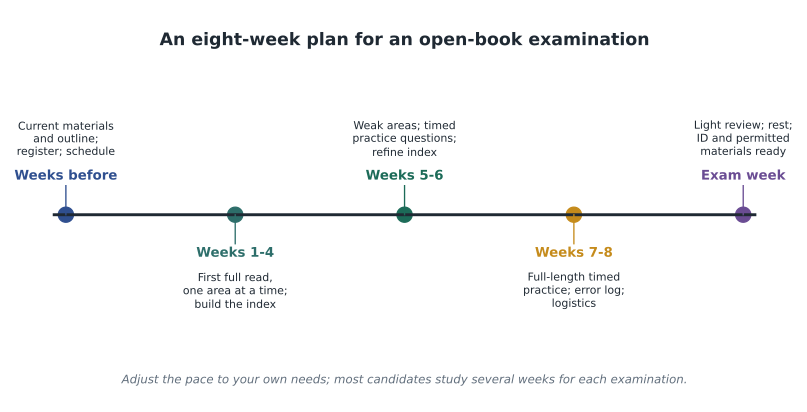
A study plan
Most successful candidates study full-time for several weeks for each examination, or part-time over a longer period. Rideout recommends an eight-week plan for candidates writing both examinations close together, adjusted for their own pace. The plan has four phases. First, a complete reading of the materials, one area at a time, with notes and an index built as the reading progresses. Second, a focused review of weak areas, with practice questions under time pressure. Third, full-length timed practice sessions to build stamina and pace, followed by careful review of every error. Fourth, a light final week with rest, logistics and confidence-building review rather than new material.
Study groups can help, particularly for building and checking indexes and for explaining difficult topics to each other. They can also waste time. A group works best when each member takes responsibility for a part of the work, the group meets for a fixed time with an agenda, and members test each other rather than reading together. Candidates without a group, including many internationally trained candidates, can find or form one through law society resources, community legal organizations and online forums, and should not feel that they are at a disadvantage if they study alone with a good plan.
Building an index
An index is a navigation tool. It lists topics, key terms, rules, tests, cases, statutory provisions and procedural deadlines in alphabetical order with the page reference in the study materials where each is explained. A good index is detailed enough that a candidate can find a specific rule in under a minute, but not so detailed that it becomes a second copy of the materials. Useful entries include synonyms and alternative terms, because examination questions may use different words from the materials, and short notes on frequently tested numbers and time limits.
Rideout's tips: build the index while reading, not afterwards; use the index during practice questions so that weaknesses show up early; add entries every time a practice question sends you searching; and keep separate quick-reference charts for deadlines, limitation periods, fees and procedural steps. Candidates who use shared indexes from previous years should check them against the current materials, because page numbers and content change.
Answering multiple-choice questions
Multiple-choice questions on licensing examinations are usually built around a short fact pattern followed by a question and four options. The wrong options are designed to be plausible: they may state a real rule that does not apply to these facts, apply the right rule to the wrong facts, describe a step that comes too late or too early in a process, or choose an option that is legally permitted but professionally improper.
A disciplined method helps. Read the question first, so you know what is being asked. Read the facts and identify the area and the precise issue. Try to predict the answer before reading the options. Then read every option, eliminating those that are wrong, and choose the best remaining answer. If you are unsure, check the index, but set a time limit: a question that cannot be resolved in a minute or two should be answered with your best choice and flagged for review. Keep track of time against the clock at regular intervals. If there is no penalty for wrong answers, never leave a question blank.
Ethics questions deserve special care because they appear throughout both examinations and often turn on a detail. Ask in every fact pattern: who is the client, is there a conflict, is there a confidentiality issue, is the lawyer competent to act, and is anyone being misled? The option that is fastest or most profitable for the client is not always the option that is professionally correct.
Practice questions
Rideout writes three original questions on the board in the style of a licensing examination. The class answers them and then discusses each wrong option.
The first: 'A lawyer is retained to defend a client in a civil action. The client tells the lawyer that a document the plaintiff has requested in discovery, a memo the client wrote, is harmful to the client's case. The client asks the lawyer to leave it out of the affidavit of documents. What should the lawyer do?' The options are: leave it out because it is harmful; leave it out only if it is privileged; include it, because relevant documents must be disclosed unless privileged, and advise the client of that obligation; or withdraw immediately. The class chooses the third. The second option is tempting, but the question says nothing that suggests privilege, and the fourth jumps to withdrawal without first advising the client.
The second: 'A client asks a lawyer to act on the purchase of a house from the client's sister. Both want to use the same lawyer to save money. What must the lawyer consider first?' The best answer is whether the transaction falls within one of the limited exceptions in the Law Society's rules that permit a lawyer to act for both transferor and transferee, and if so, whether the joint retainer requirements can be met. Options suggesting that consent alone is enough, or that family members may always use one lawyer, are wrong.
The third: 'A client is charged with an offence and released on an undertaking. The client tells the lawyer she plans to leave the province for a month for work, which the undertaking forbids without permission. What should the lawyer do?' The best answer is to advise her of the condition and the consequences of breaching it, and of the option to seek a variation with the Crown's consent or by application, without assisting a breach. Options suggesting that the lawyer must report her plans to the police, or should say nothing, are wrong.
Hannah notices the pattern: in each question, the best answer combines the correct rule with advice to the client about it. 'That is not an accident,' Rideout says. 'That is what practising law is.'
Skills-based assessments
Candidates in PREP provinces, and Ontario candidates if a skills-based model is adopted, prepare differently. PREP's Capstone Evaluation asks candidates to complete realistic tasks, such as interviewing a client, drafting a letter or a document, preparing for a negotiation or a hearing, or managing a file problem, and assesses them against performance standards. Preparation means practising the tasks themselves, under realistic time limits, and seeking feedback on the product. Daniel and Hannah are already doing this in PREP: they write, receive comments, and rewrite. Rideout points out that the same habits help on a multiple-choice examination, because candidates who have done the tasks understand the rules in context.
Exam day and afterwards
On the day, the basics matter: sleep, food, arriving early with the required identification, and having the materials and index organized and tabbed. During the examination, candidates should take any permitted breaks they need, keep track of time, and resist the temptation to spend ten minutes on one question. Afterwards, they should rest rather than replay every question.
Not everyone passes the first time. A candidate who fails should review the feedback provided, identify whether the problem was knowledge, technique or time, adjust the plan, and register for the next available sitting within the licensing term. Failing an examination says nothing about a candidate's character or potential; many excellent lawyers needed a second attempt. Candidates who are struggling with stress or health should seek support early, as lesson 11 discusses.
Learning from errors
The most valuable part of practice is the review afterwards. Rideout asks candidates to keep an error log with four columns: the question, the answer chosen, the correct answer and the reason for the mistake. Reasons fall into a few categories: not knowing the rule, misreading the facts, misreading the question, running out of time, or choosing an option that was legally possible but not the best answer. After a few practice sets, patterns appear. A candidate who keeps misreading the question needs a different reading technique; a candidate who does not know the rule needs to return to the materials; a candidate who chooses legally possible but professionally weaker answers needs to practise ethics questions.
Error logs also help candidates decide what not to study. A topic on which they consistently score well needs only light review. Time saved there can go to weak areas. Theo, whose practice sets show strong results in civil procedure and weaker results in real estate, reorganizes his last two weeks accordingly.
Accommodation and fairness
Candidates with disabilities or other needs related to grounds protected by human rights law may be entitled to accommodation on licensing assessments, such as extra time, breaks, a separate room or assistive technology. Requests must usually be made well in advance with supporting documentation. Candidates should not hesitate to apply: accommodation is not an advantage but a way of making the assessment measure what it is meant to measure. Candidates whose religious observance conflicts with a scheduled sitting should also contact the law society early.
Worked problem
Sophie's pacing problem
Sophie Tremblay-Hart takes a full-length practice barrister examination at home and runs out of time with about a fifth of the questions unanswered. Her accuracy on the questions she answered was high. She spent long periods checking the materials for questions she was almost sure about. How should she adjust her preparation?
Show solution
- Diagnose the problem: it is pace, not knowledge, caused by over-checking answers she already knew.
- Set time checkpoints: divide the examination time into segments and note where she should be at each one.
- Adopt a two-minute rule for checking the index: if she has not found the rule in that time, choose her best answer, flag it and move on.
- Practise predicting answers before reading options, to build confidence in her own understanding.
- Refine the index so that frequently checked topics can be found faster, adding synonyms and quick-reference charts.
- Take another full-length timed practice examination within a week and compare her pace and accuracy.
Common mistakes
MistakeAssuming an open-book examination can be passed by looking up every answer.
InsteadThere is time to look up only a small fraction of questions; candidates must know the material and use the index for targeted checks.
MistakeUsing an index from a previous year without checking it.
InsteadStudy materials change; page references and content must be checked against the current materials.
MistakeSpending many minutes on one difficult question.
InsteadSet a time limit, choose the best answer, flag the question and return to it if time remains.
MistakeChoosing the answer that gets the client the best result in an ethics question.
InsteadThe correct answer is the professionally proper course, which usually combines the rule with advice to the client.
Practice problems
Work each problem on paper first, then reveal the answer to check.
What are the four phases of the recommended study plan?
Show answer
A complete first reading with index building; focused review of weak areas with timed practice questions; full-length timed practice with error review; and a light final week of rest, logistics and review.
What makes a good index for an open-book examination?
Show answer
Alphabetical entries for topics, terms, rules, tests, cases, provisions and deadlines with page references, synonyms for alternative wording, and quick-reference charts, built while reading and tested during practice.
How does preparing for PREP's Capstone Evaluation differ from preparing for a multiple-choice examination?
Show answer
It requires practising realistic tasks such as interviewing, drafting and negotiating under time limits and getting feedback on the product, rather than primarily reviewing knowledge.
Summary and key terms
- Licensing assessments are built on published competencies; candidates should use the current materials and instructions.
- Open-book examinations still require thorough knowledge; the index is for targeted checks, not for looking up everything.
- A structured study plan with timed practice and error review is the most reliable preparation.
- A disciplined method for multiple-choice questions and strict time management prevent running out of time.
- Skills-based assessments such as PREP's Capstone Evaluation are prepared for by practising the tasks and seeking feedback.
- Competency outline
- The published list of knowledge and skills a licensing assessment tests.
- Study materials
- The materials a law society publishes on which licensing examination questions are based.
- Index
- A candidate's alphabetical guide to where topics and rules are found in the study materials.
- Distractor
- A plausible but wrong option in a multiple-choice question.
- Flagging
- Marking a question to return to if time remains.
- Accommodation
- An adjustment to examination conditions for a candidate with a need related to a protected ground, applied for in advance.
Lesson quiz · 5 questions
Score 60% or more to complete this lesson.
Create a free account to save your progress, take quizzes and earn a certificate.