
LAWC-314 · Lesson 12 of 12 · 21 min
Capstone: a licensing-year problem across the program
▶ Video coming soon A video version of this lesson is on the way.
The capstone brings the whole program together in one day in the working life of an articling student. Rideout chose Ezra Ravel, whom the class met in Professional Responsibility and again in lesson 3, because his file has a little of everything. Everything in the problem is fictional: the people, the firm's clients, the properties and the businesses. The day is a Tuesday in the sixth month of Ezra's articling year at Pardee & Lowe LLP in Corwin. Students work in teams, write a memo to Maren Pellegrini, the associate who supervises Ezra's daily work, and then compare their answers with the model answer below.
The facts
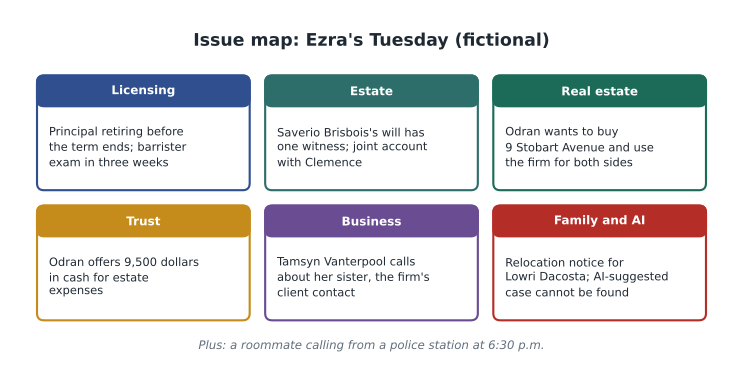
At 8:15 a.m., Warren Elsworth, Ezra's articling principal and the firm's senior partner, tells Ezra that he has decided to retire at the end of next month for health reasons, before Ezra's articling term ends. He says the firm will 'sort out the paperwork' and asks Ezra not to worry about it. Ezra's barrister licensing examination is in three weeks. He has been working about seventy hours a week and has not started his final review.
At 9:00 a.m., Ezra meets Clemence Brisbois, who has been referred to the firm. Her father, Saverio Brisbois, died in Corwin in the spring. His estate consists of his house at 9 Stobart Avenue, worth about 610,000 dollars and mortgage-free, a bank account of about 40,000 dollars, and a joint account he held with Clemence, containing about 25,000 dollars, which he opened three years ago when his eyesight began to fail so that she could pay his bills. Saverio's typed will names Clemence as estate trustee and leaves everything equally to Clemence and her brother Odran. The will is signed by Saverio but witnessed by only one person, a neighbour.
At 10:30 a.m., Odran calls. He wants to buy the house from the estate at its appraised value and live in it. He suggests that Pardee & Lowe act for the estate as seller and for him as buyer, 'since it is all in the family and it will save money'. He also says he will drop off 9,500 dollars in cash that afternoon for the estate's expenses, such as insurance and utilities. He adds that he thinks the joint account should be shared equally between him and his sister, because 'Dad only put Clemence on it for convenience'.
At noon, Tamsyn Vanterpool phones Ezra directly. She is a twenty-five percent shareholder and director of Vanterpool Joinery Ltd., an Ontario corporation that has been a client of the firm for ten years. Her sister Amalia, the seventy-five percent shareholder and the firm's usual contact, has just removed Tamsyn as a director at a meeting Tamsyn says she was not told about, and has stopped paying her the salary she has received for six years. Tamsyn wants Ezra to tell her what her rights are and asks him not to mention the call to Amalia.
At 3:00 p.m., Ezra reviews a draft notice of relocation he prepared last week for Lowri Dacosta, a family law client who wants to move with her nine-year-old son from Corwin to Sudbury for a new job. The child's father has regular parenting time. To save time, Ezra had asked a generative AI tool to suggest supporting authorities for a covering letter to the father's lawyer. One of the cases it produced, with a neutral citation, does not appear in any database he checks. The notice has not yet been sent. Lowri wants to move in seven weeks.
At 6:30 p.m., Ezra's roommate calls from a police station. He has been charged with impaired driving and asks Ezra what he should say to the police.
Model answer
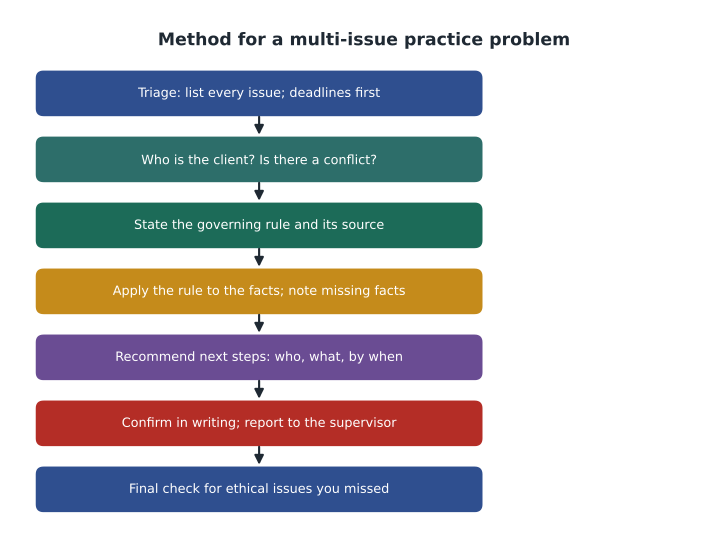
The model answer follows the method in the second figure: triage first, then for each issue the client, the conflict question, the rule, the application and the next steps.
Triage
The most time-sensitive matters are the roommate's call, which requires an immediate response; the cash Odran plans to deliver this afternoon; Tamsyn's request, which must be dealt with before she says more; and the relocation notice, which must be served sixty days before the move. The principal issue and the estate work are important but less urgent. Ezra's own health and examination preparation run through the whole day.
The roommate's call
Ezra is not a lawyer and cannot give legal advice on his own, and he is not the roommate's lawyer. The roommate has a right under section 10(b) of the Charter to retain and instruct counsel without delay and to be informed of that right, which includes access to free duty counsel. The correct response is to tell the roommate to ask the police to let him speak to a lawyer, to use duty counsel if he does not have one, and to follow that lawyer's advice. Ezra should not advise him about what to say. If the roommate later wants a lawyer, Ezra can suggest that he contact a criminal lawyer, and, if the firm does criminal work, the firm can open a file after a conflict check, with a lawyer responsible for it.
Odran's cash
By-Law 9 prohibits a lawyer from receiving 7,500 dollars or more in cash from one client in respect of one matter, subject to limited exceptions. Odran is not yet a client at all, and the estate's expenses are not a reason within any exception. Ezra should tell Odran, before the afternoon, that the firm cannot accept the cash and that any money should be paid by cheque or electronic transfer, after identification and verification under By-Law 7.1 and once the firm has confirmed whom it acts for. Better still, the estate's expenses should be paid by the estate trustee from estate funds, not by a beneficiary through the firm's trust account.
Tamsyn's call
Tamsyn's call raises conflict and confidentiality issues before any question of corporate law. The firm acts for Vanterpool Joinery Ltd. and deals with Amalia as its usual contact. Tamsyn's complaint is in substance a dispute between shareholders and potentially a claim against the corporation and Amalia under the oppression remedy. The firm cannot advise Tamsyn against its existing client, and Ezra cannot promise to keep information from the firm's client confidential while acting for her. Under the conflict rules reviewed in LAWC-214 and lesson 11, the firm would be acting directly adverse to a current client.
Ezra should stop Tamsyn before she gives more confidential information, explain that the firm acts for the corporation and cannot advise her on a dispute with it or with Amalia, and recommend that she consult an independent lawyer promptly. He should not give her legal advice, although he may say that she should get advice soon. He should make a note of the call and tell Maren immediately, so that the firm can decide how to handle what it has already heard and whether the corporation's interests require any step. If Tamsyn finds her own lawyer, that lawyer will consider the corporate records, the validity of the meeting that removed her, the articles and any shareholder agreement, and the oppression remedy under the Ontario Business Corporations Act, as reviewed in lesson 10.
The relocation notice
The Divorce Act, as amended in 2021, requires a person who intends to relocate with a child to give notice to anyone with parenting time or decision-making responsibility at least sixty days before the proposed move, in the prescribed form or with the required information. Lowri wants to move in seven weeks, which is forty-nine days, so the notice is already late for her timetable. The relocation will either have to be later or proceed by agreement or a court order. Ezra should tell Maren today, serve the notice as soon as it is finalized, and advise Lowri in writing that the move date must change unless the father agrees or the court permits it.
The AI-generated citation must not be used. Ezra must find and read every authority he relies on, and since this case cannot be found, it must be removed. If the letter were a court filing, Ontario's rules would require certification of the authenticity of authorities in a factum, and courts have sanctioned lawyers who relied on fabricated cases, as in Zhang v. Chen, 2024 BCSC 285. Ezra should tell Maren what happened, because his supervisor needs to know how the draft was prepared, and he should review the firm's policy on AI tools.
The estate
Clemence is the client, as estate trustee. The will does not meet the formal requirements, because a formal will requires two witnesses present at the same time. But Saverio died after January 1, 2022, so section 21.1 of the Succession Law Reform Act allows the Superior Court to order that the will is valid if it is satisfied that the document sets out his testamentary intentions. Ezra should gather evidence: the circumstances of signing, the neighbour's account, any drafts or notes, and whether there is an earlier valid will. The application must be served on anyone affected, including Odran, who benefits equally under the will and on an intestacy, so he may not oppose it. If the will is not validated, the intestacy rules would apply and, with no surviving spouse, divide the estate between the two children, which in this case gives the same result.
The estate will likely need a certificate of appointment, because the house must be sold or transferred. Estate administration tax is nil on the first 50,000 dollars and 15 dollars per 1,000 dollars or part above that, on the value of the estate, and the estate information return is due within 180 days of the certificate.
The joint account raises the presumption of resulting trust from Pecore v. Pecore, 2007 SCC 17. A gratuitous transfer by a parent into joint names with an adult child is presumed to be held in trust for the parent's estate unless the evidence shows that the parent intended a gift of the right of survivorship. Odran's comment that the account was 'for convenience' supports the presumption. Clemence has a personal interest in the account that may conflict with her duty as estate trustee and with Odran's interest. The firm acts for her as estate trustee; it should advise her that the presumption applies, that she may want independent advice about her personal position, and that she must not treat the account as hers without resolving the question.
The house sale
Odran wants the firm to act for both the estate and him. Under the Law Society of Ontario's rules, a lawyer may act for both transferor and transferee only within listed exceptions, and only if the joint retainer requirements are met. Even if the transaction fell within an exception for related persons or estates, acting for both would be unwise here. The estate and Odran have opposing interests on price and terms, Odran is also a beneficiary with a stake in the joint account dispute, and Clemence has a duty to the estate to obtain fair value. The firm should act for the estate only and recommend that Odran retain his own lawyer. The estate trustee can sell to a beneficiary, but should obtain a current independent appraisal, document the price and consider whether Odran's purchase price should be adjusted against his share. Standard closing issues will follow: title search, spousal consent questions (none, since Saverio had no spouse), the residency declaration and land transfer tax payable by Odran.
Ezra's principal and his licensing
An articling principal's retirement is not just paperwork. In Ontario, the student must have an eligible principal throughout the articling term, and changes must be reported to the Law Society. Ezra should not rely on Elsworth's assurance alone. He should ask Maren, who supervises him daily, whether she or another eligible lawyer at the firm will become his principal, and make sure the change is filed with the Law Society before Elsworth leaves, so that his time continues to count. He should keep copies of everything.
Ezra's health and the examination
Ezra is working seventy hours a week with an examination in three weeks. As lesson 11 discussed, exhaustion affects competence, and he has already made one mistake today in relying on an unchecked AI result. He should tell Maren about his examination date, ask for a reasonable reduction in workload for the final two weeks, and use the study plan from lesson 8, focusing on timed practice. He should also use the confidential member assistance program if the stress is becoming unmanageable.
Debrief
Rideout asks each team what it missed. Theo's team forgot the relocation deadline because they treated the AI citation as the main issue. Hannah's team spotted the cash problem but not that Odran was not a client. Sophie's team caught the Pecore point but missed Clemence's personal conflict. Daniel's team almost gave the roommate advice. Arjun's team put the principal issue last, until Rideout pointed out that if Ezra's time stopped counting, every other file would be someone else's problem.
Rideout ends the course with her board question: 'Could you do this on Monday morning?' Then she writes the answer underneath: 'Not alone, and not perfectly. But you know what to look for, who to ask, and what you must never do. That is what a licence means.'
Worked problem
Writing the memo to Maren
Ezra has twenty minutes to send Maren a short memo before she leaves for court. What should it contain, in what order?
Show solution
- A one-paragraph summary of the urgent items: the roommate (handled by referring him to counsel), Odran's cash (declined), Tamsyn's call (stopped, note made, conflict), the relocation notice (late for the planned move; AI citation removed).
- The principal issue: Elsworth's retirement date and the need to file a change of principal before he leaves.
- The estate: Clemence as client, the section 21.1 application, the certificate of appointment, estate administration tax and the Pecore issue with Clemence's personal conflict.
- The house sale: recommend acting for the estate only, with Odran independently represented and an independent appraisal.
- Requests: confirmation of who will be his principal, instructions on the Tamsyn call, review of the relocation letter, and a conversation about workload before his examination.
- A list of everything confirmed in writing to clients today, and what remains to be sent.
Common mistakes
MistakeGiving the roommate advice about what to say to the police.
InsteadEzra is a student and not his lawyer; he should direct him to exercise his section 10(b) right and speak to duty counsel or a lawyer.
MistakeListening to Tamsyn's full story and promising confidentiality.
InsteadThe firm acts for the corporation; Ezra must stop her, explain the conflict, recommend independent advice and tell his supervisor.
MistakeTreating the will as invalid because it has one witness.
InsteadFor a death after January 1, 2022, the court may validate it under section 21.1 if it sets out the testator's intentions.
MistakeActing for both the estate and Odran because they are family.
InsteadJoint representation is limited to listed exceptions and is unwise where interests conflict; the firm should act for the estate only.
Practice problems
Work each problem on paper first, then reveal the answer to check.
Why can Lowri not move in seven weeks without the father's agreement or a court order?
Show answer
Because the Divorce Act requires at least sixty days' notice of a relocation to anyone with parenting time or decision-making responsibility, and seven weeks is only forty-nine days.
What presumption applies to Saverio's joint account with Clemence, and why does it create a conflict for her?
Show answer
The presumption of resulting trust from Pecore applies to the gratuitous transfer to an adult child, so the account is presumed to belong to the estate unless a gift is shown; Clemence has a personal interest in claiming it that may conflict with her duty as estate trustee.
What must happen when Ezra's principal retires before the articling term ends?
Show answer
Ezra must have another eligible principal, and the change must be reported to the Law Society before the original principal leaves, so his articling time continues to count.
Summary and key terms
- A multi-issue problem is answered by triage first, then client, conflict, rule, application and next steps for each issue.
- Students must not give independent legal advice; the right response to an emergency call is to direct the person to counsel.
- Conflict and confidentiality issues often come before the substantive law, as with Tamsyn's call and Odran's request for a joint retainer.
- Deadlines such as the sixty-day relocation notice, and rules such as the By-Law 9 cash limit, decide outcomes as much as legal analysis does.
- The licensing process itself, including the principal relationship and the candidate's own wellbeing, is part of every articling student's file.
- Triage
- Sorting issues by urgency and deadlines before analysing them.
- Estate trustee
- The person appointed to administer a deceased person's estate.
- Certificate of appointment
- The court document confirming an estate trustee's authority to deal with estate assets.
- Resulting trust
- A trust presumed where property is transferred without consideration, unless a gift is proved.
- Oppression remedy
- The statutory remedy for conduct that is oppressive or unfairly prejudicial to, or that unfairly disregards the interests of, a shareholder or other stakeholder.
- Duty counsel
- A lawyer available free of charge to give immediate legal advice to people who have been arrested or detained.
Lesson quiz · 5 questions
Score 60% or more to complete this lesson.
Create a free account to save your progress, take quizzes and earn a certificate.