
LAWC-314 · Lesson 5 of 12 · 19 min
Alternatives to articling: the Law Practice Program and the Integrated Practice Curriculum
▶ Video coming soon A video version of this lesson is on the way.
Arjun Mehta chose the Law Practice Program on purpose. He had two articling offers, one from a small litigation firm and one from a general practice in Brampton, but he wanted structured training in areas he had never seen in practice and hoped to find a placement in a technology company's legal department. Some of his classmates are surprised. They have heard that the program is for people who could not find articles. Rideout uses the class to test that assumption. This lesson explains Ontario's two alternatives to articling, the Law Practice Program and the Integrated Practice Curriculum, and the debate about them.
Why alternatives exist
By the early 2010s, the Law Society of Ontario faced what was widely called an articling crisis. The number of licensing candidates was growing faster than the number of articling positions, and a significant number of graduates could not find placements. Some who did found themselves in poor-quality or unpaid positions because they had no bargaining power. Internationally trained candidates and graduates from equity-seeking communities were overrepresented among those who could not find articles. A licensing system that made admission depend on finding a job also gave employers, not the regulator, practical control over who could become a lawyer.
The Law Society's answer was to create alternatives that would meet the same experiential training requirement without depending on the candidate's ability to find an articling position. The Law Practice Program was introduced as a pilot in 2014. The Integrated Practice Curriculum allowed law schools to build the requirement into the degree itself; Lakehead University's Bora Laskin Faculty of Law received approval for the first one in November 2013.
The Law Practice Program
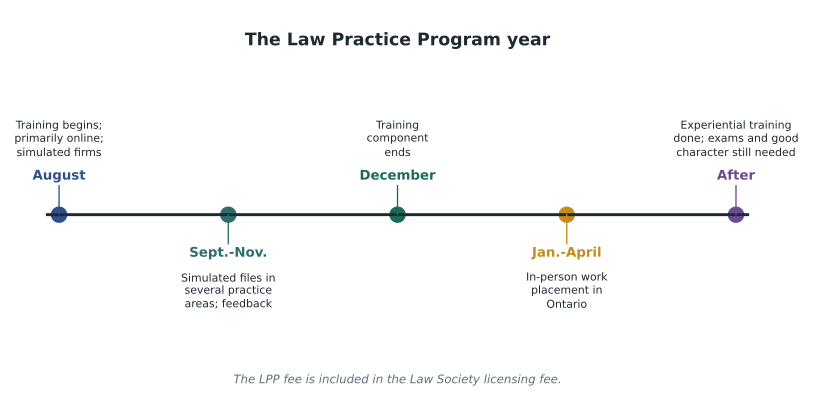
The Law Practice Program, or LPP, is now delivered in English by Toronto Metropolitan University. It lasts eight months. The first four months, from August to December, are a training course that is primarily virtual and online, run live on Eastern time, with some optional in-person activities. Candidates work in simulated law firms on realistic files across a range of practice areas, guided by practising lawyers who act as mentors and assessors, and they are assessed on their work throughout. The second four months, from January to April, are an in-person work placement with an Ontario employer, during which candidates must be located in Ontario. The program describes itself as equivalent to articling, and the Law Society treats completion as satisfying the experiential training requirement. A French-language LPP has been offered through the University of Ottawa; candidates who want to complete the program in French should confirm current availability with the Law Society.
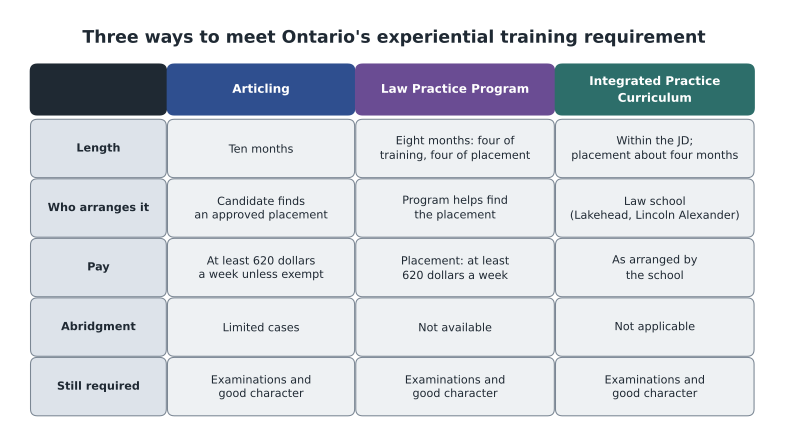
The LPP fee is included in the Law Society's licensing fee, with no additional university tuition at present. Work placements are subject to the same mandatory minimum compensation as articling, 620 dollars a week, unless an exemption is granted, and the program helps candidates find placements. Unlike articling, the LPP cannot be shortened by abridgment. LPP candidates must still pass the barrister and solicitor examinations and satisfy the good character requirement.
The Integrated Practice Curriculum
The Integrated Practice Curriculum, or IPC, takes a different approach. Instead of adding training after law school, it weaves practice skills into the law degree and includes a supervised work placement before graduation. Two Ontario law schools offer it. Lakehead's Bora Laskin Faculty of Law, in Thunder Bay, integrates skills training throughout its three-year program, and its graduates do not need to article or complete another course of study for the experiential training requirement. The Lincoln Alexander School of Law at Toronto Metropolitan University, which opened in 2020, also states that its JD fulfils the Law Society's requirements for an IPC. Its students complete practicum-based courses in second year and a required professional placement of about four months in third year, which may take place in the summer after second year or in the fall or winter of third year.
IPC graduates still write the licensing examinations and must still be of good character, but they can be licensed soon after graduation without a separate period of articling.
Comparing the pathways
Each pathway has strengths. Articling offers ten months in a real practice, with the chance of being hired back by the same firm, and with training shaped by a principal who knows the student. Its weakness is variability: one student spends the year in court and another photocopies, and the quality depends almost entirely on the placement. The LPP offers consistent, structured training across several practice areas, assessed against common standards, followed by a shorter work placement. Its weaknesses are that the placement is only four months and that, for some years, LPP graduates reported that some employers treated the program as second-best. The IPC offers integration and speed: graduates are ready to be licensed at the end of the degree. Its weakness is that it is available only to students of two schools.
Supporters of the LPP point out that its training component exposes every candidate to the same skills, such as drafting and file management, assessed against common standards, and to practice areas a candidate might never see in a single placement. The concern about stigma has been persistent. Critics argued that because candidates who could not find articles were channelled into the LPP, employers would assume that LPP graduates were weaker, and that a two-tier system would reinforce existing inequalities. Supporters respond that the stigma is fading as more candidates, like Arjun, choose the LPP for its training, and that the real two-tier problem is the inconsistency of articling itself.
Rideout puts the question to the class: if they were designing the system from scratch, which model would they choose? Sophie favours the IPC, because it integrates practice with legal education and removes a year of uncertainty. Theo defends articling, because a real practice teaches judgment in a way a simulation cannot. Daniel points out that the PREP provinces have combined the ideas: a structured, competency-based program like the LPP's training course, delivered alongside articling rather than instead of it. Hannah notes that the June 2026 western consultation is asking exactly that question, including whether training should come before or during articling and what principals should be responsible for.
How the 2025 Ontario proposal fits
The Law Society's 2025 proposal to replace the licensing examinations with a skills-based course would not, on its own, abolish articling or the LPP. It would change how knowledge and skills are assessed, not how experiential training is delivered. But the two questions are connected. If every candidate took a mandatory skills-based course with assessments, some argue that the LPP's training component would overlap with it, and that articling could focus on practice rather than on filling skills gaps. Others argue that the course would add a further requirement and cost to an already long path. Because the Law Society had not decided whether to proceed as of late 2026, candidates should plan on the existing pathways.
Choosing a pathway
For a candidate with a choice, Rideout suggests five questions. What kind of practice do I want, and which pathway gives me the best chance of being hired there? How much structure do I need? Can I afford the time and the pay at each option? How much exposure do I want to different areas of law? And what do the employers I care about actually think of each pathway? The last question matters most, she says, and the only way to answer it is to ask them.
Arjun has his answer. The technology company he hoped for has agreed to take an LPP placement student from January, with a supervising lawyer in its Toronto legal department, and he has been told the department has hired LPP candidates before. 'I get four months of training on files I would never see in-house,' he says, 'and then four months in the job I actually want.'
Making the most of a short placement
A four-month placement, whether in the LPP or the IPC, leaves little time to settle in. Rideout's advice is to treat the first week as a planning exercise. Before the placement starts, the candidate should ask the supervisor what files they will work on, which competencies the placement will cover and how feedback will be given. In the first week, the candidate should learn the office's systems: how files are opened, how conflicts are checked, how time is recorded and how documents are saved and named. By the end of the first month, the candidate should have a list of tasks they want to have done before leaving, such as drafting a pleading, attending a client meeting, preparing a closing book or conducting a negotiation, and should share that list with the supervisor so that work can be assigned to match it.
LPP candidates have one advantage over articling students: they arrive at the placement having already worked on simulated files in several areas, with feedback from mentors. Rideout encourages them to bring the best documents they produced in the training course, with the mentors' comments, as a portfolio. A supervisor who sees a well-drafted demand letter or a clean statement of adjustments from the training component is more likely to hand the candidate real work in the first week.
What employers look for
Whatever the pathway, employers hiring new lawyers look for the same things: sound judgment, reliability with deadlines, clear writing, the ability to deal with clients, and honesty about mistakes. A candidate's pathway matters much less than the evidence the candidate can offer of those qualities. Rideout tells the class to keep a record of concrete examples from every placement, simulated or real, that they can describe in an interview: a file they managed, a problem they spotted, a mistake they caught and fixed. 'Nobody hires a pathway,' she says. 'They hire a person who can show them what they did.'
Other provinces' alternatives
Ontario is not the only province to have struggled with the supply of articling positions. The PREP provinces allow candidates to complete PREP before finding articles, and Alberta credits PREP taken first as three months of the articling term, which shortens the placement a candidate must find. British Columbia allows candidates with a Canadian common law degree or an NCA certificate to register for PREP without articles. These are not full alternatives to articling, but they reduce the time a candidate depends on an employer and allow training to begin while the search continues.
Worked problem
Advising a candidate without articles
In April of third year, a Brannock classmate, Ewart Rensford, has applied for forty articling positions without success. He has a strong interest in family law and wants to practise in Corwin. He asks whether he should keep applying, take the LPP, or wait a year. How should he think about it?
Show solution
- Confirm that his licensing application is complete, because both articling and the LPP require it.
- Keep applying for articles, especially with small family law firms and clinics in Corwin that hire on their own timelines, and ask every family lawyer he knows for leads.
- Consider the LPP seriously: it meets the experiential training requirement, its training includes family law files, its fee is included in the licensing fee, and its four-month placement could be with a Corwin family firm.
- Compare timing: the LPP training runs August to December and the placement January to April, so he could be licensed in roughly the same time frame as an articling student starting in late summer.
- Ask family lawyers in Corwin how they view LPP graduates, and look for a placement employer willing to consider hiring him afterwards.
- Avoid waiting a year without a plan, which delays licensing without improving his position.
Common mistakes
MistakeSaying that the LPP is only for candidates who cannot find articles.
InsteadSome candidates choose it for its structured training; the stigma critics feared has been a concern, but it is not the program's purpose or rule.
MistakeTelling an IPC graduate that they are exempt from the licensing examinations.
InsteadThe IPC meets the experiential training requirement only; graduates still write the examinations and must be of good character.
MistakeAssuming the LPP placement can be unpaid.
InsteadLPP work placements are subject to the mandatory minimum compensation of 620 dollars a week unless an exemption is granted.
MistakeAssuming the LPP, like articling, can be abridged.
InsteadThe Law Society does not abridge the LPP.
Practice problems
Work each problem on paper first, then reveal the answer to check.
Describe the structure of the Law Practice Program.
Show answer
Eight months: a four-month training course from August to December, primarily online, with simulated files and assessments, followed by a four-month in-person work placement in Ontario from January to April.
Which Ontario law schools offer an Integrated Practice Curriculum?
Show answer
Lakehead University's Bora Laskin Faculty of Law (approved in 2013) and the Lincoln Alexander School of Law at Toronto Metropolitan University, whose JD includes a required professional placement of about four months.
What was the articling crisis, and how did the Law Society respond?
Show answer
A shortage of articling positions relative to candidates, with poor-quality and unpaid placements and disproportionate effects on internationally trained and equity-seeking candidates; the Law Society created the LPP and permitted the IPC as alternative ways to meet the experiential training requirement.
Summary and key terms
- The LPP and the IPC were created to meet the experiential training requirement without depending solely on finding an articling position.
- The LPP is an eight-month program: four months of mostly online training on simulated files and a four-month in-person placement in Ontario.
- The LPP fee is included in the licensing fee; placements are subject to the mandatory minimum compensation; the LPP cannot be abridged.
- The IPC builds practice training and a placement into the JD at Lakehead and the Lincoln Alexander School of Law.
- Every pathway still requires the licensing examinations and good character; the debate about stigma, quality and structure continues.
- Law Practice Program
- An eight-month Ontario alternative to articling combining a training course and a work placement.
- Integrated Practice Curriculum
- A law degree that builds practice training and a placement into the JD, satisfying Ontario's experiential training requirement.
- Articling crisis
- The shortage of articling positions in Ontario that prompted the creation of alternative pathways.
- Work placement
- The supervised employment component of the Law Practice Program.
- Simulated law firm
- A training environment in which candidates work on realistic fictional files under mentors' supervision.
- Two-tier concern
- The worry that alternative pathways would be treated by employers as inferior to articling.
Lesson quiz · 5 questions
Score 60% or more to complete this lesson.
Create a free account to save your progress, take quizzes and earn a certificate.