
LAWC-314 · Lesson 2 of 12 · 19 min
Licensing across Canada: PREP, Quebec and the NCA
▶ Video coming soon A video version of this lesson is on the way.
Daniel Whitecloud and Hannah Kowalczyk will not write the Ontario examinations at all. Daniel is going home to Saskatchewan and Hannah is going to Calgary, and both provinces license lawyers through a program that Ontario has so far declined to adopt. Sophie Tremblay-Hart wants to know whether she could ever practise in Montreal with a common law degree from Brannock. And Rideout has invited a former student, now practising in Corwin, who came to Canada with a law degree from Lagos and spent two years working through the National Committee on Accreditation. This lesson surveys the main licensing models outside Ontario.
A map of the models
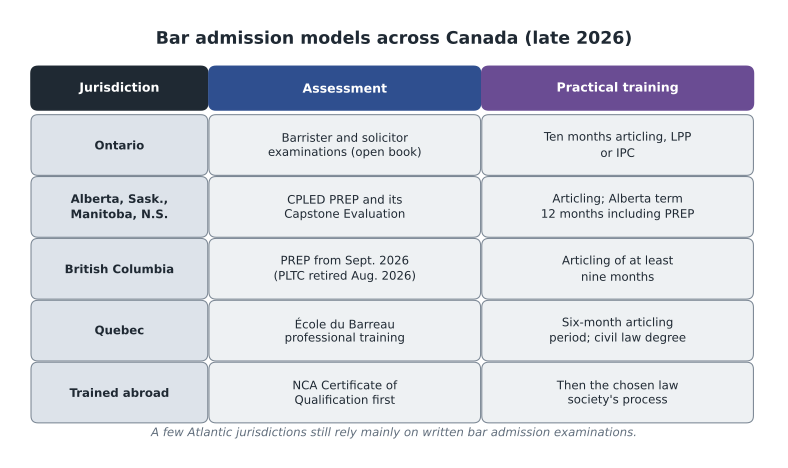
Canada's law societies all require a recognized law degree, a period of supervised practical training and good character, but they assess readiness for practice differently. Broadly, there are three approaches. Ontario relies on knowledge examinations plus experiential training. Most of the western provinces and Nova Scotia rely on a competency-based training program with skills assessments and no written law examinations, plus articling. Quebec, with its civil law system, has its own professional school and training period. Internationally trained candidates in the common law provinces first obtain a Certificate of Qualification from the National Committee on Accreditation and then enter the licensing process of the law society where they want to practise. A few smaller jurisdictions, mainly in Atlantic Canada, continue to rely chiefly on written bar admission examinations alongside articling.
CPLED and the Practice Readiness Education Program
The Canadian Centre for Professional Legal Education, known as CPLED, is a not-for-profit organization created by law societies to deliver bar admission training. Its Practice Readiness Education Program, or PREP, is used by the law societies of Alberta, Saskatchewan and Manitoba and by the Nova Scotia Barristers' Society, and from September 2026 by the Law Society of British Columbia. PREP is competency-based: its content and assessments are tied to defined performance standards for what an entry-level lawyer must be able to do, rather than to a body of legal knowledge to be memorized. Candidates work through online modules, practise skills on simulated client files, and receive feedback on their work. PREP ends with a Capstone Evaluation, a period of about two weeks in which candidates complete realistic tasks that are assessed against the standards. There are no written legal knowledge examinations.
PREP comes in two formats. Regular PREP runs part-time over about ten months alongside the candidate's articling placement. Accelerated PREP is an intensive program of about fourteen weeks, usually completed before or at the start of articling. In Alberta, the articling term returned to twelve months on January 1, 2023, or fifteen months for students clerking with the courts, and PREP is part of that term. A student who takes Regular PREP does it during the twelve months of articling; a student who takes Accelerated PREP usually completes it first and then finishes the rest of the term in the placement. A candidate who completes PREP before finding articles receives credit for three months, so that only nine months in a placement are needed.
Hannah has chosen Accelerated PREP before she starts at her Calgary firm. 'I would rather do the course full-time and then give the firm my whole attention,' she says. Daniel will do Regular PREP in Saskatchewan alongside his articles, because his principal wants him working on files from the first week.
The Western Canada Competency Profile
The four western law societies established the Western Canada Competency Profile in 2024. It describes the knowledge, skills and attributes an entry-level lawyer needs to practise competently on the first day of practice, and CPLED aligns PREP's content with the profile. In June 2026, the law societies of Alberta, British Columbia, Manitoba and Saskatchewan, the Nova Scotia Barristers' Society and CPLED consulted the profession on how to implement the profile more fully. The consultation asked about the order in which students should complete bar admission training and articling, the role principals should play in teaching and assessing the competencies during articling, and the resources principals, supervising lawyers and students need. The law societies said that no decision had been made about whether to proceed with the proposed approach.
British Columbia's move from PLTC to PREP
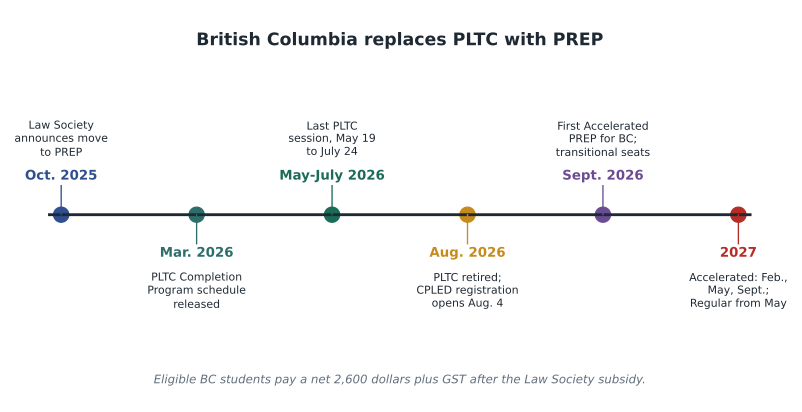
British Columbia used its own Professional Legal Training Course, known as PLTC, for decades. PLTC was a ten-week course that combined practice skills training with four skills assessments and two written law examinations. In October 2025, the Law Society of British Columbia announced that it would retire PLTC and adopt PREP. The summer 2026 session, from May 19 to July 24, 2026, was the last PLTC session, and PLTC was retired in August 2026. Students who had not completed it could finish failed or deferred assessments through a PLTC Completion Program from September 2026.
BC candidates began taking PREP with the Accelerated session in September 2026, with a one-time transitional registration option for candidates who already had articles arranged. Accelerated sessions are scheduled for February, May and September 2027, and the first Regular PREP session for BC candidates is scheduled for May 2027. CPLED's tuition for PREP is 5,000 dollars plus GST, and the Law Society of British Columbia subsidizes eligible BC students so that they pay a net 2,600 dollars plus GST. Candidates with a Canadian common law degree or an NCA Certificate of Qualification can register for PREP before they have articles. Articling in British Columbia is at least nine months unless reduced.
With British Columbia joining, half of Canada's provinces use PREP. One commentator noted in late 2025 that if Ontario also moved to a skills-based program, only a few Atlantic provinces would still rely mainly on written legal knowledge examinations.
Quebec: the Barreau and the École du Barreau
Quebec is different because its private law is civil law, codified in the Civil Code of Québec, and its legal profession is divided between avocats, regulated by the Barreau du Québec, and notaries, regulated by the Chambre des notaires. A candidate for the Barreau normally completes a civil law degree, an LL.B. or LL.L., at one of the six Quebec universities that offer one, which usually takes three years. The candidate then completes the professional training program of the École du Barreau at one of its four centres, in Montreal, Quebec City, Sherbrooke or Gatineau, followed by a six-month articling period under a supervisor, during which the candidate may perform most acts reserved to lawyers. Since the 2023 to 2024 academic year, the École's program has used experiential learning and can include work in a legal clinic. The candidate's record is reviewed when they register for training and again when they apply for membership, and since April 2022, taking the oath and entry on the Roll of the Order have been combined.
The Barreau also administers knowledge examinations in three areas: legislation, regulation and the ethical aspects of the practice of law in Quebec; civil law and related proceedings, including persons, family, successions, property and obligations; and a second civil law examination covering contracts, evidence and procedure, prescription, hypothecs, publication of rights and private international law. They are offered twice a year, in the spring and the fall, and candidates who come to the Barreau through routes other than the standard path may be required to pass them.
Sophie asks whether she could become an avocat with a common law degree. Rideout's answer is that the Quebec route assumes training in civil law. A lawyer already licensed in another province can seek a permit to practise in Quebec under the arrangements between the Barreau and the other law societies, which focus on the lawyer's ability to practise in their own field and usually require demonstrating knowledge of Quebec law relevant to that practice. A Brannock graduate who wanted a full Quebec practice would usually add civil law training, for example through a program for common law graduates offered by a Quebec faculty. 'Read the Barreau's equivalence rules before you plan anything,' Rideout says, 'and plan in years, not months.'
Internationally trained candidates and the NCA
A person who studied law outside Canada and wants to practise in a common law province must obtain a Certificate of Qualification from the National Committee on Accreditation. The process begins with an application, which costs 400 dollars plus taxes, and an assessment of the applicant's legal education and professional experience against an approved Canadian common law degree. Results usually arrive about eight weeks after the NCA receives the last document. The NCA then assigns examinations or courses to fill the gaps.
Every applicant must show competence in five mandatory Canadian core subjects: Canadian administrative law, Canadian constitutional law, Canadian criminal law, foundations of Canadian law and Canadian professional responsibility. Canadian legal research and writing is also required. Since March 1, 2026, applicants must also show competence in Indigenous law and peoples, which can be met through CPLED or an NCA-approved course, and all new applicants complete a language competency screening test before their qualifications are assessed, unless they already hold a valid recent result. Other subjects, such as contracts, torts and property, may be assigned depending on the applicant's background.
NCA examinations are open-book and are written online with remote proctoring under strict rules: candidates cannot leave in the first hour, and breaks are limited to five minutes. The pass mark is 50 percent. A candidate may write a subject three times, a fourth attempt requires the Executive Director's approval, and after four failed attempts the candidate must complete that subject at a Canadian law school. When all assignments are complete, the candidate requests the Certificate of Qualification, which does not expire. The certificate is not a licence: the holder must still meet the chosen law society's requirements, which in Ontario means the licensing examinations, experiential training and good character, and in the PREP provinces means PREP and articling.
Rideout's guest describes the practical difficulties more than the legal ones: finding an articling position without Canadian contacts, studying for NCA examinations while working, and then studying again for the Ontario examinations without the study groups and shared indexes that Canadian students take for granted. That experience, Rideout notes, is exactly what the Law Society cited when it questioned whether the current examinations measure competence fairly.
Worked problem
Advising a friend from abroad
Arjun's friend Nkiruka trained as a lawyer in Egypt, practised commercial law for six years, and now lives in Corwin. She asks Arjun what she has to do to practise law in Ontario. What should he tell her, in order?
Show solution
- Apply to the National Committee on Accreditation for an assessment of her education and experience, paying the application fee and supplying the required documents, and complete the language competency screening test required of new applicants since March 1, 2026.
- Expect to be assigned the five mandatory core subjects, Canadian legal research and writing, Indigenous law and peoples, and possibly other subjects, depending on her background.
- Write the assigned NCA examinations, which are open-book and remotely proctored, with a pass mark of 50 percent and limits on attempts, or take courses where permitted.
- Request the Certificate of Qualification when all assignments are complete; it does not expire, but it is not a licence.
- Apply to the Law Society of Ontario's lawyer licensing process and meet its requirements: the barrister and solicitor examinations, experiential training (articling or the Law Practice Program) and good character.
- Start networking for an articling or placement position early, because finding one is often the hardest step for internationally trained candidates.
Common mistakes
MistakeSaying that every Canadian province uses written bar examinations.
InsteadAlberta, Saskatchewan, Manitoba, Nova Scotia and, from September 2026, British Columbia use CPLED's PREP, which has a Capstone Evaluation but no written law examinations.
MistakeTelling a BC candidate in late 2026 to register for PLTC.
InsteadThe last PLTC session ran from May 19 to July 24, 2026; PLTC was retired in August 2026 and BC candidates now take PREP.
MistakeTreating an NCA Certificate of Qualification as a licence to practise.
InsteadThe certificate shows equivalence to a Canadian common law degree; the holder must still complete the chosen law society's licensing process.
MistakeAssuming a common law degree qualifies a graduate for the Quebec Bar through the ordinary route.
InsteadThe ordinary Quebec route requires a civil law degree, the École du Barreau and a six-month articling period; others must use equivalence or permit arrangements.
Practice problems
Work each problem on paper first, then reveal the answer to check.
How does PREP fit into Alberta's articling term?
Show answer
Alberta has a twelve-month articling term (fifteen months for court clerks) that includes PREP. Regular PREP runs during the term; Accelerated PREP is usually completed first; PREP completed before finding articles is credited as three months, leaving a nine-month placement.
What changed in NCA requirements on March 1, 2026?
Show answer
Applicants must show competence in Indigenous law and peoples, and all new applicants must complete a language competency screening test before assessment, unless exempt with a valid recent result.
What are the stages of the ordinary route to the Quebec Bar?
Show answer
A civil law degree from a Quebec university, the École du Barreau professional training program, a six-month articling period under a supervisor, review of the candidate's record, and the combined oath and entry on the Roll.
Summary and key terms
- Ontario uses knowledge examinations plus experiential training; most western provinces and Nova Scotia use CPLED's competency-based PREP plus articling.
- PREP has Regular and Accelerated formats and ends with a Capstone Evaluation; there are no written law examinations.
- British Columbia retired PLTC in August 2026 and moved to PREP from September 2026; articling there is at least nine months.
- The Quebec route requires a civil law degree, the École du Barreau and a six-month articling period; the Barreau also administers knowledge examinations.
- Internationally trained candidates need an NCA Certificate of Qualification, with new Indigenous law and language screening requirements since March 1, 2026, before entering a law society's process.
- CPLED
- The Canadian Centre for Professional Legal Education, the not-for-profit body that delivers PREP.
- PREP
- CPLED's Practice Readiness Education Program, a competency-based bar admission program with a final Capstone Evaluation.
- Capstone Evaluation
- The final assessment in PREP, in which candidates complete realistic practice tasks assessed against performance standards.
- Western Canada Competency Profile
- The statement of entry-level lawyer competencies adopted in 2024 by the four western law societies.
- École du Barreau
- The professional school of the Barreau du Québec that trains candidates for the Quebec Bar.
- Certificate of Qualification
- The NCA certificate confirming that an internationally trained candidate's education is equivalent to an approved Canadian common law degree.
Lesson quiz · 5 questions
Score 60% or more to complete this lesson.
Create a free account to save your progress, take quizzes and earn a certificate.