
LAWC-314 · Lesson 11 of 12 · 19 min
Professional responsibility review, wellness and the first year of practice
▶ Video coming soon A video version of this lesson is on the way.
Lachlan Ogilvie, who taught Professional Responsibility, returns for this lesson and reminds the class of the exercise he began with in LAWC-214: each student wrote down one thing they would refuse to do for a client and kept it folded until the capstone. Several students still have their notes. Ogilvie asks them to read them aloud. Theo's says, 'Lie to a judge.' Hannah's says, 'Bully an unrepresented person.' Daniel's says, 'Pretend to know something I don't.' 'Those three,' Ogilvie says, 'are most of the Rules of Professional Conduct in nine words.' This lesson reviews the professional responsibility rules that licensing bodies test most often and then turns to something the rules alone cannot provide: how to survive and do well in the first year of practice.
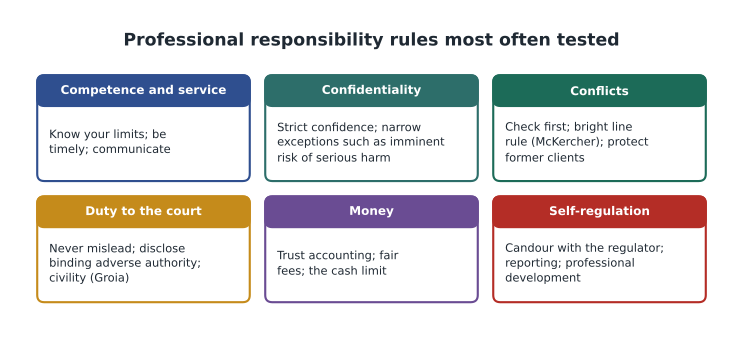
Competence and quality of service
A lawyer must perform legal services to the standard of a competent lawyer and must provide courteous, thoughtful, timely and efficient service. In practice, the competence rule is mostly about knowing your limits and acting on that knowledge: acquiring the knowledge needed for a matter without undue cost to the client, getting help from a more experienced lawyer, or referring the matter. The quality of service rule is mostly about communication: answering clients, keeping them informed and explaining matters well enough for informed decisions.
Confidentiality and privilege
A lawyer must hold all information about a client's business and affairs acquired in the course of the relationship in strict confidence and must not disclose it unless the client consents, disclosure is required by law or a court, or an exception applies. The exceptions are narrow. The most important allows disclosure where the lawyer reasonably believes there is an imminent risk of death or serious bodily harm and disclosure is necessary to prevent it, reflecting Smith v. Jones, [1999] 1 SCR 455, in which the Supreme Court recognized a public safety exception to solicitor-client privilege. Confidentiality is broader than privilege: it covers all client information, while privilege protects communications made for the purpose of legal advice from compelled disclosure, and the Supreme Court has repeatedly described solicitor-client privilege as close to absolute.
Conflicts of interest
A lawyer must not act or continue to act where there is a conflict of interest, unless the client consents and the lawyer reasonably believes they can act without adversely affecting the client. In Canadian National Railway Co. v. McKercher LLP, 2013 SCC 39, the Supreme Court confirmed the bright line rule: a lawyer may not act directly adverse to the immediate legal interests of a current client without consent, even in an unrelated matter, subject to limits on the rule's scope. Duties to former clients focus on confidential information: a lawyer must not act against a former client in the same or a related matter, or where the lawyer has relevant confidential information, unless the former client consents. Joint retainers require advance disclosure that information cannot be kept confidential between the joint clients and that the lawyer may have to withdraw if a dispute arises.
The duty to the court and civility
An advocate must represent the client resolutely and honourably within the limits of the law, and must treat the tribunal with candour, fairness, courtesy and respect. A lawyer must not knowingly mislead the court, assist a client in dishonesty, or permit a client or witness to present false evidence. In Groia v. Law Society of Upper Canada, 2018 SCC 27, the Supreme Court held that a law society assessing incivility in court must consider the context, including what the lawyer said, the manner and frequency of it, the presiding judge's reaction and whether allegations of impropriety had a reasonable basis. The decision protects vigorous advocacy while confirming that civility is a professional obligation.
Money and the regulator
Lesson 7 reviewed trust accounting, fees and the cash limit. The other piece of self-regulation is the lawyer's relationship with the law society itself. Lawyers must be candid with the regulator, respond to its inquiries, file the annual report, report certain events, and complete continuing professional development. In Ontario, lawyers must complete at least twelve hours of professional development each year, including at least three hours on professionalism topics such as ethics and practice management. Since September 2026, the Law Society has also required lawyers to complete Shared Pathways, a mandatory six-hour course on Indigenous cultural competence, by December 31, 2028. Hannah notes that every law society has its own professional development rules, and that Alberta also requires its lawyers to complete The Path, a course on Indigenous cultural competency.
A short self-test
Ogilvie gives the class three quick questions. A client tells you she plans to seriously injure her former partner tonight. May you disclose? Yes, if you reasonably believe the risk of death or serious bodily harm is imminent and disclosure is necessary to prevent it, disclosing no more than required. A large client you act for on employment matters is being sued by a small business that asks you to represent it. May you? Not without both clients' informed consent, because the bright line rule applies to direct adversity against a current client. Opposing counsel sends you an email by mistake containing their client's settlement instructions. What should you do? Notify the sender promptly, as the rules on inadvertently received documents require, and do not use the information until the issue is resolved.
Wellness
Ogilvie then turns the lesson over to Rideout, who talks about something she says no licensing examination tests but every lawyer needs. Legal practice is stressful. A national study of the psychological health of legal professionals in Canada, published in 2022 by researchers at the Université de Sherbrooke in collaboration with the Federation of Law Societies and the Canadian Bar Association, reported high levels of psychological distress, burnout and anxiety among lawyers, with new lawyers and women among the most affected. The pressures are familiar: long hours, billable targets, clients in crisis, adversarial work, fear of mistakes and the feeling of always being available.
The rules themselves recognize the connection between wellness and competence. A lawyer whose health impairs their ability to practise may not be competent to act, and many disciplinary cases involve lawyers whose problems started with exhaustion, addiction or untreated mental illness. Getting help early is not a sign of weakness or bad character; it is part of professional responsibility.
Support is available. Law societies and their insurers fund confidential member assistance programs that offer counselling and peer support to lawyers, licensing candidates and their families, and their use is confidential from the regulator. Practice management advisors at the law society answer questions about rules and practice by telephone. Mentorship programs, including the Law Society of Ontario's Coach and Advisor Network, connect new lawyers with experienced ones. Local law associations and affinity bar groups provide community. Rideout encourages every student to save the numbers in their phone before they start articling, not after a bad week.
The first year of practice
Rideout's advice for the first year is practical. In the first month, confirm insurance and reporting obligations, set up a personal diary and precedent file, and find a mentor outside your direct chain of supervision. Over the next few months, take on files with supervision, ask questions early rather than late, and complete professional development hours in areas you actually practise. By midyear, build your own systems, track time honestly, and protect some time that belongs to you. At the end of the year, review it with your mentor and plan the next year's learning.
She adds four rules from her own career. First, tell your supervisor about a mistake the day you discover it, because almost every mistake can be fixed if it is caught early, and almost none can be fixed if it is hidden. Second, never give an undertaking you do not fully understand. Third, if a client makes you uneasy, write down why, because your instinct is often noticing something your conscious mind has not caught up with. Fourth, money problems make good lawyers do bad things, so live within your means in the first years, when debt is high and income is modest.
Sophie asks how to say no to a supervisor who keeps adding work. Rideout's answer: be specific. List what you are working on, the deadlines, and ask which task should move. A good supervisor will reprioritize; a poor one will at least have been told. Arjun asks about working in-house, where he will be one lawyer among engineers. Rideout says the same rules apply, with an extra challenge: identifying who the client is, which in-house is the organization, not the person asking the question.
Looking further ahead
The profession the class is joining is changing quickly: new licensing models, new technology, new ways of delivering services, and continuing debate about access to justice and the structure of self-regulation, which LAWC-214 discussed in connection with the governance reforms in British Columbia and Ontario. Rideout tells the class that the lawyers who do best are those who keep learning, keep their judgment and keep their integrity, and who remember why they came to law school. Theo says his reason was to help people who could not navigate the system alone. 'Hold onto that,' Rideout says. 'It will get you through the third all-nighter.'
Money in the first years
Many new lawyers start practice with substantial student debt and modest income, especially in public interest, legal aid and small-firm practice. Rideout encourages students to learn about repayment assistance options, including provincial and federal student loan repayment assistance and law school loan repayment assistance programs, and to budget conservatively for the first two or three years. Financial pressure is a risk factor in many discipline cases involving trust money, and a realistic budget is part of protecting a career.
Access to justice as a professional value
The Rules of Professional Conduct describe the lawyer's role in facilitating access to legal services, and many lawyers contribute through pro bono work, legal aid, community legal clinics, limited scope retainers and volunteer roles. Daniel, who will practise in a smaller Saskatchewan community, expects much of his work to be for people who have never had a lawyer. Rideout tells the class that a new lawyer who takes on a small amount of pro bono work, carefully chosen and well supervised, learns quickly and helps people who would otherwise have no one. The same rules apply to pro bono clients as to paying ones: competence, confidentiality, conflicts and communication.
Worked problem
Hannah's third month
Three months into articling in Calgary, Hannah Kowalczyk is working seventy-hour weeks, sleeping badly and has made two small errors in documents, both caught by a senior associate. She is afraid that asking for help will make her look weak and hurt her chance of being hired back. What should she do?
Show solution
- Recognize the risk: exhaustion is already affecting her work, which engages competence and could lead to more serious mistakes.
- Use confidential support: contact the member assistance program available to Alberta students and lawyers for counselling, which is confidential from the regulator and the firm.
- Talk to her principal or a trusted mentor about workload, framed specifically: list current files and deadlines and ask for help prioritizing.
- Correct the habits that cause errors: build a checklist for document review and leave time to proofread.
- Protect basic health: sleep, food and at least some time away from work each week.
- Remember that asking for help early is part of professional responsibility, and that her principal has obligations to provide a reasonable training environment.
Common mistakes
MistakeTreating confidentiality and privilege as the same thing.
InsteadConfidentiality covers all client information; privilege protects legal advice communications from compelled disclosure.
MistakeAssuming consent is never needed to act against a current client in an unrelated matter.
InsteadThe bright line rule in McKercher bars acting directly adverse to a current client's immediate legal interests without consent.
MistakeHiding a mistake in the hope that it will not be noticed.
InsteadTell the supervisor promptly; early disclosure usually allows the problem to be fixed and is part of the duty of candour.
MistakeBelieving that using a member assistance program will be reported to the law society.
InsteadThese programs are confidential; seeking help early supports competence and is not a sign of bad character.
Practice problems
Work each problem on paper first, then reveal the answer to check.
What did the Supreme Court decide in Groia v. Law Society of Upper Canada, 2018 SCC 27?
Show answer
That a law society assessing incivility must consider context, including what was said, its manner and frequency, the judge's reaction and whether allegations had a reasonable basis, protecting vigorous advocacy while confirming civility as an obligation.
What are Ontario's annual continuing professional development requirements, and what was added in 2026?
Show answer
At least twelve hours a year, including at least three on professionalism; Shared Pathways, a mandatory six-hour Indigenous cultural competence course, was opened in September 2026, to be completed by December 31, 2028.
What did the 2022 national study of legal professionals' psychological health report?
Show answer
High levels of psychological distress, burnout and anxiety among lawyers, with new lawyers and women among the most affected.
Summary and key terms
- The rules most often tested are competence and quality of service, confidentiality, conflicts, the duty to the court and civility, money and candour with the regulator.
- McKercher's bright line rule, Smith v. Jones's public safety exception and Groia's contextual approach to civility are core authorities.
- Ontario lawyers must complete twelve hours of professional development a year, including three on professionalism, and Shared Pathways by December 31, 2028.
- Wellness is connected to competence; confidential assistance programs, practice advisors and mentors are available.
- In the first year, find a mentor, ask early, disclose mistakes promptly, build systems and protect your health.
- Quality of service
- The rule requiring courteous, thoughtful, timely and efficient service to clients.
- Bright line rule
- The rule that a lawyer may not act directly adverse to the immediate legal interests of a current client without consent.
- Public safety exception
- The exception permitting disclosure of confidential information to prevent an imminent risk of death or serious bodily harm.
- Civility
- The professional obligation to treat courts, opposing counsel and others with courtesy and respect.
- Member assistance program
- A confidential counselling and support service for lawyers, candidates and their families funded by the profession.
- Shared Pathways
- The Law Society of Ontario's mandatory six-hour course on Indigenous cultural competence.
Lesson quiz · 5 questions
Score 60% or more to complete this lesson.
Create a free account to save your progress, take quizzes and earn a certificate.