
LAWC-314 · Lesson 10 of 12 · 18 min
Solicitor review: real estate, wills and estates, and business law
▶ Video coming soon A video version of this lesson is on the way.
Rideout spent nineteen years doing the work this lesson covers, and she teaches it with obvious pleasure. 'Solicitors are the people who keep their clients out of court,' she says. 'When they do it well, nobody notices.' This review covers the three areas that dominate solicitor practice and entry-level assessment: real estate, wills and estates, and business law. Philippa Ingleby returns for the real estate section, and Miriam Ellerby, who taught LAWC-213, joins for wills and estates.
Real estate
Ingleby starts where every deal starts, with the agreement of purchase and sale. The lawyer for a buyer reads the agreement first, because its deadlines govern the file: the conditions and the dates by which they must be satisfied or waived, the requisition date for title objections, and the completion date. LAWC-303 reviewed the doctrines: conditions for one party's sole benefit can be waived by that party, true conditions precedent cannot be waived unilaterally under Turney v. Zhilka, and the duty of honest performance from Bhasin v. Hrynew and C.M. Callow Inc. v. Zollinger applies to the parties' dealings.
Title in most of Ontario is now registered in the Land Titles system, which guarantees the register subject to listed exceptions. The buyer's lawyer searches the parcel register for the property, looks for registered charges, easements, restrictions and executions against the seller, and conducts off-title searches for zoning, work orders, building permits, taxes and utilities. Objections are made by requisition before the requisition date. Under the deferred indefeasibility approach explained in Lawrence v. Wright, 2007 ONCA 55, and the 2006 amendments to the Land Titles Act, an owner whose title is taken by fraud is protected against the first party to deal with the fraudster, while later innocent purchasers are protected.
Several statutory issues arise on every residential deal. If the seller is married or has a spouse with rights in the matrimonial home, the spouse's consent under section 21 of the Family Law Act may be needed. The buyer is entitled to a declaration that the seller is not a non-resident of Canada for the purposes of section 116 of the Income Tax Act, because a buyer can otherwise be liable for a non-resident seller's tax. Land transfer tax is payable on registration, with refunds for eligible first-time buyers; in Toronto, the municipal land transfer tax applies as well. The federal prohibition on the purchase of residential property by non-Canadians remained in force in late 2026, and the federal budget of November 5, 2026 proposed extending it to January 1, 2029 and exempting new homes, changes that were not yet law.
Lawyers should also know the limits on acting for both sides. Under the Law Society of Ontario's rules, a lawyer may act for both the transferor and the transferee of real property only within listed exceptions, such as transactions between related persons, transfers in some estate situations and certain transactions in remote locations, and then only if the joint retainer requirements are met. Acting for both borrower and lender is more common but is also subject to rules. On closing, documents are registered electronically and funds are exchanged, often against undertakings, which must be clear, limited to matters within the lawyer's control and honoured strictly.
Practice problem: The seller of a house tells the buyer's lawyer, two days before closing, that he and his wife separated last year and that she still lives in the basement apartment. The deed is in his name only. What is the issue? The house may still be a matrimonial home, so the wife's consent under section 21 of the Family Law Act may be required, or the transaction may be set aside; the buyer's lawyer should requisition the consent or evidence that it is not needed before closing.
Wills and estates
Ellerby reviews the questions every will file raises. Does the testator have capacity? Under Banks v. Goodfellow, a testator must understand the nature of making a will, the extent of their property, the people who would normally be expected to benefit, and the claims of those excluded. Is there undue influence, or suspicious circumstances that shift the burden to the propounder? Is the will formally valid? A formal will must be in writing, signed at the end by the testator in the presence of two witnesses present at the same time, who then sign in the testator's presence; a holograph will must be wholly in the testator's handwriting and signed. Since amendments that took effect in 2021 and were made permanent, Ontario wills may be witnessed virtually if one witness is a licensee.
Important changes affected estates in Ontario from January 1, 2022. Marriage no longer revokes a will. Separated spouses are treated as predeceased for most purposes if they had lived apart for three years or had a separation agreement, court order or arbitral award settling their affairs, and were still separated at death. And for deaths on or after January 1, 2022, section 21.1 of the Succession Law Reform Act allows the Superior Court to validate a document that does not meet the formal requirements if it is satisfied that the document sets out the deceased's testamentary intentions, a power the courts have used in cases such as Vojska v. Ostrowski, 2023 ONSC 3894.
If there is no will, the intestacy rules apply. A surviving married spouse takes a preferential share, which for deaths on or after March 1, 2021 is 350,000 dollars, and shares the rest with any children. Common-law partners have no right to inherit on an intestacy, although they may claim support as dependants under Part V of the Succession Law Reform Act or bring trust claims. Joint accounts held by a parent and an adult child are presumed to be held on a resulting trust for the parent's estate under Pecore v. Pecore, 2007 SCC 17, unless the evidence shows an intention to make a gift.
Estate administration tax in Ontario is nil on the first 50,000 dollars of the value of the estate and 15 dollars for each 1,000 dollars or part above that. The estate trustee must file an estate information return within 180 days of the certificate of appointment being issued. Estates of 150,000 dollars or less can use a simplified small estate procedure. Powers of attorney for property and for personal care, made under the Substitute Decisions Act, 1992, are the other half of estate planning, and every will consultation should include them.
Practice problem: A client's father died in March leaving a typed will signed by him but witnessed by only one person. What should the lawyer consider? The will does not meet the formal requirements, but because the death was after January 1, 2022, an application may be made under section 21.1 to validate it if the evidence shows it sets out his testamentary intentions; the lawyer should gather that evidence and consider who must be served.
Business law
Rideout takes the business section. Choosing a structure comes first: a sole proprietorship, a partnership, or a corporation, each with different liability, tax and governance consequences. Most small businesses that incorporate in Ontario do so under the Ontario Business Corporations Act or the Canada Business Corporations Act. Incorporation requires articles, initial directors, a registered office, by-laws, organizational resolutions, share issuances and registers. Both statutes now require private corporations to keep a register of individuals with significant control: Ontario since January 1, 2023, and federally with filing with Corporations Canada and a public registry since January 22, 2024.
Directors owe a fiduciary duty to act honestly and in good faith with a view to the best interests of the corporation and a duty of care, diligence and skill, as the Supreme Court explained in Peoples Department Stores v. Wise, 2004 SCC 68, and BCE Inc. v. 1976 Debentureholders, 2008 SCC 69. Shareholders and other stakeholders whose reasonable expectations are unfairly disregarded may seek relief under the oppression remedy; in Wilson v. Alharayeri, 2017 SCC 39, the Supreme Court set out principles for when directors can be held personally liable. A shareholder agreement, including a unanimous shareholder agreement that restricts the directors' powers, is often the most important document for a small corporation with more than one owner, covering control, transfers, buy-sell rights and dispute resolution.
Tax shapes most small business advice. The capital gains inclusion rate increase announced in 2024 was cancelled on March 21, 2025. The lifetime capital gains exemption for qualified small business corporation shares was increased to 1.25 million dollars by legislation that received royal assent on March 26, 2026. Ontario's small business corporate tax rate fell to 2.2 percent on July 1, 2026. A solicitor need not be a tax specialist, but must know when to involve one.
Practice problem: Two friends want to open a café together, each contributing 30,000 dollars, and one wants to take a larger salary because she will work full-time. What should the lawyer raise? Whether to incorporate, the shareholdings and directorships, a shareholder agreement dealing with salaries and dividends, decisions, transfers and what happens if one wants out, the register of individuals with significant control, tax planning, and whether the lawyer can act for both of them or should recommend separate advice.
Solicitor's habits
Rideout ends with the habits she says matter more than any single rule. Read every document in full before signing it or advising on it. Report to the client in writing at the end of every transaction, with copies of what was signed. Keep undertakings in a register and close them. Check identities and funds. And when a client wants to do something quickly, ask what the rush is; in her experience, the files that went wrong were almost always the ones done in a hurry.
Hannah asks how much of this applies outside Ontario. Rideout's answer is that the structure is similar everywhere but the details differ: Alberta's land titles system, wills legislation and corporate statute have their own rules, and Quebec's civil law system is different again. A new lawyer who moves provinces must relearn the details, which is why the mobility arrangements require transferring lawyers to review local materials.
Worked problem
A solicitor-style examination question
Rideout gives the class another question in examination style: 'A client wants her lawyer to prepare a will leaving everything to her common-law partner of six years. She also wants to add her partner's name to her bank accounts now. She has two adult children from an earlier marriage. Which advice is most important?' The options are: (a) a will is unnecessary because common-law partners inherit on intestacy; (b) explain that common-law partners do not inherit on intestacy, so the will matters, and that adding the partner to the accounts may not pass them outside the estate unless the evidence shows a gift, and consider the children's possible dependant support claims; (c) advise her to transfer all assets to her partner now to avoid estate administration tax; (d) refuse to act because the children may object.
Show solution
- Eliminate (a): common-law partners have no intestacy rights in Ontario.
- Eliminate (c): transferring everything now has tax, control and family consequences, and is not the most important advice.
- Eliminate (d): potential objections are a reason for careful advice and documentation, not for refusing to act.
- Choose (b): it states the intestacy rule correctly, addresses the Pecore presumption on joint accounts and identifies the possible Part V claims.
- In practice, the lawyer would also assess capacity and independence, document the client's intentions and reasons, and discuss powers of attorney.
Common mistakes
MistakeTelling a client that marriage revokes an existing Ontario will.
InsteadSince January 1, 2022, marriage no longer revokes a will in Ontario.
MistakeTreating a will with one witness as necessarily invalid for a death in 2026.
InsteadSection 21.1 of the Succession Law Reform Act allows the court to validate it if it sets out the deceased's testamentary intentions.
MistakeTreating the proposed extension of the ban on purchases by non-Canadians as law.
InsteadThe November 5, 2026 budget proposal was not yet enacted; advise on the rules in force and watch for legislation.
MistakeActing for both seller and buyer of a house because both consent.
InsteadConsent alone is not enough; the transaction must fall within the Law Society's listed exceptions and meet the joint retainer requirements.
Practice problems
Work each problem on paper first, then reveal the answer to check.
How is Ontario estate administration tax calculated?
Show answer
Nil on the first 50,000 dollars of the estate's value and 15 dollars for each 1,000 dollars or part above that, with an estate information return due within 180 days of the certificate being issued.
What is the preferential share of a surviving married spouse on an Ontario intestacy for deaths on or after March 1, 2021?
Show answer
350,000 dollars.
When did Ontario and federal requirements for registers of individuals with significant control take effect?
Show answer
Ontario required them under the OBCA from January 1, 2023; federally, CBCA corporations have filed them with Corporations Canada and a public registry has existed since January 22, 2024.
Summary and key terms
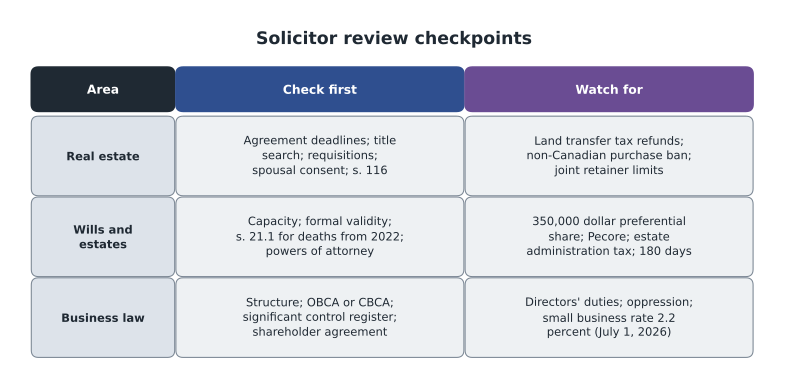
- Real estate: read the agreement first, search title in Land Titles, deal with spousal consent, residency and land transfer tax, respect the joint retainer limits and honour undertakings.
- The ban on purchases by non-Canadians remained in force in late 2026; the budget's proposed extension was not yet law.
- Wills: Banks v. Goodfellow capacity, formal validity, section 21.1 substantial compliance, and the January 1, 2022 changes on marriage and separation.
- Estates: the 350,000 dollar preferential share, Pecore on joint accounts, estate administration tax and the 180-day return.
- Business: structure, incorporation, registers of individuals with significant control, directors' duties, oppression and shareholder agreements, with current tax rules.
- Requisition
- A written objection to title or a request for documents made by a buyer's lawyer before the requisition date.
- Undertaking
- A personal promise by a lawyer, often used on closing, that must be honoured strictly.
- Substantial compliance
- The court's power under section 21.1 of the Succession Law Reform Act to validate a document that does not meet formal requirements.
- Preferential share
- The first portion of an intestate estate to which a surviving married spouse is entitled.
- Individual with significant control
- A person who owns or controls a significant interest in a corporation and must be recorded in its register.
- Unanimous shareholder agreement
- An agreement among all shareholders that restricts the powers of the directors.
Lesson quiz · 5 questions
Score 60% or more to complete this lesson.
Create a free account to save your progress, take quizzes and earn a certificate.