
LAWC-314 · Lesson 7 of 12 · 19 min
Practice management
▶ Video coming soon A video version of this lesson is on the way.
Rideout says that in her years as a practice advisor, she met very few lawyers in trouble because they did not know the law. She met many in trouble because they did not open files properly, did not diarize deadlines, mixed their own money with clients' money, or let a client go unanswered for three months. 'Practice management is not the boring part of law,' she tells the class. 'It is the part that keeps you licensed.' This lesson covers the systems every practice needs: intake and conflicts, retainers, deadlines, trust accounting, billing, client communication, records and closing, technology and AI, and planning for the unexpected.
The life of a file
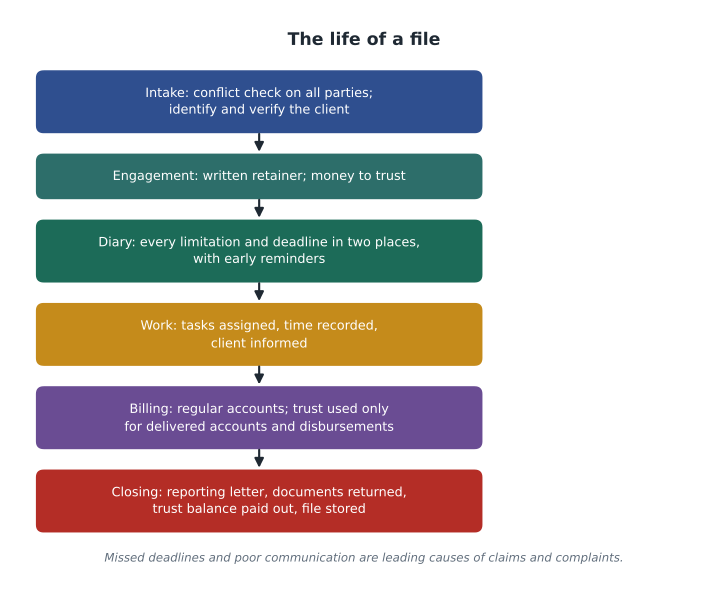
Every matter follows the same path, from intake to closing, and every step needs a system. Small practices can run on simple tools, provided they are used every time.
Intake and conflicts
Before a lawyer receives confidential information from a new client, the lawyer must check for conflicts of interest. A conflict check searches the firm's records for the client, the opposing party and other related people, such as directors of a corporate party, spouses or co-accused. LAWC-214 explained the rules: the duty of loyalty, the bright line rule against acting directly adverse to a current client without consent, and the obligations owed to former clients. The system must be able to find all of these. A conflict database is only as good as the information entered at every intake and updated when new parties appear.
Client identification and verification is also part of intake. In Ontario, By-Law 7.1 requires lawyers to identify clients and, when funds are involved, to verify identity using reliable documents and to keep records. These rules exist to prevent lawyers from being used for money laundering and fraud, and they apply even to long-standing clients when funds move.
The retainer
The retainer should be confirmed in writing. A good engagement letter sets out who the client is, the scope of the work, what is not included, how fees will be charged, what disbursements will be billed, whether a money retainer is required, how and how often the client will be billed, and what the client must do. Where the lawyer is providing limited scope services, the letter should describe the limits clearly. Contingency fee agreements in Ontario must follow the requirements of the regulation under the Solicitors Act, O. Reg. 563/20, including the use of a standard form and prescribed statements, and contingency fees are not permitted in some matters, such as most family law matters.
Deadlines and limitation periods
Missed deadlines are among the most common sources of claims against lawyers, and the most avoidable. Every limitation period, court deadline, closing date and undertaking should be entered in a diary system the moment it is known, with reminders well before the date, and ideally checked by a second person. A good rule is to diarize the date the work must start, not only the date it must be done. Rideout tells the class about a lawyer who missed a two-year limitation period because the file was opened on a Friday and the intake form was left on a desk over the weekend. The claim was paid by the lawyer's insurer; the lawyer's reputation took longer to recover.
Trust accounting
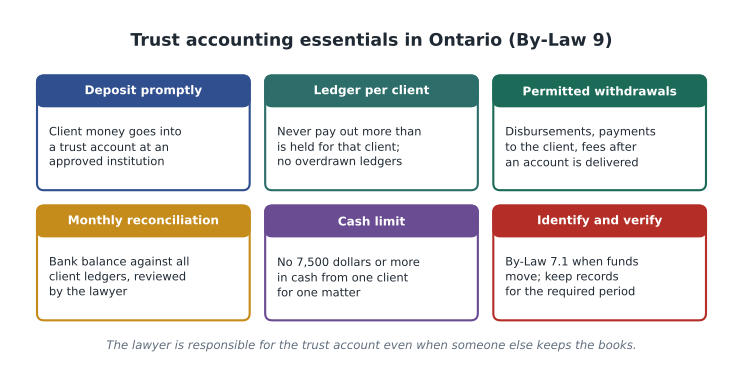
Lawyers hold money for clients, and the rules about that money are strict. In Ontario, By-Law 9 governs trust accounting. Money received in trust for a client must be deposited promptly into a trust account at an approved financial institution. The lawyer must keep a separate ledger for each client and must never withdraw more for a client than is held for that client, so that no client's ledger is ever in overdraft. Money can be withdrawn from trust only for permitted purposes, such as paying a disbursement on the client's behalf, paying the client, or paying the lawyer's fees after an account has been delivered to the client. The lawyer must reconcile the trust bank account against the client ledgers every month and keep the records for the required period. By-Law 9 also prohibits accepting 7,500 dollars or more in cash from one client in respect of one matter, subject to limited exceptions, and the rules on cash and electronic transfers were tightened in amendments that took effect on January 1, 2022.
The consequences of breaking these rules are severe. Misappropriation of trust money is among the most serious forms of professional misconduct, and usually leads to revocation of the licence. Many trust problems, however, start with poor bookkeeping rather than dishonesty: a deposit posted to the wrong client, a cheque written before funds cleared, a bookkeeper who is not supervised. The lawyer is responsible for the trust account even if someone else keeps the books. LAWC-214 discussed a hypothetical trust shortfall caused by a bookkeeper; the lesson was that the lawyer must review the reconciliations personally every month.
Billing and fees
Fees must be fair and reasonable and disclosed in a timely way. Accounts should be delivered regularly, should describe the work done and the disbursements, and should not include charges the client did not agree to. A client in Ontario may ask for an assessment of a lawyer's account by the court under the Solicitors Act. Lawyers who record time should do so as they work, not at the end of the week from memory. Rideout recommends billing at least monthly on active files, both for cash flow and because clients who receive regular accounts are less likely to be surprised.
Client communication
Failure to communicate is one of the most common complaints clients make to law societies, and a leading cause of claims. The quality of service rule requires lawyers to keep clients reasonably informed, to answer within a reasonable time and to explain matters well enough for the client to make informed decisions. Practical habits help: acknowledge every client message within a business day, even if only to say when a full answer will follow; send copies of important documents with a short explanation; report after every significant event; and confirm instructions in writing.
Records, closing and retention
A file should be organized so that another lawyer could pick it up and understand it. At the end of a matter, the lawyer sends a final reporting letter, returns original documents the client is entitled to, pays out any trust balance, and closes the file. Closed files are stored securely for the retention period appropriate to the type of matter and the law society's requirements, and then destroyed securely. Wills and other original documents held for safekeeping require special care and a register.
Technology and cybersecurity
Most practices now run on practice management software, cloud storage and electronic communication. The Model Code's commentary on competence recognizes that a lawyer should understand the benefits and risks of relevant technology. Practical obligations follow: secure passwords and multi-factor authentication, encrypted devices, careful handling of client information on personal phones, and procedures for confirming payment instructions by telephone using a known number. Wire fraud, in which a fraudster impersonates a client or another lawyer and sends altered payment instructions, is a common risk in real estate and estate practice. LAWC-303's capstone included a changed wire instruction on closing day for that reason.
Generative AI in the practice
The Law Society of Ontario published a white paper on licensee use of generative AI in April 2024, with a checklist and practice tips. The core obligations are the familiar ones applied to a new tool. A lawyer must be competent in the tool used, must protect client confidentiality, which may rule out entering client information into public tools, must supervise the output as they would the work of a junior, must not mislead the court or the client, and must consider whether to tell the client and how to bill fairly for work done with AI assistance. Courts have added their own requirements, as lesson 6 explained. Rideout's rule is simple: 'Use it like a bright summer student who sometimes makes things up. Check everything.'
Planning for the unexpected
Lawyers get sick, have accidents and die, and clients still need their files. A sole practitioner in particular should have a written plan naming another lawyer who can step in, with access to files, the trust account and the diary. Insurance matters too: Ontario lawyers in private practice must carry professional liability insurance through LAWPRO unless exempt, and should consider disability and office overhead insurance. Hannah notes that Alberta has its own mandatory insurance program through the Alberta Lawyers Insurance Association; every province has an equivalent.
Building the systems
Daniel asks how a new lawyer starting a practice in a small community should begin. Rideout's answer is a list: a conflict system and an intake form used every time; a written engagement letter template; a diary with two-person checking; trust accounting software and a bookkeeper who understands By-Law 9 or its equivalent, with monthly reconciliations the lawyer reviews and signs; a document management system with a consistent naming scheme; secure technology; a succession plan; and a habit of calling the law society's practice advisors with questions before, not after, a problem. 'None of this is exciting,' she says. 'All of it is the difference between a practice and a liability.'
Supervision and delegation
Most lawyers work with others: assistants, law clerks, paralegals, students and junior lawyers. The Rules of Professional Conduct allow a lawyer to delegate tasks, but the lawyer remains responsible for the work and must supervise it. Some tasks cannot be delegated to non-lawyers at all, such as giving legal advice, accepting a client, or giving or accepting undertakings, and in Ontario licensed paralegals may provide only the services their licence permits. Delegation works when the instructions are clear, the person has the training to do the task, and the lawyer reviews the result before it leaves the office.
Rideout tells the class that the most common supervision failure she saw was not dishonesty but assumption: a lawyer who assumed that an experienced clerk had diarized a deadline, or that a bookkeeper had reconciled the trust account, without checking. Her fix was a weekly ten-minute meeting with every person who worked on her files, going through upcoming deadlines one by one. It was the cheapest insurance she ever bought.
Knowing when to stop
Practice management also means knowing when not to take a file. A lawyer should decline a matter that is outside their competence, that would create a conflict, that the lawyer does not have time to do properly, or where the client's instructions or conduct suggest that the lawyer is being used to further a fraud. Red flags include urgent requests to move money through the trust account with little legal work, clients who will not provide identification, and unusual payment arrangements. Declining politely, in writing, and recording why protects both the client and the lawyer.
Worked problem
A deposit and a deadline
A first-year associate, working alone on a Saturday, receives a call from a new client, Corentin Quigg, who has been sued over a car accident and has been served with a statement of claim six days ago. He wants to drop off 9,000 dollars in cash as a retainer that afternoon. What should the associate do?
Show solution
- Run a conflict check on Corentin and the plaintiff, and any other parties named in the claim, before discussing the merits.
- Note the deadline: in Ontario, a statement of defence is generally due twenty days after service if the defendant is served in Ontario, so diarize it immediately, with a reminder, and check whether his insurer is defending.
- Decline to accept 9,000 dollars in cash: By-Law 9 prohibits accepting 7,500 dollars or more in cash from one client for one matter except in limited circumstances; ask for a cheque or electronic transfer instead.
- Identify and verify Corentin under By-Law 7.1 when funds are received.
- Send an engagement letter setting out the scope, fees and retainer, and deposit the retainer into trust when received.
- Report the new matter to the supervising lawyer on Monday morning, with the file opened and the deadline diarized.
Common mistakes
MistakeReceiving confidential information before running a conflict check.
InsteadCheck conflicts first, against all parties and related persons, so that the firm is not disqualified or placed in a conflict.
MistakeLeaving trust reconciliations entirely to a bookkeeper.
InsteadThe lawyer is responsible for the trust account and must review the monthly reconciliations personally.
MistakeTransferring fees from trust before delivering an account.
InsteadFees may be paid from trust only after an account has been delivered to the client.
MistakeEntering client information into a public AI tool to save time.
InsteadConfidentiality obligations may prohibit it; lawyers must understand how the tool uses data and supervise its output.
Practice problems
Work each problem on paper first, then reveal the answer to check.
What does By-Law 9 say about cash?
Show answer
A lawyer must not receive 7,500 dollars or more in cash from one client in respect of one matter, subject to limited exceptions; the rules were tightened in amendments effective January 1, 2022.
What must a lawyer do each month in relation to the trust account?
Show answer
Reconcile the trust bank account against the client trust ledgers and keep the records, reviewing the reconciliation personally.
What are the core obligations when using generative AI in practice?
Show answer
Competence with the tool, protecting confidentiality, supervising and verifying the output, not misleading the court or client, and considering disclosure to and fair billing of the client.
Summary and key terms
- Every file needs systems at each stage: intake, conflicts, retainer, diary, work, billing and closing.
- Conflict checks and client identification under By-Law 7.1 come before substantive work.
- By-Law 9 requires prompt deposit, separate client ledgers, permitted withdrawals only, monthly reconciliation and a 7,500 dollar cash limit.
- Missed deadlines and poor communication are leading causes of claims and complaints; both are preventable with habits and systems.
- Technology and AI bring new risks but the same duties: competence, confidentiality, supervision and honesty.
- Conflict check
- A search of the firm's records for the client and related parties before taking on a matter.
- Trust account
- A bank account in which a lawyer holds money belonging to clients, separate from the lawyer's own money.
- Client ledger
- The record of all trust money received and paid for a particular client.
- Monthly reconciliation
- The comparison of the trust bank balance with the total of all client ledgers, required every month.
- Diary system
- A system that records deadlines and limitation periods with advance reminders.
- Succession plan
- A written arrangement for another lawyer to take over a practice if the lawyer cannot continue.
Lesson quiz · 5 questions
Score 60% or more to complete this lesson.
Create a free account to save your progress, take quizzes and earn a certificate.