
LAWC-314 · Lesson 1 of 12 · 21 min
The path to licensing
▶ Video coming soon A video version of this lesson is on the way.
Professor Gilda Rideout opens the last course of the program by writing one question on the board and leaving it there for the whole term: 'Could you do this on Monday morning?' She practised for nineteen years in a small general practice in Corwin, doing real estate closings, wills, small business work and the occasional family file, and then spent six years advising lawyers on how to run their practices before coming to Brannock to direct its practice program. 'You have spent three years learning law,' she tells the class. 'This course is about the year after this one, when someone hands you a file, a deadline and a client who is frightened, and expects you to know what to do with all three.'
This lesson sets out the path from law school to a licence to practise law in Ontario, the province where most of the class will be licensed, and explains why that path is changing. Later lessons look at the other provinces, at good character, at articling and its alternatives, and at the skills and knowledge that licensing bodies test.
Who licenses lawyers
There is no national licence to practise law in Canada. The regulation of the legal profession falls within provincial jurisdiction over property and civil rights and the administration of justice, and each province and territory has a statute that creates a law society and gives it power to license and discipline lawyers. In Ontario, the Law Society Act establishes the Law Society of Ontario and makes it unlawful for anyone other than a licensee to practise law or provide legal services, subject to listed exceptions. The Law Society licenses two kinds of legal professionals: lawyers, who hold an L1 licence to practise law as a barrister and solicitor, and paralegals, who hold a P1 licence to provide a defined range of legal services. As LAWC-214 explained, the Act also makes the Law Society's function of regulating in the public interest its central duty, and the licensing process is one of the main ways it carries out that duty.
The Federation of Law Societies of Canada, the national coordinating body of the fourteen law societies, plays a supporting role. It sets the national requirement that an approved Canadian common law degree must meet, it runs the National Committee on Accreditation, which assesses the credentials of people who studied law outside Canada, and it maintains the Model Code of Professional Conduct that most law societies have adopted with local variations. Law societies also cooperate through mobility agreements that let a lawyer licensed in one province practise temporarily in another and transfer permanently with limited further requirements.
The Ontario lawyer licensing process
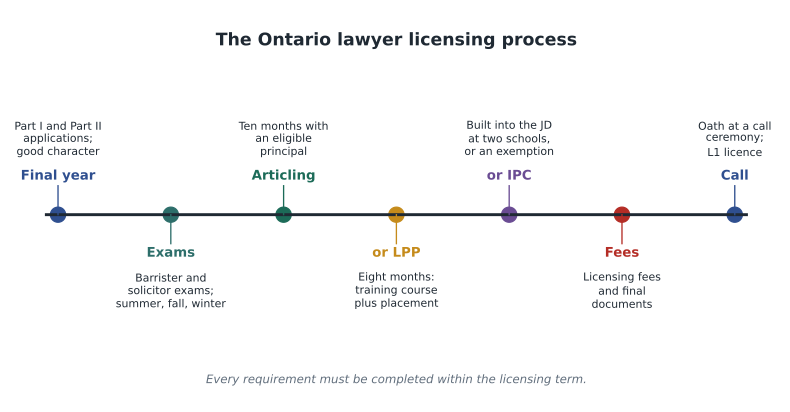
A graduate of an approved Canadian common law program who wants to be licensed in Ontario enters the lawyer licensing process. The process has three substantive requirements, all of which must be met within a limited licensing term: passing the licensing examinations, completing the experiential training requirement, and being of good character. Candidates apply in two parts, normally during the final year of law school, and must have a complete application before they start articling or the Law Practice Program. The application includes detailed questions about the candidate's history, and the candidate declares that the information is complete, true and correct. The Law Society warns candidates that false or misleading information will result in not being licensed.
The licensing examinations are a barrister examination and a solicitor examination. They were introduced in their current form in 2006, and the competencies they test were last updated in 2011. Each examination is a multiple-choice, open-book test written in a single sitting of about four and a half hours. The Law Society publishes study materials for each examination, and candidates may bring those materials, and their own notes and indexes, into the examination. The examinations are offered in several sittings each licensing year, usually in the summer, fall and winter, and candidates choose when to write within their licensing term. Lesson 8 looks closely at how to prepare for them.
The experiential training requirement can be met in four ways. The traditional route is articling: ten months of supervised work in an approved placement with a licensed lawyer acting as principal. The second is the Law Practice Program, an eight-month program consisting of a four-month training course followed by a four-month work placement. The third is the Integrated Practice Curriculum, which builds the experiential requirement into the law degree itself at the law schools that offer it. The fourth is an exemption for candidates with qualifying legal experience, for example lawyers already practising in another jurisdiction. Lessons 4 and 5 discuss these routes in detail.
The good character requirement appears in the Law Society Act itself, which requires an applicant for a licence to be of good character. The Law Society assesses good character through the application questions, and in a small number of cases through an investigation and a hearing before the Law Society Tribunal. Lesson 3 explains how that works and what a candidate must disclose.
When every requirement has been met, the candidate pays the licensing fees, files the final documents and attends a call to the bar ceremony, where new lawyers take the barristers' and solicitors' oath. From that moment they are licensees, with all the obligations that the profession brings: paying the annual fee, carrying the mandatory professional liability insurance provided through LAWPRO unless exempt, completing continuing professional development each year, filing an annual report, and following the Rules of Professional Conduct and the by-laws, including the trust accounting rules in By-Law 9.
How well does the current system work?
The examinations are passed by most candidates, but not evenly. Figures reported in public coverage of the Law Society's 2025 proposal showed that in 2023, about 88 percent of candidates with Canadian law degrees passed the barrister examination and about 81 percent passed the solicitor examination, compared with about 58 percent and 50 percent of internationally trained candidates. Atrisha Lewis, chair of the Law Society's Professional Development and Competence Committee, described the examinations as largely an exercise in using an index, and noted that building a good index is time-consuming work often done in study groups. Candidates who lack those networks, many of them internationally trained, may be disadvantaged for reasons that have little to do with whether they are competent to practise.
Critics also point out that a multiple-choice examination tests knowledge recognition rather than the skills a new lawyer uses every day: interviewing a client, writing a clear letter, managing a file, negotiating, or noticing that a matter has an ethical problem. Supporters of the examinations respond that a standardized, objectively scored test is fair, defensible and hard to replace, that it gives the public an assurance that every new lawyer has a common base of knowledge, and that skills can be taught and assessed during articling.
The 2025 proposal and the 2026 debate
In September 2025, the Law Society's Professional Development and Competence Committee proposed replacing the barrister and solicitor examinations with a mandatory skills-based course and assessments for all lawyer licensing candidates. As described in the consultation, the course would cover entry-level competencies such as practice management, communications, client relationship management and professional ethics. It would combine self-directed modules, workshops and virtual law firms, be delivered online so that it is accessible across Ontario, use ongoing assessments that give candidates feedback, and end with a final assessment, possibly including scenario-based exercises, scored by trained lawyer assessors using accepted testing standards. The committee did not propose simply adopting CPLED's Practice Readiness Education Program, which the western provinces use, or the Law Practice Program.
The consultation closed on January 31, 2026. Responses were divided. Some legal organizations told the Law Society that they supported reform of the licensing process but wanted to keep a standardized examination, and the Federation of Ontario Law Associations, which represents the county and district law associations, opposed the proposed skills-based assessment. Ontario's Attorney General said publicly in November 2025 that scrapping written examinations would not be acceptable. As this course was prepared in late 2026, the Law Society's own consultation page stated that it had not yet decided whether to proceed with the committee's recommendations, and no implementation date had been set.
Rideout is careful about what this means for the class. 'Plan for the system that exists,' she says. 'If the examinations are still in place when you register, you will write them. If a new course is introduced, the Law Society will publish transition rules, and you will read them the week they come out. Either way, the competencies do not change much: you need to know the law well enough to find it fast, and you need to be able to use it for a client.'
The class makes its plans
Rideout asks each student where they expect to be licensed and how. Theo Marchetti, who spent ten years as a litigation law clerk in Hamilton before law school, has an articling position with a litigation boutique in Hamilton and plans to write both examinations before he starts. Sophie Tremblay-Hart has accepted an articling position with a federal government legal department in Ottawa and will be licensed in Ontario first, though she is thinking about practising in Quebec later, which, as lesson 2 explains, is a very different route. Arjun Mehta, the former civil engineer, has enrolled in the Law Practice Program, partly because he wants its training course and partly because he hopes to land a placement in the legal department of a technology company. Daniel Whitecloud is going home to Saskatchewan, where he will article with a firm that does Indigenous governance work and complete CPLED's program. Hannah Kowalczyk has an articling position with an energy firm in Calgary.
'That is three provinces and four pathways in five people,' Rideout says. 'Which is a fair picture of the profession you are joining.'
Planning the licensing year
A licensing year has several moving parts, and most problems come from timing rather than from substance. A candidate who plans to article must apply to the licensing process before the articling term starts, because the term cannot begin until the application is complete. A candidate who wants to write the examinations before articling must register by the deadline for the chosen sitting and leave enough time to study, which for most candidates means several weeks of full-time preparation. Fees are due at registration and at each stage, and late filing fees apply. A candidate who changes principals, pauses articling or needs accommodation must tell the Law Society promptly and in writing.
Rideout recommends a simple planning document: one page with every deadline in the licensing year, the source of each one (the Law Society's dates page, the articling agreement, the examination registration confirmation) and the action needed before it. The same habit, she says, will be the first thing they use in practice, when the deadlines belong to clients.
Mobility after licensing
A licence from one Canadian law society is not a licence everywhere, but the law societies have made it relatively easy to move. Under the national mobility arrangements, a lawyer licensed in one common law province may practise temporarily in another for a limited number of days a year without becoming a member, provided they carry insurance and are not subject to discipline. A lawyer who wants to move permanently can transfer by meeting the receiving law society's requirements, which usually involve reviewing local materials and certifying that the lawyer has done so, rather than writing new examinations. Moving between a common law province and Quebec is more complicated because of the different legal systems, and is governed by separate arrangements. Hannah, who might want to come back to Ontario one day, takes note: her Alberta licence would not lock her into Alberta.
Worked problem
Theo plans his licensing year
Theo Marchetti will graduate in the spring. He has an articling position starting in late August with a Hamilton litigation boutique, and he wants to write the barrister and solicitor examinations before he starts. He also coaches his son's hockey team two evenings a week and does not want to give it up. Using the Ontario requirements, what should his plan look like?
Show solution
- List the requirements: complete licensing application (Part I and Part II), both licensing examinations, ten months of articling, good character, then fees and the call ceremony, all within the licensing term.
- Work back from the articling start date. The application must be complete before articling begins, so file Part I and Part II by the Law Society's published deadlines in the final year of law school.
- Choose an examination sitting. If he wants both examinations done before late August, he must register for a summer sitting by its registration deadline and pay the fees.
- Build a study plan of several weeks after final law school exams, with a weekly schedule that keeps the two hockey evenings but protects study blocks, and plan to build or refine an index for each examination.
- Confirm with the principal, in writing, the articling start date, the rotation through the firm's work and how the firm handles a candidate who must rewrite an examination.
- Put every date, its source and the action needed on one page, and review it monthly.
Common mistakes
MistakeAssuming there is a national licence to practise law in Canada.
InsteadEach province and territory licenses its own lawyers under its own statute; mobility arrangements make it easier to move, but do not create a national licence.
MistakeStarting articling before the licensing application is complete.
InsteadIn Ontario, the Part I and Part II application must be complete before articling or the Law Practice Program begins, or the time may not count.
MistakeTelling a 2026 candidate that the Ontario licensing examinations have been abolished.
InsteadThe Law Society consulted on replacing them with a skills-based course, but as of late 2026 it had not decided whether to proceed; candidates should follow the current rules and watch for transition rules.
MistakeTreating the licensing examinations as closed-book memory tests.
InsteadThey are multiple-choice, open-book examinations based on published materials; the skill being tested is finding and applying the right rule quickly.
Practice problems
Work each problem on paper first, then reveal the answer to check.
What are the three substantive requirements of the Ontario lawyer licensing process?
Show answer
Passing the barrister and solicitor licensing examinations, completing the experiential training requirement (articling, the Law Practice Program, the Integrated Practice Curriculum or an exemption), and being of good character, all within the licensing term.
What did the Law Society of Ontario propose in September 2025, and what was its status in late 2026?
Show answer
Its Professional Development and Competence Committee proposed replacing the licensing examinations with a mandatory skills-based course, ongoing assessments and a final assessment scored by trained lawyer assessors. The consultation closed January 31, 2026, and the Law Society had not yet decided whether to proceed.
What role does the Federation of Law Societies of Canada play in licensing?
Show answer
It coordinates national standards: it sets the national requirement for approved common law degrees, runs the National Committee on Accreditation for internationally trained candidates, maintains the Model Code and supports mobility arrangements, but individual law societies grant licences.
Summary and key terms
- Lawyers are licensed by provincial and territorial law societies; in Ontario, the Law Society of Ontario issues L1 licences under the Law Society Act.
- Ontario requires passing the barrister and solicitor examinations, completing experiential training and being of good character, all within the licensing term.
- The examinations, introduced in 2006, are open-book, multiple-choice tests of about four and a half hours each.
- Pass rates differ markedly between Canadian-trained and internationally trained candidates, which is one reason for the 2025 proposal to replace the examinations with a skills-based course.
- As of late 2026, the Law Society had not decided whether to adopt the proposal; candidates should plan for the existing system and watch for transition rules.
- L1 licence
- The Law Society of Ontario licence that permits the holder to practise law in Ontario as a barrister and solicitor.
- Licensing term
- The limited period within which a licensing candidate must complete all the requirements of the licensing process.
- Experiential training requirement
- The Ontario requirement of supervised practical training, met by articling, the Law Practice Program, the Integrated Practice Curriculum or an exemption.
- Call to the bar
- The ceremony at which a new lawyer takes the oath and is admitted to practise.
- National Committee on Accreditation
- The Federation of Law Societies committee that assesses the legal education of people trained outside Canada.
- Mobility
- The arrangements that allow lawyers licensed in one province to practise temporarily in another or to transfer with limited further requirements.
Lesson quiz · 5 questions
Score 60% or more to complete this lesson.
Create a free account to save your progress, take quizzes and earn a certificate.