
LAWC-314 · Lesson 4 of 12 · 19 min
Articling
▶ Video coming soon A video version of this lesson is on the way.
Theo Marchetti has spent ten years in law offices and assumes articling will hold no surprises. Rideout warns him that it will, because for the first time he will be the one whose judgment is being trained rather than the one carrying out someone else's. 'A law clerk is asked to do it right,' she says. 'An articling student is asked to decide what right is, and then to explain the decision to a principal who will tell you, sometimes bluntly, why you were wrong.' This lesson explains what articling is for, how it is structured in Ontario and the PREP provinces, the obligations of principals and students, the limits on what students may do, and what to do when an articling placement goes badly.
The purpose of articling
Articling is the oldest form of practical legal training in Canada: a period of supervised work in which a law graduate learns to practise by doing, under a licensed lawyer who is responsible for the student's training. Its purpose is to move the graduate from knowing about law to being able to use it for real clients: to interview, to advise, to draft, to manage deadlines, to deal with opposing counsel and courts, and to recognize and handle ethical problems. Law societies treat articling as a training relationship, not merely a job, and they attach obligations to both sides.
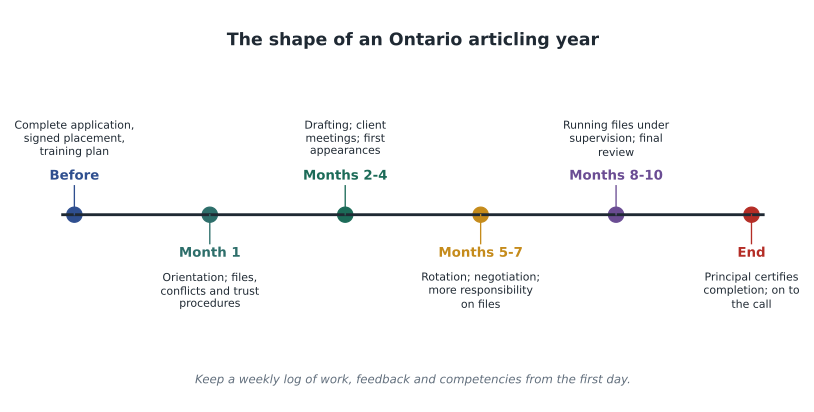
In Ontario, articling is ten months. In Alberta it is twelve months, including PREP, or fifteen for students clerking with the courts. In British Columbia it is at least nine months unless reduced. Saskatchewan, Manitoba and Nova Scotia combine articling with PREP under their own rules. Whatever the length, the placement must be approved, the supervising lawyer must be eligible, and the student must be registered with the law society before the term begins.
Finding a placement
Most large and mid-sized firms recruit articling students through formal recruitment processes with fixed dates, often a year or more in advance. Many government offices, legal clinics and smaller firms hire on their own timelines. Candidates who have not found a position by graduation are not out of options: smaller firms in regional centres, sole practitioners, in-house legal departments and public interest organizations all hire students, and in Ontario the Law Practice Program, discussed in lesson 5, provides an alternative. Rideout advises students to treat the search like a practice skill: keep a list, follow up in writing, and ask every lawyer they meet whether they know of anyone who might take a student.
Pay
For placements beginning on or after May 1, 2023, the Law Society of Ontario requires mandatory minimum compensation of 620 dollars a week for all Ontario-based articling positions and Law Practice Program work placements. A principal or supervisor who cannot pay may apply for an exemption, which requires that the placement be of high quality, that the principal declare that the employer cannot pay, and that the principal have a clean discipline history for the previous five years. The requirement followed a long debate in Convocation, prompted by reports that a significant minority of placements were unpaid or paid below minimum wage. Employment standards legislation may also apply to articling students, and the Law Society of Alberta has reminded principals of their employment standards obligations to students. A minimum is a floor; many placements pay considerably more.
Principals and students
An articling principal must meet the law society's eligibility requirements, which in every province include being a licensee in good standing with a minimum amount of practice experience and no disqualifying regulatory history. The principal agrees to provide training across the competencies the law society has defined, to supervise and review the student's work, to give regular feedback and to certify at the end whether the student has completed the term. In Ontario, the training is organized around the Law Society's experiential training competencies, which cover areas such as ethics and professionalism, client communication and management, research, drafting, advocacy, negotiation, and practice and file management, and the student keeps a record of the competencies covered.
A principal's certification is a statement to the regulator, and it must be honest. A principal who certifies a student who has not actually done the work, or who certifies completion for a student who was barely supervised, misleads the law society. A principal also owes the student the ordinary obligations of any employer and the professional obligations of the Rules of Professional Conduct, including the duty not to engage in harassment or discrimination.
The student's obligations mirror the principal's. The student works under supervision, follows the Rules of Professional Conduct, keeps client information confidential, records the work done and tells the principal about mistakes immediately. The student must also report changes to the law society, such as a change of principal, a leave or a period of time away that affects the length of the term.
What a student may do
A licensing candidate who is articling is not yet a licensee and may not practise law independently. In Ontario, the Law Society's by-laws allow a student to provide legal services under the supervision of the principal or another lawyer, and court rules and practice directions allow students to appear in some proceedings, for example in the Small Claims Court and in certain matters in the Ontario Court of Justice and on some motions, subject to the court's permission and to limits that vary by court and type of proceeding. A student must never hold themselves out as a lawyer, must identify themselves as a student when dealing with clients, opposing counsel and the court, and must not give a legal opinion or accept a retainer on their own.
Arjun asks a practical question: can he sign a letter to opposing counsel? Rideout's answer is that he can sign correspondence if the firm permits it, if the letter clearly identifies him as an articling student, and if a lawyer has reviewed anything substantive. What he cannot do is give an undertaking on the firm's behalf without a lawyer's authority, because an undertaking binds the lawyer personally and the firm.
Reducing the term
Ontario allows the articling term to be shortened, called abridgment, in limited circumstances. Compassionate abridgment of up to six weeks may be approved for reasons such as family responsibilities or prolonged illness or injury, usually after the time has been taken. Abridgment for prior legal experience is available to candidates who have practised as lawyers elsewhere or have other legal experience gained after completing a law degree. Experience gained before or during law school, such as clinical placements and summer work, does not count, and the Law Society will not shorten the entire term. The Law Practice Program cannot be abridged.
That rule surprises Theo. His ten years as a litigation law clerk were before law school, so they do not count toward abridgment, however valuable they are. 'It is not that the experience is worthless,' Rideout says. 'It is that the competency being certified is a lawyer's judgment, which you could not exercise as a clerk.' Theo will article for the full ten months, though he expects to move faster through the routine parts.
When articling goes wrong
Most articling placements work well. Some do not. Problems include students given only clerical work, principals who are never available, unreasonable hours, unpaid overtime that pushes pay below the minimum, and, most seriously, harassment and discrimination. Law society surveys over the past decade have found that a troubling number of students reported discrimination or harassment during articling, and law societies have responded with education requirements for principals, confidential support services and reporting options.
A student facing a problem has several options, and the right one depends on the problem. A training problem can often be solved by raising it directly with the principal, in writing if a conversation does not work. If that fails, the student can contact the law society's articling or licensing staff, who can advise on changing placements and can follow up with the principal. A student who experiences harassment or discrimination can seek confidential advice from the services the law society funds for that purpose, such as Ontario's Discrimination and Harassment Counsel, and can make a complaint to the law society or to the Human Rights Tribunal. A student who needs to leave a placement should tell the law society promptly so that the time already served is recorded, and should look for another principal to complete the term.
Rideout's practical advice is to keep a short weekly log from the first day: what work was done, what feedback was given and any problems. The log helps the student complete the record of competencies, gives the principal a structure for feedback, and, if something goes wrong, provides a contemporaneous record.
Getting the most out of articling
The best students, Rideout says, do four things. They ask for work outside their comfort zone. They ask for feedback on each piece of work, not only at the end of a rotation. They keep their own precedent file of good letters, memos and documents, with notes on why each one worked. And they learn the systems of the office, from the conflict check to the trust ledger, because those systems are what keep lawyers out of trouble. Hannah, who will spend her articles at an energy firm in Calgary, adds a fifth: learn who the clerks and assistants are, because they know where everything is and they will save you from your mistakes.
Feedback and evaluation
Good principals give feedback in small, frequent doses. A short conversation after each significant piece of work, with marked-up drafts returned rather than silently corrected, teaches more than a formal review at the end of a rotation. Students can encourage this by asking specific questions: not 'was the memo all right?' but 'was the structure of the analysis what you needed, and what would you have cut?' Rideout recommends that students keep the marked-up drafts in their precedent file with a note of the lesson learned, because the same comments tend to recur until the habit is fixed.
Formal evaluation usually happens at the midpoint and at the end of the term. In Ontario, the student and principal confirm the competencies covered and the time served, and the principal certifies completion to the Law Society. A student who is concerned that the placement will not cover all the competencies should raise it at the midpoint, when there is still time to assign the missing work, rather than in the final week.
Worked problem
Arjun's friend and the unpaid hours
Arjun's friend Clothilde articles at a small Corwin firm. Her placement agreement pays the Law Society's minimum weekly amount for a forty-hour week, but she regularly works fifty-five hours with no additional pay and spends most of her time photocopying and filing. Her principal, a sole practitioner, rarely reviews her work. She is afraid that complaining will cost her the placement and her licence. What should she do?
Show solution
- Identify the issues: training quality (little substantive work and supervision), compensation (hours may push effective pay below the minimum and engage employment standards obligations), and the principal's obligations under the placement agreement.
- Start with the record: keep a log of hours and tasks, and compare the work with the experiential training competencies.
- Raise the training issue with the principal in writing, proposing specific changes such as reviewing one memo or draft a week and attending client meetings.
- If nothing changes, contact the Law Society's articling staff for confidential advice; they can discuss options, including changing placements, and can follow up with the principal.
- Get advice on her employment standards rights, which exist independently of the Law Society's minimum.
- If she leaves, tell the Law Society promptly so that time served is recorded, and look for a new principal to finish the term.
Common mistakes
MistakeAssuming legal work done before or during law school can shorten Ontario articling.
InsteadAbridgment for prior experience counts only experience gained after completing the law degree; compassionate abridgment is limited to six weeks.
MistakeLetting an articling student give undertakings or legal opinions on their own.
InsteadStudents work under supervision; undertakings and opinions require a lawyer's authority and review.
MistakeTreating the mandatory minimum compensation as the only pay rule.
InsteadOntario's minimum of 620 dollars a week applies to placements starting on or after May 1, 2023, but employment standards legislation may impose other obligations.
MistakeTelling a student in a bad placement simply to endure it.
InsteadStudents can raise problems with the principal, seek confidential advice from law society staff or harassment counsel, and change placements while preserving time served.
Practice problems
Work each problem on paper first, then reveal the answer to check.
What is Ontario's mandatory minimum compensation for articling and LPP placements, and when does it apply?
Show answer
620 dollars a week for Ontario-based articling and LPP work placements beginning on or after May 1, 2023, unless an exemption is granted.
What are the conditions for an exemption from the mandatory minimum compensation?
Show answer
The placement must be of high quality, the principal or supervisor must declare that the employer cannot pay the minimum, and the principal must have a clean discipline history for the previous five years.
Why do Theo's years as a law clerk not shorten his articling term?
Show answer
Ontario counts only legal experience gained after completing a law degree for abridgment, and the competency being certified is a lawyer's judgment.
Summary and key terms
- Articling is a supervised training relationship that moves a graduate from knowing law to using it for clients.
- Ontario articling is ten months; Alberta's term is twelve months including PREP; British Columbia's is at least nine months unless reduced.
- Ontario requires mandatory minimum compensation of 620 dollars a week for placements starting on or after May 1, 2023, subject to exemptions.
- Principals must train, supervise, give feedback, respect the rules and certify honestly; students must work within the limits on what students may do.
- Abridgment is limited; problems in a placement can be raised with the principal, the law society and harassment counsel, and students can change placements.
- Articling
- A period of supervised practical training with a licensed lawyer, required before licensing.
- Principal
- The licensed lawyer responsible for training and supervising an articling student and certifying completion.
- Experiential training competencies
- The Law Society of Ontario's list of skills and tasks that articling and placements must cover.
- Abridgment
- A reduction in the length of an articling term granted by the law society.
- Mandatory minimum compensation
- The minimum weekly pay the Law Society of Ontario requires for articling and LPP placements.
- Undertaking
- A personal promise by a lawyer to do or refrain from doing something, which binds the lawyer professionally.
Lesson quiz · 5 questions
Score 60% or more to complete this lesson.
Create a free account to save your progress, take quizzes and earn a certificate.