
LAWC-313 · Lesson 9 of 12 · 19 min
Climate litigation and the Charter
▶ Video coming soon A video version of this lesson is on the way.
When the ninth class begins, Wyndham projects a photograph from late October 2026: fifteen young people outside the Federal Court building in Vancouver on the first day of the evidentiary phase in La Rose v. Canada. 'Six years ago,' she says, 'the Federal Court struck this claim out as non-justiciable. Now it is being tried. Today we ask why, and what the plaintiffs must prove.' Sophie Tremblay-Hart, who has read the 2023 appeal decision, says she is not sure whether the case is about law or politics. 'That,' says Wyndham, 'is the defendant's first argument.'
Lesson 8 showed that Canada's climate statutes rely mostly on targets, plans and pricing, with few enforceable obligations. Climate litigation tries to fill that gap through the courts. This lesson examines the two leading Canadian Charter cases, Mathur v. Ontario and La Rose v. Canada, the legal obstacles they face, the possibility of climate claims in tort, and the international decisions that Canadian litigants and courts are watching.
Why litigate climate change?
Climate litigants usually pursue one of three strategies. Rights-based claims argue that government action or inaction on climate change violates constitutional rights, typically section 7 of the Charter (life, liberty and security of the person) and sometimes section 15 (equality). Tort claims seek damages or injunctions from major emitters or fossil fuel producers for contributing to climate harms. And regulatory or administrative claims challenge particular decisions, such as project approvals, for failing to consider climate effects as the law requires. The third category is the most common and the most often successful, because it relies on ordinary judicial review. The first two are harder but have attracted the most attention.
The legal hurdles
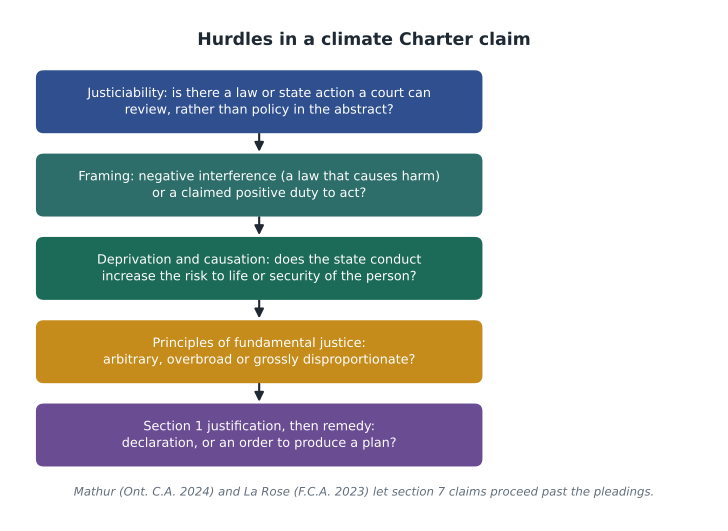
Justiciability comes first. Courts decide legal disputes; they do not make policy. Governments argue that climate policy involves complex scientific, economic and political trade-offs that belong to legislatures. In Operation Dismantle v. The Queen, [1985] 1 S.C.R. 441, the Supreme Court held that Cabinet decisions are reviewable for Charter compliance even on matters of defence policy, so a claim is not non-justiciable merely because it is political. But courts have struck claims that challenge a diffuse network of government policies rather than an identifiable law or decision. In Tanudjaja v. Canada (Attorney General), 2014 ONCA 852, the Court of Appeal for Ontario struck a Charter claim that government housing policies caused homelessness, partly because it did not challenge a specific law.
The second hurdle is the line between negative and positive rights. Section 7 has traditionally been read as protecting people from state deprivations, not as requiring the state to provide benefits or protection. In Gosselin v. Quebec (Attorney General), 2002 SCC 84, the Supreme Court declined to find a positive obligation on the facts but left open the possibility that special circumstances might one day require one. Climate plaintiffs therefore try to frame their claims as challenges to state conduct that causes harm, such as authorizing emissions or setting an inadequate target, rather than demands that government act.
Third is causation. Section 7 requires a sufficient causal connection between state conduct and the deprivation. In Canada (Attorney General) v. Bedford, 2013 SCC 72, the Supreme Court held that this standard is flexible: the state conduct need not be the only or dominant cause, but there must be a real connection rather than speculation. Canada produces under two percent of global emissions, so governments argue that no Canadian law causes climate harm. Plaintiffs respond that every emitter contributes to a cumulative problem and that the Bedford standard does not require dominant causation.
Fourth, a deprivation violates section 7 only if it is contrary to the principles of fundamental justice, which include the rules against arbitrariness, overbreadth and gross disproportionality. Plaintiffs must show, for example, that a target is arbitrary because it bears no connection to its own stated purpose of protecting against climate harm. Finally, if a breach is found, the government may try to justify it under section 1, and the court must choose a remedy. Courts readily issue declarations; they are much more cautious about orders requiring governments to develop plans, though Doucet-Boudreau v. Nova Scotia (Minister of Education), 2003 SCC 62, confirms that supervisory remedies are available in appropriate cases.
Mathur v. Ontario
In 2019, seven young Ontarians, represented by Ecojustice, challenged Ontario's climate legislation. After winning the 2018 election, the provincial government repealed the cap-and-trade system and enacted the Cap and Trade Cancellation Act, 2018. That Act required the government to set a greenhouse gas reduction target and prepare a climate plan. The government set a target of 30 percent below 2005 levels by 2030, weaker than the previous target. The applicants argued that the target and the repeal of the earlier climate legislation violated sections 7 and 15 of the Charter by authorizing emissions that would contribute to dangerous climate change, endangering their lives and security, with disproportionate effects on young people and future generations.
In April 2023, Vermette J. of the Superior Court dismissed the application. She accepted much of the applicants' scientific evidence, finding that climate change is already increasing the risk of death and harm to Ontarians and that Ontario's target fell well short of what scientific consensus indicated was needed. But she held that the claim sought to impose a positive obligation on the government to legislate a stronger target, which section 7 does not require, and that the applicants had not established a section 15 violation.
On October 24, 2024, the Court of Appeal for Ontario allowed the appeal and ordered a new hearing (Mathur v. Ontario, 2024 ONCA 762). The court held that the application judge erred in characterizing the claim as seeking a free-standing positive right. Once Ontario chose to legislate a target and a plan, that statutory scheme had to comply with the Charter; the applicants were challenging what the state had done, not asking it to act from scratch. The court did not decide whether the target violated the Charter. It sent the case back for a new hearing on the merits, including the section 15 claim. On May 1, 2025, the Supreme Court of Canada declined to hear Ontario's appeal.
The Ontario government then changed the law. Bill 68, the Plan to Protect Ontario Act (Budget Measures), passed in November 2025 and repealed the provisions of the Cap and Trade Cancellation Act, 2018 that required a target and a climate plan. Ontario argued that the challenge had become moot because the impugned provisions no longer existed. A rehearing scheduled for December 2025 did not proceed. In August 2026, the case was directed to proceed before Vermette J., who will decide whether the repeal makes any part of the application moot and whether the Charter claims should continue. No new hearing date had been set as of November 2026.
Theo Marchetti is blunt: 'So the lesson is that the government can repeal its way out of a Charter claim.' Wyndham suggests it is more complicated. The Court of Appeal's reasoning drew on the existence of a legislated target; without one, the applicants may have to frame their claim around other state conduct, such as the repeal itself or the province's authorization of emissions, which brings back the positive rights problem. Courts also have discretion to hear moot cases of public importance under Borowski v. Canada (Attorney General), [1989] 1 S.C.R. 342. The mootness ruling may itself become an important precedent.
La Rose v. Canada
La Rose was filed in the Federal Court in 2019 by fifteen children and youth from across Canada, several of them Indigenous. They alleged that Canada's conduct, including its support for fossil fuel development and its failure to set and meet adequate targets, contributed to dangerous climate change in violation of sections 7 and 15 of the Charter and a public trust doctrine. In 2020, the Federal Court struck the claim as non-justiciable and disclosing no reasonable cause of action.
On December 13, 2023, the Federal Court of Appeal allowed the appeal in part, deciding La Rose together with a related claim by Wet'suwet'en house groups (La Rose v. Canada, 2023 FCA 241). On section 7, it held that the Federal Court erred in striking the claim without leave to amend. The line between negative and positive rights is blurred, and section 7 could, in special circumstances, support positive obligations; it was not plain and obvious that the claim would fail. The plaintiffs were allowed to amend to make their challenge more specific. The court upheld the striking of the section 15 claim, holding that the disproportionate effects of climate change on young and Indigenous people were not the kind of adverse distinction section 15 addresses, and of the public trust claim, which it held is not recognized in Canadian law. It also rejected the argument that the peace, order and good government power imposes a duty on Parliament to legislate.
After amendment, the case was set down for trial. The evidentiary phase began in Vancouver in late October 2026 and was expected to last about four weeks, with legal argument scheduled for February 2027. The plaintiffs seek declarations that their section 7 rights have been infringed and an order requiring Canada to develop and implement a science-based plan to reduce emissions, with reference to the Net-Zero Emissions Accountability Act and the government's own plans. The trial will be the first full adjudication of a climate Charter claim in Canada.
Daniel Whitecloud notes that Indigenous plaintiffs have additional arguments based on section 35 and treaty rights, and that the Federal Court of Appeal's section 15 ruling may not end the equality debate. Wyndham agrees that Indigenous claims are likely to grow, and refers back to LAWC-114 and forward to LAWC-304.
Other Canadian cases and tort claims
In Quebec, ENvironnement JEUnesse sought authorization of a class action on behalf of Quebecers aged 35 and under against Canada. The Quebec Court of Appeal upheld the refusal of authorization in 2021, primarily because the class definition was arbitrary and the remedy sought was not suited to a class action; the Supreme Court declined to hear an appeal in 2022. The decision shows that procedural vehicles matter as much as substantive rights.
Tort claims against fossil fuel companies face different obstacles. A plaintiff in nuisance or negligence would have to prove that a particular company's contribution caused particular harm, among countless contributors over decades, and overcome arguments that the conduct was lawful and that the issue is political. No Canadian court had imposed liability on a fossil fuel producer for climate harms as of November 2026. Some municipalities in Canada have considered such suits; municipal litigation is further advanced in the United States, where cases have largely been fought over whether they belong in state or federal court.
International developments
Canadian courts do not follow foreign decisions, but they consider them. In the Netherlands, the Supreme Court held in Urgenda in 2019 that the state had a duty under the European Convention on Human Rights to reduce emissions by at least 25 percent below 1990 levels by 2020. In Verein KlimaSeniorinnen Schweiz v. Switzerland, decided in April 2024, the European Court of Human Rights held that Switzerland had violated the right to private and family life by failing to adopt adequate climate measures. And in July 2025, the International Court of Justice delivered an advisory opinion, requested by the United Nations General Assembly, concluding that states have legal obligations under international law to protect the climate system from greenhouse gas emissions and that breaches may engage state responsibility. These decisions are influential in argument, but each rests on legal instruments that differ from the Charter.
Worked problem
Mootness in Mathur
Assume you are a law clerk to the judge hearing the mootness question in Mathur in 2027. Ontario argues that the repeal of the target and plan provisions by Bill 68 leaves nothing to challenge. The applicants argue that the repeal itself is state action that authorizes more emissions and that the issues are of public importance. Outline the analysis.
Show solution
- Apply Borowski's two steps. First, ask whether a live controversy remains: is there still state conduct, such as the repeal or ongoing authorization of emissions, that affects the applicants' rights?
- If the dispute is moot, consider discretion to hear it anyway: adversarial context, judicial economy and whether deciding would intrude on the legislature's role.
- Assess the effect of the Court of Appeal's reasoning. It relied on Ontario having chosen to legislate a target; without that, the claim may revert to a positive rights claim, which affects whether hearing it would be useful.
- Consider whether the applicants should be permitted to amend to challenge the repeal or other provisions directly, rather than dismissing the case.
- Recommend a disposition that explains how the case relates to La Rose, where the trial judge will be considering similar section 7 questions.
Common mistakes
MistakeAssuming climate Charter claims are non-justiciable.
InsteadPolitical subject matter does not bar review (Operation Dismantle); Mathur and La Rose both proceeded past early challenges.
MistakeStating that Mathur found a Charter violation.
InsteadThe Court of Appeal ordered a new hearing without deciding the merits; the rehearing is now caught up in a mootness dispute after Bill 68.
MistakeTreating La Rose as a section 15 case.
InsteadThe Federal Court of Appeal struck the section 15 and public trust claims; only the section 7 claim proceeded to trial.
MistakeAssuming Canada's small share of emissions defeats causation.
InsteadBedford requires a sufficient causal connection, not dominant causation; causation is contested on the evidence.
Practice problems
Work each problem on paper first, then reveal the answer to check.
Why did the Court of Appeal for Ontario order a new hearing in Mathur?
Show answer
Because the application judge wrongly treated the claim as seeking a free-standing positive right; Ontario had legislated a target and plan, which had to comply with the Charter.
Which claims in La Rose did the Federal Court of Appeal allow to proceed?
Show answer
Only the section 7 claims, with leave to amend; the section 15, public trust and POGG claims were struck without leave.
What causation standard did Bedford set for section 7?
Show answer
A sufficient causal connection between the state conduct and the deprivation, which need not be the only or dominant cause.
Summary and key terms
- Climate Charter claims face hurdles of justiciability, the negative-positive rights distinction, causation, the principles of fundamental justice, section 1 and remedy.
- Mathur (2024 ONCA 762) held that a legislated target must comply with the Charter and ordered a new hearing; the SCC denied leave in 2025, and Bill 68 has since raised mootness.
- La Rose (2023 FCA 241) let the section 7 claim proceed after amendment; its trial began in Vancouver in October 2026.
- Class actions and tort claims face procedural and causation obstacles; no Canadian court has imposed climate liability on a fossil fuel producer.
- Urgenda, KlimaSeniorinnen and the 2025 ICJ advisory opinion influence argument but rest on different legal instruments.
- Justiciability
- Whether a dispute is appropriate for resolution by a court rather than another branch of government.
- Positive rights
- Claims that the state must act or provide something, as opposed to refraining from interference.
- Sufficient causal connection
- The section 7 causation standard from Bedford, requiring a real link between state conduct and harm.
- Mootness
- The absence of a live controversy; courts may still hear moot cases in their discretion (Borowski).
- Public trust doctrine
- A doctrine that government holds certain natural resources in trust for the public; not recognized in Canadian law according to the Federal Court of Appeal in La Rose.
- Supervisory remedy
- A court order retaining jurisdiction to oversee compliance, as in Doucet-Boudreau.
Lesson quiz · 5 questions
Score 60% or more to complete this lesson.
Create a free account to save your progress, take quizzes and earn a certificate.