
LAWC-313 · Lesson 10 of 12 · 20 min
Liability and enforcement
▶ Video coming soon A video version of this lesson is on the way.
Wyndham, the former prosecutor, clearly enjoys the tenth class. She hands out a mock information charging Norvell Coatings Ltd. with three offences arising from the hypothetical spill: discharging a contaminant causing an adverse effect contrary to the Environmental Protection Act, failing to notify the Ministry forthwith, and depositing a deleterious substance in water frequented by fish contrary to the Fisheries Act. 'Every word on this page has been litigated,' she says. 'By the end of today you should be able to defend it, prosecute it and sentence it.'
Environmental law relies on enforcement to give its prohibitions meaning. This lesson covers how environmental offences are classified and proved, the defences available, the liability of corporations and their directors and officers, sentencing, and the administrative tools that sit beside prosecution, including the polluter pays order upheld in Imperial Oil. Lesson 11 then turns to private civil liability.
Regulatory offences and Sault Ste. Marie
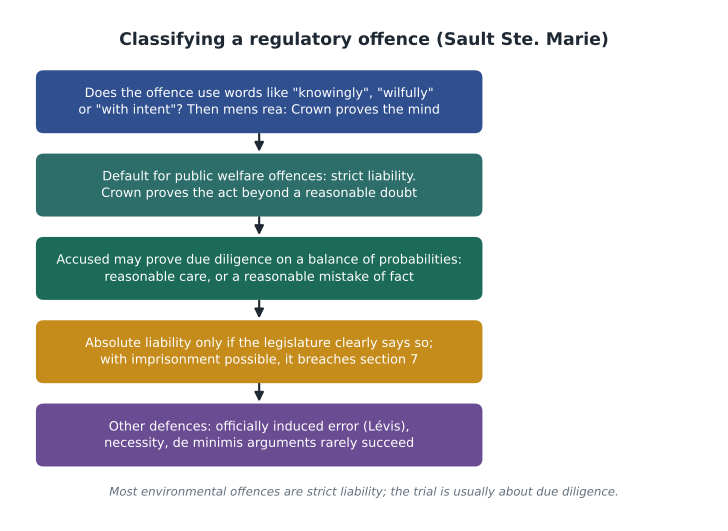
Environmental offences are regulatory, or public welfare, offences. They exist to protect the public from harm rather than to punish moral wrongdoing, and they usually concern conduct that is lawful if done carefully, such as running a factory or a landfill. The leading case is R. v. Sault Ste. Marie (City), [1978] 2 S.C.R. 1299. The city had contracted with a company to dispose of its garbage; the company's landfill polluted nearby creeks, and the city was charged under the Ontario Water Resources Act with discharging or permitting the discharge of polluting material. The question was what mental element the Crown had to prove.
Dickson J., for the Court, created three categories. Mens rea offences require proof of a positive mental state such as intent, knowledge or recklessness; they are identified by words such as 'wilfully', 'knowingly' or 'with intent'. Absolute liability offences require proof only that the accused committed the prohibited act, with no defence of reasonable care. And in between are strict liability offences: the Crown must prove the prohibited act beyond a reasonable doubt, but need not prove any mental element; the accused avoids liability by proving, on a balance of probabilities, that it took all reasonable care to avoid the event, or that it reasonably believed in a mistaken set of facts which, if true, would have made the act innocent. Public welfare offences are presumed to be strict liability unless the legislature clearly indicates otherwise.
Two later cases confirmed the framework under the Charter. In Reference re Section 94(2) of the Motor Vehicle Act (B.C.), [1985] 2 S.C.R. 486, the Supreme Court held that combining absolute liability with the possibility of imprisonment violates section 7. In R. v. Wholesale Travel Group Inc., [1991] 3 S.C.R. 154, it held that placing the burden of proving due diligence on the accused in a regulatory offence does not violate the presumption of innocence in a way that cannot be justified, because regulated actors choose to enter a regulated field and are best placed to prove their own diligence.
Most environmental offences, including the EPA's discharge prohibition and section 36(3) of the Fisheries Act, are strict liability. That means most environmental trials are not about whether the discharge occurred, which is usually clear, but about whether the accused was duly diligent.
Due diligence
Due diligence is assessed objectively, in light of the risk. The question is what a reasonable person in the accused's position would have done to prevent the event, considering how foreseeable the harm was, how serious it could be, the available technology and industry practice, the accused's skill and knowledge, and whether there were warnings or prior incidents. The defence is directed at the specific event charged; a company with a good general environmental program may still fail if it neglected the particular risk that materialized.
In practice, courts look for an effective environmental management system: identified risks, written procedures, trained staff, regular inspection and maintenance, monitoring, supervision, records showing that procedures were followed, and a culture in which problems are reported and fixed. For Norvell, the evidence will focus on the failed tank. When was it last inspected? Did the inspection meet industry standards? Was there secondary containment, such as a berm, around the tank farm? Was the storm drain protected by a valve or shut-off that could have stopped the flow? Were staff trained in spill response? Theo Marchetti predicts that the answer to the storm drain question will decide the case. Wyndham agrees: 'If the risk was foreseeable and the fix was cheap, due diligence is very hard to prove.'
Officially induced error is a narrow additional defence. In Lévis (City) v. Tétreault, 2006 SCC 12, the Supreme Court set out its elements: an error of law or of mixed law and fact; the accused considered the legal consequences of its actions; it obtained advice from an appropriate official; the advice was reasonable in the circumstances; the advice was erroneous; and the accused relied on it in acting. If a ministry inspector had told Norvell in writing that its storm drain arrangement was acceptable, the defence might be raised, though reliance on informal comments rarely suffices.
Corporate, director and officer liability
Corporations are the usual defendants. For strict liability offences, a corporation is liable for the prohibited acts of its employees and agents acting in the course of their work; the corporation's due diligence, assessed through the systems it put in place and how senior management supervised them, determines the outcome.
Individuals can also be liable. Many environmental statutes impose specific duties on directors and officers. Under section 194 of Ontario's EPA, every director and officer of a corporation that engages in an activity that may result in a discharge has a duty to take all reasonable care to prevent the corporation from discharging contaminants in contravention of the Act, from failing to notify the Ministry of discharges and from contravening orders, among other things. Breach of that duty is an offence. The Fisheries Act and CEPA provide that directors and officers who directed, authorized, assented to, acquiesced in or participated in an offence are parties to it and liable to conviction, whether or not the corporation is prosecuted, and CEPA imposes a duty on directors and officers to take all reasonable care to ensure the corporation complies.
In R. v. Bata Industries Ltd. (1992), an Ontario provincial court considered charges against three directors of a shoe manufacturer after drums of chemical waste leaked at a storage site. The court described what diligent directors do: ensure there is a pollution prevention system, ask for and receive regular reports on compliance, respond promptly to problems that come to their attention, stay informed about industry standards, and ensure that the people they rely on have the authority and resources to act. It convicted two directors who knew of the problem and did not act effectively, and acquitted a third who had reasonably relied on a responsible manager on site. Bata remains the standard reference for advising boards.
Sentencing
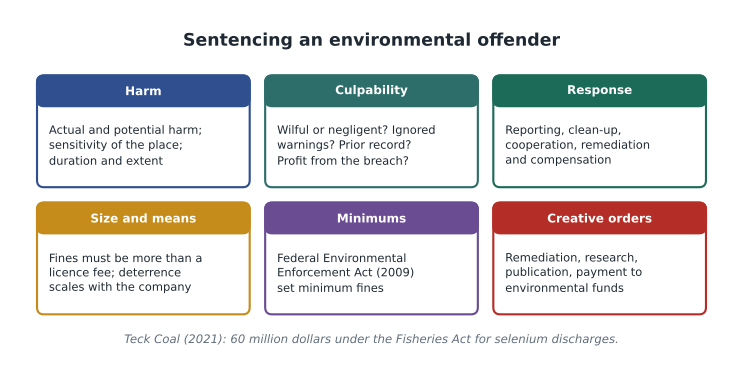
Sentencing for environmental offences emphasizes deterrence. Fines must be high enough that they are not treated as a cost of doing business. Courts consider the actual and potential harm, the nature of the environment affected, whether the offence was deliberate, reckless or negligent, any prior record, whether the offender profited, the offender's size and ability to pay, its cooperation and remedial efforts, and whether it reported promptly. These factors trace back to R. v. United Keno Hill Mines Ltd. (1980), a Yukon decision that remains widely cited.
Federal statutes now direct courts more specifically. The Environmental Enforcement Act, enacted in 2009, amended the Fisheries Act, CEPA, the Migratory Birds Convention Act, 1994 and other statutes to add sentencing principles, aggravating factors, higher maximum fines and minimum fines for serious offences that vary with the size of the offender, and to direct fines to the Environmental Damages Fund. Under the Fisheries Act, for example, a large corporation convicted on indictment of a first offence faces a minimum fine of 500,000 dollars and a maximum of several million dollars per offence, and fines can be multiplied for continuing offences. Courts may also make creative orders: requiring remediation, research, community service, publication of the facts of the conviction, contributions to environmental organizations, or environmental audits.
The largest Canadian environmental penalty to date illustrates the scale. In March 2021, Teck Coal Limited was ordered to pay 60 million dollars after pleading guilty to Fisheries Act offences arising from selenium and calcite discharges from its coal mines in British Columbia's Elk Valley. In an earlier, widely publicized case, Syncrude Canada was convicted in 2010 under Alberta's environmental statute and the Migratory Birds Convention Act after about 1,600 ducks died on a tailings pond, and was sentenced to a penalty of about 3 million dollars, most of it directed to environmental research and education.
Ontario's EPA sets high maximum fines, which for corporations convicted of the most serious offences can reach several million dollars for each day the offence continues, and allows the court to order the offender to remediate and to pay compensation. Ontario also has administrative environmental penalties, imposed by the Ministry without prosecution for specified contraventions by regulated facilities.
Administrative enforcement and Imperial Oil
Prosecution is only one enforcement tool. Regulators also use inspections, warnings, compliance agreements, orders, administrative monetary penalties and amendments to approvals. Both the federal government and Ontario publish compliance and enforcement policies describing when they will choose each response. Factors include the harm, the violator's history and intent, and whether a response will achieve compliance. Private prosecutions are possible but rare; the Attorney General may intervene and stay them.
Orders, as lesson 5 explained, are remedial and do not depend on fault. Imperial Oil Ltd. v. Quebec (Minister of the Environment), 2003 SCC 58, shows how far they can reach and how courts view them. Imperial Oil had operated a petroleum depot in Lévis, Quebec for decades before decommissioning it and selling the land; homes were later built on the site. When contamination was discovered, the residents sued the Quebec government and others, and the Minister of the Environment ordered Imperial Oil, under Quebec's Environment Quality Act, to carry out a characterization study of the soil at its own expense. Imperial argued that the Minister was biased because the government faced civil liability to the residents and stood to benefit if Imperial paid. LeBel J., for the Court, rejected the argument. The Minister was exercising a primarily political and discretionary function, not an adjudicative one, so the strict standard of impartiality that applies to courts did not apply. The statute expressly allowed orders against the person responsible, reflecting the polluter pays principle, which the Court described as firmly entrenched in Canadian environmental law.
Sophie Tremblay-Hart points out that the Lévis depot and the Norvell site are similar: in both, the polluter left decades ago and the people living with the contamination did nothing wrong. Wyndham asks the class whether the polluter pays principle should reach Lucan Industries even though it sold the Norvell site lawfully in 2012. Most students say yes, at least where Lucan caused the contamination and still has assets. Arjun Mehta asks what happens if it does not. 'Then,' says Wyndham, 'the order goes to Norvell, the current owner, and the public pays for anything Norvell cannot.'
Worked problem
Defending Norvell
In the hypothetical prosecution, the evidence shows that the tank was inspected annually by a qualified contractor, most recently eight months before the failure, with no defects noted. The tank farm had a concrete berm, but the berm drain valve was left open after a rainstorm the previous week and the thinner flowed through it to the storm drain. Norvell's written procedures required the valve to be closed except when draining rainwater under supervision. The operator responsible had been trained, but the shift supervisor did not check the valve at the start of the shift. Norvell reported four hours after discovery. Assess the defences.
Show solution
- Classify the offences. The EPA discharge and Fisheries Act charges are strict liability; the Crown must prove the discharge and deposit beyond a reasonable doubt, which it can.
- Assess due diligence on the tank. Annual qualified inspection with no defects noted supports reasonable care regarding the tank failure itself.
- Assess due diligence on the valve. The relevant risk is the release from the berm. Norvell had a written procedure and training, but no system to verify the valve's position at shift start; a court may find that a reasonable operator would have had a check or an interlock, given the foreseeable consequences.
- Assess the reporting charge. The question is whether four hours was 'forthwith'; time spent on containment may be considered, but delayed notification to try to avoid a report is not diligence.
- Advise on outcome and sentence. Conviction on the discharge counts is likely; mitigating factors include the procedures, training, cooperation and clean-up; Norvell should consider a plea with agreed remediation and creative sentencing terms.
Common mistakes
MistakeRequiring the Crown to prove intent or negligence in a strict liability offence.
InsteadThe Crown proves the act; the accused must prove due diligence on a balance of probabilities (Sault Ste. Marie).
MistakeTreating a good general environmental program as automatic due diligence.
InsteadThe defence focuses on the specific event and whether reasonable care was taken to prevent it.
MistakeAssuming directors are liable only if the corporation is convicted.
InsteadMany statutes impose personal duties and party liability on directors and officers whether or not the corporation is prosecuted.
MistakeTreating orders as penalties requiring proof of fault.
InsteadOrders are remedial and can be issued on a polluter pays basis, as in Imperial Oil.
Practice problems
Work each problem on paper first, then reveal the answer to check.
What are the three categories of offences in Sault Ste. Marie?
Show answer
Mens rea offences, strict liability offences (with a due diligence defence proved by the accused) and absolute liability offences.
What must an accused prove to establish officially induced error under Lévis v. Tétreault?
Show answer
An error of law or mixed law and fact, consideration of legal consequences, advice from an appropriate official, reasonable advice, erroneous advice and reliance on it.
Why did the Supreme Court reject the bias argument in Imperial Oil?
Show answer
Because the Minister was exercising a primarily political and discretionary function, not an adjudicative one, under a statute authorizing orders against the polluter.
Summary and key terms
- Environmental offences are usually strict liability: the Crown proves the act, and the accused may prove due diligence (Sault Ste. Marie, Wholesale Travel).
- Due diligence is assessed objectively against the specific risk, focusing on systems, training, supervision and response.
- Directors and officers have statutory duties and party liability; Bata describes the diligent director.
- Sentencing emphasizes deterrence; federal statutes set minimum fines and allow creative orders, and penalties such as Teck Coal's 60 million dollars show the scale.
- Administrative orders, penalties and compliance tools sit beside prosecution, and Imperial Oil confirms the polluter pays basis for orders.
- Strict liability offence
- An offence requiring proof of the prohibited act, with a defence of due diligence proved by the accused.
- Due diligence
- The defence that the accused took all reasonable care to avoid the prohibited event, or reasonably believed in mistaken facts.
- Officially induced error
- A defence where the accused reasonably relied on erroneous legal advice from an appropriate official.
- Environmental Damages Fund
- A federal fund that receives fines and payments from environmental offences for restoration and related projects.
- Creative sentencing
- Court orders beyond fines, such as remediation, research funding, publication or community service.
- Administrative monetary penalty
- A penalty imposed by a regulator without prosecution for specified contraventions.
Lesson quiz · 5 questions
Score 60% or more to complete this lesson.
Create a free account to save your progress, take quizzes and earn a certificate.