
LAWC-313 · Lesson 4 of 12 · 19 min
Provincial assessment, approvals and public participation
▶ Video coming soon A video version of this lesson is on the way.
Theo Marchetti arrives at the fourth class with a printout of an Environmental Registry notice he found the night before: a hypothetical proposal by Norvell Coatings to amend its air approval so it can increase production by thirty percent and add a second solvent recovery unit. 'Dervla Yarrow is going to see this,' he says. 'What can she actually do about it?' Wyndham smiles. 'That question,' she says, 'is the whole of today's class.'
Most environmental decisions that affect people's daily lives are provincial: the approvals that let factories emit, landfills operate, municipalities discharge sewage and companies take water. This lesson explains how Ontario assesses projects and issues approvals, and how members of the public can participate in and challenge those decisions. Other provinces use different statutes but similar ideas, and the lesson notes some of the differences.
Provincial environmental assessment
Ontario's Environmental Assessment Act was enacted in 1975. For most of its history it applied mainly to public sector undertakings: provincial ministries, municipalities and public bodies such as Ontario Hydro and its successors. Private sector projects were caught only if a regulation designated them, as with large landfills and certain electricity projects. The Act required a proponent to describe the purpose of the undertaking, consider alternatives (including the alternative of doing nothing), predict environmental effects broadly defined to include social, economic and cultural conditions, and consult the public, before the Minister approved the undertaking.
Because individual assessment of every road, sewer and transmission line would be impractical, Ontario developed 'class environmental assessments' for routine categories of projects, such as municipal infrastructure, provincial highways and conservation authority works. A class assessment sets out a standard planning process; a project that follows it is approved without individual review, subject to a request to the Minister to require a more detailed assessment (historically called a 'bump-up' or Part II order request).
In 2020, Ontario amended the Act substantially to move toward a 'project list' approach under which a regulation identifies the major projects that require a comprehensive assessment, while other projects follow streamlined processes or none at all. The transition has been phased in over several years, and some class assessments have been revoked or replaced. In 2025, Ontario enacted the Protect Ontario by Unleashing our Economy Act, 2025, which, among other things, created a Special Economic Zones Act, 2025 allowing Cabinet to designate zones and trusted proponents that may be exempted from provincial laws and approvals. Critics argued that these changes reduce scrutiny and public participation; the government argued they remove duplication and speed up critical projects. Either way, a lawyer advising on a provincial project must check the current regulations carefully, because the answer to 'does this project need an assessment?' has changed several times in recent years.
For the Caskey Lake mine, Ontario's Environmental Assessment Act does not usually apply to a private mining project unless it is designated. Instead, the province regulates the mine through a series of approvals: a closure plan under the Mining Act, environmental compliance approvals for effluent and air emissions, permits to take water under the Ontario Water Resources Act, approvals for dams under the Lakes and Rivers Improvement Act, and authorizations under species legislation. Related public infrastructure, such as a provincially funded all-season road, may require assessment. Daniel Whitecloud observes that each approval is also a Crown decision triggering the duty to consult. Wyndham notes that consultation spread across many small decisions can be harder for a First Nation to manage than a single assessment, which is one reason some communities push for a comprehensive process even when the law does not require one.
Other provinces take different approaches. Alberta's Environmental Protection and Enhancement Act requires an environmental impact assessment for mandatory activities listed in regulation and for other projects at the Director's discretion, followed by approvals from regulators such as the Alberta Energy Regulator. Quebec's Environment Quality Act requires an assessment for projects listed in regulation, and the Bureau d'audiences publiques sur l'environnement (BAPE) holds public hearings and reports to the Minister. Sophie Tremblay-Hart points out that BAPE hearings are a familiar part of public life in Quebec in a way that Ontario's processes are not.
Environmental compliance approvals
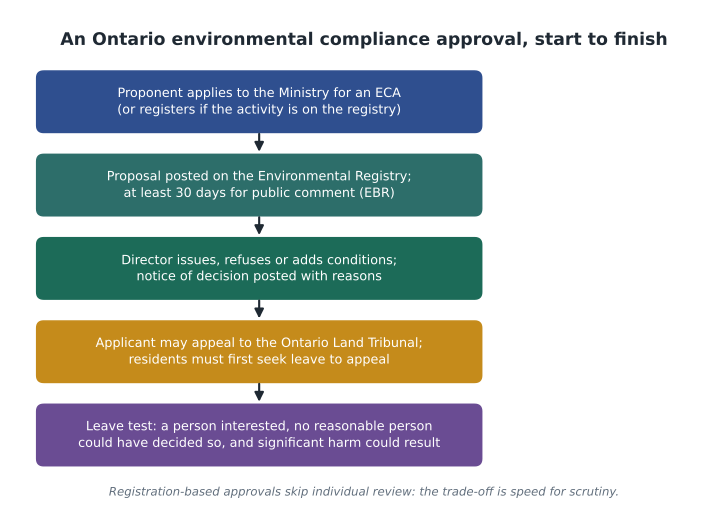
The most common provincial environmental instrument is the approval to emit. Under section 20.2 of Ontario's Environmental Protection Act, no person may use, operate, establish, alter, extend or replace a facility, equipment or process that may discharge a contaminant into the natural environment, or that relates to waste management or sewage works, without an environmental compliance approval (ECA), unless an exemption applies. The Director, a ministry official named in the Act, issues ECAs and may attach conditions. ECAs replaced the older certificates of approval in 2011.
For lower-risk, standardized activities, such as many small heating systems, automotive refinishing shops and some waste transportation, Ontario uses the Environmental Activity and Sector Registry. The operator registers online, certifies that it will comply with the rules in the applicable regulation, and may begin. No individual review takes place. Registration is faster and cheaper; the trade-off is that the public has no opportunity to comment on an individual facility and enforcement depends on inspections and complaints.
An ECA typically sets limits on emissions or discharges, requires monitoring, reporting and record keeping, sets operating and maintenance requirements, requires complaint procedures and spill contingency plans, and sometimes requires financial assurance to cover clean-up costs. The Director may amend or revoke an ECA, and may impose new conditions, on notice. Breach of an ECA condition is an offence.
Norvell's proposed amendment would increase its solvent emissions. The Director will review an emission summary and dispersion modelling report showing that concentrations of each contaminant at the most impacted point of reception off the property comply with the standards in the Ontario air regulation. Arjun Mehta, the former engineer, is pleased to discover that the regulation sets numerical standards for hundreds of contaminants and requires modelling to show compliance. Wyndham warns him that the numbers are only half the story: a facility can comply with the air regulation and still cause an adverse effect, such as odour complaints, which the general prohibition in section 14 of the EPA forbids.
The Environmental Bill of Rights
Ontario's Environmental Bill of Rights, 1993 (EBR) is the main source of public participation rights in provincial environmental decision making. It was enacted after years of advocacy and was considered unusual at the time. Its preamble declares that the people of Ontario have a right to a healthful environment, though the statute does not create a free-standing enforceable right. Instead it gives procedural rights.
The first is notice and comment. Prescribed ministries must post proposals for significant environmental policies, acts, regulations and instruments, including many ECAs and permits to take water, on the Environmental Registry, with at least thirty days for public comment. The decision maker must take every reasonable step to consider comments and must post a notice of the decision explaining the effect of public participation. Prescribed ministries must also have Statements of Environmental Values setting out how they will consider the environment in their decisions.
The second is the right to seek leave to appeal. When the Director issues an ECA, the applicant can appeal to the Ontario Land Tribunal as of right. Members of the public cannot. But under the EBR, any person resident in Ontario with an interest in a decision on a classified instrument may seek leave to appeal it, within fifteen days after notice of the decision is posted. Under section 41, leave is granted only if it appears that there is good reason to believe that no reasonable person, having regard to the relevant law and to any government policies developed to guide decisions of that kind, could have made the decision, and that the decision could result in significant harm to the environment.
The leave test is demanding but not impossible. In Lafarge Canada Inc. v. Ontario (Environmental Review Tribunal), 2008, the Divisional Court upheld the tribunal's decision to grant residents leave to appeal approvals allowing a cement plant near Kingston to burn alternative fuels, including tires, on a trial basis. The court accepted that the tribunal could consider whether the Director had applied the Ministry's own Statement of Environmental Values. The case illustrates a useful strategy: a party seeking leave should show that the Director failed to follow the law or the government's own policies, not merely that the party disagrees with the outcome.
The EBR also lets two residents apply for a review of an existing policy, act, regulation or instrument, or for an investigation of an alleged contravention of a prescribed act. And in section 84 it creates a limited right to sue for harm to a public resource, available only after an application for investigation has been made and not adequately answered. Few actions have been brought under section 84. The office of the Environmental Commissioner of Ontario, created by the EBR to oversee its operation, was abolished in 2019 and its functions moved to a Commissioner of the Environment within the office of the Auditor General.
Consultation in provincial approvals
Provincial approvals are Crown decisions, so the duty to consult applies whenever the Crown has knowledge of a credible Aboriginal or treaty right and contemplates conduct that might adversely affect it, under the test from Rio Tinto Alcan Inc. v. Carrier Sekani Tribal Council, 2010 SCC 43. In Clyde River (Hamlet) v. Petroleum Geo-Services Inc., 2017 SCC 40, and Chippewas of the Thames First Nation v. Enbridge Pipelines Inc., 2017 SCC 41, the Supreme Court held that the Crown may rely on a regulator's process to fulfil the duty, but the decision maker must assess whether consultation was adequate and give reasons, and approvals issued without adequate consultation may be quashed. For ECAs, permits to take water and mine closure plans in northern Ontario, the Ministry usually delegates procedural aspects of consultation to the proponent while retaining responsibility for its adequacy. LAWC-304 examines these cases in depth; for this course, the point is that a technically sound approval can still fall if consultation was inadequate.
Appeals and judicial review
A person to whom an order or approval decision is directed may appeal to the Ontario Land Tribunal under the EPA and related statutes. The tribunal hears the matter afresh and may confirm, alter or revoke the Director's decision and substitute its own. Further appeals lie to the Divisional Court on questions of law, and to the Minister on other questions in some statutes. Judicial review of decisions not subject to a statutory appeal goes to the Divisional Court, applying the standards from Vavilov that LAWC-202 explained.
Theo Marchetti returns to his question. 'So if the Director approves Norvell's amendment, Dervla's only real option is the leave application, and she has fifteen days.' Wyndham nods. 'And she should have commented during the thirty-day comment period, because the tribunal will want to know what the Director was told and ignored. Participation early makes the later remedy possible.'
Worked problem
Dervla Yarrow seeks leave to appeal
In the hypothetical, the Director approves Norvell's amended ECA. The approval allows a production increase, requires air dispersion modelling to be updated within a year and does not address the Severn River spill or the odour complaints residents have filed over three years. Yarrow and her neighbour commented during the posting period. The decision notice says comments were 'considered'. Advise Yarrow on a leave to appeal application.
Show solution
- Confirm standing and timing. Yarrow is an Ontario resident with an interest; the application must be filed within fifteen days after the decision notice is posted on the Environmental Registry.
- Frame the first branch: no reasonable person could have made the decision having regard to the law and government policy. Point to the EPA's prohibition on adverse effects, the Ministry's Statement of Environmental Values and policies on odour and cumulative effects, and the Director's apparent failure to address documented odour complaints and spill history.
- Frame the second branch: the decision could result in significant harm to the environment. Use evidence of odour complaints, the increased emissions and the proximity of homes and the river.
- Anticipate Norvell's response that it complies with the air regulation's numerical standards. Answer that compliance with standards does not exhaust the Director's duty to prevent adverse effects.
- Advise on outcomes. If leave is granted, the appeal proceeds before the Ontario Land Tribunal, which can add conditions such as an odour management plan; Norvell may also negotiate conditions to avoid a hearing.
Common mistakes
MistakeAssuming every major private project in Ontario requires a provincial environmental assessment.
InsteadPrivate projects usually need assessment only if designated; otherwise they are regulated through approvals such as ECAs and permits.
MistakeTreating the EBR as creating an enforceable right to a healthful environment.
InsteadIts preamble recognizes the right, but the statute grants procedural rights such as notice, comment, leave to appeal, review and investigation.
MistakeArguing only that a decision was wrong in a leave application.
InsteadThe test requires good reason to believe no reasonable person could have made it, having regard to law and policy, and that significant harm could result.
MistakeEquating compliance with numerical air standards with compliance with the EPA.
InsteadA facility meeting the standards can still breach the general prohibition on discharges causing adverse effects.
Practice problems
Work each problem on paper first, then reveal the answer to check.
When does Ontario's Environmental Assessment Act traditionally apply to private sector projects?
Show answer
Only when a regulation designates the project or category of project, as with large landfills and certain electricity projects.
What is the two-part test for leave to appeal under section 41 of the EBR?
Show answer
Good reason to believe no reasonable person, having regard to relevant law and government policy, could have made the decision, and that the decision could result in significant harm to the environment.
What is the Environmental Activity and Sector Registry?
Show answer
An online registration system for prescribed lower-risk activities, allowing operators to proceed without an individual ECA if they comply with regulatory rules.
Summary and key terms
- Ontario's Environmental Assessment Act applies mainly to public sector undertakings and designated private projects, and was substantially reformed in 2020 and affected by 2025 legislation.
- Most emitting activities need an environmental compliance approval under section 20.2 of the EPA, or registration for prescribed lower-risk activities.
- ECAs set enforceable conditions; compliance with numerical standards does not excuse adverse effects.
- The Environmental Bill of Rights provides notice and comment, leave to appeal, review, investigation and a limited right of action.
- Applicants appeal to the Ontario Land Tribunal as of right; residents need leave, which turns on unreasonableness and significant harm.
- Class environmental assessment
- A standard planning process approved for a category of routine projects, which then proceed without individual approval.
- Environmental compliance approval
- An approval under the EPA authorizing an activity that may discharge contaminants, subject to conditions.
- Environmental Registry
- Ontario's online registry where proposals and decisions under the EBR are posted.
- Leave to appeal
- Permission a resident must obtain before appealing an instrument decision to the tribunal.
- Statement of Environmental Values
- A ministry's statement of how it will consider the environment in its decisions under the EBR.
- Point of reception
- In air regulation, a location off a facility's property where contaminant concentrations are measured against standards.
Lesson quiz · 5 questions
Score 60% or more to complete this lesson.
Create a free account to save your progress, take quizzes and earn a certificate.