
LAWC-313 · Lesson 8 of 12 · 19 min
Climate law
▶ Video coming soon A video version of this lesson is on the way.
Wyndham begins the eighth class by writing two numbers on the board: 2030 and 2050. 'Canada has promised to cut its greenhouse gas emissions by 40 to 45 percent below 2005 levels by 2030 and to reach net zero by 2050,' she says. 'Today's question is not whether those targets are wise. It is what the law actually requires anyone to do to meet them.' Hannah Kowalczyk, who spent two years administering industrial emissions reporting in Alberta, warns the class that the answer has changed several times since she started law school.
Climate law is the newest major branch of environmental law and the fastest-moving. It combines international commitments, a federal framework statute, carbon pricing, sector-specific regulations, provincial programs, federal-provincial agreements and, increasingly, financial and consumer protection rules. This lesson maps that architecture as it stands in late 2026. Lesson 9 turns to climate litigation.
International commitments
Canada is a party to the United Nations Framework Convention on Climate Change (1992) and the Paris Agreement (2015). Paris does not set binding emission limits for each country. Instead, each party must prepare and communicate successive 'nationally determined contributions' (NDCs), pursue domestic measures to achieve them, and report transparently; the collective goal is to hold warming well below 2 degrees Celsius above pre-industrial levels and pursue efforts to limit it to 1.5 degrees. Canada's NDC for 2030 is a reduction of 40 to 45 percent below 2005 levels. In February 2025, the federal government announced a 2035 target of 45 to 50 percent below 2005 levels.
Because international treaties are not self-executing in Canada, these commitments bind Canada internationally but create domestic obligations only through legislation and regulation. Canada withdrew from the Kyoto Protocol in 2011 after it became clear it would not meet its target, an episode often cited as evidence that targets without domestic legal machinery accomplish little.
The Canadian Net-Zero Emissions Accountability Act
The Canadian Net-Zero Emissions Accountability Act, enacted in 2021, is Canada's framework climate statute. It enshrines the goal of net-zero emissions by 2050 and requires the Minister of Environment and Climate Change to set national emissions targets for 2030, 2035, 2040 and 2045, each at least ten years in advance. For each target, the Minister must publish an emissions reduction plan describing the measures and strategies to achieve it, followed by progress reports and assessment reports. An independent Net-Zero Advisory Body provides advice, and the Commissioner of the Environment and Sustainable Development, within the Office of the Auditor General, must periodically examine and report on the government's implementation.
What the Act does not do is equally important. It does not make the targets legally enforceable against the government or anyone else, and it imposes no penalty if a target is missed. Its tools are transparency and accountability: plans must be published, progress measured and failures explained to Parliament. Arjun Mehta calls it 'a reporting statute with a mission statement'. Wyndham thinks that undersells it. Accountability frameworks change political behaviour, she argues, and the published plans have become evidence in litigation such as La Rose, discussed in lesson 9.
Carbon pricing
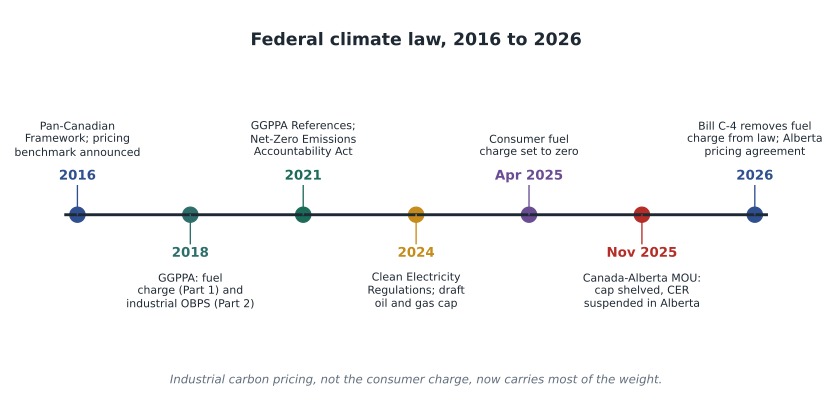
Carbon pricing has been the centrepiece of federal climate policy since 2016, when the federal government announced that every province and territory would need a carbon price meeting a federal benchmark, either through its own system or through a federal 'backstop'. The Greenhouse Gas Pollution Pricing Act (GGPPA), enacted in 2018, created the backstop in two parts.
Part 1 imposed a regulatory charge on fossil fuels, the 'fuel charge', in provinces listed because their own pricing fell short. Most of the proceeds were returned to households in those provinces through quarterly rebates. Part 2 created an output-based pricing system (OBPS) for large industrial emitters. Instead of paying a charge on every tonne, facilities face an emissions-intensity standard for their sector; those that emit above the standard must pay or remit credits, while those below it earn surplus credits they can sell. The design preserves the incentive to cut emissions at the margin while reducing the risk that trade-exposed industries move to jurisdictions without carbon pricing.
Lesson 2 explained how the Supreme Court upheld the GGPPA in 2021 as establishing minimum national standards of greenhouse gas price stringency. The constitutional question is settled; the political one is not. The consumer fuel charge became the most contested element of federal climate policy. In March 2025, the federal government made regulations setting the fuel charge rate to zero from April 1, 2025, and removed the requirement that provinces maintain a consumer-facing carbon price. British Columbia ended its own consumer carbon tax on the same date. In March 2026, Bill C-4, the Making Life More Affordable for Canadians Act, received royal assent; it removed the federal consumer fuel charge from the law permanently.
The legal character of carbon pricing also mattered constitutionally. In the GGPPA References, the provinces argued that the fuel charge and output-based charges were taxes, which under section 53 of the Constitution Act, 1867 can be imposed only by Parliament itself and not delegated to Cabinet. The Supreme Court held that they were valid regulatory charges, not taxes, because their primary purpose was to change behaviour by putting a price on emissions rather than to raise revenue, and the revenue was connected to that regulatory purpose. That characterization is why Cabinet could list the provinces subject to the backstop and adjust the schedule of prices by regulation, and why the government could later set the fuel charge to zero by regulation before Parliament repealed it.
Industrial carbon pricing continues and is now the main pricing instrument. The federal benchmark price for industrial systems was 110 dollars per tonne in 2026, on a schedule rising toward 170 dollars by 2030. Provinces may run their own industrial systems if they meet the benchmark. Alberta's Technology Innovation and Emissions Reduction (TIER) system, Ontario's Emissions Performance Standards program, Saskatchewan's output-based system and Quebec's cap-and-trade system, linked with California's since 2014, are examples. Because industrial credits can trade below the headline price, the effective price can be much lower than the benchmark. Kowalczyk notes that Alberta credits were trading at roughly 40 dollars a tonne while the federal headline price was 110.
The Canada-Alberta agreements
In November 2025, Canada and Alberta signed a memorandum of understanding that reshaped climate regulation in the country's largest emitting province. Among other commitments, Canada agreed not to implement its proposed oil and gas emissions cap, to suspend the federal Clean Electricity Regulations in Alberta, to negotiate a methane equivalency agreement targeting a 75 percent reduction in oil and gas methane emissions below 2014 levels by 2035, and to support an application for a new bitumen pipeline to Asian markets linked to the Pathways carbon capture and storage project. Alberta agreed to strengthen its industrial carbon price.
An implementation agreement followed in May 2026. It sets Alberta's headline industrial carbon price to rise to 140 dollars per tonne by 2040 and the effective credit price to reach 130 dollars by 2040, adds a price floor, and provides for jointly issued carbon contracts for difference covering 75 million tonnes of reductions to give investors price certainty. On the Clean Electricity Regulations, the governments agreed to defer to the courts in Alberta's constitutional challenge: if the regulations are upheld, they will negotiate an electricity equivalency agreement, and if they are struck down, the regulations will be stood down. Critics argued that the agreements weaken national climate policy; supporters argued that they trade unenforceable caps for durable, investment-grade pricing and carbon capture. For lawyers, the agreements matter because they change which instruments actually bind Alberta facilities and because similar arrangements may follow with other provinces.
Sector regulations
Alongside pricing, the federal government uses CEPA regulations to target particular sectors. The Clean Fuel Regulations, made in 2022, require suppliers of gasoline and diesel to reduce the carbon intensity of their fuels over time, with credit trading. The Clean Electricity Regulations, finalized in December 2024, set emissions limits for fossil fuel electricity generating units to move the grid toward net zero by 2035, with flexibility mechanisms; as noted, they are suspended in Alberta and under constitutional challenge there. Methane regulations for the oil and gas sector, coal-fired electricity phase-out regulations, vehicle emissions standards and an electric vehicle availability standard complete the picture, though several have been revisited or paused since 2025. Students should always check whether a sector regulation is in force, proposed, suspended or subject to an equivalency agreement in the relevant province.
Equivalency agreements deserve particular attention. CEPA allows the federal Minister to agree with a province that a provincial regime is equivalent to a federal regulation, in which case the federal regulation does not apply in that province. Equivalency avoids duplicate regulation but means the operative rules for a facility are often provincial even where the policy began federally.
Markets, disclosure and greenwashing
Climate law increasingly operates through markets and corporate law. The Office of the Superintendent of Financial Institutions requires federally regulated banks and insurers to manage climate-related risks and make climate disclosures under its Guideline B-15, phased in from 2024. Canadian securities regulators consulted on mandatory climate disclosure for public companies but paused that work in 2025. Directors' fiduciary duties, as LAWC-204 explained, require them to act in the best interests of the corporation, and many corporate law scholars argue that this includes managing material climate risks.
The Competition Act regulates claims businesses make about their environmental performance. In June 2024, Parliament amended it to require that claims about a product's environmental benefits be based on adequate and proper testing, and that claims about the environmental benefits of a business or business activity be based on adequate and proper substantiation in accordance with internationally recognized methodology, and to give private parties access to the Competition Tribunal to challenge misleading environmental claims. After business groups warned that the rules were chilling legitimate climate communications, Parliament narrowed them through Bill C-15, which received royal assent on March 26, 2026. Business-level claims still require adequate and proper substantiation, but no longer according to internationally recognized methodology, and private parties can no longer seek leave to challenge them before the Tribunal. The requirement of adequate and proper testing for product claims, and private access for those claims, remain. Norvell's marketing department, which in the hypothetical had been planning a 'carbon neutral by 2030' campaign, would need to be able to substantiate it.
Adaptation
Climate law is not only about reducing emissions. Floods, wildfires, heat and drought are already reshaping land use planning, infrastructure standards, insurance and disaster law. Canada published a National Adaptation Strategy in 2023. Provinces and municipalities are updating floodplain mapping, building codes and stormwater standards, and lawyers advise clients on climate risk in real estate transactions, project finance and municipal liability. Dervla Yarrow's garden, which floods every spring, is a reminder that the Severn River's floods may change in frequency and size.
Worked problem
An Ontario industrial emitter under carbon pricing
In the hypothetical, Norvell's board is considering a new solvent recovery unit that would reduce its emissions, and asks whether carbon pricing gives it a financial reason to invest now. Norvell's plant is below the threshold for mandatory participation in Ontario's industrial program but could opt in. Advise the board on the current legal landscape.
Show solution
- Clarify what no longer applies. The federal consumer fuel charge was set to zero from April 1, 2025 and removed from law by Bill C-4 in March 2026, so Norvell's fuel purchases no longer carry a federal carbon charge.
- Explain industrial pricing. Ontario's Emissions Performance Standards program applies to large emitters against sector intensity standards; facilities below the threshold may be able to opt in, which can let a facility that beats its standard earn credits.
- Assess the economics. The value of credits depends on the effective price, which may be lower than the federal benchmark; the board should model scenarios rather than assume the headline price.
- Consider other drivers. VOC regulations under CEPA, customer expectations and any 'carbon neutral' marketing claims, which must be substantiated under the Competition Act, may justify the investment independently.
- Advise on uncertainty. Climate policy has shifted repeatedly since 2025; decisions should be robust to changes in pricing and regulation.
Common mistakes
MistakeStating that Canada no longer has carbon pricing.
InsteadThe consumer fuel charge ended in 2025, but industrial carbon pricing under the GGPPA benchmark and provincial systems continues.
MistakeTreating the Net-Zero Emissions Accountability Act targets as legally enforceable.
InsteadThe Act requires targets, plans and reporting but creates no enforceable obligation or penalty for missing a target.
MistakeAssuming every federal sector regulation applies in every province.
InsteadCheck for suspension, equivalency agreements and federal-provincial arrangements, such as the Canada-Alberta agreements.
MistakeAssuming greenwashing rules disappeared in 2026.
InsteadBill C-15 narrowed them, but product claims still require adequate and proper testing and business claims adequate and proper substantiation.
Practice problems
Work each problem on paper first, then reveal the answer to check.
What does the Canadian Net-Zero Emissions Accountability Act require of the Minister?
Show answer
To set targets for 2030, 2035, 2040 and 2045, publish emissions reduction plans, and prepare progress and assessment reports, with oversight by an advisory body and the Commissioner of the Environment and Sustainable Development.
How does an output-based pricing system differ from a fuel charge?
Show answer
It prices emissions above a sector intensity standard, so facilities pay or remit credits only for emissions over the standard and earn credits below it, preserving the marginal incentive while limiting competitiveness effects.
What did Bill C-15 change in the Competition Act environmental claims provisions?
Show answer
It removed the requirement that business-level claims be substantiated according to internationally recognized methodology and removed private access to the Tribunal for those claims.
Summary and key terms
- Canada's Paris commitments are 40 to 45 percent below 2005 by 2030 and 45 to 50 percent by 2035, with net zero by 2050 in the Net-Zero Emissions Accountability Act.
- The Net-Zero Act relies on targets, plans, reporting and oversight rather than enforceable obligations.
- The consumer fuel charge was set to zero in April 2025 and removed from law by Bill C-4 in 2026; industrial pricing continues under the federal benchmark and provincial systems.
- The 2025 Canada-Alberta memorandum and 2026 implementation agreement shelved the oil and gas cap, suspended the Clean Electricity Regulations in Alberta and set a rising industrial price.
- Sector regulations, equivalency agreements, financial disclosure and the Competition Act's environmental claims rules complete the climate law picture.
- Nationally determined contribution
- A country's emissions target and plan communicated under the Paris Agreement.
- Output-based pricing system
- An industrial carbon pricing system that prices emissions above a sector intensity standard.
- Fuel charge
- The federal regulatory charge on fossil fuels under Part 1 of the GGPPA, set to zero in 2025 and removed by Bill C-4.
- Benchmark
- The federal minimum standard for carbon pricing stringency that provincial systems must meet.
- Equivalency agreement
- A CEPA agreement under which a federal regulation does not apply in a province with an equivalent regime.
- Carbon contract for difference
- A contract guaranteeing a future carbon price to a project, paying the difference if market prices fall short.
Lesson quiz · 5 questions
Score 60% or more to complete this lesson.
Create a free account to save your progress, take quizzes and earn a certificate.