
LAWC-313 · Lesson 11 of 12 · 20 min
Civil liability and environmental justice
▶ Video coming soon A video version of this lesson is on the way.
Dervla Yarrow, the hypothetical retired teacher downstream from Norvell, is the focus of the eleventh class. Wyndham reads from a letter Yarrow sent to the clinic: 'My well smells of paint. I can't eat my vegetables. My grandchildren don't visit in the summer any more. The province says it is handling the spill. Who is handling me?' The class's job is to answer her. The second half of the class widens the lens: why do people like Yarrow, and whole communities, so often end up living next to pollution, and what is the law doing about it?
Regulation and prosecution protect the public interest, but they rarely compensate individuals. Fines go to the government or environmental funds; orders require clean-up but not payment for a ruined summer or a lost sale. Private law fills that gap. This lesson covers the main civil causes of action for environmental harm, the special features of environmental litigation, and the growing body of law and policy on environmental justice.
Private nuisance
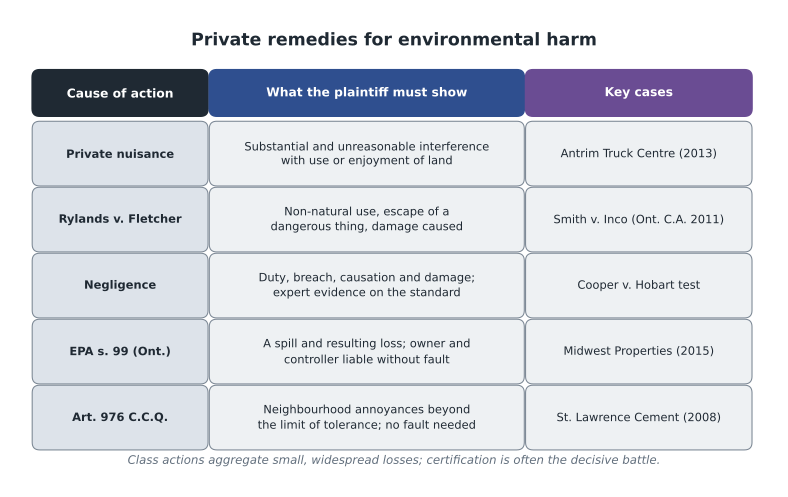
Nuisance is the oldest environmental tort. A private nuisance is an interference with an occupier's use or enjoyment of land that is both substantial and unreasonable. In Antrim Truck Centre Ltd. v. Ontario (Transportation), 2013 SCC 13, the Supreme Court restated the test. 'Substantial' means non-trivial: more than a slight annoyance or trifling interference. 'Unreasonable' requires balancing the gravity of the harm against the utility of the defendant's conduct, considering factors such as the severity and duration of the interference, the character of the neighbourhood, the sensitivity of the plaintiff's use and the frequency of the interference. The focus is on the harm to the plaintiff, not on whether the defendant was careless. Physical damage to property will usually be substantial and unreasonable; interference with amenities, such as odours or noise, requires closer balancing.
Yarrow's claim against Norvell in nuisance looks strong on the spill: contamination of her well and garden is physical interference, and the plant's general utility does not justify contaminating a neighbour's water. Her claim about years of odours is more typical of nuisance litigation and would require evidence of frequency, intensity and how a reasonable person in her neighbourhood would experience them.
Statutory authority is the main defence. A defendant whose activity is authorized by statute is not liable in nuisance if the interference was the inevitable result of doing what the statute authorized, as the Supreme Court explained in Tock v. St. John's Metropolitan Area Board, [1989] 2 S.C.R. 1181, and Ryan v. Victoria (City), [1999] 1 S.C.R. 201. The burden is on the defendant to show that the harm could not have been avoided. An environmental compliance approval does not, by itself, authorize a nuisance: Norvell's ECA permits emissions within limits, but it does not make the spill or avoidable odours inevitable.
Rylands v. Fletcher and negligence
Under the rule in Rylands v. Fletcher (1868), a person who brings onto land and keeps there something likely to do mischief if it escapes, in the course of a non-natural use of the land, is liable for damage caused by its escape, without proof of negligence. The rule is a natural fit for chemical storage. But Canadian courts have applied it narrowly. In Smith v. Inco Ltd., 2011 ONCA 628, residents of Port Colborne brought a class action alleging that nickel particles emitted for decades by a refinery had contaminated their properties and reduced their value. The trial judge awarded about 36 million dollars. The Court of Appeal reversed. It held that operating a refinery in an industrial area was not a non-natural use for Rylands purposes, and that the presence of nickel particles in the soil was not, without more, the kind of physical damage that nuisance requires: there had to be a material, actual change that made the property less useful or valuable, and the plaintiffs had not shown that the nickel posed a health risk. Smith v. Inco is a sobering precedent for plaintiffs in historical contamination cases.
Negligence is often pleaded alongside nuisance. The plaintiff must establish a duty of care under the framework from Cooper v. Hobart, 2001 SCC 79, breach of the standard of care, causation and damage. Industrial operators owe a duty to neighbours who could foreseeably be harmed by releases. The standard of care is informed by regulatory requirements and industry practice; breach of a statute is not automatically negligence, but it is evidence of it. In Yarrow's case, the evidence assembled for the due diligence defence in lesson 10, such as the open berm valve, becomes evidence of negligence.
Statutory causes of action
Ontario's EPA gives spill victims a stronger option. As lesson 5 explained, section 99 gives any person a right to compensation from the owner of a pollutant and the person having control of it for loss or damage incurred as a direct result of a spill, without proof of fault, subject to narrow defences.
Midwest Properties Ltd. v. Thordarson, 2015 ONCA 819, shows the power of a related provision. Thordarson's company stored large quantities of petroleum waste on its property, which migrated onto the neighbouring property that Midwest had bought as an investment. The trial judge found the contamination proven but awarded only nominal damages because Midwest had not shown that the property's value had dropped. The Court of Appeal allowed the appeal. Relying on the statutory cause of action in section 99, it held that Midwest was entitled to the cost of restoring its property, even though that cost exceeded the property's value, because the statute was designed to make polluters pay and to restore the environment, not merely to compensate for lost market value. The court also awarded punitive damages against Thordarson, who had ignored ministry orders. Midwest makes section 99 the first claim an Ontario plaintiff should consider after a spill.
The Court of Appeal's earlier decision in Tridan Developments Ltd. v. Shell Canada Products Ltd. (2002), concerning gasoline that leaked from a service station onto a neighbouring property, also allowed damages measured by the cost of a full clean-up, recognizing that a contaminated property may be unsaleable or stigmatized even after partial remediation.
Quebec takes a different route. Article 976 of the Civil Code of Québec provides that neighbours must accept the normal neighbourhood annoyances that are not beyond the limit of tolerance they owe each other, according to the nature or location of their land or local custom. In St. Lawrence Cement Inc. v. Barrette, 2008 SCC 64, residents near a cement plant in Beauport brought a class action for dust, noise and odours. The plant had complied with its permits and applicable standards. The Supreme Court held that article 976 creates no-fault liability: a neighbour who causes abnormal annoyances is liable even without fault. Sophie Tremblay-Hart is delighted to find a Quebec rule more protective of neighbours than the common law. Wyndham notes that the decision has influenced debate in common law provinces about whether nuisance has drifted too far toward fault.
Public resources and the Crown
Damage to public resources, such as rivers, forests and wildlife, raises the question of who can sue. In British Columbia v. Canadian Forest Products Ltd., 2004 SCC 38, a forest fire caused by Canfor's negligence burned Crown forest land. The Supreme Court held that the Crown could sue, not only as landowner for the commercial value of the timber but potentially, in its role as protector of the public interest, for environmental losses beyond commercial value. On the evidence, however, it awarded only the commercial losses, because the Crown had not proved its environmental claim. The case opened the door to environmental damages claims by governments without settling how to value them. Ontario's EBR, as lesson 4 explained, also gives residents a limited right to sue for harm to a public resource.
Features of environmental litigation
Environmental claims share some recurring features. Causation is often the hardest issue: plaintiffs must show that the defendant's emissions, rather than other sources or natural conditions, caused their harm, which requires expert evidence on fate and transport, toxicology and epidemiology. Limitation periods are relaxed for latent harm: under section 17 of Ontario's Limitations Act, 2002, there is no limitation period for an environmental claim that has not been discovered, though the ordinary two-year period runs once it is. Remedies may include damages for diminution of value, remediation costs, loss of use and enjoyment, personal injury, stigma and, rarely, punitive damages, as well as injunctions.
Class actions allow many people with small individual claims to sue together. Certification, the procedural step that allows a class action to proceed, is often the decisive battle. In Hollick v. Toronto (City), 2001 SCC 68, the Supreme Court refused to certify a class action by residents near a large landfill because individual issues about the effects of noise and odour on each resident would overwhelm the common issues, and the province's small claims compensation fund offered a preferable procedure. Later cases, including Smith v. Inco, were certified, but the path is demanding. Contracts also allocate environmental risk: purchase agreements for contaminated land, like Norvell's 2012 purchase from Lucan, typically contain representations, indemnities and releases, and the outcome of a dispute between the current and former owner may depend more on those terms than on tort law.
Environmental justice
Yarrow is a homeowner with a lawyer. Many people living with pollution are not. Environmental justice research in Canada and elsewhere has documented that polluting facilities, waste sites and contaminated land are disproportionately located near Indigenous, Black, racialized and low-income communities, and that those communities have had less influence over decisions. Canadian examples are well known. Africville, a Black community in Halifax, was surrounded by a dump, an infectious disease hospital and industrial facilities before its residents were relocated and the community demolished in the 1960s. For decades, effluent from a pulp mill was piped into Boat Harbour, next to Pictou Landing First Nation in Nova Scotia, until legislation required the treatment facility to close in 2020. Aamjiwnaang First Nation sits beside 'Chemical Valley', the concentration of petrochemical facilities near Sarnia, Ontario, where members have long raised concerns about air quality and health. And the mercury contamination affecting Grassy Narrows and Wabaseemoong, introduced in lesson 1, is often described as a defining example of environmental injustice in Canada.
Law is beginning to respond. The National Strategy Respecting Environmental Racism and Environmental Justice Act, which received royal assent in June 2024, requires the federal Minister to develop a national strategy to promote efforts across Canada to advance environmental justice and to assess, prevent and address environmental racism, including by examining the link between race, socioeconomic status and environmental risk and by collecting information on health outcomes in affected communities. A draft strategy for 2026 to 2031 was released on June 26, 2026, built around four priority areas: embedding environmental justice across federal institutions, strengthening collaboration on assessing and addressing environmental racism, enhancing community participation in federal environmental decisions, and learning from experience. CEPA now requires the government to consider vulnerable populations and cumulative effects, and the 2025 implementation framework for the right to a healthy environment names environmental justice as a guiding principle.
Daniel Whitecloud asks whether a strategy changes anything on the ground. Wyndham's answer is practical: strategies do not create causes of action, but they shape how assessments are scoped, which communities get monitoring and funding, and what regulators must consider. A lawyer acting for an affected community should use them in comments, assessments and judicial review, alongside the duty to consult where Indigenous rights are engaged, and should use public data such as the National Pollutant Release Inventory to document cumulative burdens.
Worked problem
Advising Dervla Yarrow
In the hypothetical, testing shows xylene in Yarrow's well above drinking water guidelines and solvent residues in her garden soil. A real estate appraiser says her property is worth 15 percent less than before the spill, though it may recover after clean-up. Norvell's insurer has offered to install a filter and pay 5,000 dollars. Several neighbours also have complaints about odours dating back years. Advise Yarrow.
Show solution
- Start with section 99 of the EPA. Norvell is the owner and controller of the spilled thinner; liability is without fault, and Midwest supports recovery of restoration costs, including well replacement and soil remediation, not just lost value.
- Add nuisance and negligence. The spill is a substantial and unreasonable interference; the open berm valve supports negligence; the historical odours require separate evidence and may support a broader nuisance claim.
- Address damages. Claim remediation costs, alternative water supply, loss of use and enjoyment, any stigma after clean-up and expert fees; note that punitive damages are rare and require high-handed conduct.
- Consider procedure. Yarrow's claim may be pursued individually; neighbours with odour claims may consider a class action, recognizing the certification hurdles in Hollick.
- Evaluate the offer. A filter and 5,000 dollars are far below the likely value; Yarrow should not sign a release until testing and remediation cost estimates are complete, and limitation periods should be calendared.
Common mistakes
MistakeAssuming compliance with an approval defeats a nuisance claim.
InsteadStatutory authority applies only where the harm was the inevitable consequence of the authorized activity (Tock, Ryan).
MistakeLimiting damages for contaminated land to the drop in market value.
InsteadUnder section 99, Midwest allows restoration costs even above the property's value.
MistakeTreating the presence of a contaminant as automatically physical damage.
InsteadSmith v. Inco requires a material change that makes the property less useful or valuable.
MistakeAssuming environmental justice strategies create new causes of action.
InsteadThey shape assessments, participation and regulatory considerations; claims still rest on existing law.
Practice problems
Work each problem on paper first, then reveal the answer to check.
What is the test for private nuisance in Antrim Truck Centre?
Show answer
An interference with the use or enjoyment of land that is substantial (non-trivial) and unreasonable, considering the gravity of the harm against the utility of the defendant's conduct.
Why did the Court of Appeal reverse the judgment in Smith v. Inco?
Show answer
Because operating a refinery in an industrial area was not a non-natural use, and nickel particles in the soil without proof of health risk or other material change were not physical damage.
What does article 976 of the Civil Code of Québec provide, as applied in St. Lawrence Cement?
Show answer
No-fault liability for neighbourhood annoyances that exceed the limit of tolerance neighbours owe each other.
Summary and key terms
- Private nuisance requires substantial and unreasonable interference (Antrim); statutory authority is a defence only for inevitable harm.
- Rylands and negligence are available but narrowly applied in historical contamination cases (Smith v. Inco).
- Section 99 of the EPA creates no-fault liability for spills, and Midwest allows restoration costs beyond market value; article 976 C.C.Q. provides no-fault neighbourhood liability.
- The Crown may claim for damage to public resources (Canfor); causation, limitation periods, class certification and contracts shape environmental litigation.
- Environmental justice law is emerging through the 2024 federal Act, the 2026 draft national strategy and CEPA's attention to vulnerable populations.
- Private nuisance
- A substantial and unreasonable interference with an occupier's use or enjoyment of land.
- Rylands v. Fletcher
- A rule imposing liability without negligence for the escape of a dangerous thing brought onto land in the course of a non-natural use.
- Statutory authority defence
- A defence to nuisance where the interference was the inevitable result of an activity authorized by statute.
- Certification
- The court's approval for a proceeding to continue as a class action.
- Environmental racism
- The disproportionate exposure of racialized and Indigenous communities to environmental hazards and their exclusion from decisions.
- Stigma damages
- Compensation for a continuing reduction in property value caused by the perception of contamination.
Lesson quiz · 5 questions
Score 60% or more to complete this lesson.
Create a free account to save your progress, take quizzes and earn a certificate.