
LAWC-313 · Lesson 12 of 12 · 22 min
Capstone: an environmental law problem
▶ Video coming soon A video version of this lesson is on the way.
The last class of LAWC-313 is a problem day. Wyndham hands out a fact pattern, entirely fictional, and gives the class ninety minutes to outline an answer before working through it together. She reminds them of her board question from the first day, 'What is being harmed, who decided, and who pays?', and of her rule: 'Find the power, then the duty.' She adds five rules for examination answers. First, lead with what is urgent. Second, list every regime before choosing which matters most. Third, apply the test, not the topic: name the elements and match facts to them. Fourth, distinguish what the regulator can order from what a court can award. Fifth, advise: say what the client should do on Monday morning.
The problem
Pinecastle Battery Recovery Inc. operates a lithium-ion battery recycling plant on a former farm property in Estervale Township, a small rural municipality in southwestern Ontario. The plant opened in 2021 under an environmental compliance approval (ECA) for air emissions and for a stormwater management pond. Pinecastle's president and controlling shareholder is Isadora Faustine; its two other directors live in Toronto and attend quarterly board meetings by video. The plant is 400 metres upstream of Marigold Creek's confluence with a river that supports a recreational walleye fishery and, in the hypothetical, a population of a mussel species listed as endangered under the federal Species at Risk Act.
Pinecastle's 2023 ECA amendment allowed it to triple its storage of spent batteries. The amendment was posted on the Environmental Registry; a residents' group, Friends of Marigold Creek, commented that the plant's fire suppression and runoff containment were inadequate for the larger inventory. The Director issued the amendment with a condition requiring a fire safety and containment plan 'to the satisfaction of the District Manager' within twelve months. Pinecastle submitted a plan eighteen months later; the Ministry had not responded.
One night in the autumn, in the hypothetical, a fire broke out in a storage building holding several thousand spent batteries. The Estervale volunteer fire department fought it for fourteen hours with large volumes of water. Firefighting runoff carrying metals, electrolyte residues and combustion products overflowed the stormwater pond, which had not been enlarged after the 2023 amendment, and flowed into Marigold Creek. Within two days, residents reported dead fish along the creek and in the river below the confluence. Smoke forced the evacuation of thirty homes for a night. A dairy farmer, Rufus Annick, whose cattle drink from the creek, moved his herd and lost a week of milk sales. Several families on private wells near the creek are worried about their water.
Pinecastle's plant manager called the Spills Action Centre at 6 a.m., about three hours after the fire started, reporting 'a fire with runoff'. Pinecastle had a fire safety plan on paper, but its staff had not been trained on it, and a contractor's report from the previous spring had recommended a containment berm and shut-off valves for the pond outlet, at an estimated cost of 180,000 dollars. The board minutes show that Faustine told the directors the work was 'scheduled for next year' because of cash flow problems. Pinecastle's main lender has now demanded repayment, and Pinecastle may file for insolvency protection.
The Ministry has issued a provincial officer's order requiring Pinecastle to contain the runoff, sample the creek and provide alternative water to affected residents. The Director is considering a preventive order naming Pinecastle, Faustine and the two other directors, and Marigold Holdings Ltd., the company that owns the land and leases it to Pinecastle. Environment and Climate Change Canada enforcement officers have attended. Friends of Marigold Creek wants to know what it can do, including about the Ministry's failure to act on the overdue containment plan.
Wyndham assigns the roles: Theo Marchetti and Hannah Kowalczyk advise Pinecastle; Arjun Mehta advises the Ministry; Sophie Tremblay-Hart acts for Rufus Annick and the well owners; Daniel Whitecloud acts for Friends of Marigold Creek. Each must outline the issues and advice.
Step one: map the facts
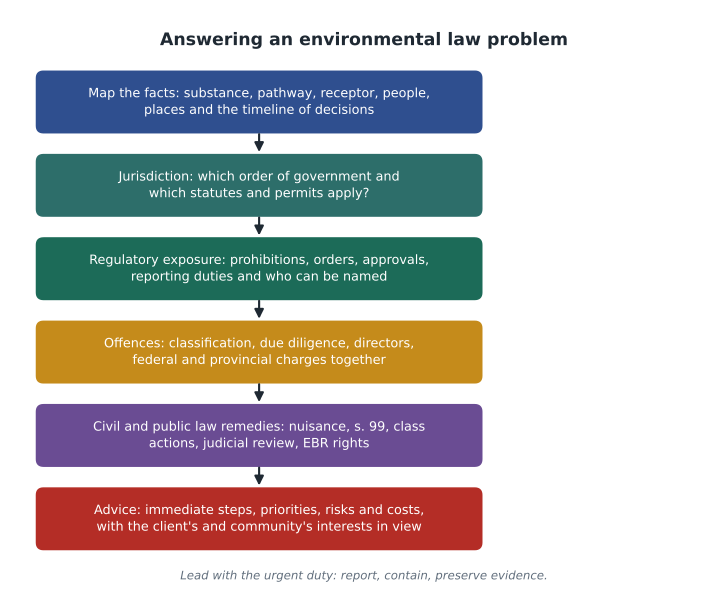
Mehta starts with a diagram. The substances are metals, electrolyte residues and combustion products in the runoff and smoke. The pathways are the overflowing pond to the creek and river, smoke through the air, and possibly groundwater to private wells. The receptors are fish and the listed mussel, the creek and river, the evacuated residents, Annick's cattle and business, and well users. The key decisions are the 2023 ECA amendment and its containment condition, Pinecastle's late plan and the Ministry's silence, the contractor's recommendation and the board's decision to defer the work, and the response timeline on the night of the fire.
Step two: jurisdiction and regimes
The plant is a provincially regulated local undertaking, so Ontario's EPA, the Ontario Water Resources Act and the ECA govern most of its operations. The deposit of runoff into fish-bearing water engages the federal Fisheries Act, which applies regardless of provincial approval. The listed mussel is an aquatic species, so the prohibitions in sections 32 and 33 of the Species at Risk Act apply on all lands, and any destruction of identified critical habitat matters. The township's by-laws and the Fire Protection and Prevention Act are relevant to the fire itself. Civil claims lie in nuisance, negligence and under section 99 of the EPA. Friends of Marigold Creek may use the Environmental Bill of Rights and judicial review. And the possible insolvency brings in the federal insolvency statutes and Redwater.
Step three: regulatory exposure (Mehta, for the Ministry)
Mehta explains the Ministry's tools. The runoff is a spill under Part X of the EPA: a discharge of pollutants from a structure, abnormal in quantity and quality. Pinecastle, as owner and person in control of the pollutants, must do everything practicable to prevent, eliminate and ameliorate the adverse effects and restore the environment, and the Director can order specific steps. The provincial officer's order is already in place; it must be complied with even if Pinecastle appeals, unless the Ontario Land Tribunal grants a stay.
A preventive order under section 18 may name the current owner, Marigold Holdings, and persons who have or had charge, management or control of the undertaking, which can include directors. The Ministry should weigh, as its practice suggests, who caused the problem, who had knowledge and control, who benefited and who acted diligently. Faustine had knowledge of the contractor's recommendation and control of the decision to defer it; she is a strong candidate. The Toronto directors were told the work was scheduled; whether they had real control is less clear. Marigold Holdings did not cause the fire but owns the land; naming it secures a solvent party for long-term remediation if Pinecastle becomes insolvent, though the Ministry should expect an appeal.
On insolvency, Mehta relies on Orphan Well Association v. Grant Thornton Ltd., 2019 SCC 5, and Newfoundland and Labrador v. AbitibiBowater Inc., 2012 SCC 67. If the Ministry acts as a regulator requiring remediation in the public interest, rather than as a creditor seeking payment, its orders are unlikely to be provable claims that can be compromised, and any trustee or monitor will have to comply before distributing assets to the lender. The Ministry should avoid converting its orders into a monetary claim prematurely.
Mehta also raises an uncomfortable point for his client: the Ministry did not follow up on the overdue containment plan. That may not create Crown liability, but it will feature in any public criticism and in the residents' arguments.
Step four: offences (Marchetti and Kowalczyk, for Pinecastle)
Pinecastle's lawyers identify the likely charges: discharging contaminants causing an adverse effect contrary to section 14 of the EPA; failing to comply with the ECA condition requiring a containment plan within twelve months; possibly failing to report forthwith; depositing a deleterious substance in water frequented by fish contrary to section 36(3) of the Fisheries Act; and possibly killing or harming a listed species contrary to section 32 of SARA.
All of these are strict liability offences under R. v. Sault Ste. Marie (City), [1978] 2 S.C.R. 1299, and the deposit and discharge are not seriously disputable. Under R. v. Kingston (City), the Crown need only prove that the runoff was deleterious at the point of deposit, which toxicity testing will likely show. The defence must therefore rest on due diligence. Kowalczyk is candid that it is weak: the risk of runoff from a battery fire was identified by residents in 2023, by the ECA condition and by the contractor's report; the fix was known and costed; and the board deferred it for financial reasons. Courts are reluctant to accept cash flow as an excuse where the foreseeable harm is serious. The late plan breaches the ECA condition regardless of the fire. The reporting count is more arguable: three hours during an active fire, with staff evacuating and firefighters in control, may be found reasonable, especially if Pinecastle can show it called as soon as runoff was observed.
Directors' exposure follows. Under section 194 of the EPA, Faustine and the other directors had a duty to take all reasonable care to prevent the corporation's unlawful discharges. R. v. Bata Industries Ltd. (1992) suggests that a director who knew of a specific, costed risk and allowed it to be deferred without an interim measure is in a difficult position. The Toronto directors may argue that they reasonably relied on Faustine's assurance that the work was scheduled, but they did not ask how the risk would be managed in the meantime. Under the Fisheries Act, directors who acquiesced in the offence may also be parties.
Marchetti's advice to Pinecastle is practical. Comply fully with the orders, because compliance is mandatory and cooperation is the strongest mitigating factor at sentencing. Retain experts through counsel to protect privilege. Preserve all records, including the board minutes, which will be producible. Do not make statements minimizing the harm. Consider early resolution with the Crown, including a plea to some counts with agreed remediation and creative sentencing terms, recognizing that federal minimum fines apply to Fisheries Act convictions and that penalties will be scaled to Pinecastle's size and means. Advise the directors to obtain independent counsel, since their interests may diverge from the corporation's, especially if insolvency looms.
Step five: civil claims (Tremblay-Hart, for Annick and the well owners)
Tremblay-Hart begins with section 99 of the EPA. The runoff was a spill; Pinecastle is the owner and controller of the pollutants; Annick's lost milk sales, the costs of moving his herd and the well owners' testing and alternative water costs are losses incurred as a direct result. Liability does not depend on fault, and the statutory defences do not fit: the fire may have been accidental, but Pinecastle did not take all reasonable steps to prevent the spill, and no third party's intentional act or exceptional natural phenomenon caused it. Midwest Properties Ltd. v. Thordarson, 2015 ONCA 819, supports recovery of restoration costs if wells or land need remediation.
She adds nuisance and negligence. Under Antrim Truck Centre Ltd. v. Ontario (Transportation), 2013 SCC 13, contamination of the creek and wells and the smoke evacuation are substantial and unreasonable interferences. The ECA does not provide a statutory authority defence, because the overflow was not an inevitable consequence of the approved activity; it resulted from failing to build the recommended containment. Negligence is supported by the same evidence that defeats due diligence. If many residents are affected, a class action is possible, but under Hollick v. Toronto (City), 2001 SCC 68, the individual nature of damages may make joinder of individual claims or a test case more practical. Because Pinecastle may become insolvent, she advises filing claims promptly, identifying insurance, and considering claims against Marigold Holdings as owner if the facts support them. Section 17 of the Limitations Act, 2002 helps for undiscovered contamination, but the ordinary two-year period runs from discovery for known losses.
Step five, continued: public law remedies (Whitecloud, for Friends of Marigold Creek)
Whitecloud's clients want accountability and prevention. Under the Environmental Bill of Rights, two residents may apply for an investigation of alleged contraventions of the EPA and the ECA, and for a review of the ECA itself, asking that it be amended to require containment before battery storage resumes. The group's 2023 comments put the Ministry on notice of the risk, which strengthens both applications. Any new or amended ECA for rebuilding must be posted for comment; if approved without adequate containment, the group could seek leave to appeal, arguing that no reasonable person, having regard to the law and the Ministry's own policies, could approve it, and that significant harm could result.
He considers judicial review of the Ministry's failure to act on the overdue plan. Mandamus requires a clear public legal duty owed to the applicant, which is hard to establish for the Ministry's discretionary enforcement decisions; the more effective route is the EBR process and participation in any reapproval. He also notes that the creek and river may be part of the treaty territory of First Nations who were not consulted on the 2023 amendment; if so, Ontario's duty to consult was engaged when the amendment could adversely affect their rights, and consultation should accompany any decision to allow the plant to rebuild. Finally, he points to the federal regime: the group can provide information to federal enforcement officers and, if critical habitat for the mussel was harmed, press for recovery measures under SARA.
Step six: what happens next
Wyndham closes by asking each team for one sentence of Monday-morning advice. Marchetti: 'Comply, cooperate and get the directors their own lawyers.' Mehta: 'Name the people who controlled the decision, and protect the Crown's position before the insolvency filing.' Tremblay-Hart: 'File under section 99 now, and get the wells tested.' Whitecloud: 'Use the EBR, insist on consultation and make sure the plant cannot reopen without containment.' Kowalczyk adds a last point: the whole disaster turned on a 180,000 dollar decision deferred to save cash. 'Prevention,' Wyndham says, 'is the first principle for a reason.'
She returns the jar of Severn River water to the shelf. 'You now know who decides what goes into a river, what duties they owe and who pays when it goes wrong,' she says. 'Find the power, then the duty. And never forget that somebody downstream is drinking the answer.'
Worked problem
Ranking the issues for an examination answer
On an examination, you have ninety minutes to answer the Pinecastle problem from Pinecastle's perspective. How should you organize your answer?
Show solution
- Open with urgent duties: compliance with the provincial officer's order, ongoing containment, reporting obligations and evidence preservation.
- Map jurisdiction briefly: EPA and ECA, Fisheries Act, SARA, municipal and fire law, and insolvency, explaining why each applies.
- Analyze orders: who may be named under section 18, the factors the Director will consider and appeal rights, including the Redwater effect of insolvency.
- Analyze offences: classify as strict liability, apply Kingston to the deposit, assess due diligence honestly and address directors under section 194 and Bata.
- Analyze civil exposure: section 99, nuisance and negligence, damages and insurance.
- Conclude with prioritized advice and sentencing strategy, noting where facts are missing, such as whether the ECA condition was formally extended.
Common mistakes
MistakeStarting an answer with constitutional theory instead of urgent duties.
InsteadLead with reporting, containment, compliance with orders and evidence; then map jurisdiction.
MistakeTreating the ECA as a defence to the overflow.
InsteadAn approval does not authorize discharges causing adverse effects or make avoidable harm inevitable.
MistakeOverstating the due diligence defence.
InsteadForeseeable, costed risks deferred for financial reasons rarely support due diligence.
MistakeForgetting insolvency.
InsteadRedwater and AbitibiBowater determine whether orders survive and whether claimants should move quickly.
Practice problems
Work each problem on paper first, then reveal the answer to check.
Why can the Director consider naming Marigold Holdings in a section 18 order?
Show answer
Because section 18 orders may be directed to the owner of the property, regardless of fault, and naming a solvent owner protects the public if the operator becomes insolvent.
Why is Pinecastle's due diligence defence weak?
Show answer
The risk of runoff was foreseeable and identified by residents, the ECA and the contractor; the fix was known and costed; and the board deferred it for financial reasons.
Which statutory provision gives Annick the strongest civil claim, and why?
Show answer
Section 99 of the EPA, because it imposes no-fault liability on the owner and controller of spilled pollutants for direct losses, subject to narrow defences that do not fit these facts.
Summary and key terms
- Answer environmental problems by mapping facts, identifying every regime, analyzing regulatory exposure, offences and civil and public law remedies, and advising.
- Spill duties and orders under the EPA can reach operators, owners and directors, and survive insolvency where the regulator acts in the public interest.
- Strict liability offences turn on due diligence, which is weak where foreseeable, costed risks are deferred.
- Section 99, nuisance and negligence give affected neighbours strong claims; insolvency counsels speed.
- Community groups can use the EBR, participation in reapproval, the duty to consult and federal enforcement to secure prevention.
- Preventive order
- An order under section 18 of the EPA requiring steps to prevent or reduce discharges or adverse effects, which may name owners and those with control.
- Mandamus
- A remedy compelling a public authority to perform a clear public legal duty owed to the applicant.
- Firefighting runoff
- Water and other substances used to fight a fire that carry contaminants into the environment.
- Interim measure
- A temporary step to manage a known risk until a permanent solution is in place.
- Independent legal advice
- Advice from a lawyer acting only for one party, such as a director whose interests may diverge from the corporation's.
- Test case
- A single representative claim litigated to resolve common issues for others in a similar position.
Lesson quiz · 5 questions
Score 60% or more to complete this lesson.
Create a free account to save your progress, take quizzes and earn a certificate.