
LAWC-313 · Lesson 2 of 12 · 20 min
Constitutional framework
▶ Video coming soon A video version of this lesson is on the way.
Wyndham opens the second class by asking a question that sounds simple: 'Who regulates the Severn River?' Sophie Tremblay-Hart answers first: Ontario, because the river and the land under it are provincial. Arjun Mehta adds that the fish are federal. Theo Marchetti points out that Norvell's sewer connection is governed by a city by-law. Daniel Whitecloud asks whether anyone has asked the First Nations whose treaty territory includes the watershed. 'All correct,' Wyndham says. 'That is the problem and the genius of Canadian environmental federalism. Nobody owns the environment, so everyone regulates a piece of it.'
This lesson builds on the division of powers analysis from LAWC-101. It shows how the courts have allocated environmental authority under the Constitution Act, 1867, and how the leading cases fit together. The method is the familiar one: identify the pith and substance of the challenged law, classify it under a head of power, and then consider interjurisdictional immunity and paramountcy if both orders of government have acted.
The environment is not a head of power
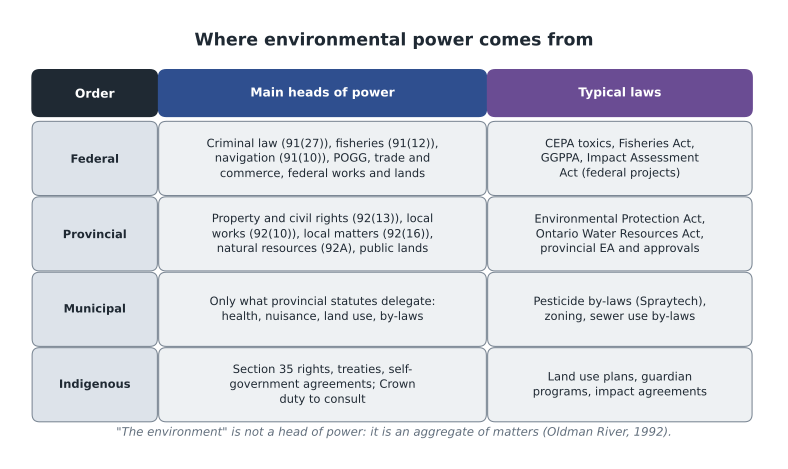
Sections 91 and 92 of the Constitution Act, 1867 say nothing about the environment. The drafters in 1867 were concerned with railways, canals and fisheries, not acid rain or greenhouse gases. The courts have therefore had to decide how environmental laws fit into the existing heads of power.
The leading statement comes from Friends of the Oldman River Society v. Canada (Minister of Transport), [1992] 1 S.C.R. 3. Alberta built a dam on the Oldman River without a federal environmental assessment. The federal Environmental Assessment and Review Process Guidelines Order required one where a federal decision maker had an 'affecting' responsibility, and here the dam needed a permit under the federal Navigable Waters Protection Act. Alberta argued that federal assessment of a provincial project intruded on provincial jurisdiction. La Forest J. rejected the argument. The environment, he wrote, is not an independent matter of legislation; it is a diffuse subject that cuts across many areas of constitutional responsibility, some federal and some provincial. Each order of government may consider environmental effects when it legislates under its own heads of power. Because the federal government could take environmental factors into account in deciding whether to grant a navigation permit, it could require an assessment of those factors. The assessment had to be linked to federal jurisdiction, but it was not confined to effects on navigation alone.
Two consequences follow. First, environmental laws are classified by their dominant purpose and effect, not by the label 'environment'. A law that regulates pollution from a provincially regulated factory is likely provincial; a law that prohibits toxic substances to protect health throughout Canada may be federal criminal law. Second, overlapping regulation is normal and expected. A single facility can lawfully be subject to both federal and provincial environmental laws, so long as compliance with both is possible and the provincial law does not frustrate the purpose of a federal one.
Federal heads of power
The criminal law power in section 91(27) is the most important federal source. In R. v. Hydro-Québec, [1997] 3 S.C.R. 213, Hydro-Québec was charged under CEPA's interim order provisions for releasing PCBs. A five-judge majority led by La Forest J. upheld the toxic substances provisions as valid criminal law. Protecting the environment, the Court held, is a legitimate public purpose that can support criminal prohibitions, and a regulatory scheme with prohibitions backed by penalties can be criminal law even if it is detailed and administered by officials. The four dissenting judges thought the scheme was regulatory rather than prohibitory and so beyond the criminal law power. Hydro-Québec is the constitutional foundation for CEPA's control of toxic substances, which lesson 6 examines. The Federal Court of Appeal relied on it in Syncrude Canada Ltd. v. Canada (Attorney General), 2016 FCA 160, to uphold the Renewable Fuels Regulations, and again in 2026 in the plastics case discussed in lesson 6.
Fisheries under section 91(12) supports the Fisheries Act prohibitions on depositing deleterious substances into water frequented by fish and on harmful alteration of fish habitat. Courts have upheld those provisions so long as they are linked to protecting fish. Navigation and shipping under section 91(10) supports federal control over works in navigable waters. Federal authority over federal works and undertakings, such as interprovincial pipelines, railways, airports and nuclear facilities, supports environmental regulation of those works. Trade and commerce, the spending power and the federal power over Indians and lands reserved for the Indians in section 91(24) also play roles.
Peace, order and good government (POGG) under its national concern branch supports federal regulation of matters that are of genuine national concern. In R. v. Crown Zellerbach Canada Ltd., [1988] 1 S.C.R. 401, a logging company was charged under the federal Ocean Dumping Control Act for dumping wood waste in provincial waters off British Columbia. Le Dain J., for a four to three majority, held that marine pollution, including in provincial waters, was a single, distinct and indivisible matter of national concern. The key test asks whether the matter has a singleness, distinctiveness and indivisibility that clearly distinguishes it from matters of provincial concern, and whether a province's failure to deal with it would harm other provinces (the 'provincial inability' factor). La Forest J., dissenting, warned that almost every form of pollution affects the sea eventually, so the majority's approach could give Parliament sweeping environmental power.
That concern framed the Greenhouse Gas Pollution Pricing Act References, 2021 SCC 11. Saskatchewan, Ontario and Alberta challenged the federal Greenhouse Gas Pollution Pricing Act (GGPPA), which imposed a fuel charge and an output-based pricing system for industry in provinces whose own carbon pricing did not meet a federal benchmark. Wagner C.J., for a six to three majority, upheld the Act under the national concern branch. He restated the test in three steps: a threshold question whether the matter is of sufficient concern to Canada as a whole; then whether it has the singleness, distinctiveness and indivisibility that distinguishes it from provincial matters, including an assessment of provincial inability; and finally whether the impact on provincial jurisdiction is reconcilable with the division of powers. The matter, he held, was narrowly defined as establishing minimum national standards of greenhouse gas price stringency to reduce emissions. Climate change was an existential threat, emissions crossed borders, and one province's failure to act could undermine the efforts of others. Côté, Brown and Rowe JJ. dissented in separate reasons.
Provincial heads of power
Provinces hold the broadest environmental authority. Property and civil rights under section 92(13) supports regulation of private land use, industrial activity and civil liability. Local works and undertakings under section 92(10) and matters of a merely local or private nature under section 92(16) support regulation of most factories, landfills and municipal works. Section 92A, added in 1982, confirms provincial authority over non-renewable natural resources, forestry and electricity. Provinces also own most public lands and resources under sections 109 and 117, which gives them proprietary as well as legislative control.
Provincial laws cannot regulate matters outside the province. In Interprovincial Co-operatives Ltd. v. The Queen, [1976] 1 S.C.R. 477, Manitoba legislation creating a cause of action for fishers harmed by mercury discharged into rivers by plants in Saskatchewan and Ontario was held to be beyond provincial power, because it purported to regulate activities licensed in other provinces. The case shows a recurring gap: interprovincial pollution is hard for any single province to address, which is one reason the courts have accepted federal regulation of such matters.
Provincial laws also cannot single out federal undertakings in ways that impair their core. In Reference re Environmental Management Act, 2020 SCC 1, the Supreme Court dismissed British Columbia's appeal from the bench and adopted the reasons of the British Columbia Court of Appeal (2019 BCCA 181), which held that proposed provincial permit requirements for heavy oil carried through an interprovincial pipeline were, in pith and substance, an attempt to regulate the federal undertaking and therefore invalid.
Municipalities have only the powers that provincial statutes give them, but those powers can be broad. In Spraytech, the town of Hudson's by-law restricting cosmetic pesticide use was upheld under a general welfare power in Quebec's Cities and Towns Act, and was not in operational conflict with federal and provincial pesticide laws, which permitted but did not require use.
The Impact Assessment Act Reference
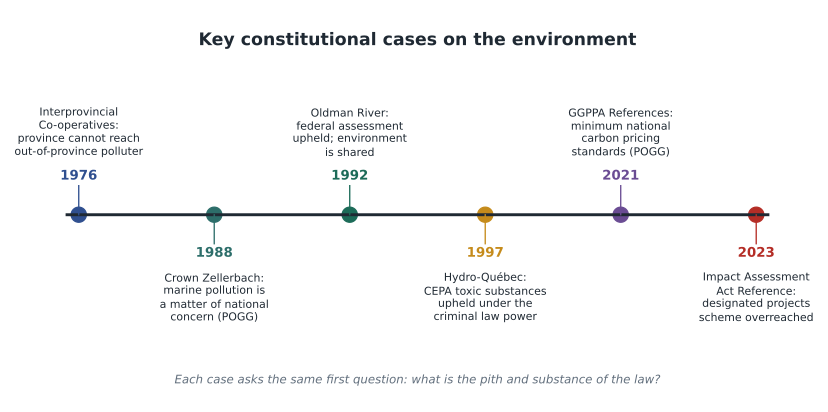
The most recent major decision is Reference re Impact Assessment Act, 2023 SCC 23. Alberta referred questions about the federal Impact Assessment Act (IAA), enacted in 2019, to its Court of Appeal, which held the whole Act unconstitutional. On appeal, Wagner C.J., for a five to two majority, divided the Act into two schemes. The scheme in sections 81 to 91, which governs projects carried out or funded by federal authorities on federal lands or outside Canada, was constitutional. But the 'designated projects' scheme, covering major projects listed in regulations or designated by the Minister, was ultra vires as drafted.
The majority's reasoning had two parts. First, the scheme's trigger was overbroad: projects could be designated and caught by the prohibition in section 7 even if their effects within federal jurisdiction were trivial, so the federal government could effectively regulate projects that were essentially provincial. Second, the decision-making function was not confined to federal matters: the public interest decision allowed the Minister and Cabinet to weigh a project's effects as a whole, including matters within provincial jurisdiction, and to block a project on that basis. Parliament may assess and regulate effects within federal jurisdiction, the Chief Justice wrote, but it may not use assessment as a means of regulating provincial projects generally. Karakatsanis and Jamal JJ., dissenting in part, would have upheld the designated projects scheme as well.
Parliament amended the IAA in June 2024 through the Budget Implementation Act, 2024, No. 1 to respond to the Reference, narrowing the definition of effects within federal jurisdiction, focusing decisions on those effects and limiting the Minister's designation power. Lesson 3 examines the amended Act.
Overlap, immunity and paramountcy
Because both orders can regulate environmental matters, overlap is common. The courts' approach is cooperative federalism. Interjurisdictional immunity, which protects the core of a federal head of power from provincial laws that impair it, applies narrowly. A provincial environmental law of general application, such as a spill reporting requirement, usually applies to federal undertakings unless it would impair a vital part of their operation.
Federal paramountcy applies where there is an operational conflict, meaning it is impossible to comply with both laws, or where the provincial law frustrates the purpose of a federal law. In practice, most overlapping environmental laws can be complied with together; a company simply complies with the stricter one. A permissive federal law, such as an approval allowing an activity, does not usually displace a stricter provincial prohibition unless the federal purpose was to authorize the activity notwithstanding provincial law.
Hannah Kowalczyk raises the October 19, 2026 Alberta referendum, in which about three quarters of voters chose to remain in Canada. She argues that the climate cases have tilted power toward Ottawa and that provinces with resource economies feel it most. Wyndham does not disagree that the cases are contested. 'But read the GGPPA majority carefully,' she says. 'It upheld minimum national standards of price stringency, narrowly defined, and it left provinces free to design their own systems. The Impact Assessment Act Reference then reminded Parliament where the edge is.'
Worked problem
A federal river protection law
Suppose Parliament enacts a hypothetical National Rivers Protection Act. It prohibits any person from carrying on an activity that 'may degrade the ecological integrity of a Canadian river' without a federal permit, and authorizes the Minister to refuse a permit 'having regard to all environmental, social and economic effects'. Norvell argues the Act is ultra vires as applied to its Severn River plant. Analyze.
Show solution
- Characterize the law. Its pith and substance appears to be regulating all activities affecting rivers, including local industrial activity, with a broad public interest permitting power.
- Consider the criminal law power. A prohibition backed by penalty with a public purpose can be criminal law (Hydro-Québec), but a permitting scheme that weighs all social and economic effects looks regulatory and reaches matters of provincial concern.
- Consider POGG. Unlike marine pollution in Crown Zellerbach or GHG price stringency in the GGPPA References, degradation of any river is not single, distinct and indivisible; provinces can and do regulate local water pollution, so provincial inability is weak.
- Apply the Impact Assessment Act Reference. A trigger catching activities with trivial federal effects and a decision power considering all effects resembles the designated projects scheme the Court struck down.
- Conclude that the law is likely ultra vires as drafted. A narrower law tied to fisheries, navigation, interprovincial pollution or toxic substances would likely be valid, and Norvell remains subject to the Fisheries Act in any event.
Common mistakes
MistakeTreating "the environment" as a federal or provincial head of power.
InsteadOldman River holds it is an aggregate of matters; classify each law by its pith and substance under existing heads.
MistakeAssuming the GGPPA References give Parliament general power over climate or the environment.
InsteadThe matter upheld was narrowly defined as minimum national standards of greenhouse gas price stringency.
MistakeTreating any overlap between federal and provincial environmental laws as a conflict.
InsteadOverlap is normal; paramountcy applies only where dual compliance is impossible or the provincial law frustrates a federal purpose.
MistakeReading the Impact Assessment Act Reference as striking down federal assessment altogether.
InsteadFederal assessment remains valid if confined to effects within federal jurisdiction; the scheme for federal projects was upheld.
Practice problems
Work each problem on paper first, then reveal the answer to check.
What test did Crown Zellerbach set for the national concern branch?
Show answer
The matter must have a singleness, distinctiveness and indivisibility that clearly distinguishes it from provincial matters, with provincial inability to deal with it effectively an important factor, and a scale of impact on provincial jurisdiction reconcilable with the division of powers.
Why did the majority in Hydro-Québec uphold CEPA's toxic substances provisions?
Show answer
Because protecting the environment is a valid criminal law purpose and the scheme prohibited conduct, backed by penalties, even though it was detailed and administered by officials.
What two defects did the Supreme Court find in the IAA's designated projects scheme?
Show answer
Its trigger could catch projects with only trivial federal effects, and its public interest decision was not confined to effects within federal jurisdiction.
Summary and key terms
- The environment is not a head of power; laws are classified by pith and substance under existing federal and provincial heads (Oldman River).
- Federal authority rests mainly on criminal law (Hydro-Québec), fisheries, navigation, federal works and the national concern branch of POGG (Crown Zellerbach, GGPPA References).
- Provinces hold broad authority over property, local works, local matters, resources and public lands, but cannot regulate outside the province or impair federal undertakings.
- The Impact Assessment Act Reference (2023) confined federal assessment of major projects to effects within federal jurisdiction, prompting 2024 amendments.
- Overlap is normal; interjurisdictional immunity applies narrowly and paramountcy only on operational conflict or frustration of federal purpose.
- Pith and substance
- The dominant purpose and effect of a law, used to classify it under a head of power.
- National concern branch
- The branch of the peace, order and good government power that supports federal laws on matters of genuine national concern.
- Provincial inability
- The factor asking whether one province's failure to deal with a matter would harm other provinces.
- Designated project
- Under the Impact Assessment Act, a major project listed in regulations or designated by the Minister for federal assessment.
- Paramountcy
- The doctrine that a valid federal law prevails over a conflicting provincial law to the extent of the conflict.
- Interjurisdictional immunity
- The doctrine protecting the core of a head of power from impairment by laws of the other order of government.
Lesson quiz · 5 questions
Score 60% or more to complete this lesson.
Create a free account to save your progress, take quizzes and earn a certificate.