
LAWC-313 · Lesson 6 of 12 · 19 min
Toxic substances and the Canadian Environmental Protection Act
▶ Video coming soon A video version of this lesson is on the way.
For the sixth class, Wyndham empties a shopping bag on the table: a plastic takeout container, a non-stick frying pan, a can of spray solvent from the hypothetical Norvell plant and a box of wooden stir sticks. 'Three of these things have been through the federal toxic substances process,' she says, 'and one of them is here because the federal government banned its plastic cousin.' The class's task is to work out how Ottawa decides that a substance is 'toxic', what follows from that label, and why the label provoked one of the most closely watched environmental cases of the decade.
The Canadian Environmental Protection Act, 1999 (CEPA) is the main federal pollution statute. It covers toxic substances, new substances, pollution prevention, vehicle and fuel emissions, ocean disposal, environmental emergencies, hazardous waste movements and federal lands, among other things. Environment and Climate Change Canada and Health Canada administer it jointly. This lesson concentrates on Part 5, the toxic substances regime, which is CEPA's core and its most litigated part.
The constitutional foundation
As lesson 2 explained, CEPA's toxic substances provisions rest on the federal criminal law power. In R. v. Hydro-Québec, [1997] 3 S.C.R. 213, the Supreme Court upheld the scheme because it prohibits the use of substances found harmful, backed by penalties, to protect the environment and human health. The scheme works by first identifying a substance as toxic through scientific assessment and then authorizing regulations that prohibit or restrict it. The criminal law characterization explains why the listing step matters so much: the more a listing order looks like a general regulatory power over a whole industry, the more it invites the argument that Parliament has strayed beyond criminal law.
What 'toxic' means
Section 64 defines a substance as toxic if it is entering or may enter the environment in a quantity or concentration or under conditions that (a) have or may have an immediate or long-term harmful effect on the environment or its biological diversity; (b) constitute or may constitute a danger to the environment on which life depends; or (c) constitute or may constitute a danger in Canada to human life or health. The word 'toxic' is a legal term of art. A substance can be CEPA-toxic because of how it behaves in the environment, such as persistence or bioaccumulation, even if it is not poisonous in the everyday sense. Conversely, a dangerous chemical may not be CEPA-toxic if it is not entering the environment in harmful quantities.
The definition looks at exposure as well as hazard. A risk assessment asks both whether a substance can cause harm and whether it is reaching people or ecosystems in quantities that make that harm likely. Arjun Mehta, thinking like an engineer, sums it up as 'risk equals hazard times exposure'. Wyndham accepts the formula with a caveat: the 'may' in section 64 builds in precaution, so certainty of harm is not required.
Identifying and assessing substances
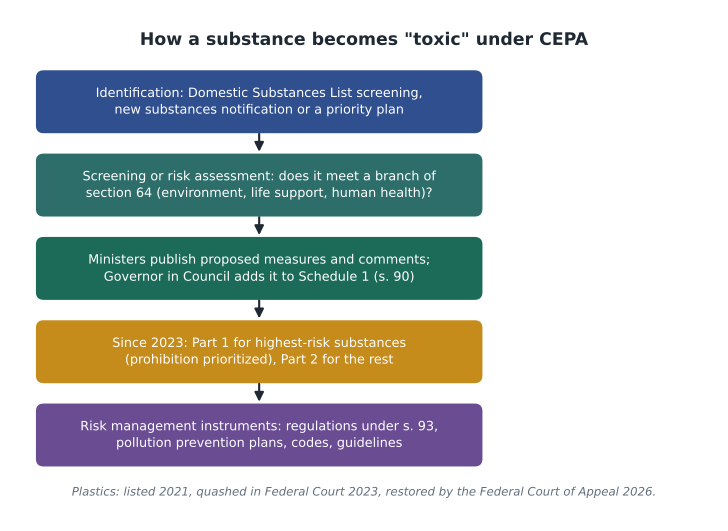
Canada inherited tens of thousands of chemicals that were in commerce before modern assessment began. CEPA required the government to categorize the roughly 23,000 substances on the Domestic Substances List by 2006 to identify those that were persistent, bioaccumulative or inherently toxic, or to which people had the greatest potential exposure. The Chemicals Management Plan, launched in 2006, then set out a program to assess thousands of priority substances in phases, with results published in the Canada Gazette.
New substances follow a different path. Under the New Substances Notification Regulations, a company must notify the government and provide prescribed information before manufacturing or importing a substance not on the Domestic Substances List. The government assesses the information and may impose conditions, require more information or prohibit the substance.
Assessment conclusions follow a public process. The ministers publish a draft screening assessment and proposed conclusion and take comments, usually for sixty days. They then publish a final assessment and decide among three outcomes: take no further action, add the substance to a priority list for further assessment, or recommend that it be added to Schedule 1, the List of Toxic Substances.
Listing and risk management
If the ministers recommend listing, the Governor in Council may make an order adding the substance to Schedule 1 under section 90. Listing does not itself prohibit anything. It is the gateway to regulation: once a substance is on Schedule 1, the government may make regulations under section 93 on a wide range of matters, including quantities released, manufacturing, use, sale, labelling, import and export. CEPA sets timelines for proposing and finalizing risk management instruments after a substance is found toxic. Other tools include pollution prevention planning notices under Part 4, which require specified companies to prepare and implement plans, as well as codes of practice and guidelines.
Most CEPA regulations are uncontroversial and technical: limits on releases of specific chemicals from specific sectors, restrictions on certain flame retardants, bans on microbeads in toiletries, limits on volatile organic compounds in consumer products. The Norvell solvent case illustrates how these work. Regulations limit the volatile organic compound content of many architectural coatings and solvent products; a coatings manufacturer like Norvell must ensure its products meet those limits before sale, test and keep records, and report.
The 2023 amendments
In June 2023, Parliament enacted the Strengthening Environmental Protection for a Healthier Canada Act, the first major amendment to CEPA since 1999. Its main changes include:
First, recognition of a right to a healthy environment. The Act now provides that, in administering CEPA, the Government of Canada must protect the right of every individual in Canada to a healthy environment as provided under the Act, subject to any reasonable limits, and required the ministers to develop an implementation framework. The framework, published in July 2025, describes the principles of environmental justice, intergenerational equity and non-regression and explains that the right is to be considered in decisions under CEPA, weighed against relevant scientific, health, social, economic and environmental factors. It is a duty on government within the Act, not a free-standing right that individuals can enforce in court against private polluters. But it can be relevant on judicial review of CEPA decisions, where an applicant may argue that a decision maker failed to consider it.
Second, a two-part Schedule 1. Part 1 now lists toxic substances that pose the highest risk, such as those that are persistent and bioaccumulative, for which the government must give priority to total, partial or conditional prohibition. Part 2 lists other toxic substances, for which a wider range of tools is used.
Third, a requirement to publish and periodically update a plan of chemicals management priorities and a 'watch list' of substances that may become a concern. Fourth, assessments must consider vulnerable populations and cumulative effects. Fifth, members of the public may request that the Minister assess a substance, and the Minister must respond within set timelines. Sixth, the amendments support the replacement, reduction and refinement of animal testing.
Sophie Tremblay-Hart asks whether the right to a healthy environment could become constitutional. Wyndham notes that some advocates argue it already lies within section 7 of the Charter, which lesson 9 considers, and that Quebec's Charter of Human Rights and Freedoms includes a right to live in a healthful environment in which biodiversity is preserved, to the extent and according to the standards provided by law. The phrase 'to the extent provided by law' has kept that right modest in practice.
The plastics case
The most important recent CEPA decision concerns plastics. In April 2021, the Governor in Council added 'plastic manufactured items' to Schedule 1, relying on a science assessment of plastic pollution. In June 2022, the government made the Single-use Plastics Prohibition Regulations, which phased in prohibitions on manufacturing, importing and selling six categories of single-use plastic items: checkout bags, cutlery, foodservice ware made from problematic plastics, ring carriers, stir sticks and straws, with some exceptions. That is why Wyndham brought wooden stir sticks.
A coalition of plastics manufacturers, joined by Alberta and Saskatchewan as interveners, challenged the listing order. In Responsible Plastic Use Coalition v. Canada (Environment and Climate Change), 2023 FC 1511, Furlanetto J. quashed it. She held that the category 'plastic manufactured items' was so broad that it included many items for which there was no evidence of harm, so the Governor in Council could not reasonably conclude that the whole category met section 64. She also held that listing such a broad category was not a valid exercise of the criminal law power.
The Federal Court of Appeal reversed that decision on January 30, 2026, in Canada v. Responsible Plastic Use Coalition, 2026 FCA 17. The Court held that plastic manufactured items are a 'substance' within CEPA, that the Governor in Council had sufficient evidence to reasonably conclude that they cause or may cause harm under section 64, and that section 90 does not require the order to list individual plastics or to rest on quantitative testing of each item. On the constitutional question, the Court held that the listing order did not itself raise a substantive division of powers issue: it was an enabling step under section 90, not a prohibition. Whether any particular regulation made after listing is valid criminal law is a separate question. The judicial review was dismissed, and the listing and the regulations remained in place.
Hannah Kowalczyk, who followed the case closely because of Alberta's involvement, says the reasoning on the constitutional question troubles her: 'If listing is never the problem, every challenge has to wait for the regulation.' Wyndham agrees that this is the effect, and asks whether that is a flaw or a sensible division of labour. Challenges to specific prohibitions can test whether they truly target harm. Students should check whether further appeals have been sought.
Other federal pollution tools
CEPA does much more than regulate toxic substances. The National Pollutant Release Inventory requires facilities above reporting thresholds to report annually their releases and transfers of listed substances, which become public and are widely used by communities and researchers. Part 8 requires certain facilities to prepare and test environmental emergency plans for listed hazardous substances. Part 7 regulates disposal at sea, implementing the London Protocol. Part 7 also controls exports and imports of hazardous waste and recyclable materials under the Basel Convention. And CEPA regulations govern vehicle, engine and fuel emissions, including fuel standards.
Enforcement officers have broad inspection powers and may issue environmental protection compliance orders to stop or prevent contraventions. Offences carry substantial fines, including minimum fines for serious offences added by the Environmental Enforcement Act in 2009, and administrative monetary penalties are available for some contraventions. Lesson 10 covers enforcement and sentencing generally.
Worked problem
A solvent ingredient comes under review
In the hypothetical, a solvent ingredient that Norvell uses in its thinners is the subject of a draft screening assessment proposing that it be added to Part 2 of Schedule 1 because of risks to workers' and residents' health near facilities that use it. Norvell's general counsel asks what this means for the company and whether Norvell should comment.
Show solution
- Explain the stage. A draft assessment is not law; the ministers will consider comments and then publish a final assessment and proposed measures.
- Advise commenting. Norvell can submit data on its actual releases, exposure controls and alternatives; robust exposure data can affect the conclusion or the risk management approach.
- Explain consequences of listing. Listing on Part 2 enables regulations under section 93 or other instruments, such as pollution prevention planning notices; it does not itself prohibit use.
- Flag Part 1. If the ingredient were found persistent and bioaccumulative, it could be placed in Part 1, where prohibition must be prioritized.
- Plan ahead. Norvell should review substitution options and its reporting under the National Pollutant Release Inventory, and consider the right to a healthy environment and vulnerable populations near its plant, which the assessment must now consider.
Common mistakes
MistakeTreating "toxic" under CEPA as meaning poisonous.
InsteadSection 64 is a legal test based on entry into the environment and harmful effects on the environment, life support systems or human health.
MistakeAssuming listing on Schedule 1 bans a substance.
InsteadListing enables regulations and other instruments; prohibitions come from regulations made under section 93.
MistakeDescribing the CEPA right to a healthy environment as a free-standing enforceable right.
InsteadIt is a duty on government in administering CEPA, subject to reasonable limits, guided by the 2025 implementation framework.
MistakeStating that the federal single-use plastics ban was struck down.
InsteadThe Federal Court quashed the listing in 2023, but the Federal Court of Appeal reversed that decision in 2026 (2026 FCA 17).
Practice problems
Work each problem on paper first, then reveal the answer to check.
What are the three branches of the section 64 definition of toxic?
Show answer
Harmful effect on the environment or biological diversity; danger to the environment on which life depends; danger in Canada to human life or health.
What is the difference between Part 1 and Part 2 of Schedule 1 after 2023?
Show answer
Part 1 lists toxic substances posing the highest risk, for which prohibition must be prioritized; Part 2 lists other toxic substances managed with a wider range of tools.
What did the Federal Court of Appeal decide in the plastics case in January 2026?
Show answer
That the listing of plastic manufactured items was reasonable under sections 64 and 90 and did not itself raise a division of powers issue, so the judicial review was dismissed.
Summary and key terms
- CEPA's toxic substances regime rests on the criminal law power (Hydro-Québec).
- A substance is toxic under section 64 if it is entering or may enter the environment under conditions harmful to the environment, life support systems or human health.
- Assessment, publication, listing in Schedule 1 under section 90 and regulation under section 93 are distinct steps.
- The 2023 amendments recognized a right to a healthy environment within CEPA, split Schedule 1 into two parts and added priority plans, a watch list and public requests.
- The Federal Court of Appeal restored the plastics listing in 2026 FCA 17, holding the listing reasonable and constitutionally unobjectionable as an enabling step.
- Schedule 1
- The List of Toxic Substances under CEPA; listing enables risk management regulations.
- Screening assessment
- A scientific assessment of whether a substance meets the section 64 definition of toxic.
- Domestic Substances List
- The list of substances in Canadian commerce before modern notification requirements, which CEPA required to be categorized.
- Pollution prevention planning notice
- A CEPA notice requiring specified persons to prepare and implement a plan to prevent or reduce pollution from a substance.
- National Pollutant Release Inventory
- A public federal inventory of facility releases and transfers of listed substances.
- Right to a healthy environment (CEPA)
- The government's statutory duty, in administering CEPA, to protect each individual's right to a healthy environment, subject to reasonable limits.
Lesson quiz · 5 questions
Score 60% or more to complete this lesson.
Create a free account to save your progress, take quizzes and earn a certificate.