
LAWC-313 · Lesson 3 of 12 · 20 min
Environmental assessment
▶ Video coming soon A video version of this lesson is on the way.
Wyndham introduces the second running file of the term. Northbrae Minerals Corp., a hypothetical Toronto-listed junior miner, wants to build the Caskey Lake Graphite Project in northwestern Ontario: an open-pit mine, a processing plant, a tailings management facility, an all-season access road and a camp, about ninety kilometres from the nearest highway. The deposit sits near the headwaters of a river system that supports lake sturgeon and walleye, within the treaty territory of a First Nation whose members hunt, trap and fish in the area. Northbrae's investors want the mine running before graphite prices fall. 'Before Northbrae moves a single tonne of rock,' Wyndham says, 'it has to get through assessment. Today is about who assesses, what they look at and what they decide.'
Environmental assessment is the core prevention tool for major projects. Instead of regulating a project after it is built, assessment requires the proponent and the government to predict a project's effects before approval, consider alternatives and mitigation, hear from the public and Indigenous peoples, and decide whether and on what conditions the project may proceed. This lesson covers the federal regime under the Impact Assessment Act (IAA). Lesson 4 turns to provincial assessment and approvals.
From the Guidelines Order to the Impact Assessment Act
Federal assessment began with a 1984 Guidelines Order, which the Supreme Court held binding in Oldman River. Parliament replaced it with the Canadian Environmental Assessment Act in 1992, then with a narrower Canadian Environmental Assessment Act, 2012, which focused on a list of designated projects and on a limited set of federal effects. The IAA, enacted in 2019 as part of Bill C-69, replaced the 2012 Act. It broadened the scope of assessment to include health, social and economic effects, made Indigenous participation and knowledge central, added the consideration of climate commitments, and created the Impact Assessment Agency of Canada to run most assessments.
As lesson 2 explained, the Supreme Court held in Reference re Impact Assessment Act, 2023 SCC 23 that the designated projects scheme was unconstitutional as drafted. Parliament amended the IAA in June 2024. The amended Act keeps the same basic structure but narrows it so that the federal government assesses and decides only on matters within federal jurisdiction.
Which projects are assessed
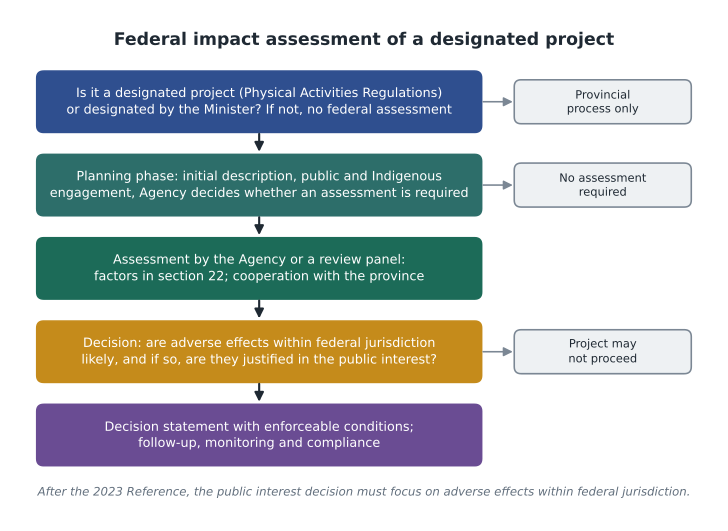
The IAA applies to 'designated projects'. Most are listed in the Physical Activities Regulations, which set out categories and thresholds: for example, new mines above certain daily ore production capacities, certain oil and gas facilities, large dams, interprovincial pipelines and transmission lines, new nuclear facilities, and some projects in national parks or on federal lands. A project below the thresholds is not designated by regulation.
The Minister may also designate a project that is not listed, on request or on the Minister's own initiative. After the 2024 amendments, the Minister may do so only if the project may cause adverse effects within federal jurisdiction or adverse direct or incidental effects, and the Minister must consider factors such as the project's potential effects, public concern about those effects and any provincial or Indigenous assessment that applies. The narrowed power responds to the Supreme Court's concern that federal designation could reach essentially provincial projects.
Section 7 contains the central prohibition. A proponent must not carry out any physical activity that is part of a designated project, and may not cause certain environmental effects, unless the Agency has decided that no assessment is required or the Minister has issued a decision statement permitting the project. Breach is an offence. Arjun Mehta asks whether Northbrae can build its access road first, since a road alone might not be designated. Wyndham explains that the regulations and the Agency treat physical activities incidental to a designated project as part of the project; splitting a project to avoid the threshold would invite designation and possible prosecution.
Effects within federal jurisdiction
The concept of 'effects within federal jurisdiction' is now the key to the whole Act. As amended in 2024, it covers non-negligible adverse changes to fish and fish habitat, aquatic species and migratory birds within the meaning of their federal statutes; adverse changes to the environment on federal lands, in another province or outside Canada; adverse impacts on the Indigenous peoples of Canada arising from changes to the environment, including on their physical and cultural heritage, their use of lands and resources for traditional purposes and their health, social and economic conditions; and certain other matters linked to federal heads of power.
The Act also captures 'direct or incidental effects', meaning effects that are directly linked or necessarily incidental to a federal authority's exercise of a power or performance of a duty in relation to the project, such as issuing a Fisheries Act authorization or providing federal funding.
For Caskey Lake, the likely federal effects are clear. The tailings facility and any destruction of streams would affect fish and fish habitat. The project may affect migratory birds that nest in the area. And it will almost certainly have adverse effects on the First Nation's use of the lands for hunting, trapping and fishing and on its members' health and culture. Each of those is within federal jurisdiction even though the mine itself, as a provincial undertaking on provincial Crown land, is primarily regulated by Ontario.
The planning phase
Assessment begins with an early planning phase. The proponent files an initial project description. The Agency posts it, invites public comment and begins consultation with Indigenous groups whose rights may be affected. The proponent then files a detailed project description responding to the issues raised. Within a legislated time limit, the Agency decides whether an impact assessment is required, considering among other things the project's possible adverse effects within federal jurisdiction, public and Indigenous comments, and any provincial assessment. If an assessment is required, the Agency issues tailored guidelines setting out what the proponent's impact statement must address, a public participation plan, an Indigenous engagement and partnership plan, and a plan for cooperation with other jurisdictions.
The planning phase matters because it frames everything that follows. Daniel Whitecloud notes that a First Nation that engages only after the impact statement is filed may find that the key choices, such as the location of the tailings facility, have already been made. Wyndham agrees: 'If you act for a community, you want to be in the room when the guidelines are written.'
The assessment
Most assessments are conducted by the Agency. The Minister may refer a project to a review panel, usually where there is significant public concern or the effects are particularly complex. Panels hold public hearings. Both routes are subject to legislated time limits, which the Minister or Cabinet can extend.
Section 22 lists the factors that must be considered. They include the changes to the environment and to health, social and economic conditions that the project is likely to cause; cumulative effects with other projects; mitigation measures; alternative means of carrying out the project; the project's effects on the rights of Indigenous peoples; Indigenous knowledge; the extent to which the project contributes to sustainability; the extent to which it hinders or contributes to Canada's ability to meet its environmental obligations and its commitments in respect of climate change; and the intersection of sex and gender with other identity factors. Considering a factor does not mean federal decision makers may regulate it; after the Reference, the information gathered serves the federal decision about federal effects.
The proponent prepares an impact statement; the Agency or panel reviews it, seeks more information and prepares a report setting out the effects, their significance and recommended mitigation measures and follow-up programs. The report is published for comment.
Cooperation with provinces
Many major projects also require provincial assessment. The IAA encourages cooperation: the Agency may conduct an assessment jointly with a province, and the Minister may approve the substitution of another jurisdiction's process for the federal assessment if it meets federal requirements, such as public participation and Indigenous consultation. The 2024 amendments widened these options.
Federal-provincial agreements are increasingly important. In November 2025, Canada and Alberta signed a memorandum of understanding committing, among other things, to conclude a cooperation agreement on impact assessment providing a single assessment process that respects both jurisdictions. Ontario has pressed for similar arrangements for mining projects in the north. Hannah Kowalczyk welcomes 'one project, one assessment'. Daniel Whitecloud asks whether substitution of a provincial process will still meet the Crown's federal duty to consult. Wyndham's answer is that the federal Crown cannot delegate away its constitutional duty; it can rely on a provincial process to fulfil procedural aspects of consultation only if that process is adequate in fact.
The decision
For a project assessed by the Agency, the Minister makes the decision; for a panel review, Cabinet does. As amended in 2024, the decision maker must decide whether the adverse effects within federal jurisdiction, and the adverse direct or incidental effects, that are indicated in the report are likely to be, in whole or in part, justified in the public interest. In making that determination, the decision maker must consider the extent to which the project contributes to sustainability, the extent to which the adverse effects are significant, the mitigation measures, the impact on Indigenous groups and their rights, and the extent to which the effects hinder or contribute to Canada's ability to meet its environmental obligations and climate commitments.
If the effects are justified, the Minister issues a decision statement with conditions. Conditions must relate to the adverse effects within federal jurisdiction or the direct or incidental effects. They are legally binding on the proponent, and failing to comply is an offence. The decision statement also sets out follow-up and monitoring requirements. If the effects are not justified, the project may not proceed. Decisions and reasons must be published.
Decisions under the IAA are reviewable in the Federal Court on the reasonableness standard from Canada (Minister of Citizenship and Immigration) v. Vavilov, 2019 SCC 65. A decision that fails to consider a mandatory factor, or that cannot be justified in light of the record, may be quashed. In Tsleil-Waututh Nation v. Canada (Attorney General), 2018 FCA 153, decided under the 2012 Act, the Federal Court of Appeal quashed Cabinet's approval of the Trans Mountain pipeline expansion because the regulator unjustifiably excluded project-related marine shipping from the project's scope and because consultation with Indigenous groups at the final stage was inadequate. After further consultation and a reconsideration, the project was approved again, and the Federal Court of Appeal dismissed new challenges in Coldwater First Nation v. Canada (Attorney General), 2020 FCA 34.
Regional, strategic and national interest processes
The IAA also provides for regional assessments of the cumulative effects of existing and future activities in an area, and strategic assessments of federal policies, plans or programs. A Strategic Assessment of Climate Change, completed in 2020, sets out how greenhouse gas emissions are considered in project assessments. A regional assessment of the Ring of Fire area in northern Ontario has been the subject of extended negotiation with First Nations and the province.
In June 2025, Parliament enacted the Building Canada Act as part of the One Canadian Economy Act. It allows Cabinet to designate projects in the national interest, after consultation with provinces and Indigenous peoples, and to treat certain federal regulatory determinations for those projects as made, with a single conditions document issued later. The Act sits beside the IAA rather than replacing it, and LAWC-304 examines how it has been used for energy and resource projects. For environmental lawyers, the key point is that a national interest designation changes the route to federal approval but does not remove the constitutional duty to consult or the need for enforceable conditions.
Worked problem
Does Caskey Lake need a federal assessment?
Northbrae's initial project description says the mine will process ore at a rate just below the Physical Activities Regulations threshold for a new mineral mine in its first five years, with a planned expansion later. The tailings facility will destroy two small fish-bearing streams. The First Nation has written to the Minister asking for designation. Advise Northbrae on whether federal assessment is likely and what it should do.
Show solution
- Check designation by regulation. If the project's capacity, including the planned expansion described in the project materials, exceeds a threshold, it is designated; describing only the first phase to stay below the line is risky and invites designation.
- Consider ministerial designation. The Minister may designate an unlisted project if it may cause adverse effects within federal jurisdiction, considering public and Indigenous concerns and any provincial process.
- Identify federal effects. Destroying fish-bearing streams affects fish and fish habitat, and the project is likely to affect the First Nation's traditional use of lands, both within federal jurisdiction as amended in 2024.
- Note that even without IAA assessment, the Fisheries Act requires an authorization to harmfully alter or destroy fish habitat, and any release of mine effluent into fish-bearing water engages the deleterious substance prohibition; each federal decision carries its own consultation duty.
- Advise early, genuine engagement with the First Nation and the Agency, a candid project description including the expansion, and coordination with Ontario's process to seek a cooperative or substituted assessment.
Common mistakes
MistakeAssuming the Impact Assessment Act Reference ended federal assessment of major projects.
InsteadThe Act was amended in 2024 and continues to apply, focused on effects within federal jurisdiction.
MistakeTreating the section 22 factors as matters the federal decision maker may regulate.
InsteadThey must be considered, but decisions and conditions must relate to effects within federal jurisdiction and direct or incidental effects.
MistakeSplitting a project into phases to stay below a designation threshold.
InsteadIncidental activities are part of the project, and the Minister may designate projects that may cause federal effects.
MistakeAssuming substitution of a provincial process removes the federal duty to consult.
InsteadThe federal Crown may rely on procedural aspects of another process only if consultation is adequate in fact.
Practice problems
Work each problem on paper first, then reveal the answer to check.
What does section 7 of the Impact Assessment Act prohibit?
Show answer
Carrying out a physical activity that is part of a designated project unless the Agency has decided no assessment is required or a decision statement permits the project.
What question must the decision maker answer at the end of an assessment, as amended in 2024?
Show answer
Whether the adverse effects within federal jurisdiction and the adverse direct or incidental effects are likely to be justified in the public interest, considering the statutory factors.
Why did the Federal Court of Appeal quash the Trans Mountain approval in 2018?
Show answer
Because marine shipping was unjustifiably excluded from the project's scope and the final stage of Indigenous consultation was inadequate.
Summary and key terms
- Federal assessment applies to designated projects listed in the Physical Activities Regulations or designated by the Minister.
- The 2024 amendments narrowed effects within federal jurisdiction to non-negligible adverse effects and focused decisions on them, responding to the 2023 Reference.
- Assessment begins with a planning phase, proceeds through the Agency or a review panel considering section 22 factors, and ends with a public interest decision.
- Decision statements carry binding conditions; decisions are reviewable on the reasonableness standard.
- Cooperation, substitution, regional and strategic assessments, and the Building Canada Act shape how major projects move through federal review.
- Designated project
- A project subject to federal assessment because it is listed in the Physical Activities Regulations or designated by the Minister.
- Effects within federal jurisdiction
- Adverse effects on matters such as fish, aquatic species, migratory birds, federal lands, other provinces or countries, and Indigenous peoples, as defined in the Impact Assessment Act.
- Planning phase
- The early stage of federal assessment in which the project is described, engagement begins and the Agency decides whether an assessment is required.
- Decision statement
- The Minister's statement permitting a project to proceed, with binding conditions.
- Substitution
- Approval of another jurisdiction's assessment process in place of a federal assessment.
- Regional assessment
- An assessment of the cumulative effects of existing and future activities in a defined area.
Lesson quiz · 5 questions
Score 60% or more to complete this lesson.
Create a free account to save your progress, take quizzes and earn a certificate.