
LAWC-313 · Lesson 7 of 12 · 19 min
Water, fisheries and species at risk
▶ Video coming soon A video version of this lesson is on the way.
The seventh class meets the morning after a local news story reports that lake sturgeon spawned below a dam on the Severn River for the first time in decades. Wyndham uses the story to open the lesson. 'The sturgeon are listed under Ontario's species law and, for some populations, assessed nationally. The river is fish habitat. The dam needed a permit. And the Norvell spill went into that river. Today we look at the laws that protect water, fish and wildlife, which are some of the oldest and most powerful in the field.'
This lesson covers three regimes: the federal Fisheries Act, which is Canada's most potent water pollution law; provincial water law, using Ontario's statutes as the example; and species at risk legislation, both federal and provincial. Together they protect much of what people mean when they speak of 'the environment'.
The Fisheries Act
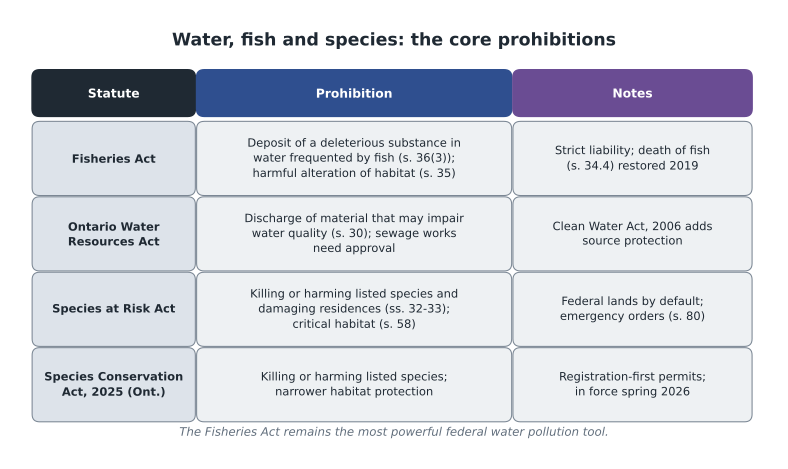
Federal authority over 'sea coast and inland fisheries' under section 91(12) supports the Fisheries Act. Although it began as a statute managing commercial fishing, its pollution and habitat provisions have made it central to environmental law. Those provisions apply across Canada, in every province, to every kind of operation, including municipal sewage systems, mines, farms and factories.
The pollution prohibition is in section 36(3). Subject to regulations that authorize certain deposits, no person may deposit or permit the deposit of a deleterious substance of any type in water frequented by fish, or in any place under any conditions where it, or any other deleterious substance that results from its deposit, may enter such water. 'Deleterious substance' is defined to include any substance that, if added to water, would degrade or alter its quality so that it is rendered or is likely to be rendered deleterious to fish, fish habitat or the use of fish by humans.
The courts have read the prohibition broadly. In R. v. Kingston (City) (2004), the Court of Appeal for Ontario considered leachate from a closed municipal landfill seeping into the Cataraqui River. It held that the focus is on the substance deposited, not on the receiving water: the Crown must prove that the substance, at the time and place of deposit, was deleterious to fish, but need not prove that the river as a whole was actually harmed. Toxicity tests showing that undiluted leachate killed fish in a laboratory were sufficient. The result is that a discharge can breach section 36(3) even if the river dilutes it so quickly that no harm is ever observed downstream.
Applied to the hypothetical Norvell spill, the analysis is straightforward. Xylene-based thinner is acutely toxic to fish; it entered a storm drain from which it could reach, and did reach, the Severn River, which is water frequented by fish. Norvell deposited or permitted the deposit. The only real issue in a prosecution would be the defence of due diligence, discussed in lesson 10.
Regulations authorize some deposits on conditions. The Metal and Diamond Mining Effluent Regulations, the Pulp and Paper Effluent Regulations and the Wastewater Systems Effluent Regulations set effluent limits and testing requirements; a discharger that complies is authorized, and one that does not may be prosecuted under section 36(3). The Wastewater Systems Effluent Regulations, made in 2012, require municipalities to meet national standards for sewage treatment, with phased deadlines for upgrading systems that did not meet them.
The habitat provisions protect the places fish need. Section 35 prohibits carrying on any work, undertaking or activity that results in the harmful alteration, disruption or destruction of fish habitat, and section 34.4 prohibits works, undertakings or activities, other than fishing, that result in the death of fish. Both may be authorized by the Minister, usually with conditions requiring offsetting. Parliament weakened these provisions in 2012 by limiting protection to 'serious harm' to fish that are part of commercial, recreational or Aboriginal fisheries; in 2019 it restored broad protection of all fish and fish habitat, added factors the Minister must consider such as Indigenous knowledge and cumulative effects, and strengthened the role of Indigenous governments.
Reporting and clean-up duties apply too. Where there is a deposit of a deleterious substance not authorized under the Act, or a serious and imminent danger of one, persons who own, manage or control the substance, or who cause or contribute to the deposit, must report it to an inspector or other designated authority without delay and must take all reasonable measures to prevent, counteract, mitigate or remedy its effects. Fisheries Act inspectors can direct those measures. Norvell would have had to report to federal authorities as well as to Ontario's Spills Action Centre; in practice Ontario and Environment and Climate Change Canada coordinate notifications, but the legal duties are separate.
Penalties are heavy, and federal sentencing principles, examined in lesson 10, include minimum fines for some offences. The Fisheries Act has produced Canada's largest environmental fines.
Provincial water law
Provinces own and regulate most inland waters. Ontario's Ontario Water Resources Act (OWRA) prohibits discharging or depositing any material of any kind into or near water that may impair the quality of the water, in section 30, a prohibition that parallels both the EPA and the Fisheries Act. The OWRA also requires a permit to take more than 50,000 litres of water a day from surface or ground water, subject to exceptions such as most domestic and farm uses, and regulates sewage works, which now require environmental compliance approvals under the EPA framework.
The Walkerton tragedy of May 2000 transformed Ontario's approach to drinking water. Justice Dennis O'Connor's inquiry found that contamination from cattle manure entered a poorly protected municipal well and that operators failed to treat and test the water properly, and that provincial cuts to inspection and the privatization of laboratory testing contributed. His recommendations produced the Safe Drinking Water Act, 2002, which sets standards for drinking water systems and licenses operators and laboratories, and the Clean Water Act, 2006, which requires local source protection plans to identify and manage threats to municipal water sources. The Safe Drinking Water Act imposes a statutory standard of care on people with decision-making authority over municipal drinking water systems, including members of municipal council, who must exercise the level of care, diligence and skill a reasonably prudent person would in similar circumstances. Theo Marchetti notes that few councillors seem to know this.
Drinking water on First Nations reserves has a different history. Federal responsibility, inadequate funding and infrastructure, and the lack of enforceable federal standards left many communities under long-term drinking water advisories, some for decades. In 2021, the Federal Court and the Manitoba Court of Queen's Bench approved a national class action settlement, arising from Tataskweyak Cree Nation v. Canada, providing compensation and funding commitments estimated at about eight billion dollars. Daniel Whitecloud points out that compensation does not by itself build a treatment plant. Federal legislation on First Nations clean water has been introduced more than once; students should check its current status.
Boundary and shared waters add an international layer. The Boundary Waters Treaty of 1909 created the International Joint Commission, which approves certain works affecting levels and flows in boundary waters and investigates questions referred by both governments. The Great Lakes Water Quality Agreement commits Canada and the United States to restore and protect the Great Lakes. These instruments influence domestic regulation even though most of their commitments are implemented through ordinary federal and provincial law.
Species at risk
The federal Species at Risk Act (SARA), enacted in 2002, protects wildlife species at risk of extinction. It begins with science: the Committee on the Status of Endangered Wildlife in Canada (COSEWIC), an independent body of experts, assesses species and classifies them as extirpated, endangered, threatened or of special concern. The Governor in Council then decides, on the Minister's recommendation, whether to add the species to Schedule 1 of the Act. The listing decision is political as well as scientific; the government may decline to list or refer the matter back.
Once a species is listed as extirpated, endangered or threatened, section 32 prohibits killing, harming, harassing, capturing or taking an individual, and section 33 prohibits damaging or destroying its residence, such as a den or nest. But these prohibitions apply automatically only to aquatic species and migratory birds protected by the Migratory Birds Convention Act, 1994, and, for other species, only on federal lands. On provincial and private lands, protection of non-aquatic species is left to the provinces, unless the federal government makes a 'safety net' order under section 34 after the Minister forms the opinion that provincial laws do not effectively protect the species.
The Act requires recovery strategies and action plans that identify critical habitat, the habitat necessary for a species' survival or recovery. Critical habitat on federal lands and for aquatic species must be legally protected under section 58. The Federal Court and the Federal Court of Appeal have enforced these duties. In Environmental Defence Canada v. Canada (Fisheries and Oceans), 2009 FC 878, the Federal Court held that the Minister must identify critical habitat in a recovery strategy to the extent possible on the best available information and could not leave it out for policy reasons. In David Suzuki Foundation v. Canada (Fisheries and Oceans), 2012 FCA 40, concerning resident killer whales, the Federal Court of Appeal held that critical habitat must be protected by legally enforceable means, not by ministerial discretion or policy.
The strongest tool is the emergency order under section 80. If the Minister is of the opinion that a species faces imminent threats to its survival or recovery, the Minister must recommend an emergency order, which can apply on any land, including provincial and private land, and can prohibit activities that would harm the species or its habitat. In Le Groupe Maison Candiac Inc. v. Canada (Attorney General), 2020 FCA 88, a developer challenged an emergency order protecting habitat of the western chorus frog on land it planned to develop south of Montreal. The Federal Court of Appeal upheld the order as a valid exercise of the federal criminal law power. Emergency orders remain rare because of their political cost.
Ontario's Species Conservation Act, 2025
Provinces protect species on their lands under their own statutes, which vary widely in strength. Ontario's Endangered Species Act, 2007 was considered one of the stronger provincial laws: species were listed on the advice of an independent scientific committee, habitat of listed species was automatically protected, and recovery strategies were required. In 2025, Ontario enacted the Species Conservation Act, 2025 as part of the Protect Ontario by Unleashing our Economy Act, 2025. It came into force in spring 2026 and repealed the 2007 Act.
The new Act retains prohibitions on killing and harming listed species but narrows the protection of habitat, focusing on specific areas such as dens and nests rather than the broader range of habitat a species uses. It replaces individual permits for many activities with an online registration system under which proponents can often proceed once they register and follow the rules in the regulations, and it no longer requires recovery strategies. Supporters argued that the old Act delayed housing, mining and infrastructure projects without clear conservation benefit. Critics, including environmental organizations, argued that the changes will harm wide-ranging species such as woodland caribou and called for federal intervention under SARA's safety net. For Norvell and Caskey Lake, the practical effect is that provincial species approvals may be faster but federal protections for aquatic species, such as lake sturgeon where listed, and migratory birds still apply in full.
Worked problem
Caskey Lake and the sturgeon
Northbrae's tailings facility will destroy two small streams, and its effluent will discharge to a river that, in the hypothetical, supports a lake sturgeon population listed under SARA as endangered. Woodland caribou range overlaps the access road. Northbrae's environmental manager asks which federal and provincial approvals are needed.
Show solution
- Fisheries Act habitat. Destroying fish-bearing streams requires a section 35 authorization, with an offsetting plan; Indigenous knowledge and cumulative effects must be considered.
- Fisheries Act pollution. Mine effluent discharged to fish-bearing water must not be deleterious unless authorized by regulation; Northbrae must design treatment to meet the applicable effluent standards and test regularly.
- SARA for sturgeon. As an aquatic species, listed sturgeon are protected everywhere by sections 32 and 33; critical habitat identified in the recovery strategy must not be destroyed, and any permit under section 73 requires that all reasonable alternatives be considered and that survival or recovery not be jeopardized.
- Caribou. Woodland caribou are not aquatic, so SARA's prohibitions apply on federal lands only unless a safety net or emergency order applies; provincial protection now flows from the Species Conservation Act, 2025, likely through registration.
- Coordinate with assessment and consultation. These federal decisions are also Crown decisions triggering the duty to consult, and will feed into any Impact Assessment Act process.
Common mistakes
MistakeRequiring proof that a river was actually harmed to convict under section 36(3).
InsteadThe test focuses on whether the substance deposited was deleterious; dilution in the receiving water is no defence (Kingston).
MistakeAssuming SARA protects all listed species everywhere.
InsteadIts prohibitions apply everywhere only to aquatic species and migratory birds; other species are protected on federal lands unless a safety net or emergency order applies.
MistakeTreating critical habitat protection as discretionary policy.
InsteadDavid Suzuki Foundation (2012 FCA 40) requires legally enforceable protection.
MistakeAssuming Ontario's Endangered Species Act, 2007 still governs.
InsteadIt was repealed and replaced by the Species Conservation Act, 2025, in force since spring 2026.
Practice problems
Work each problem on paper first, then reveal the answer to check.
What does section 36(3) of the Fisheries Act prohibit?
Show answer
Depositing or permitting the deposit of a deleterious substance in water frequented by fish or anywhere it may enter such water, unless authorized by regulation.
When does SARA's prohibition on killing a listed species apply on private land?
Show answer
Automatically for aquatic species and migratory birds; for other species only if a safety net order under section 34 or an emergency order under section 80 applies.
What did Le Groupe Maison Candiac decide?
Show answer
That the emergency order protecting western chorus frog habitat was a valid exercise of the federal criminal law power.
Summary and key terms
- The Fisheries Act prohibits deposits of deleterious substances into water frequented by fish (s. 36(3)), harmful alteration of fish habitat (s. 35) and the death of fish (s. 34.4).
- Kingston focuses the deleterious substance test on the substance deposited, not the receiving water.
- Provincial water law, such as the OWRA, the Safe Drinking Water Act, 2002 and the Clean Water Act, 2006, regulates discharges, water takings and drinking water after Walkerton.
- SARA protects listed species through prohibitions, critical habitat protection and emergency orders, but applies on non-federal land mainly to aquatic species and migratory birds.
- Ontario's Species Conservation Act, 2025, in force since spring 2026, narrows habitat protection and moves to registration-based permissions.
- Deleterious substance
- Under the Fisheries Act, a substance that would degrade water so that it is or is likely to be harmful to fish, fish habitat or human use of fish.
- Water frequented by fish
- Canadian fisheries waters and other waters that fish use, the trigger for the section 36(3) prohibition.
- Harmful alteration, disruption or destruction (HADD)
- Changes to fish habitat prohibited by section 35 of the Fisheries Act unless authorized.
- COSEWIC
- The independent scientific committee that assesses the status of wildlife species for SARA.
- Critical habitat
- Habitat necessary for the survival or recovery of a listed species, identified in a recovery strategy or action plan.
- Emergency order
- An order under section 80 of SARA protecting a species facing imminent threats, which can apply on any land.
Lesson quiz · 5 questions
Score 60% or more to complete this lesson.
Create a free account to save your progress, take quizzes and earn a certificate.