
LAWC-313 · Lesson 5 of 12 · 20 min
Pollution regulation
▶ Video coming soon A video version of this lesson is on the way.
Wyndham returns to the jar of Severn River water. 'Lesson 4 was about permission,' she says. 'Today is about prohibition and cure: what the law forbids, what the Ministry can order, and what happens when something spills.' The class spends the session on Ontario's Environmental Protection Act (EPA), the province's general pollution statute, applying it to the hypothetical Norvell spill and the older contamination under the plant.
Most provinces have a general statute of this kind, and the concepts are similar across Canada: a broad prohibition on harmful discharges, an approval system, administrative orders to stop or clean up pollution, special rules for spills, and offences. Ontario's EPA is the model this course uses because Brannock is in Ontario and because Ontario cases have shaped much of the national law.
The core definitions
Everything in the EPA turns on two defined terms. A 'contaminant' is any solid, liquid, gas, odour, heat, sound, vibration or radiation, or combination of them, resulting directly or indirectly from human activities, that causes or may cause an adverse effect. The definition is circular by design: a substance is a contaminant because of what it does, not what it is. Clean water released in a flood can be a contaminant if it causes damage; sound from a concrete plant can be a contaminant if it disturbs neighbours.
An 'adverse effect' is defined broadly to include impairment of the quality of the natural environment for any use that can be made of it; injury or damage to property or to plant or animal life; harm or material discomfort to any person; an adverse effect on the health of any person; impairment of the safety of any person; rendering any property or plant or animal life unfit for human use; loss of enjoyment of normal use of property; and interference with the normal conduct of business. The 'natural environment' means the air, land and water, or any combination of them.
Those definitions are deliberately wide. In Ontario v. Canadian Pacific Ltd., [1995] 2 S.C.R. 1031, Canadian Pacific was charged after burning brush along its right of way, producing smoke that affected neighbours. It argued that the prohibition on discharging contaminants likely to cause 'impairment of the quality of the natural environment for any use that can be made of it' was so vague that it violated section 7 of the Charter. The Supreme Court disagreed. Gonthier J. held that environmental protection legislation must be drafted broadly to respond to a wide range of harms, that the provision provided enough guidance for legal debate, and that courts could read it in light of its purpose to exclude trivial impairments.
The general prohibition
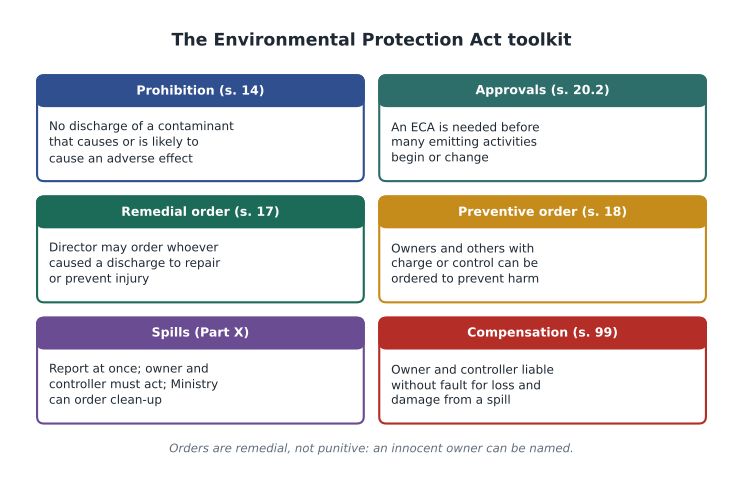
Section 14 of the EPA is the central prohibition. Subject to limited exceptions, such as discharges from normal farming practices, a person must not discharge a contaminant, or cause or permit the discharge of a contaminant, into the natural environment if the discharge causes or may cause an adverse effect. Section 6 separately prohibits discharges that exceed limits set by regulation, whether or not an adverse effect results.
Three features of section 14 matter in practice. First, it applies whether or not the discharger holds an ECA; an approval that does not specifically authorize a discharge does not excuse a discharge that causes an adverse effect. Second, 'causes or permits' reaches beyond the person who physically releases the contaminant. A company that controls the activity, or that fails to prevent a discharge it could have prevented, may permit it. Third, the prohibition covers potential harm: the Crown need not prove that damage actually occurred, only that the discharge may cause an adverse effect.
In R. v. Castonguay Blasting Ltd., 2013 SCC 52, a blasting contractor working on a highway project set off a blast that threw rock debris (flyrock) onto a nearby house and car. It did not report the incident to the Ministry. Section 15 of the EPA requires a person who discharges a contaminant out of the normal course of events, where the discharge causes or is likely to cause an adverse effect, to notify the Ministry forthwith. The company argued that the duty applied only to discharges causing significant harm to the natural environment. Abella J., for the Court, rejected that argument: the duty applies to any discharge out of the normal course that causes or is likely to cause an adverse effect as defined, subject only to the exclusion of trivial effects. The reporting duty exists precisely so that the Ministry can decide whether the harm is significant.
Orders
Prosecution punishes past wrongdoing. Orders prevent and repair harm. The EPA gives the Director and provincial officers a range of order-making powers, and these are often more important than prosecution on a real file.
A provincial officer may issue an order to a person who contravenes the Act, a regulation or an approval, requiring compliance and specifying steps. A remedial order under section 17 may be made against a person who caused or permitted a discharge that injured, damaged or endangered land, water, property, plant or animal life or human health or safety, requiring the person to repair or prevent the injury or, where a water supply has been affected, to provide an alternative supply. A preventive order under section 18 may be made where the Director reasonably believes it is necessary or advisable to prevent or reduce the risk of a discharge, or to prevent, decrease or eliminate an adverse effect. Section 18 orders may be directed to a broad range of people: the current or a previous owner of the undertaking or property, and a person who has or had charge, management or control of it.
Orders are remedial rather than punitive, so they do not require proof of fault. The Ontario tribunals have upheld orders against owners who did not cause the contamination but who own the land now. The Ministry's practice has been to consider factors such as whether the person caused the problem, had knowledge or control, benefited from the polluting activity and acted with due diligence when deciding whom to name. But those factors guide discretion; they are not legal preconditions.
Orders can also reach individuals. Because section 18 reaches anyone who had management or control, directors and officers can be named. The best-known example is the Northstar Aerospace matter, in which the Ministry named former directors of an insolvent aerospace parts company in orders to continue remediating groundwater contamination in Cambridge, Ontario, after the company went bankrupt; the directors ultimately settled. Under section 194, directors and officers also have a statutory duty to take all reasonable care to prevent the corporation from causing certain discharges and contraventions, and breach of that duty is an offence. Theo Marchetti asks whether Norvell's board members should be worried. 'They should be well informed,' Wyndham says. 'Informed directors who insist on good systems are the ones the Ministry rarely names.'
The historical contamination
The investigation of the hypothetical spill reveals older solvent contamination in the soil and groundwater under the Norvell yard. Historical records suggest it came from Lucan Industries, which operated the plant from the 1970s until it sold the site to Norvell in 2012. Lucan still exists as a holding company with some assets.
The Director could name Norvell, as the current owner and the person in control, in a section 18 order requiring it to delineate and remediate the contamination, even though Norvell did not cause it. The Director could also name Lucan as a previous owner and the person who had management and control when the contamination occurred. Lesson 10 discusses Imperial Oil Ltd. v. Quebec (Minister of the Environment), 2003 SCC 58, in which the Supreme Court upheld a similar order against a former owner under Quebec's Environment Quality Act and invoked the polluter pays principle.
Norvell's lawyers would ask several questions. Did Norvell's 2012 purchase agreement include environmental representations, warranties or indemnities from Lucan? Was a Phase I or Phase II environmental site assessment done? Did anyone file a record of site condition under Part XV.1 of the EPA and its regulation? A record of site condition, filed after the site meets prescribed standards for its intended use, provides certain protections from future orders in respect of the contamination it addresses. Each of these affects both the regulatory exposure and the private allocation of risk between Norvell and Lucan.
Insolvency and environmental orders
A recurring problem arises when the polluter is insolvent. In Newfoundland and Labrador v. AbitibiBowater Inc., 2012 SCC 67, the Supreme Court held that environmental orders can be 'claims' provable in insolvency if three conditions are met: there is a debt, liability or obligation to a creditor; it arose before the insolvency proceedings; and it is possible to attach a monetary value to it, which requires that it be sufficiently certain the regulator will perform the remediation and claim reimbursement. In Orphan Well Association v. Grant Thornton Ltd., 2019 SCC 5, the Court held that Alberta's requirements for an insolvent oil company to clean up abandoned wells were not provable claims, because the regulator was acting in the public interest rather than as a creditor, and so the trustee had to satisfy them before distributing assets to secured creditors. LAWC-304 examines Redwater in the oil and gas setting. For pollution regulation generally, the lesson is that regulators may be able to require remediation from an insolvent estate before creditors are paid, depending on how the obligation is framed.
Spills
Part X of the EPA creates a special regime for spills. A 'spill' is a discharge of a pollutant into the natural environment from or out of a structure, vehicle or other container that is abnormal in quality or quantity in light of all the circumstances. The tank failure at Norvell is a classic spill.
Three duties follow. First, notification: the person who spills, and the person having control of the pollutant, must notify the Ministry, the municipality and the owner of the pollutant forthwith. Ontario operates a 24-hour Spills Action Centre for this purpose. Second, the duty to act: the owner of the pollutant and the person having control of it must do everything practicable to prevent, eliminate and ameliorate the adverse effect and to restore the natural environment. Third, the Director may make orders requiring specified clean-up steps, and the Ministry may do the work itself and recover its costs.
Section 99 adds a civil remedy. The Crown in right of Ontario and any other person have the right to compensation from the owner of the pollutant and the person having control of it for loss or damage incurred as a direct result of the spill, and for reasonable costs of carrying out orders or directions. Liability does not depend on fault. The defences are narrow: the owner or controller must prove that it took all reasonable steps to prevent the spill, or that the spill was caused by an act of war, a natural phenomenon of an exceptional character, or an intentional act or omission of a third party. Dervla Yarrow's claim, which lesson 11 develops, would rely on section 99.
Municipal sewer use by-laws add another layer. Norvell's ECA for its pre-treatment system allows discharges to the sanitary sewer within limits; the city's by-law sets limits for substances such as solvents, metals and oils, prohibits discharges to storm sewers and authorizes surcharges and prosecution. Because the spill entered a storm drain, it likely contravened the by-law as well.
Worked problem
The Norvell spill under the EPA
In the hypothetical, Norvell reported the spill four hours after discovery, after the plant manager tried unsuccessfully to pump the storm drain dry. The Ministry has issued a provincial officer's order requiring delineation of the plume in the river sediment. The Director is considering a section 18 order for the historical contamination naming Norvell and Lucan, and a separate order naming Quennell personally. Analyze Norvell's regulatory exposure.
Show solution
- Classify the event. The tank failure is a spill under Part X: a discharge of a pollutant from a container, abnormal in quantity. It also likely contravenes section 14 because the discharge caused dead fish, odour and impairment of river water.
- Assess reporting. The duty to notify is 'forthwith'. A four-hour delay while attempting containment may be argued as reasonable in the circumstances, but it creates a risk of a separate charge; the facts of what the manager knew and when will matter.
- Address the duty to act and orders. Norvell, as owner and controller, must do everything practicable to restore the environment; compliance with the officer's order is mandatory pending any appeal.
- Consider the section 18 order. Norvell can be named as current owner even if Lucan caused the historical contamination; it should argue that Lucan, as polluter and previous owner, should bear primary responsibility and seek an allocation.
- Consider the individual order. Quennell had management or control; naming him is possible but unusual for a plant manager acting under a board. Counsel should provide evidence of systems and diligence and consider whether the company will indemnify him.
- Plan the appeal route. Orders can be appealed to the Ontario Land Tribunal within the statutory time limit, but filing an appeal does not automatically stay most orders.
Common mistakes
MistakeThinking a substance must be inherently toxic to be a contaminant.
InsteadUnder the EPA, anything from human activity that causes or may cause an adverse effect is a contaminant, including noise, odour and clean water.
MistakeAssuming an ECA excuses any discharge from the facility.
InsteadSection 14 applies unless the discharge is specifically authorized; a discharge causing an adverse effect may be unlawful even under an ECA.
MistakeTreating orders as requiring proof of fault.
InsteadOrders are remedial; current owners and others with control can be named even if they did not cause the contamination.
MistakeAssuming bankruptcy ends environmental obligations.
InsteadUnder Redwater, regulatory obligations not owed to a creditor may survive and must be met before distribution to creditors.
Practice problems
Work each problem on paper first, then reveal the answer to check.
Why did the Supreme Court in Canadian Pacific reject the vagueness challenge to the EPA prohibition?
Show answer
Because environmental legislation must be broad to address diverse harms, the provision gave enough guidance for legal debate, and courts could read it purposively to exclude trivial impairments.
What did Castonguay Blasting decide about the reporting duty in section 15?
Show answer
That it applies to any discharge out of the normal course that causes or is likely to cause an adverse effect, not only to significant environmental harm, subject to excluding trivial effects.
What defences are available to a section 99 compensation claim?
Show answer
That the owner or controller took all reasonable steps to prevent the spill, or that it was caused by an act of war, a natural phenomenon of exceptional character, or an intentional act or omission of a third party.
Summary and key terms
- The EPA defines contaminants and adverse effects broadly, and Canadian Pacific upheld that breadth against a vagueness challenge.
- Section 14 prohibits discharges that cause or may cause an adverse effect, regardless of approval, and section 15 requires reporting of abnormal discharges (Castonguay Blasting).
- Remedial and preventive orders can be issued without proof of fault to current and previous owners and those with charge, management or control, including directors.
- Insolvency does not automatically end remediation obligations (AbitibiBowater, Redwater).
- Part X imposes immediate notification and clean-up duties for spills, and section 99 creates no-fault compensation with narrow defences.
- Contaminant
- Under the EPA, any substance or energy from human activity that causes or may cause an adverse effect.
- Adverse effect
- A broadly defined harm under the EPA, including impairment of the environment, harm to health, property damage and loss of enjoyment of property.
- Preventive order
- An order under section 18 of the EPA requiring measures to prevent or reduce a discharge or adverse effect.
- Spill
- A discharge of a pollutant from a structure, vehicle or container that is abnormal in quality or quantity.
- Record of site condition
- A filed record confirming that a property meets prescribed standards for its use, which provides some protection from future orders.
- Spills Action Centre
- Ontario's 24-hour ministry line for reporting spills and environmental emergencies.
Lesson quiz · 5 questions
Score 60% or more to complete this lesson.
Create a free account to save your progress, take quizzes and earn a certificate.