
LAWC-313 · Lesson 1 of 12 · 21 min
Environmental law: sources, principles and actors
▶ Video coming soon A video version of this lesson is on the way.
The first class of LAWC-313 begins with a jar of river water on the lectern. Professor Cressida Wyndham, who spent twelve years prosecuting environmental offences for Ontario's Ministry of the Environment before running a community environmental law clinic for eight more, holds it up to the light. 'This came out of the Severn River behind the Norvell Coatings plant,' she says, describing a hypothetical file the class will follow all term. 'Before you can tell me whether anyone broke the law, you need three things: who had the power to decide what could go into this river, what duty they owed, and who pays when it goes wrong.' She writes her board question for the term: 'What is being harmed, who decided, and who pays?' Her rule for every answer is shorter: 'Find the power, then the duty.'
Environmental law is not a single code. It is a layered body of constitutional rules, federal and provincial statutes, regulations, permits, municipal by-laws, common law torts, Indigenous law and international commitments. This lesson maps those sources, introduces the principles that courts and legislatures use to interpret them, and identifies the people and institutions who make, apply and challenge environmental decisions. The rest of the course builds on this map.
Why environmental law looks the way it does
Modern Canadian environmental law grew out of a series of crises. In the 1960s and 1970s, mercury contamination of the English-Wabigoon river system in northwestern Ontario, caused by discharges from a pulp and paper operation upstream, devastated the fishery and the health of the Grassy Narrows and Wabaseemoong communities, with effects that continue today. Acid rain from smelters and power plants killed lakes across the Canadian Shield. Ontario enacted its Environmental Protection Act in 1971 and the federal government created a Department of the Environment the same year. The 1980s brought the Mississauga train derailment and chlorine release, and a growing awareness of toxic chemicals. In May 2000, contamination of the municipal water supply in Walkerton, Ontario with E. coli killed seven people and made about 2,300 ill. The inquiry that followed led directly to the Safe Drinking Water Act, 2002 and the Clean Water Act, 2006.
Each crisis produced legislation designed to prevent the last disaster. That history explains a feature students notice quickly: environmental law is reactive and fragmented. There is no single 'environment ministry act' that covers everything. Instead, a contaminated site may engage a provincial environmental protection statute, a water statute, the federal Fisheries Act, municipal sewer by-laws, a provincial approval with its own conditions, and the law of nuisance, all at once.
Hannah Kowalczyk, who worked in an oil and gas regulatory office in Calgary before law school, puts it bluntly: 'Every regulator I ever dealt with thought their statute was the only one.' Wyndham agrees that this is the practical challenge. A competent environmental lawyer's first task on any file is to list every instrument that might apply, and only then to decide which matters most.
The sources
The Constitution sets the outer limits. Neither order of government has exclusive authority over 'the environment'; as lesson 2 explains, the Supreme Court of Canada has described it as a diffuse subject that cuts across many heads of power. Federal laws rest mainly on the criminal law power, fisheries, navigation and the national concern branch of peace, order and good government. Provincial laws rest on property and civil rights, local works and matters of a merely local nature, and natural resources.
Statutes do most of the work. Federally, the main ones are the Canadian Environmental Protection Act, 1999 (CEPA), the Fisheries Act, the Impact Assessment Act, the Species at Risk Act, the Greenhouse Gas Pollution Pricing Act and the Canadian Net-Zero Emissions Accountability Act. In Ontario, the core statutes are the Environmental Protection Act (EPA), the Ontario Water Resources Act, the Environmental Assessment Act, the Environmental Bill of Rights, 1993, the Clean Water Act, 2006, the Safe Drinking Water Act, 2002 and, since spring 2026, the Species Conservation Act, 2025. Other provinces have their own counterparts, such as Alberta's Environmental Protection and Enhancement Act and Quebec's Environment Quality Act.
Regulations fill in the detail. Most environmental statutes are framework laws that set prohibitions and powers in general terms and leave standards, thresholds and procedures to regulations. A statute may prohibit discharging a contaminant that causes an 'adverse effect'; a regulation will set a numerical limit for sulphur dioxide at the property line. Students must learn to read the two together.
Instruments issued to individual operators are the third layer. An environmental compliance approval (ECA) in Ontario, a licence under Alberta law, a permit to take water or a federal decision statement under the Impact Assessment Act each impose conditions on a particular facility or project. Breaching a condition is usually an offence in its own right. On most files, the approval is the document the client will be measured against.
Policy and guidance are not law, but they matter. Ministries publish compliance policies, guidelines on how they will exercise discretion and guidance on technical standards. Courts reviewing administrative decisions, as LAWC-202 taught, will often look at whether a decision maker followed or departed from its own published guidance when assessing whether a decision was reasonable.
The common law remains important. Nuisance, trespass, negligence and the rule in Rylands v. Fletcher predate every statute and still allow private parties to recover for environmental harm. Lesson 11 examines them in detail. Quebec's Civil Code supplies a no-fault neighbourhood disturbance rule in article 976, which the Supreme Court applied in St. Lawrence Cement Inc. v. Barrette, 2008 SCC 64.
Indigenous law and Aboriginal and treaty rights are a further source. Section 35 of the Constitution Act, 1982 protects Aboriginal and treaty rights, and the Crown's duty to consult and accommodate shapes nearly every major resource and environmental decision. LAWC-114 introduced these doctrines and LAWC-304 applies them in depth to resources and energy; this course refers to them where they intersect with environmental regulation rather than repeating them. Many First Nations also have their own environmental laws, land use plans and guardian programs, and federal and provincial statutes increasingly refer to Indigenous knowledge and to the United Nations Declaration on the Rights of Indigenous Peoples Act.
International law influences domestic law without usually binding directly. Canada is party to the Paris Agreement, the Convention on Biological Diversity, the Basel Convention on hazardous waste and many others. Canadian courts presume that Parliament intends to comply with international obligations, and in 114957 Canada Ltée (Spraytech, Société d'arrosage) v. Hudson (Town), 2001 SCC 40, the Supreme Court used the precautionary principle, drawn from international instruments, to help interpret a municipal pesticide by-law.
The principles
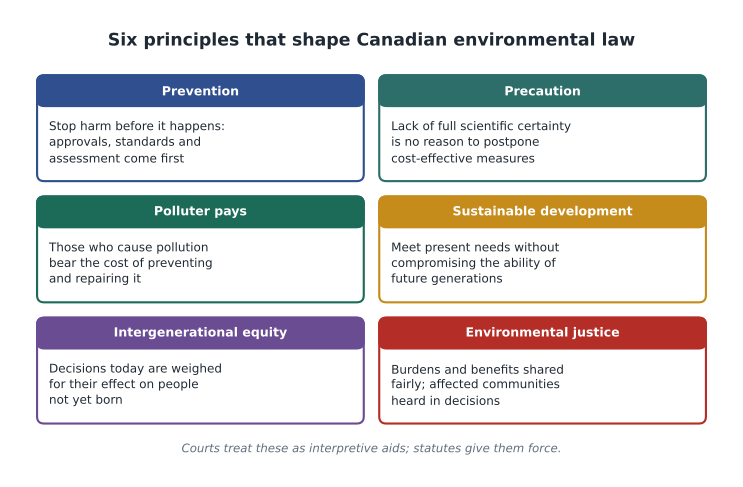
Six principles recur throughout environmental law. None of them is a free-standing rule that a court will enforce on its own; their force comes from being written into statutes, used to interpret them or relied on in judicial reasoning.
Prevention is the oldest. Rather than waiting for harm and then compensating victims, environmental statutes require approvals before emitting activities begin, set standards that limit releases, and require assessment of major projects before they are built. The approval system in Ontario's EPA is a prevention tool.
Precaution addresses uncertainty. The classic formulation, from Principle 15 of the 1992 Rio Declaration, is that where there are threats of serious or irreversible damage, lack of full scientific certainty should not be used as a reason for postponing cost-effective measures to prevent environmental degradation. CEPA's preamble and section 2 commit the federal government to apply it. In Spraytech, L'Heureux-Dubé J. relied on it to support the town's power to restrict cosmetic pesticide use even though the science on health effects was not settled.
Polluter pays means that those who cause pollution should bear the costs of preventing and remedying it, rather than the public. In Imperial Oil Ltd. v. Quebec (Minister of the Environment), 2003 SCC 58, the Supreme Court described the principle as firmly entrenched in environmental law in Canada and used it to support the minister's power to order a former owner to pay for a study of contamination it had caused decades earlier. Lesson 10 returns to that case.
Sustainable development, popularized by the 1987 Brundtland Report, asks decision makers to integrate environmental, social and economic considerations. Intergenerational equity, a close cousin, asks that decisions be weighed for their effect on future generations. Both appear in CEPA, in the Federal Sustainable Development Act and in many provincial statutes. The federal implementation framework for the right to a healthy environment under CEPA, published in July 2025, lists environmental justice, intergenerational equity and non-regression as guiding principles.
Environmental justice is the newest principle to receive legislative recognition. It asks whether environmental burdens, such as polluting facilities, contaminated sites and poor air quality, fall disproportionately on racialized, Indigenous and low-income communities, and whether those communities have a fair voice in decisions. Parliament enacted the National Strategy Respecting Environmental Racism and Environmental Justice Act in 2024, and a draft national strategy for 2026 to 2031 was released in June 2026. Lesson 11 examines these developments.
The actors
Governments make the rules. Federally, Environment and Climate Change Canada administers CEPA and much of the Fisheries Act pollution regime, Fisheries and Oceans Canada administers the habitat provisions, and the Impact Assessment Agency of Canada runs federal assessments. In Ontario, the Ministry of the Environment, Conservation and Parks issues approvals and orders, investigates and prosecutes. Directors and provincial officers named in the statutes exercise most of the powers. Municipalities regulate land use, sewers and nuisances under authority delegated by provincial statutes.
Courts and tribunals resolve disputes. The Ontario Land Tribunal, which in 2021 absorbed the former Environmental Review Tribunal, hears appeals from ministry orders and approvals. Provincial courts try offences. Superior courts hear civil claims and judicial review applications; in Ontario, judicial review of most provincial environmental decisions goes to the Divisional Court. The Federal Court reviews federal decisions, such as listings under CEPA and decisions under the Impact Assessment Act.
Indigenous governments are both rights holders and regulators. Many negotiate impact benefit agreements, participate in assessments as partners and, increasingly, run their own assessment and monitoring processes. Daniel Whitecloud, who worked in band administration in northern Saskatchewan, notes that from a First Nation's perspective the question is often not 'which Crown decides' but 'whose law applies on this land'. Wyndham asks the class to hold that question for lesson 3.
Industry is the regulated party, but also a major source of technical expertise. Companies apply for approvals, monitor their own emissions, report spills and fund much of the scientific work in assessments. Their lawyers negotiate approval conditions, respond to orders and defend prosecutions.
The public, community groups and environmental organizations participate in decisions, monitor compliance and litigate. Ontario's Environmental Bill of Rights gives residents rights to notice and comment, to seek leave to appeal some approvals, to request reviews and investigations and, in limited circumstances, to sue. Public interest litigants have shaped much of Canadian environmental law, from Oldman River to the climate cases studied in lesson 9.
The Norvell file
Wyndham introduces the hypothetical file the class will return to all term. Norvell Coatings Ltd. operates a paint and industrial coatings plant on the bank of the Severn River in Corwin. It bought the site in 2012 from Lucan Industries Ltd., which had made solvent-based finishes there since the 1970s. Norvell holds an ECA for air emissions and for its on-site wastewater pre-treatment system, which discharges to the city sewer. Plant manager Aldous Quennell reports to a board in Toronto.
Early one spring morning, in the hypothetical, a storage tank of xylene-based thinner fails during a transfer. Several thousand litres flow across the yard and into a storm drain that empties into the river, not the sanitary sewer. Within hours, residents downstream report a chemical smell and dead fish along the bank. Dervla Yarrow, a retired teacher whose riverfront property is two hundred metres downstream, has a private well and a vegetable garden that floods each spring. Investigation later reveals soil and groundwater contamination under the yard that predates the spill and appears to come from Lucan's operations.
Wyndham asks the class to list every legal regime that might apply. The students produce a long list: the EPA's spill provisions and its general discharge prohibition, the conditions of Norvell's ECA, the Ontario Water Resources Act, the Fisheries Act prohibition on depositing deleterious substances in water frequented by fish, the city's sewer use by-law, the possibility of an order against Lucan as a former owner, a claim by Yarrow in nuisance or under section 99 of the EPA, and possible prosecutions of Norvell and its officers. 'Good,' Wyndham says. 'Now you know why this course has twelve lessons.'
Worked problem
First steps on the Norvell file
Norvell's general counsel calls the clinic's former partner firm at 7 a.m. on the morning of the hypothetical spill. Quennell has had the tank isolated, but no one has called anyone outside the company. The general counsel asks whether Norvell can wait until it knows how much was released before notifying the Ministry. What should the lawyer advise in the first hour?
Show solution
- Identify the immediate statutory duties. The EPA requires a person who spills a pollutant, or who has control of it, to notify the Ministry forthwith, and imposes duties to act to prevent, eliminate and ameliorate adverse effects. The ECA likely contains its own reporting conditions.
- Advise that reporting cannot wait for full information. 'Forthwith' means as soon as reasonably possible; a delay to gather data risks a separate offence and undermines any later due diligence defence.
- Address containment. The company must take all reasonable steps to stop the flow, protect the storm outfall and begin clean-up, using contractors if needed. These steps are both legally required and the best evidence of diligence.
- Preserve evidence and privilege. Document the tank's condition, maintenance records and the timeline; consider retaining technical experts through counsel so their reports attract litigation privilege.
- Flag the other regimes. A deposit into fish-bearing water may engage the Fisheries Act, which has its own reporting duty to federal authorities. Downstream residents may need warnings. Note the possible historical contamination as a separate issue for later.
Common mistakes
MistakeTreating environmental law as a single statute.
InsteadAny incident may engage federal and provincial statutes, regulations, approvals, by-laws and the common law at once; list them all first.
MistakeTreating the precautionary principle as an enforceable rule on its own.
InsteadPrinciples guide interpretation and policy; their legal force comes from statutes and judicial reasoning that adopt them.
MistakeIgnoring the approval or licence.
InsteadThe ECA or permit is usually the most specific source of a facility's obligations, and breach of a condition is itself an offence.
MistakeDelaying a spill report to gather complete information.
InsteadReporting duties are immediate; delay creates a separate risk and weakens any due diligence defence.
Practice problems
Work each problem on paper first, then reveal the answer to check.
Name four layers of legal sources that might apply to a single industrial facility.
Show answer
Constitutional limits, federal and provincial statutes, regulations made under them, approvals or licences issued to the facility, municipal by-laws, and the common law (any four).
How did the Supreme Court use the precautionary principle in Spraytech?
Show answer
It used the principle, drawn from international law, as an aid to interpret and support a municipal by-law restricting cosmetic pesticide use despite scientific uncertainty.
Which tribunal hears appeals from Ontario environmental approvals and orders today?
Show answer
The Ontario Land Tribunal, which absorbed the Environmental Review Tribunal in 2021.
Summary and key terms
- Canadian environmental law grew in response to crises and is layered and fragmented across constitutional, statutory, regulatory, permit, by-law and common law sources.
- Federal and provincial statutes are framework laws; regulations and site-specific approvals supply most of the detail a client must meet.
- Prevention, precaution, polluter pays, sustainable development, intergenerational equity and environmental justice guide interpretation and policy.
- Governments, regulators, courts, tribunals, Indigenous governments, industry and the public all make, apply or challenge environmental decisions.
- Every file begins by listing every regime that may apply, then deciding which matters most.
- Framework statute
- A statute that sets general prohibitions and powers and leaves detailed standards to regulations and approvals.
- Environmental compliance approval
- An Ontario approval authorizing an activity that may discharge contaminants, subject to conditions.
- Precautionary principle
- The principle that lack of full scientific certainty should not postpone cost-effective measures to prevent serious or irreversible harm.
- Polluter pays principle
- The principle that those who cause pollution should bear the cost of preventing and remedying it.
- Environmental justice
- The fair distribution of environmental burdens and benefits and meaningful participation of affected communities in decisions.
- Intergenerational equity
- The principle that present decisions should account for their effects on future generations.
Lesson quiz · 5 questions
Score 60% or more to complete this lesson.
Create a free account to save your progress, take quizzes and earn a certificate.