
LAWC-312 · Lesson 9 of 12 · 20 min
Trademark infringement, depreciation and passing off
▶ Video coming soon A video version of this lesson is on the way.
Kaplinsky starts the ninth class by holding up two boxes. One is a Kettlebrook Loom box: green, with the kettle logo and the word KETTLEBROOK in white capitals. The other is a Sonavant box: dark grey, with the word KETTLEBORNE in white capitals, a stylized steam cloud and, in small print, 'by Sonavant'. 'Would you confuse them?' she asks. Theo says no, because the colours differ and the Sonavant name is on the box. Sophie says she might, if she saw an online listing without the box. Kaplinsky says both answers capture part of the test, and that the law asks a precise question about a hypothetical consumer. This lesson covers the statutory claims for infringement and depreciation, the law of passing off and the remedies.
The structure of the statutory claims
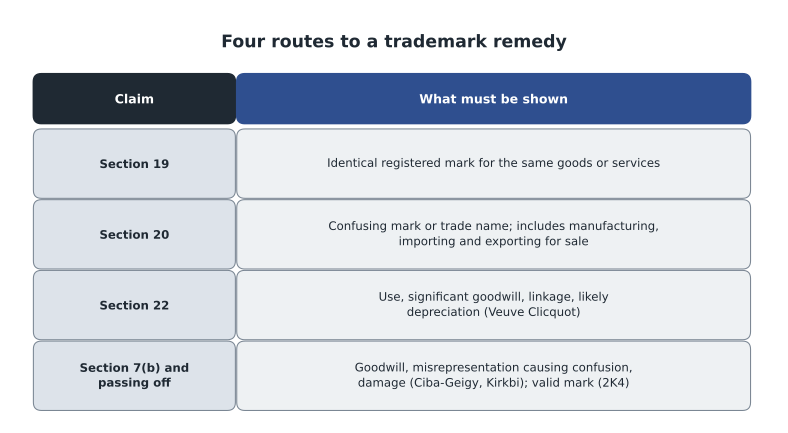
The Trademarks Act gives the owner of a registered trademark three main claims. Section 19 gives the exclusive right to the use throughout Canada of the registered mark in respect of the registered goods and services, and is infringed by use of the identical mark for the same goods or services. Section 20 deems the right to be infringed by a person who sells, distributes or advertises goods or services in association with a confusing trademark or trade name, and, since amendments in force on January 1, 2015, by a person who manufactures, causes to be manufactured, possesses, imports, exports or attempts to export goods for the purpose of their sale or distribution in association with a confusing mark, or deals in labels or packaging for that purpose. Section 22 prohibits use of a registered trademark in a manner likely to have the effect of depreciating the value of the goodwill attaching to it. Section 7(b), the statutory form of passing off, protects registered and unregistered marks alike.
Confusion
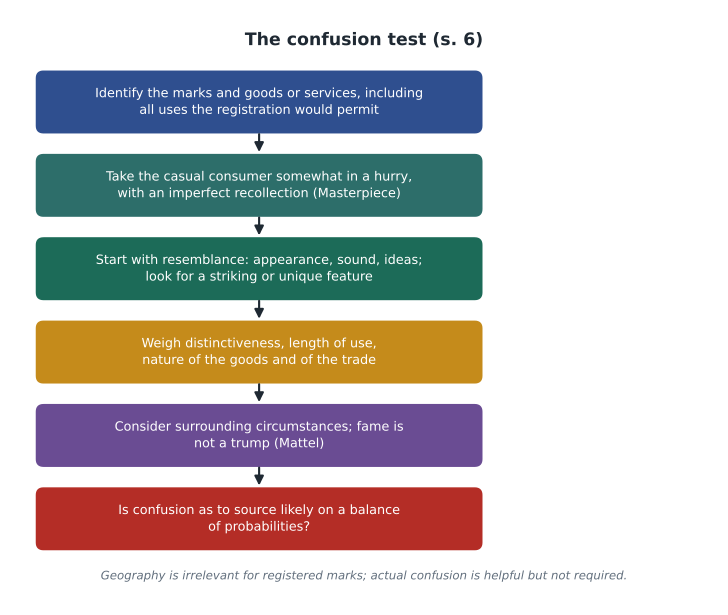
Confusion is defined in section 6. Under section 6(2), the use of a trademark causes confusion with another trademark if the use of both in the same area would be likely to lead to the inference that the goods or services associated with them are manufactured, sold, leased, hired or performed by the same person, whether or not the goods or services are of the same general class or appear in the same class of the Nice Classification. The question is confusion as to source, not whether consumers would mistake one mark for the other in a side-by-side comparison. Section 6(5) directs the court or Registrar to have regard to all the surrounding circumstances, including the inherent distinctiveness of the marks and the extent to which they have become known, the length of time they have been in use, the nature of the goods, services or business, the nature of the trade, and the degree of resemblance between the marks in appearance or sound or in the ideas suggested by them.
Mattel and Veuve Clicquot
In 2006 the Supreme Court decided two cases about famous marks on the same day. In Mattel, Inc. v. 3894207 Canada Inc., 2006 SCC 22, Mattel opposed the registration of BARBIE'S, with a design, for restaurant and catering services in Montreal. The Court held that fame is an important surrounding circumstance but is not a trump card. The test is whether the casual consumer, somewhat in a hurry, encountering the restaurant's mark with an imperfect recollection of Mattel's BARBIE mark, would likely infer that the restaurant was associated with Mattel. Because the goods and services were very different and there was no evidence that consumers would make that inference, the Registrar was entitled to find no likelihood of confusion. Justice Binnie rejected the idea that a famous mark is automatically protected across all product lines.
In Veuve Clicquot Ponsardin v. Boutiques Cliquot Ltée, 2006 SCC 23, the owner of the champagne mark VEUVE CLICQUOT sued women's clothing stores in Quebec and Ontario called Cliquot. The Court found no likelihood of confusion, given the differences in goods, trade channels and clientele, despite the fame of the champagne mark. It then considered depreciation of goodwill under section 22, discussed below.
Masterpiece
The leading case on resemblance is Masterpiece Inc. v. Alavida Lifestyles Inc., 2011 SCC 27. Masterpiece had used MASTERPIECE THE ART OF LIVING for retirement residences in Alberta; Alavida later applied to register MASTERPIECE LIVING for the same services and began using it in Ontario. Justice Rothstein held that the degree of resemblance, although listed last in section 6(5), is often the factor likely to have the greatest effect, and that the analysis should usually begin with it. Marks must be considered as a whole, but it is useful to ask whether there is an aspect of each mark that is particularly striking or unique. Confusion is assessed from the first impression of the casual consumer somewhat in a hurry with an imperfect recollection. The Court also held that geography is irrelevant for a registered mark, because registration confers rights throughout Canada, and that the analysis must consider the full scope of uses the registration would permit, not only the applicant's actual use. Finally, it held that the cost of the services, retirement residences, did not eliminate the risk of confusion, because confusion must be assessed at the time the consumer first encounters the mark, even if later research would correct it.
Applying the test to KETTLEBORNE
Hannah works through the factors. Inherent distinctiveness: both marks are coined words with no descriptive meaning for headphones, so both are inherently strong; KETTLEBROOK has acquired some reputation through four years of use. Length of use: Kettlebrook since 2022, Sonavant since October 2026. Nature of goods and trade: identical goods sold through the same online and retail channels. Resemblance: the marks share the first and dominant element KETTLE and differ only in the endings BROOK and BORNE, which sound similar when spoken quickly; the ideas suggested, a kettle near water or born of a kettle, are close. The different colours and the 'by Sonavant' line on the box are not decisive, because the registration covers the word mark in any colour and style, and Masterpiece directs attention to the full scope of the registration. Kaplinsky says a court would very likely find confusion.
Depreciation of goodwill
Section 22 protects the value of a registered mark's goodwill even without confusion. In Veuve Clicquot, the Court identified four elements: the defendant used a trademark registered by the plaintiff, which can include a mark that is not identical but is sufficiently similar to evoke the registered mark in consumers' minds; the registered mark is sufficiently well known to have significant goodwill attached to it; the mark was used in a manner likely to have an effect on that goodwill, which requires a mental link in consumers' minds; and the likely effect is to depreciate the value of the goodwill, through disparagement, blurring or tarnishment. The claim failed because consumers of clothing would not make a link between the boutiques and the champagne, so there could be no effect on the goodwill.
Section 22 is also used against comparative advertising that uses a competitor's mark. In Clairol International Corp. v. Thomas Supply & Equipment Co. (1968), the Exchequer Court held that printing a competitor's trademarks on packaging in a comparison chart could depreciate the goodwill of those marks. Advertisers therefore compare products without displaying competitors' marks in ways that trade on their goodwill. The Sonavant comparison page from lesson 3 used the word KETTLEBROOK repeatedly next to claims that reviewers preferred Sonavant. Kettlebrook could add a section 22 claim, though it would need evidence that its mark has significant goodwill and that the comparison was likely to diminish it.
Passing off
Passing off protects goodwill against misrepresentation, whether or not a mark is registered. The common law tort and the statutory version in section 7(b) share three elements, set out in Ciba-Geigy Canada Ltd. v. Apotex Inc., [1992] 3 S.C.R. 120, and confirmed in Kirkbi: the existence of goodwill; deception of the public due to a misrepresentation by the defendant, whether intentional or not; and actual or potential damage to the plaintiff. Section 7(b) prohibits directing public attention to one's goods, services or business in such a way as to cause or be likely to cause confusion in Canada, at the time one commenced so to direct attention to them, between those goods, services or business and those of another. Under section 7(b), the plaintiff must also show a valid and enforceable trademark, registered or unregistered; the Federal Court applied that requirement in 2K4 Inc. (Indican Pictures) v. Indiecan Entertainment Inc., 2025 FC 20, dismissing a claim where the plaintiff did not hold such a trademark when the alleged passing off began.
In Ciba-Geigy, the plaintiff complained that a generic manufacturer's metoprolol tablets copied the size, shape and colour of its own tablets. The Supreme Court held that the relevant public for a prescription drug includes not only physicians and pharmacists but also patients, who could be confused by look-alike pills. The case broadened the class of consumers whose perceptions count. In Kirkbi, the Court held that Lego could not use passing off to stop Mega Bloks from making compatible bricks, because the doctrine of functionality prevents a functional shape from serving as a trademark, and allowing passing off to protect it would create a perpetual monopoly over the expired patents.
Passing off is especially useful where a mark is unregistered, where the misrepresentation concerns get-up or trade dress rather than a mark, and where the plaintiff wants to sue in a provincial court alongside contract or confidential information claims. Kettlebrook could sue in passing off over its unregistered kettle logo and green packaging if Sonavant adopted similar features, and over KETTLEBORNE as well as under sections 19 to 22.
Defences and limits
Several defences limit trademark claims. Section 21 allows the Federal Court to permit continued use of a confusing mark by a person who adopted it in good faith before the plaintiff's registration, within a defined area. A defendant may also attack the registration itself, usually by counterclaiming for expungement on the grounds in section 18, such as non-distinctiveness or abandonment. Use of a mark to describe the defendant's own goods honestly, such as a repair shop saying it services Kettlebrook headphones, is generally not use as a trademark at all, and section 20(1.1) protects bona fide use of a personal name as a trade name and bona fide use of geographical names and accurate descriptions of the character or quality of goods, other than as a trademark, if the use does not depreciate goodwill. Parallel imports of genuine goods are generally lawful under trademark law unless the goods differ materially.
Remedies
Section 53.2 gives the court power to make any order it considers appropriate, including an injunction, damages or profits, punitive damages, and the destruction or other disposition of offending goods, packaging, labels and advertising material. Interlocutory injunctions are more common in trademark cases than patent cases, because loss of control over reputation and goodwill can be irreparable, though the court still requires clear evidence. The Combating Counterfeit Products Act, in force January 1, 2015, created a request-for-assistance system under which the Canada Border Services Agency may detain suspected counterfeit goods at the border for owners of registered marks, and added criminal offences in sections 51.01 and following for knowingly selling or distributing counterfeit goods. As noted in lesson 8, an owner suing within three years of registration must now prove use.
| Claim | Registration required? | Confusion required? | Key authority |
|---|---|---|---|
| Section 19 | Yes | No: identical mark, same goods | Statute |
| Section 20 | Yes | Yes | Masterpiece, Mattel |
| Section 22 | Yes | No: linkage and depreciation | Veuve Clicquot |
| Section 7(b) | No: registered or unregistered | Yes, plus goodwill and damage | Kirkbi, 2K4 |
| Common law passing off | No | Misrepresentation causing deception | Ciba-Geigy |
Worked problem
Drafting the claims against Sonavant
Tolland wants a single action against Sonavant covering the name KETTLEBORNE, the use of KETTLEBROOK on Sonavant's comparison web page, and Sonavant's new travel case, which is green and bears a small kettle-shaped tag. Kettlebrook owns a 2022 registration for the word KETTLEBROOK for headphones, speakers and online retail services; the logo and green colour are unregistered. Outline the claims and the forum.
Show solution
- Section 20 claim for KETTLEBORNE. Plead confusion under section 6, emphasizing resemblance in appearance, sound and ideas under Masterpiece, identical goods and channels, and the full scope of the word registration regardless of Sonavant's colours.
- Section 22 claim for the comparison page. Plead use of the registered mark, significant goodwill, a link in consumers' minds and likely depreciation, following Veuve Clicquot and Clairol; gather evidence of reputation and of the page's disparaging tone.
- Section 7(b) and passing off for the travel case. The kettle tag and green colour are unregistered, so Kettlebrook must prove goodwill in those features, a misrepresentation causing confusion and damage; it must also show the features function as a trademark and are not dictated by function, following Kirkbi.
- Defences to anticipate. Sonavant may counterclaim to expunge KETTLEBROOK for non-use with some goods, so Kettlebrook should verify use with each item, and may argue that comparison is honest description not depreciation.
- Forum. Bring the action in the Federal Court, which can hear all the trademark claims and the patent claim from lesson 6 together; any breach of confidence claim against Eskola may need to be brought in the Ontario Superior Court.
- Remedies. Seek an interlocutory injunction against KETTLEBORNE supported by evidence of actual confusion, then a permanent injunction, damages or profits, delivery up of packaging and, after trial, expungement of any KETTLEBORNE registration.
Common mistakes
MistakeComparing marks side by side and looking for differences.
InsteadMasterpiece asks about the first impression of a casual consumer somewhat in a hurry with an imperfect recollection.
MistakeAssuming a famous mark is protected against use on any goods.
InsteadMattel held that fame is a factor, not a trump; confusion across product lines must still be likely.
MistakeTreating section 22 as requiring confusion.
InsteadDepreciation requires use, significant goodwill, a link in consumers' minds and likely depreciation, but not confusion.
MistakeRelying on passing off to protect a functional shape.
InsteadKirkbi bars using passing off to monopolize functional features, especially those covered by expired patents.
Practice problems
Work each problem on paper first, then reveal the answer to check.
What did Masterpiece decide about geography and registered marks?
Show answer
That geography is irrelevant because registration confers rights throughout Canada, so confusion is assessed as if both marks were used in the same area.
State the three elements of passing off from Ciba-Geigy.
Show answer
Goodwill, deception of the public due to a misrepresentation by the defendant, and actual or potential damage to the plaintiff.
Why did the depreciation claim fail in Veuve Clicquot?
Show answer
Because consumers of the clothing stores would not make a mental link to the champagne mark, so there could be no effect on its goodwill.
Summary and key terms
- Section 19 protects against use of the identical registered mark for the same goods; section 20 covers confusing marks and, since 2015, manufacturing, importing and exporting for sale; section 22 protects goodwill against depreciation.
- Confusion under section 6 is confusion as to source, judged from the first impression of the casual consumer somewhat in a hurry; Masterpiece makes resemblance the usual starting point.
- Mattel and Veuve Clicquot hold that fame is not a trump; depreciation requires use, significant goodwill, linkage and likely depreciation.
- Passing off requires goodwill, misrepresentation causing deception and damage (Ciba-Geigy); section 7(b) also requires a valid trademark (2K4, 2025) and cannot protect functional shapes (Kirkbi).
- Remedies include injunctions, damages or profits, punitive damages, destruction of goods, border detention and criminal sanctions for counterfeiting.
- Confusion
- A likely inference that goods or services come from the same source, judged under section 6.
- Casual consumer somewhat in a hurry
- The hypothetical person whose first impression governs the confusion test.
- Depreciation of goodwill
- Reduction in the value of a registered mark's goodwill through use of the mark by another, under section 22.
- Goodwill
- The benefit and advantage of a business's reputation and connection with customers.
- Passing off
- A misrepresentation that leads the public to believe one's goods or business are those of another, causing damage.
- Functionality doctrine
- The rule that features dictated primarily by function cannot be protected as a trademark.
Lesson quiz · 5 questions
Score 60% or more to complete this lesson.
Create a free account to save your progress, take quizzes and earn a certificate.