
LAWC-312 · Lesson 5 of 12 · 22 min
Patents
▶ Video coming soon A video version of this lesson is on the way.
Kaplinsky brings the Kettlebrook hinge to the fifth class in a plastic bag: an aluminum bracket, a spring and two small pins. She snaps it into a pair of ear cups and folds them flat in a single motion, then inward toward the headband. 'Odhran Eskola spent eleven months on this,' she says. 'Copyright protects his drawings of it. It does not stop anyone from building it. Only a patent does that.' The next three lessons are about patents: this one on what can be patented and how a patent is obtained, the next on validity and infringement, and the third on remedies and the special rules for pharmaceuticals.
The nature of a patent
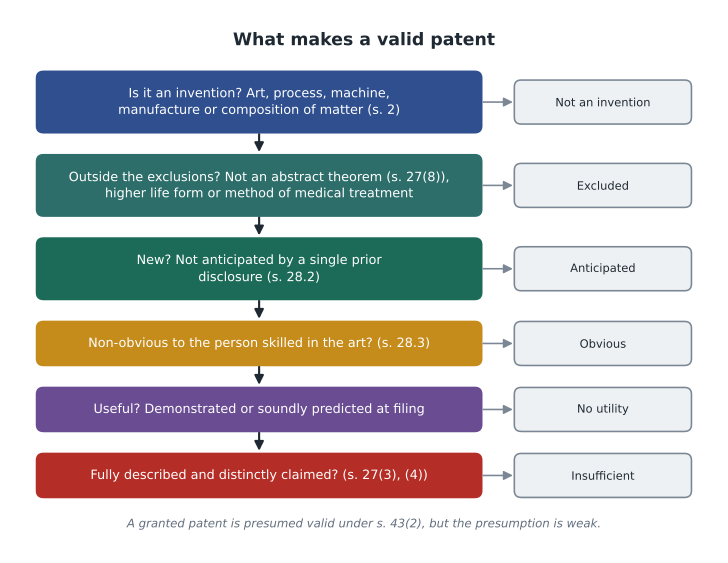
A patent is a statutory right, granted by the Commissioner of Patents under the Patent Act, giving the patentee, for the term of the patent, the exclusive right, privilege and liberty of making, constructing and using the invention and selling it to others to be used. Those words come from section 42. The right is to exclude others; a patent does not by itself give the patentee permission to make the invention, which may infringe someone else's patent or be prohibited by other laws. The term is twenty years from the filing date of the Canadian application under section 44, subject to maintenance fees and, since 2025, to patent term adjustment.
The Supreme Court has repeatedly described the patent as a bargain. The inventor discloses the invention fully, so that the public can make and use it once the patent expires and can build on it in the meantime, and in exchange receives a limited monopoly. The disclosure is the price of the monopoly. Patents are granted after examination, so a patent carries a statutory presumption of validity under section 43(2), but the presumption is weak and can be rebutted by evidence.
What is an invention
Section 2 defines an invention as any new and useful art, process, machine, manufacture or composition of matter, or any new and useful improvement in any art, process, machine, manufacture or composition of matter. The categories are broad. A machine is a mechanical device, like the hinge. A manufacture is a product made by hand or machine. A composition of matter is a combination of ingredients, such as a chemical compound or an alloy. An art or process is a method of doing something that produces a result in relation to trade, industry or commerce, and has been read to include new uses for known substances.
Section 27(8) provides that no patent shall be granted for any mere scientific principle or abstract theorem. A newly discovered law of nature cannot be patented, nor can a mathematical formula as such. A practical application of the principle can be. The courts have also excluded certain subject matter on policy grounds even without express words in the statute.
Higher life forms
In Harvard College v. Canada (Commissioner of Patents), 2002 SCC 76, the Supreme Court held, five to four, that a genetically modified mouse susceptible to cancer, the 'oncomouse', was not a manufacture or composition of matter, and so was not patentable. Justice Bastarache for the majority reasoned that the words of section 2, read in their ordinary sense, did not naturally include complex life forms, and that whether to extend patent protection to higher life forms raised ethical and economic questions for Parliament. The process for making the mouse and the genetically altered cells were patentable, and Harvard obtained claims to them. The dissent, written by Justice Binnie, would have allowed the claims as a composition of matter.
Two years later, in Monsanto Canada Inc. v. Schmeiser, 2004 SCC 34, the Court again divided five to four, but this time in favour of the patentee. Monsanto held a patent on genes and cells that made canola resistant to its glyphosate herbicide. Percy Schmeiser, a Saskatchewan farmer, saved and planted seed he knew or should have known contained the patented gene and grew a crop that was almost entirely resistant. The Court held that the claims to genes and cells were valid, consistent with Harvard, and that Schmeiser 'used' the invention by planting and cultivating plants containing it, even though the plants themselves could not be patented. Use means utilizing the invention for its commercial or business advantage, depriving the inventor of the full enjoyment of the monopoly. But the Court awarded no profits, because Schmeiser earned nothing more from the patented feature, since he never sprayed his crop with the herbicide.
Methods of medical treatment
Canadian law does not allow patents for methods of medical or surgical treatment of humans. The rule comes from Tennessee Eastman Co. v. Commissioner of Patents, [1974] S.C.R. 111, in which the Supreme Court held that a method of bonding the edges of surgical incisions using a known adhesive was not a patentable process, because a method of medical treatment does not produce a result in relation to trade, industry or commerce. Drug compounds and compositions remain patentable, as do new uses of known compounds when claimed as a use rather than as a method of treatment. Claims that tie a drug to a dosing regimen have produced much litigation, because they can look like claims to a physician's skill. Courts now ask whether the claim, properly construed, actually restricts the exercise of a physician's skill and judgment, for example by requiring a dose to be adjusted according to the patient's response, or whether it simply claims a product with a fixed dose, which is generally acceptable.
Business methods and computer-implemented inventions
There is no special exclusion for business methods or software in Canada, but the courts and the Patent Office have struggled with claims that seem to cover abstract ideas implemented on a computer. In Canada (Attorney General) v. Amazon.com, Inc., 2011 FCA 328, the Federal Court of Appeal rejected the Patent Office's view that business methods are excluded and held that the Commissioner must determine the actual invention through purposive construction of the claims, the same approach used for infringement. The Federal Court applied the purposive approach in Choueifaty v. Canada (Attorney General), 2020 FC 837, rejecting the Patent Office's 'problem and solution' method of identifying the essential elements of a claim.
In Canada (Attorney General) v. Benjamin Moore & Co., 2023 FCA 168, the Federal Court of Appeal considered applications for computer-implemented methods of matching paint colours to a customer's emotional preferences. The Federal Court had imposed a three-step framework for subject matter. The Court of Appeal set the framework aside, holding that it was not supported by Canadian law, and that novelty and inventiveness may be considered when determining whether a claim is directed to patentable subject matter. It sent the applications back to the Commissioner. The practical result is that a claim must do more than add a generic computer to an abstract idea or a mental process; it is more likely to be patentable if the computer is used in a way that solves a technical problem or produces a physical effect. The Patent Office's examination guidance continues to evolve, and practitioners draft claims to emphasize the technical contribution.
Arjun asks whether Kettlebrook's tuning software could be patented. Kaplinsky says that a claim to the mathematical formula for the sound profile would fail under section 27(8). A claim to a pair of headphones with a processor programmed to adjust output in a specific way that solves a technical problem, such as reducing distortion at high volume, has a much better chance. She adds that Kettlebrook has chosen to keep the algorithm secret instead, a choice lesson 11 examines.
Who may obtain a patent
Only the inventor or the inventor's legal representative may apply. The inventor is the person who conceived the inventive concept, not someone who merely carried out instructions or tested it, and joint inventors must each contribute to the inventive concept. Patents may be assigned, and an assignment must be registered with the Patent Office to be effective against a later purchaser without notice under section 51. Unlike copyright, the Patent Act contains no rule that an employer owns an employee's inventions. Ownership depends on the contract and, absent an express term, on whether the employee was hired to invent. Courts have held that an employee hired for a general purpose may own an invention even if made at work, while one employed to solve the very problem the invention addresses holds it for the employer. Employment agreements for engineers and scientists therefore almost always contain an express assignment of inventions.
Eskola's employment agreement with Kettlebrook contains such a clause, and he signed an assignment of the hinge application before he left. Kaplinsky says that is the single most important document in the file: without it, the dispute with Sonavant could have begun with a fight over who owns the patent.
The application and the specification
An application contains a specification, which includes a description of the invention and one or more claims, and usually drawings. Section 27(3) requires the specification to correctly and fully describe the invention and its operation or use as contemplated by the inventor, and to set out clearly the various steps in a process or the method of constructing, making, compounding or using a machine, manufacture or composition, in such full, clear, concise and exact terms as to enable any person skilled in the art to make or use it. Section 27(4) requires the specification to end with claims defining distinctly and in explicit terms the subject matter of the invention for which an exclusive privilege is claimed. The claims are the fence around the monopoly. Everything outside them is free.
Patent drafting is a specialist skill. A good specification describes the invention broadly enough to support claims that cover foreseeable variations and narrowly enough to avoid prior art. Claims usually progress from broad independent claims to narrower dependent claims, so that if a broad claim is invalid a narrower one may survive. Every claim is assessed separately for validity and infringement, as the Federal Court of Appeal stressed in Zero Spill Systems (Int'l) Inc. v. Heide, 2015 FCA 115.
Prosecution
Canada has been a first-to-file country since October 1, 1989: between two inventors who independently make the same invention, the one who files first is entitled to the patent. An applicant who first filed in another Paris Convention country may claim priority from that filing if the Canadian application is filed within twelve months, and many applicants enter Canada through the national phase of an international application under the Patent Cooperation Treaty, usually thirty months after the priority date. The application is laid open to public inspection eighteen months after the earliest priority or filing date. From then until grant, section 55(2) entitles the patentee to reasonable compensation from anyone who does an act that would have infringed if the patent had been granted.
Examination does not begin automatically; the applicant must request it and pay a fee within the period fixed by the Patent Rules, or the application is deemed abandoned. The examiner searches the prior art and issues reports objecting to defects. The applicant responds by arguing or amending the claims, and amendments may not add new matter beyond what was reasonably to be inferred from the original specification. After a final action, the application may be reviewed by the Patent Appeal Board and the Commissioner, whose decisions can be appealed to the Federal Court. Maintenance fees must be paid annually on pending applications and granted patents; missing a payment leads to deemed abandonment or lapse, subject to strict reinstatement rules. Under the Patent Rules that took effect in 2019, a granted patent that lapses for non-payment can be reinstated only if the failure occurred in spite of the due care required by the circumstances. Since October 2022, applicants also pay excess claim fees for more than twenty claims and must request continued examination after a set number of examination rounds. Since January 1, 2025, a patentee whose patent issued after unreasonable delay by the Patent Office may apply for patent term adjustment, discussed in lesson 7.
| Stage | Key rule | Practical point |
|---|---|---|
| Before filing | Novelty is destroyed by public disclosure, subject to a one-year grace period for the applicant's own disclosure | Keep the invention confidential and use non-disclosure agreements |
| Priority | Twelve months from a first Paris Convention filing | A provisional or foreign filing can secure the date |
| Laying open | Eighteen months after priority; reasonable compensation runs from then | Competitors can read the application |
| Examination | Must be requested within the period fixed by the rules | Missing deadlines can abandon the application |
| Grant | Twenty-year term from filing, with annual maintenance fees | Diary every fee deadline |
The grace period
Section 28.2(1)(a) provides that a claim is not anticipated by a disclosure made more than one year before the filing date only if the disclosure was by someone other than the applicant. Put the other way, a disclosure by the applicant, or by someone who obtained the information from the applicant, within the year before the Canadian filing date does not destroy novelty in Canada. The grace period is narrower than it looks: many other countries, including most of Europe, have no general grace period, so an inventor who discloses first may lose rights abroad even if Canada remains open. The prudent course is to file before any public disclosure.
Kettlebrook filed its Canadian application in February 2025, two months before it showed the Loom at a trade fair in Toronto in April 2025. It did not file elsewhere. Hannah asks whether it can still file in Europe. Kaplinsky says the twelve-month Paris priority window closed in February 2026, and the trade fair disclosure would anticipate a European filing now, so European patent protection is almost certainly lost. In Canada, however, the application remains alive and examination has been requested.
Worked problem
Can Kettlebrook patent its new ideas?
Tolland lists four ideas her engineers have proposed since Eskola left: (1) a new alloy for the hinge pins that resists wear; (2) a method of fitting headphones that uses a phone camera to measure the user's ear and recommends a size; (3) a formula that predicts how the ear cups will sound in different room temperatures; and (4) a method of treating tinnitus by playing a specific sequence of tones through the headphones. Which can be patented in Canada?
Show solution
- Alloy (1). A new composition of matter is within section 2. It is patentable if it is new, non-obvious and useful and the specification enables a skilled person to make it.
- Fitting method (2). A process implemented on a phone is not excluded as such. Under Amazon.com and Benjamin Moore, the question is whether the claim, purposively construed, is directed to more than an abstract idea on a generic computer; using the camera to measure physical features and produce a result is a reasonable basis for patentable subject matter, subject to novelty and obviousness.
- Formula (3). A formula alone is a mere scientific principle or abstract theorem under section 27(8). It might form part of a claim to headphones that adjust their output based on temperature, but the formula itself cannot be claimed.
- Tinnitus method (4). A method of medical treatment of humans is excluded under Tennessee Eastman. Kettlebrook might claim the headphones configured to generate the sequence, or a use of the device, but drafting must avoid claiming the therapeutic method itself.
- Timing. Each idea should be kept confidential and filed before any public disclosure, with priority claimed in other countries within twelve months.
- Ownership. Kettlebrook should confirm that each engineer has signed an assignment of inventions, since the Patent Act has no employer ownership rule.
Common mistakes
MistakeAssuming an employer automatically owns an employee's invention, as with copyright.
InsteadThe Patent Act has no equivalent of section 13(3) of the Copyright Act; ownership depends on contract or on whether the employee was hired to invent.
MistakeSaying genetically modified organisms cannot be patented in Canada.
InsteadHarvard excludes higher life forms as such, but genes, cells and processes can be patented, and Schmeiser held that using plants containing a patented gene infringes.
MistakeRelying on the one-year grace period as if it applied everywhere.
InsteadCanada's grace period covers the applicant's own disclosures for Canadian purposes only; many countries require absolute novelty.
MistakeTreating a patent as permission to make the invention.
InsteadA patent is a right to exclude others; making the invention may still infringe another's patent.
Practice problems
Work each problem on paper first, then reveal the answer to check.
What did the Supreme Court decide in Harvard College?
Show answer
By five to four, that a genetically modified mouse is not a manufacture or composition of matter, so higher life forms are not patentable, though the process and modified cells were.
Why did Schmeiser pay no profits despite infringing?
Show answer
Because he earned no profit attributable to the invention: he never used the herbicide, so the patented resistance gave him no advantage.
What did Benjamin Moore decide about patentable subject matter?
Show answer
It set aside the Federal Court's three-step framework, held that novelty and inventiveness may be considered, and sent the computer-implemented applications back to the Commissioner.
Summary and key terms
- A patent gives the exclusive right to make, use and sell an invention for twenty years from filing, in exchange for full disclosure, and is presumed valid after examination.
- An invention is a new and useful art, process, machine, manufacture or composition of matter; mere scientific principles and abstract theorems are excluded by section 27(8).
- Higher life forms are not patentable (Harvard), but genes and cells are and using plants containing them infringes (Schmeiser); methods of medical treatment are excluded (Tennessee Eastman).
- Computer-implemented inventions are assessed by purposive construction to find the actual invention (Amazon.com, Choueifaty, Benjamin Moore).
- Canada is first-to-file, with Paris priority, PCT national phase, laying open at eighteen months, examination on request, annual maintenance fees and a narrow one-year grace period.
- Claims
- The numbered statements at the end of a specification that define the scope of the monopoly.
- Specification
- The description and claims of a patent, which must enable a skilled person to make and use the invention.
- First-to-file
- The rule that the first applicant, not the first inventor, is entitled to a patent for an invention.
- Laid open
- Published for public inspection, eighteen months after the priority or filing date.
- Reasonable compensation
- The payment due for acts between laying open and grant that would have infringed a granted patent.
- Abstract theorem
- A mathematical or scientific principle as such, which section 27(8) excludes from patent protection.
Lesson quiz · 5 questions
Score 60% or more to complete this lesson.
Create a free account to save your progress, take quizzes and earn a certificate.