
LAWC-312 · Lesson 7 of 12 · 20 min
Patent remedies and pharmaceutical patents
▶ Video coming soon A video version of this lesson is on the way.
Kaplinsky opens the seventh class with a number: 3,800. That is how many pairs of its leaf-spring headphones Sonavant sold in Canada between October and mid-November 2026, according to a market report Tolland obtained. 'Suppose Kettlebrook wins,' Kaplinsky says. 'What does it get? Money, but measured how? An order to stop, but from when? And what about the sales Sonavant will make next year on the strength of the head start it took?' The first half of this lesson answers those questions. The second half turns to the pharmaceutical sector, where patent law has been reshaped by special regulations, price controls and trade agreements.
Injunctions
Section 57 of the Patent Act allows the court to grant an injunction restraining further infringement, and permanent injunctions usually follow a finding that a valid patent has been infringed, though the remedy is equitable and discretionary. Interlocutory injunctions before trial are rare in Canadian patent cases. Under the RJR-MacDonald test, the patentee must show a serious issue, irreparable harm and a favourable balance of convenience. Courts generally hold that lost sales can be compensated in damages, so irreparable harm must be proved by clear and non-speculative evidence of harm that cannot be quantified, such as permanent loss of market share or of a company's very existence. Patentees therefore usually seek an expedited trial instead.
Damages or an accounting of profits
Section 55(1) makes an infringer liable to the patentee for all damage sustained by reason of the infringement after the grant. Section 57 also allows the court to order an accounting of profits, an equitable remedy. The patentee elects between them, usually after discovery of the infringer's financial information, and the court has discretion to refuse an accounting where, for example, the patentee delayed unreasonably.
Damages compensate the patentee for its losses. The usual heads are lost profits on sales the patentee proves it would have made but for the infringement, a reasonable royalty on infringing sales the patentee would not have made, and price erosion if the infringement forced the patentee to lower its prices. Courts ask what would have happened in a hypothetical world without infringement, and they may consider whether the infringer could have sold a non-infringing substitute.
An accounting of profits does not compensate; it disgorges the infringer's profits causally attributable to the invention. The leading case is Nova Chemicals Corp. v. Dow Chemical Co., 2022 SCC 43. Nova had infringed Dow's patent for a type of polyethylene film resin. The Supreme Court, by a majority, upheld an award of about 645 million dollars. It confirmed that an accounting uses the differential profit approach: the infringer's actual profits are compared with the profits it would have made using its best non-infringing alternative, and only the difference is disgorged. The Court also held that the infringer may deduct a portion of its fixed costs only if they were causally attributable to the infringing product, and, most significantly, that the patentee may recover 'springboard' profits earned after the patent expired, if they were caused by the infringement during the patent term, for example because the infringer built up a customer base it could not otherwise have had. The decision makes an accounting attractive to patentees whose competitors entered the market early.
In Monsanto v. Schmeiser, by contrast, the accounting produced nothing, because the farmer's profits did not depend on the patented trait. The Schmeiser result illustrates the causal focus of the remedy.
Reasonable compensation, punitive damages and limitation
Section 55(2) entitles the patentee to reasonable compensation for acts done after the application was laid open and before grant that would have infringed if the patent had been granted. The amount is usually assessed as a reasonable royalty. Kettlebrook's application was laid open in August 2026, eighteen months after its February 2025 filing, and its patent was granted in September 2026, so Sonavant's October and November 2026 sales are infringing sales after grant if the patent is valid and infringed, and any earlier acts after laying open would attract reasonable compensation.
Punitive damages are available for high-handed, malicious or reprehensible conduct but are rare in patent cases, since infringement is often a good-faith disagreement about validity. Section 55.01 sets a six-year limitation period for infringement claims; the Court of Appeal of Alberta confirmed in JL Energy Transportation Inc. v. Alliance Pipeline LP, 2025 ABCA 26, that this federal period, not the two-year provincial limitation, applies to patent infringement claims brought in Alberta. Costs in patent litigation can be very large, and in December 2025 amendments to Tariff B of the Federal Courts Rules raised the scale of recoverable costs, which matters to clients deciding whether to sue.
Defences and responses
A defendant normally pleads non-infringement and counterclaims for a declaration of invalidity, which in the Federal Court can lead to the patent being declared invalid against the world. Other responses include licence, exhaustion, the statutory exceptions for regulatory and experimental use, and prior use under section 56. A defendant may also bring an impeachment action in the Federal Court under section 60 before any infringement claim is made, or seek a declaration of non-infringement. Before launching a product, careful competitors obtain a freedom-to-operate opinion from patent counsel, and some design around the claims, as Sonavant may have tried to do by substituting a leaf spring.
Compulsory licences and Crown use
Section 65 allows the Commissioner to grant a compulsory licence where the exclusive rights have been abused, for example where demand in Canada is not being met on reasonable terms three years after grant. The provision is rarely used. Section 19 allows the federal and provincial governments to use a patented invention on payment of compensation set by the Commissioner. Canada's Access to Medicines Regime, enacted in 2005 under sections 21.01 to 21.2, permits compulsory licences to make patented medicines for export to developing countries facing public health problems. It was used only once, for shipments of an HIV medicine to Rwanda in 2008 and 2009, and is widely regarded as too cumbersome.
Pharmaceutical patents
Pharmaceuticals generate a large share of Canada's patent litigation, for three reasons: drug patents are enormously valuable, generic entry causes prices to fall sharply, and Health Canada's drug approval system is linked to the patent system.
Linkage: the NOC Regulations
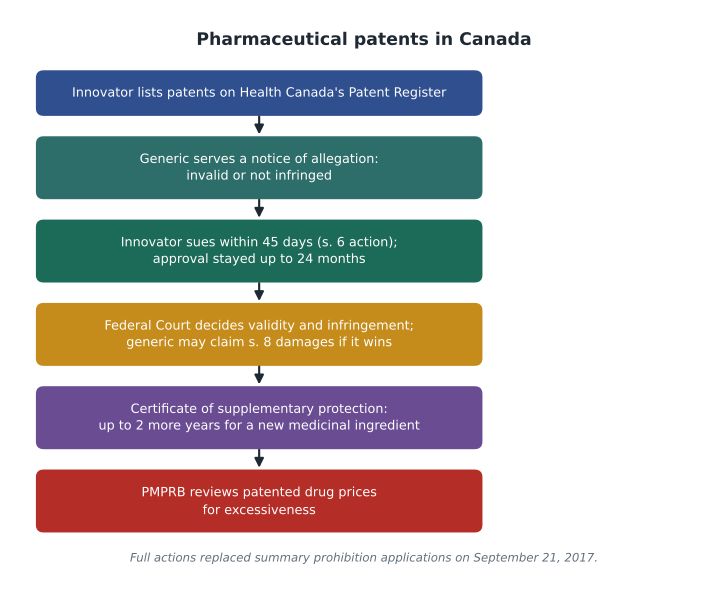
The Patented Medicines (Notice of Compliance) Regulations link drug approval to patents. An innovator company that obtains approval of a drug may list relevant patents on a Patent Register maintained by Health Canada. A generic manufacturer that seeks approval by comparison with the innovator's drug must address each listed patent, either by waiting for it to expire or by serving a notice of allegation that the patent is invalid or would not be infringed. Until September 2017, the innovator could respond with a summary application for an order prohibiting the Minister from approving the generic, a proceeding that did not finally decide validity or infringement and was often followed by a separate action. Amendments in force on September 21, 2017, as part of Canada's implementation of its trade agreement with the European Union, replaced those applications with full actions under section 6. The innovator has forty-five days to sue, which triggers a stay of the generic's approval for up to twenty-four months, and the action finally determines infringement and validity, with full rights of appeal. A generic that is kept off the market and ultimately succeeds may claim damages under section 8 for its losses during the stay.
Certificates of supplementary protection
Drug development and approval take years, eroding the effective life of a patent. Since September 21, 2017, the Certificates of Supplementary Protection Regulations have allowed a patentee to obtain a certificate that extends protection for a new medicinal ingredient or combination by up to two years after the patent expires. The certificate is available only for the first approval of the ingredient, must be applied for within a short window after approval, and requires the Canadian approval application to have been filed within a specified time after the first application in certain other countries. The certificate holder has the same rights as under the patent, but making the drug for export does not infringe a certificate.
Price review
The Patented Medicine Prices Review Board, created in 1987 under sections 79 to 103 of the Patent Act, reviews the prices of patented medicines sold in Canada and can order price reductions or payments where it finds a price excessive, having regard to the factors in section 85, such as prices in comparator countries and changes in the consumer price index. The Board's attempts to strengthen its regulations and guidelines between 2019 and 2023 produced litigation and political controversy, and it has since revised its guidelines after a lengthy consultation. Courts have upheld the scheme as a valid exercise of the federal patent power, while repeatedly reviewing the Board's interpretation of 'excessive', as in Alexion Pharmaceuticals Inc. v. Canada (Attorney General), 2021 FCA 157, where the Federal Court of Appeal held that a decision based mainly on the lowest international price was unreasonable.
Patent term adjustment
Under the Canada-United States-Mexico Agreement, Canada agreed to compensate patentees for unreasonable delays by the Patent Office. Patent term adjustment came into force on January 1, 2025. It is available for patents issued from applications filed on or after December 1, 2020, where the patent issues later than five years after the filing date or three years after the request for examination, whichever is later. The adjustment is calculated by subtracting from that delay periods attributable to the applicant and other excluded periods, and it must be requested after grant on payment of a fee, with third parties able to seek reconsideration. Commentators expect adjustments to be modest and uncommon, because the rules exclude many periods from the calculation.
Sophie asks why the pharmaceutical rules matter in a course whose running file is about headphones. Kaplinsky says that almost every Supreme Court patent decision of the last twenty-five years, from Wellcome to Sanofi to Teva to AstraZeneca, arose in pharmaceutical litigation, and that the doctrines they created apply to all patents, including Kettlebrook's hinge. A lawyer who understands why the promise doctrine grew up in drug cases and why the Supreme Court abolished it will understand Canadian patent law.
Valuing the Kettlebrook claim
Arjun works through the numbers on the board. Sonavant sold 3,800 pairs at a retail price of 320 dollars, with a margin to Sonavant of about 90 dollars a pair, or 342,000 dollars in profit. Kettlebrook's own margin on the Loom is about 110 dollars a pair. If Kettlebrook can prove it would have made, say, 2,000 of those sales, its lost profits would be 220,000 dollars, plus a reasonable royalty on the other 1,800 sales and any price erosion. If it elects an accounting, it would recover Sonavant's profits attributable to the hinge, which under Nova means comparing Sonavant's actual profit with what it would have made using its best non-infringing alternative hinge. If Sonavant could easily have used an older non-folding design and still sold most of its headphones, the attributable profit might be small; if the folding hinge drove the sales, much of the 342,000 dollars could be disgorged, together with springboard profits from customers Sonavant won through the infringement. Kaplinsky adds that an injunction, if granted at trial, may be worth more than either, because it would force Sonavant to redesign or leave the market.
| Remedy | Measures | Best for the patentee when |
|---|---|---|
| Lost profits damages | Patentee's lost margin on sales it would have made | Patentee has capacity and the infringer took its customers |
| Reasonable royalty | Notional licence fee on other infringing sales | Patentee would not have made those sales |
| Accounting of profits | Infringer's profits attributable to the invention, including springboard profits | Infringer earned high margins or gained a head start |
| Reasonable compensation | Royalty for acts between laying open and grant | Infringement began before grant |
| Permanent injunction | Order to stop infringing for the rest of the term | Market exclusivity matters more than money |
Worked problem
Advising on a pharmaceutical launch
Hannah's cousin works for Pellbrook Generics Inc., which wants to launch a generic version of an innovator's heart medicine. Two patents are listed on the Patent Register: a compound patent expiring in 2027 and a formulation patent expiring in 2033. The innovator also holds a certificate of supplementary protection extending the compound protection to 2029. Outline the steps and risks.
Show solution
- Address each listed patent. Pellbrook may wait for the compound patent and certificate to expire or serve a notice of allegation; it cannot challenge the certificate's term simply because it dislikes it, but it can challenge the underlying patent's validity.
- Expect an action. If Pellbrook alleges the formulation patent is invalid or not infringed, the innovator will likely sue within forty-five days under section 6, triggering a stay of up to twenty-four months.
- Plan the evidence. Validity will be judged by anticipation and obviousness under Sanofi, utility under AstraZeneca and sufficiency under Teva; non-infringement will depend on purposive construction of the formulation claims.
- Consider early working. Pellbrook may conduct the tests needed for its regulatory submission under section 55.2 without infringing.
- Assess damages exposure. If Pellbrook launches at risk and loses, it faces damages or an accounting of profits, including springboard profits under Nova; if it is kept off the market and wins, it may claim section 8 damages.
- Watch prices. The Patented Medicine Prices Review Board's jurisdiction applies to patented medicines, including the innovator's, but not to generic products that are not patented.
Common mistakes
MistakeAssuming a patentee can easily obtain an interlocutory injunction.
InsteadCanadian courts require clear evidence of irreparable harm, and lost sales are usually compensable in damages.
MistakeTreating an accounting of profits as the infringer's total profit.
InsteadUnder Nova, only profits causally attributable to the invention are disgorged, using the differential approach and considering non-infringing alternatives.
MistakeSaying the NOC Regulations still use summary prohibition applications.
InsteadSince September 21, 2017, they use full actions under section 6 that finally determine validity and infringement.
MistakeDescribing patent term adjustment as an automatic extension for all patents.
InsteadIt applies only to applications filed on or after December 1, 2020, must be requested, and compensates only for unreasonable office delay after exclusions.
Practice problems
Work each problem on paper first, then reveal the answer to check.
What are springboard profits, and when can they be recovered?
Show answer
Profits an infringer earns after the patent expires that were caused by its infringement during the term, such as a customer base built through infringement; Nova held they can be recovered in an accounting.
What happens when an innovator sues under section 6 of the NOC Regulations?
Show answer
A full action determines validity and infringement, and Health Canada's approval of the generic is stayed for up to twenty-four months.
How long can a certificate of supplementary protection extend protection?
Show answer
Up to two years after the patent expires, for a new medicinal ingredient or combination.
Summary and key terms
- Permanent injunctions usually follow infringement, but interlocutory injunctions are rare because irreparable harm is hard to show.
- The patentee elects between damages (lost profits, reasonable royalty, price erosion) and an accounting of profits, which after Nova disgorges causally attributable profits, including springboard profits.
- Reasonable compensation runs from laying open; the limitation period is six years under section 55.01 (JL Energy, 2025).
- The NOC Regulations link drug approval to patents through section 6 actions and a 24-month stay; certificates of supplementary protection add up to two years; the PMPRB reviews prices for excessiveness.
- Patent term adjustment, in force January 1, 2025, compensates for unreasonable office delay on applications filed since December 1, 2020; compulsory licences and Crown use are rarely used.
- Accounting of profits
- An equitable remedy requiring the infringer to disgorge profits attributable to the invention.
- Differential profit approach
- Measuring attributable profit by comparing actual profit with profit from the best non-infringing alternative.
- Springboard profits
- Post-expiry profits caused by infringement during the patent term.
- Allegation (NOC Regulations)
- A generic manufacturer's statement that a listed patent is invalid or not infringed.
- Certificate of supplementary protection
- A right extending drug patent protection by up to two years for a new medicinal ingredient.
- Patent term adjustment
- An extension of term compensating for unreasonable delay by the Patent Office.
Lesson quiz · 5 questions
Score 60% or more to complete this lesson.
Create a free account to save your progress, take quizzes and earn a certificate.