
LAWC-312 · Lesson 1 of 12 · 24 min
IP policy, sources and the federal power
▶ Video coming soon A video version of this lesson is on the way.
Professor Imara Kaplinsky begins the first class of LAWC-312 by setting a pair of headphones on the lectern in the Lister Room. They are a matte green over-ear set made by Kettlebrook Audio Inc., a small Corwin company with about forty employees. 'Tell me what in this object belongs to someone,' she says. Arjun Mehta, the former civil engineer, points to the folding hinge and guesses that it is patented. Sophie Tremblay-Hart points to the word KETTLEBROOK stamped on the headband. Hannah Kowalczyk asks about the companion app on her phone that lets her tune the sound. Theo Marchetti, who spent ten years as a litigation clerk, asks who owns the instruction booklet in the box. Daniel Whitecloud notices the curved shape of the ear cups and asks whether a shape can be owned at all.
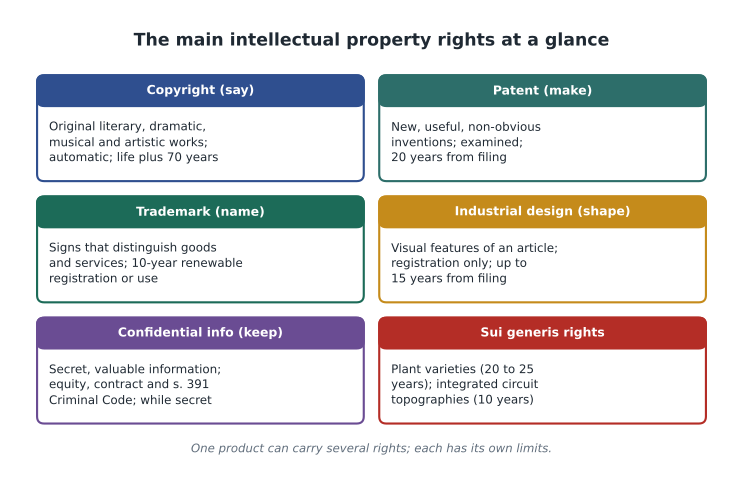
Kaplinsky, who spent fifteen years at a Toronto intellectual property boutique as a lawyer and registered patent and trademark agent before joining Brannock, writes five words on the board: 'Make. Name. Shape. Say. Keep.' Inventors make things, she explains, and patents protect what they make. Businesses name things, and trademarks protect the names. Designers shape things, and industrial designs protect the shape. Authors say things, and copyright protects how they say them. And everyone keeps some things secret, which is where the law of confidential information comes in. Every one of those rights can sit in a single pair of headphones, and the Kettlebrook file will follow the course from start to finish. The company's founder, Wrenna Tolland, is a former sound engineer who built the first prototype in her garage. Its lead engineer, Odhran Eskola, designed the hinge and wrote the tuning software, and in August 2026 he left to join Sonavant Ltd., a larger competitor. Those facts are hypothetical, and they will generate most of this term's problems.
What intellectual property is
Intellectual property is a set of legal rights over intangible things: information, ideas expressed in particular forms, inventions, signs and designs. The rights are property in the sense that they can be owned, licensed, assigned, mortgaged and inherited, and they can be enforced against people who never agreed to anything with the owner. But they are unusual property. A loaf of bread can be eaten by only one person; a song can be sung by millions at once without anyone's copy being diminished. Economists call information non-rival. It is also hard to exclude people from information once it is released. Those two features explain why markets on their own tend to produce too little of it: if anyone can copy an invention or a novel the day it appears, the person who paid to create it may never recover the cost. Intellectual property law responds by giving creators a limited, legally enforceable power to exclude others for a time.
The key word is limited. Every intellectual property right in Canada has edges. Patents last twenty years and require the inventor to disclose the invention to the public. Copyright protects expression but not ideas, and it is subject to fair dealing and other user rights. Trademarks protect signs only as indicators of source and only against confusing or damaging uses. Industrial designs last at most fifteen years from filing and never protect function. Confidential information is protected only while it remains secret and only against those who obtained it in confidence or improperly. Kaplinsky tells the class that most of the hard questions in this field are questions about where those edges lie.
Why we protect it: the justifications
Three families of justification appear in the cases and the literature. The first, and in Canada the most influential, is utilitarian or incentive-based: intellectual property exists to encourage the creation and disclosure of works and inventions that benefit society, and it should be no broader than needed to achieve that goal. The patent bargain is the clearest example. The inventor receives a monopoly for a limited time in exchange for a full description of the invention, which becomes free for everyone when the patent expires. The Supreme Court has repeatedly described the Patent Act in those terms.
The second family is the labour or natural rights theory associated with John Locke: a person who mixes labour with unowned material earns a right in the product. The theory has intuitive appeal for authors and inventors, but it has trouble explaining why rights should expire, why independent creation is a defence to copyright but not to patent infringement, and why some kinds of effort, such as compiling a telephone directory, earn no protection at all. The third family is the personality theory associated with Hegel, which treats a creative work as an extension of its author's self. It is most visible in moral rights, which protect an author's connection to the work even after the economic rights are sold.
In Canada the Supreme Court has adopted a balancing approach that draws mainly on the first theory. In Théberge v. Galerie d'Art du Petit Champlain inc., 2002 SCC 34, Justice Binnie described the Copyright Act as a balance between promoting the public interest in the encouragement and dissemination of works of the arts and intellect and obtaining a just reward for the creator. He warned that excessive control by rights holders could unduly limit the ability of the public domain to incorporate and embellish creative innovation. That balance became the organizing idea of the Court's copyright decisions over the next two decades, and you will see it again in CCH, in the 2012 fair dealing cases and in SOCAN v. Entertainment Software Association in 2022.
Hannah, who studied economics, objects that the balance metaphor is too vague to decide cases. Kaplinsky agrees that it does not decide cases on its own, but says it tells a court which way to lean when the statute is ambiguous. 'When the words could go either way,' she says, 'the Supreme Court has usually asked which reading keeps the right within the limits of its purpose.'
The constitutional division of powers
Section 91 of the Constitution Act, 1867 gives Parliament exclusive authority over 'patents of invention and discovery' in section 91(22) and over 'copyrights' in section 91(23). Trademarks are not mentioned. Their federal basis is the general branch of the trade and commerce power in section 91(2). In MacDonald v. Vapor Canada Ltd., [1977] 2 S.C.R. 134, the Supreme Court struck down a broad federal provision, then section 7(e) of the Trade Marks Act, that prohibited any business practice contrary to honest industrial or commercial usage, because it was really a general law of civil wrongs that belonged to the provinces. Almost three decades later, in Kirkbi AG v. Ritvik Holdings Inc., 2005 SCC 65, the Court upheld section 7(b), the statutory passing off provision, because it was integrally connected to the federal scheme for regulating trademarks, which the Court accepted as a valid exercise of the general trade and commerce power.
Industrial designs are governed by the federal Industrial Design Act, and their constitutional basis has not been seriously challenged. Confidential information and trade secrets are different. There is no federal trade secrets statute for civil claims; protection comes from provincial law of contract, equity and property and civil rights under section 92(13). Parliament has used its criminal law power to create a trade secret offence in section 391 of the Criminal Code, added in 2020 as part of the implementation of the Canada-United States-Mexico Agreement. In Quebec, the Civil Code governs confidential information on the civil side.
Where disputes are heard
The Federal Court has jurisdiction over most intellectual property matters under section 20 of the Federal Courts Act, concurrently with provincial superior courts for infringement claims. Some remedies are reserved to the Federal Court, most importantly the power to expunge or vary a registration: a provincial court can decide that a patent is invalid as between the parties, but only the Federal Court can order a trademark struck from the register or a copyright registration rectified. Appeals from the Federal Court go to the Federal Court of Appeal and then, with leave, to the Supreme Court of Canada. The Federal Court sits across the country, has judges with deep experience in patent and trademark cases, and can issue injunctions enforceable anywhere in Canada, which is why most large disputes are brought there. Contract and confidential information claims, by contrast, are usually brought in provincial superior courts, often alongside a claim against a departing employee.
Theo asks why a client would ever choose a provincial court. Kaplinsky gives three common reasons: the claim is mainly about breach of contract or breach of confidence, which the Federal Court cannot hear on its own; the defendants include individuals or companies over whom the Federal Court's jurisdiction is doubtful; or the client wants the provincial court's familiar procedures, such as Ontario's summary judgment rules. Many disputes end up in both courts at once, and careful counsel coordinate them.
Administrative agencies
The Canadian Intellectual Property Office, a special operating agency within Innovation, Science and Economic Development Canada, examines and registers patents, trademarks and industrial designs, and keeps the voluntary copyright register. Within it, the Trademarks Opposition Board hears oppositions and summary cancellation proceedings on behalf of the Registrar. The Patent Appeal Board reviews examiners' final rejections for the Commissioner of Patents. The Copyright Board of Canada, a separate tribunal, sets tariffs for collective societies and certain uses of works. Patent agents and trademark agents are licensed by the College of Patent Agents and Trademark Agents, a regulator created by statute that began operating in 2021, and only licensed agents may prosecute applications for others before the office.
International framework
Intellectual property is territorial: a Canadian patent can be infringed only by acts in Canada, and a Canadian trademark registration says nothing about rights in France. But international treaties set minimum standards and make it easier to obtain rights abroad. The Paris Convention for the Protection of Industrial Property of 1883 established national treatment and a twelve-month priority period for patents (six months for trademarks and designs), so that an applicant who files first in one member country can file elsewhere within that period and keep the original filing date. The Berne Convention of 1886 established national treatment for copyright and the principle that copyright must arise without formalities. The Agreement on Trade-Related Aspects of Intellectual Property Rights, or TRIPS, administered by the World Trade Organization since 1995, made minimum standards enforceable through trade dispute settlement.
Several procedural treaties matter in practice. The Patent Cooperation Treaty lets an inventor file one international application and later enter the national phase in many countries. Canada joined the Madrid Protocol for international trademark registrations on June 17, 2019, the same day its major trademark reforms took effect, and it acceded to the Hague Agreement for industrial designs in November 2018. The WIPO Copyright Treaty and the WIPO Performances and Phonograms Treaty, implemented by the Copyright Modernization Act of 2012, require protection for technological protection measures and rights management information. Trade agreements add obligations: the Canada-European Union agreement led to certificates of supplementary protection for pharmaceutical patents in 2017, and the Canada-United States-Mexico Agreement, in force since July 1, 2020, required Canada to extend the general copyright term to life plus 70 years, which it did at the end of 2022, and to introduce patent term adjustment, which took effect on January 1, 2025.
How the rights overlap
Because each right protects a different aspect of a product, a single object can carry several at once, and clients rarely care which label applies so long as they are protected. But the overlaps are policed. The Supreme Court in Kirkbi refused to let Lego use trademark law to extend the protection of its expired patents over the shape of its bricks: a functional shape cannot become a trademark, because that would create a perpetual patent. The Copyright Act, in section 64, removes copyright protection from the design of a useful article once more than fifty copies have been made with the copyright owner's authorization, steering mass-produced designs into the shorter industrial design regime. And the courts have resisted attempts to use the law of confidential information to protect material that was already public. Kaplinsky calls this the 'no double dipping' principle: the law lets an owner stack rights, but it does not let one right be used to defeat the limits of another.
Daniel asks whether the curved ear cup shape could be protected by all three of design, trademark and copyright. Kaplinsky says it could be registered as an industrial design if it is new and appeals to the eye; it might eventually function as a trademark if consumers come to see the shape itself as identifying Kettlebrook and if the shape is not dictated primarily by function; and its drawings attract copyright, but section 64 would likely prevent Kettlebrook from using copyright to stop competitors from making headphones of that shape once it has sold more than fifty pairs. Choosing among those rights, and filing for the right one in time, is one of the most valuable things an intellectual property lawyer does.
A first look at the Kettlebrook file
To close the first class, Kaplinsky hands out a one-page summary of the hypothetical Kettlebrook Audio file. Wrenna Tolland incorporated the company in 2021. Its first product, the Kettlebrook Loom headphones, launched in 2025. Odhran Eskola, an employee, designed a folding hinge that lets the ear cups rotate flat and fold inward in one motion, and Kettlebrook filed a Canadian patent application for it. The company commissioned a freelance photographer, Ottavio Bramley, to shoot product photos for its website, and hired a contractor, Céleste Varenne, to write the first version of its companion app. Kettlebrook registered the word KETTLEBROOK as a trademark and has been using a stylized kettle logo. It never registered the ear cup shape. Its tuning software contains a sound-profile algorithm that Eskola wrote and that the company treats as secret. Eskola left for Sonavant in August 2026. In October 2026 Sonavant launched headphones with a similar hinge, similar ear cups and a product name, KETTLEBORNE, that Tolland finds suspicious. Each later lesson will pull one thread from that knot.
| Kettlebrook asset | Likely right | First question |
|---|---|---|
| Folding hinge | Patent (pending application) | Is it new and non-obvious, and does Sonavant fall within the claims? |
| Word KETTLEBROOK and kettle logo | Registered and unregistered trademark | Is KETTLEBORNE confusing? |
| Ear cup shape | Industrial design (not filed), possibly trademark | Is it too late to register a design? |
| Companion app code and manual | Copyright | Who owns code written by a contractor? |
| Website photographs | Copyright | Did the photographer assign or license the rights? |
| Sound-profile algorithm | Confidential information | Did Eskola take it to Sonavant? |
Worked problem
Mapping rights onto a product
Tolland asks the class for a one-paragraph answer to a simple question: what does Kettlebrook own, and what should it do in the next month to protect itself? Prepare the outline a junior lawyer would send her.
Show solution
- List each asset and the right that most naturally protects it, using the five-word scheme: make (patent), name (trademark), shape (industrial design), say (copyright) and keep (confidential information).
- Check the status of each right. The patent application is pending; the trademark KETTLEBROOK is registered; the logo is unregistered; no design application was filed; copyright arose automatically when each work was created; confidential information is protected only if Kettlebrook took reasonable steps to keep it secret.
- Identify ownership gaps. Copyright in the photographs and the first version of the app may belong to the freelancers unless they assigned it in writing, because the employment rule in section 13(3) of the Copyright Act does not apply to independent contractors.
- Identify deadlines. An industrial design can be registered only if the application is filed within twelve months of the design's first public disclosure, so a 2025 launch may already have closed that door; the patent application should be reviewed to see whether its claims cover Sonavant's hinge.
- Identify the forum. A claim against Sonavant for patent, trademark and design infringement would normally go to the Federal Court, but a claim against Eskola for breach of confidence and breach of his employment agreement belongs in the Ontario Superior Court of Justice unless it is closely tied to a federal claim.
- Recommend immediate steps: preserve evidence, obtain written assignments from the freelancers, file a trademark application for the logo, review Eskola's employment agreement and exit documents, and send a carefully drafted letter to Sonavant only after the theory of the case is settled.
Common mistakes
MistakeAssuming that an idea can be owned if it is valuable enough.
InsteadNo Canadian right protects an idea as such; copyright protects expression, patents protect a claimed and disclosed invention, and confidential information protects information only while it is secret and only against those under an obligation.
MistakeTreating trademarks as resting on the same constitutional head as patents and copyright.
InsteadPatents and copyright are listed in sections 91(22) and 91(23); trademarks rest on the general trade and commerce power, as Vapor Canada and Kirkbi show.
MistakeBelieving a Canadian patent or trademark protects the owner worldwide.
InsteadIntellectual property is territorial; treaties make foreign filing easier through priority and international applications, but rights must be obtained country by country.
MistakeFiling everything in the Federal Court by reflex.
InsteadThe Federal Court cannot hear a stand-alone breach of contract or breach of confidence claim, so claims against a departing employee often belong in a provincial superior court.
Practice problems
Work each problem on paper first, then reveal the answer to check.
What did the Supreme Court decide in Kirkbi AG v. Ritvik Holdings about section 7(b) of the Trademarks Act?
Show answer
That the statutory passing off provision was valid federal law because it was integrally connected to the federal trademark scheme, a valid exercise of the general trade and commerce power, and that Lego could not use passing off to protect the functional shape of its bricks.
What is the balance described in Théberge?
Show answer
A balance between promoting the public interest in the encouragement and dissemination of works and obtaining a just reward for the creator, with a warning against giving rights holders more control than the purpose requires.
Name two international treaties Canada joined in 2018 or 2019 that changed how Canadians obtain rights abroad.
Show answer
The Hague Agreement for industrial designs, in November 2018, and the Madrid Protocol for trademarks, on June 17, 2019.
Summary and key terms
- Intellectual property rights give limited, enforceable powers to exclude others from using non-rival information, inventions, signs and designs.
- Canadian courts justify the rights mainly in utilitarian terms and, since Théberge, describe copyright as a balance between users and creators.
- Patents and copyright are federal under sections 91(22) and 91(23); trademarks rest on the general trade and commerce power (Vapor Canada, Kirkbi); confidential information is mainly provincial, with a federal criminal offence in section 391 of the Criminal Code.
- The Federal Court shares jurisdiction with provincial superior courts over infringement, but only the Federal Court can expunge registrations; CIPO examines and registers rights.
- Treaties such as Paris, Berne, TRIPS, the PCT, Madrid and Hague, and trade agreements such as CUSMA, shape Canadian law; rights can overlap, but one right cannot be used to evade another's limits.
- Non-rival good
- A good whose use by one person does not reduce its availability to others, such as information or a melody.
- Patent bargain
- The exchange of a limited monopoly for full public disclosure of an invention.
- Territoriality
- The principle that an intellectual property right exists and can be infringed only within the country that grants it.
- Priority period
- The period under the Paris Convention during which a later foreign filing keeps the date of the first application.
- CIPO
- The Canadian Intellectual Property Office, which examines and registers patents, trademarks and industrial designs.
- Sui generis right
- A specialized right created for a particular subject matter, such as plant breeders' rights or integrated circuit topographies.
Lesson quiz · 5 questions
Score 60% or more to complete this lesson.
Create a free account to save your progress, take quizzes and earn a certificate.