
LAWC-312 · Lesson 6 of 12 · 22 min
Patent validity and infringement
▶ Video coming soon A video version of this lesson is on the way.
On the screen at the start of the sixth class are two documents. The first is claim 1 of Kettlebrook's hinge application, now granted as a Canadian patent in September 2026: 'A folding headphone assembly comprising a headband, a pair of ear cups, and a hinge connecting each ear cup to the headband, the hinge comprising a bracket, a torsion spring and a cam surface arranged so that rotation of the ear cup to a flat position automatically releases the ear cup to fold inward toward the headband.' The second is a photograph of Sonavant's new headphone, which uses a leaf spring instead of a torsion spring. 'Two questions,' Kaplinsky says. 'Is the patent valid? And does Sonavant infringe? Sonavant's lawyers will say yes to the first only if the answer to the second is no.' This tension, in which broad claims are easier to infringe but also easier to invalidate, runs through every patent case.
Claim construction comes first
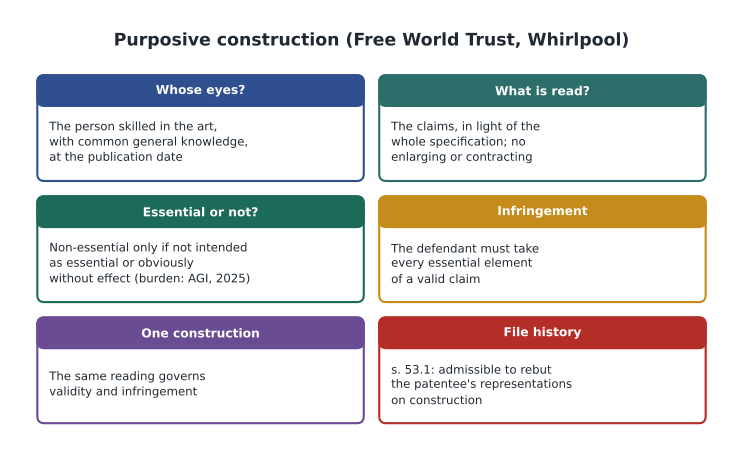
Every patent case begins with construction of the claims, which is a question of law for the judge. In Free World Trust v. Électro Santé Inc., 2000 SCC 66, and Whirlpool Corp. v. Camco Inc., 2000 SCC 67, released the same day, Justice Binnie set out the modern Canadian approach. Claims are construed purposively, through the eyes of the person of ordinary skill in the art to which the patent relates, in light of the whole specification and the common general knowledge, as of the date the patent was published. The claims are read with a mind willing to understand, not one looking for difficulties. The specification can explain words in the claims but cannot be used to enlarge or contract them.
Purposive construction sorts the elements of a claim into essential and non-essential. An element is essential unless it is shown that, on a purposive reading, the inventor did not intend it to be essential, or that a skilled reader would have known at the publication date that a variant would obviously have no effect on the way the invention works. The Federal Court of Appeal confirmed in AGI Suretrack LLC v. Farmers Edge Inc., 2025 FCA 134, that there is no presumption either way, and that the party asserting that an element is non-essential bears the burden of proving it. Infringement requires that the defendant's product or process take all of the essential elements of a claim; omitting or substituting a non-essential element does not avoid infringement. The same construction must be used for validity and infringement, so a patentee cannot read a claim narrowly to avoid prior art and broadly to catch a competitor.
In Free World Trust, the Court rejected a separate doctrine of equivalents of the American kind, holding that purposive construction already accommodates substitutes that a skilled reader would see as obviously working the same way. It also rejected a 'spirit of the invention' approach that would let courts protect what the inventor meant rather than what the claims say. Fairness and predictability for competitors require that the claims mean what they say.
Prosecution history
For decades Canadian courts refused to consider the file wrapper, the record of exchanges between the applicant and the Patent Office, when construing claims. Section 53.1, added in 2018, changed that. A written communication made in the course of prosecution, or in a re-examination or other proceeding before the Patent Office, may be admitted to rebut any representation made by the patentee in the action as to the construction of a claim. The Federal Court of Appeal has held that the provision is meant to prevent patentees from taking inconsistent positions, not to make the file history a general aid to construction.
Anticipation
Section 28.2 requires that the subject matter of a claim not have been disclosed, in such a manner that it became available to the public, before the claim date by someone other than the applicant more than a year before filing, or by anyone before the claim date, with special rules for co-pending applications. A claim is anticipated only if a single prior disclosure both discloses and enables the invention. In Apotex Inc. v. Sanofi-Synthelabo Canada Inc., 2008 SCC 61, Justice Rothstein held that disclosure means the prior art must disclose subject matter that, if performed, would necessarily result in infringement of the patent; the skilled person reads the prior art trying to understand it, without trial and error. Enablement means the skilled person must be able to perform the invention from the prior art, and here limited routine trial and error is permitted. Mosaicking several documents together is not anticipation; that is the job of obviousness.
A public use or sale can anticipate, as can an oral disclosure, a conference presentation or a product sold to the public if its features could be discovered by examination. The applicant's own disclosure more than a year before filing anticipates in Canada. Kettlebrook's April 2025 trade fair demonstration came after its February 2025 filing, so it does not affect the Canadian patent. Sonavant has found a 2019 German utility model describing a folding hinge with a torsion spring but no cam surface. Kaplinsky says that document does not anticipate, because it does not disclose the cam that releases the cup automatically, an essential element.
Obviousness
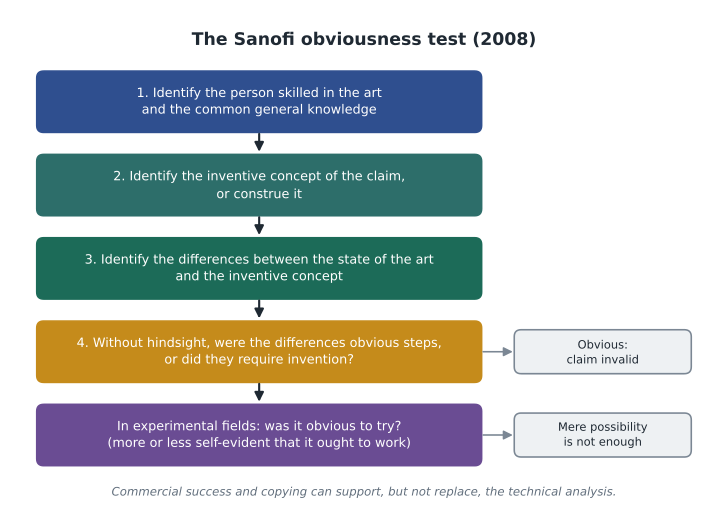
Section 28.3 requires that the subject matter of a claim not have been obvious on the claim date to a person skilled in the art, having regard to information disclosed by the applicant more than a year before filing or by anyone else before the claim date. In Sanofi, the Supreme Court adopted a four-step approach from the English courts. First, identify the notional person skilled in the art and the relevant common general knowledge of that person. Second, identify the inventive concept of the claim in question or, if that cannot readily be done, construe it. Third, identify what differences, if any, exist between the matters cited as forming part of the state of the art and the inventive concept of the claim. Fourth, viewed without any knowledge of the alleged invention as claimed, ask whether those differences constitute steps that would have been obvious to the skilled person or whether they require any degree of invention.
In fields where advances are often won by experimentation, such as pharmaceuticals, the fourth step may involve an 'obvious to try' inquiry. The Court said it must be more or less self-evident that what is being tried ought to work, and it listed factors: whether it is more or less self-evident that the solution works, the extent, nature and amount of effort required, and whether there was a motive in the prior art to find the solution. A mere possibility that something might work is not enough. Courts guard against hindsight: an invention often looks obvious once someone has made it. Secondary considerations such as long-felt need, commercial success and copying can support non-obviousness, though they carry less weight than the technical analysis. The Federal Court of Appeal has since cautioned that hunting for an 'inventive concept' separate from the words of the claim invites error, so courts now usually work from the construed claim itself.
Applied to the hinge, the skilled person is a mechanical engineer with experience designing consumer electronics enclosures. The common general knowledge includes torsion springs and cam mechanisms. The difference between the German document and claim 1 is the cam surface that converts the rotation of the cup into an automatic release for folding. Sonavant will say adding a cam is routine. Kettlebrook will say no one had combined the motions into a single action despite years of folding headphones on the market, and that consumers and reviewers praised it as new. Theo predicts a battle of experts, and Kaplinsky agrees.
Utility after AstraZeneca
An invention must be useful. For years, the Federal Court and the Federal Court of Appeal applied a 'promise doctrine', under which a patent that promised a particular result in its disclosure was invalid if that promise was not demonstrated or soundly predicted at the filing date, even if the claimed invention was useful in a more modest way. In AstraZeneca Canada Inc. v. Apotex Inc., 2017 SCC 36, the Supreme Court rejected the doctrine as unsound. Justice Rothstein held that a court should first identify the subject matter of the invention as claimed, then ask whether that subject matter is useful, meaning capable of a practical purpose, an actual result. A mere scintilla of utility related to the nature of the subject matter is enough. Utility must be established as of the filing date, either by demonstration or by sound prediction. Overstating the invention's benefits is not a utility issue, though a deliberate misrepresentation can make a patent void under section 53.
Sound prediction comes from Apotex Inc. v. Wellcome Foundation Ltd., 2002 SCC 77, the AZT case. A prediction is sound if there is a factual basis for it, the inventor has an articulable and sound line of reasoning from which the desired result can be inferred from the factual basis, and there is proper disclosure of the basis and reasoning in the specification. Glaxo had predicted that AZT would treat HIV before clinical trials were complete, and the Court held the prediction sound.
Sufficiency and overbreadth
Section 27(3) requires full disclosure. In Teva Canada Ltd. v. Pfizer Canada Inc., 2012 SCC 60, Pfizer's patent claimed a large number of compounds, including sildenafil, the active ingredient in Viagra, in a series of cascading claims, and stated that one of the especially preferred compounds was effective for erectile dysfunction without saying which. The Supreme Court held the patent void for insufficient disclosure, because the specification did not tell the skilled reader which compound worked, forcing the reader to conduct further tests. The Court emphasized that the disclosure is the quid pro quo for the monopoly and that a patentee cannot game the system by hiding the invention among many claims.
A claim is also invalid for overbreadth if it claims more than the inventor invented or described. The courts compare the claims with the invention made and disclosed. A claim to 'any folding mechanism for headphones' would be overbroad if Kettlebrook invented only a cam-and-spring mechanism. Other grounds of invalidity include ambiguity, double patenting, which bars a second patent for the same invention or an obvious variant of it, as discussed in Whirlpool, and the rule in section 53 that a material untrue allegation willfully made for the purpose of misleading voids a patent.
Infringement
The Patent Act does not define infringement. Section 55 provides that a person who infringes a patent is liable to the patentee and all persons claiming under the patentee for all damage sustained after the grant. The courts define infringement as any act that interferes with the full enjoyment of the monopoly, including making, constructing, using or selling the invention without the patentee's consent. Infringement is assessed claim by claim, and it is enough that one valid claim is infringed. Intention is irrelevant: a defendant who did not know of the patent still infringes. The burden is on the patentee to prove infringement on a balance of probabilities.
Several kinds of infringement deserve mention. Using a patented product, even for a purpose other than its intended one, can infringe, as Schmeiser showed. Possessing a patented product can give rise to a presumption of use if the possession is for a commercial purpose. Inducing infringement requires that the direct infringement be completed by someone else, that the inducer's influence be such that without it the infringement would not occur, and that the inducer knowingly exerted that influence. Selling a component that has no use other than in the patented combination, with instructions to combine, is a common example. Courts have also held that importing and selling in Canada a product made abroad using a process patented in Canada can infringe, at least where the patented process remains important to the product. Exhaustion means that once a patentee sells a patented article without conditions, the buyer and later owners may use and resell it, though they may not make a new one.
Statutory exceptions
Section 55.2 sets out exceptions. Using an invention solely for uses reasonably related to developing and submitting information required by law, such as data for regulatory approval of a drug, does not infringe. That is the 'early working' exception that allows generic manufacturers to prepare their submissions before the patent expires. Since 2018, section 55.3 has provided an experimental use exception for acts committed for the purpose of experimentation relating to the subject matter of the patent. Section 56 protects prior users: a person who, before the claim date, in good faith, committed an act that would otherwise infringe, or made serious and effective preparations to do so, may continue that act, a rule substantially rewritten in 2018.
Back to the leaf spring
Daniel works through infringement. The essential elements of claim 1 include a bracket, a spring, a cam surface and the automatic release. Sonavant uses a leaf spring instead of a torsion spring. Is 'torsion spring' essential? Kettlebrook must prove that a skilled reader in 2025, reading the specification, would understand that the inventor did not intend the type of spring to matter, or that substituting a leaf spring would obviously have no effect on how the hinge works. If the specification describes the torsion spring as storing the rotational energy that drives the release, and a leaf spring does the same job in the same way, Kettlebrook has a strong argument. If the specification stresses the torsion spring's particular advantages, the word may be essential and Sonavant may escape. Kaplinsky adds that Kettlebrook's dependent claims, which may not mention the spring type at all, should also be reviewed, and that a careful drafter would have written 'a resilient member' in claim 1.
Worked problem
Testing a claim against prior art and a competitor
Kettlebrook's patent has claim 1 (the torsion spring hinge described above) and claim 5: 'The assembly of claim 1 wherein the cam surface is formed integrally with the bracket.' Sonavant's hinge uses a leaf spring and a separate cam piece riveted to the bracket. Sonavant argues invalidity based on the German utility model and a 2022 Japanese patent describing a cam-release mechanism for a camera tripod. Analyze validity and infringement.
Show solution
- Construe the claims first. Identify the skilled person, read the claims in light of the specification as of publication, and decide whether 'torsion spring' and 'formed integrally' are essential elements, with the burden on the party asserting non-essentiality under AGI Suretrack.
- Anticipation. Neither prior document alone discloses every essential element of claim 1 and enables it, so neither anticipates under Sanofi.
- Obviousness. Apply the four Sanofi steps: the skilled engineer's common knowledge, the inventive concept of a single-motion flat-and-fold release, the differences from the German and Japanese documents, and whether combining a tripod cam with a headphone hinge was obvious without hindsight. Evidence of commercial success and copying supports Kettlebrook.
- Utility and sufficiency. The hinge works, and the specification shows a skilled person how to build it, so these grounds are weak.
- Infringement of claim 1. If 'torsion spring' is non-essential because a leaf spring obviously works the same way, Sonavant takes every essential element and infringes; if essential, it does not.
- Infringement of claim 5. If 'formed integrally' is essential, Sonavant's riveted cam avoids claim 5, so Kettlebrook should rely on claim 1. The case will likely turn on expert evidence about the spring.
Common mistakes
MistakeConstruing the claims differently for validity and for infringement.
InsteadFree World Trust and Whirlpool require one construction for both purposes.
MistakeCombining several prior documents to show anticipation.
InsteadAnticipation requires a single disclosure that both discloses and enables the invention; combinations are considered under obviousness.
MistakeArguing that a patent is invalid because it promised more than the invention delivers.
InsteadAstraZeneca abolished the promise doctrine; a scintilla of utility related to the claimed subject matter, demonstrated or soundly predicted at filing, is enough.
MistakeAssuming every word in a claim is essential, or that none are.
InsteadThere is no presumption; the party asserting non-essentiality must prove it on a purposive reading (AGI Suretrack, 2025).
Practice problems
Work each problem on paper first, then reveal the answer to check.
State the two requirements for anticipation under Sanofi.
Show answer
Prior disclosure of subject matter that, if performed, would necessarily infringe the patent, and enablement allowing the skilled person to perform the invention with only routine trial and error.
Why was Pfizer's sildenafil patent held void in Teva v. Pfizer?
Show answer
For insufficient disclosure, because the specification hid which of the claimed compounds was effective, so the skilled reader could not tell what the invention was without further testing.
What three elements make a prediction sound under Wellcome?
Show answer
A factual basis, an articulable and sound line of reasoning from that basis to the result, and proper disclosure of both in the specification.
Summary and key terms
- Claims are construed purposively through the eyes of the skilled person as of publication, sorting elements into essential and non-essential, with one construction for validity and infringement (Free World Trust, Whirlpool).
- Anticipation requires a single prior disclosure that discloses and enables the invention; obviousness uses the four-step Sanofi test, with obvious to try in experimental fields.
- AstraZeneca abolished the promise doctrine; utility requires a scintilla of usefulness related to the claimed subject matter, demonstrated or soundly predicted (Wellcome).
- Teva v. Pfizer voids patents that hide the invention; overbreadth, ambiguity, double patenting and willful misrepresentation are further grounds of invalidity.
- Infringement is any interference with the monopoly by taking all essential elements of a valid claim; inducement, use, possession and exceptions for regulatory work, experimentation and prior users complete the picture.
- Purposive construction
- Reading claims as a skilled person would, in light of the specification, to identify the essential elements.
- Essential element
- A claim element that must be taken for infringement, because the inventor intended it to be essential.
- Person skilled in the art
- The notional worker of ordinary skill in the field, through whose eyes patents are read and validity is assessed.
- Common general knowledge
- The knowledge generally known and accepted by persons skilled in the art at the relevant date.
- Sound prediction
- A basis for utility where the result is predicted from facts and reasoning disclosed at filing.
- Inducement
- Influencing another to infringe, such that the infringement would not otherwise occur, knowingly.
Lesson quiz · 5 questions
Score 60% or more to complete this lesson.
Create a free account to save your progress, take quizzes and earn a certificate.