
LAWC-312 · Lesson 8 of 12 · 21 min
Trademarks
▶ Video coming soon A video version of this lesson is on the way.
At the start of the eighth class, Kaplinsky draws two words on the board, one above the other: KETTLEBROOK and KETTLEBORNE. Below them she draws Kettlebrook's logo, a simple green kettle with a sound wave rising from its spout. 'Kettlebrook registered its name in 2022,' she says. 'It never registered the logo. In August 2026 Sonavant filed an application to register KETTLEBORNE for headphones and speakers, and in October it launched products under that name. What does trademark law give Kettlebrook, and what should it do now?' This lesson covers what a trademark is and how it is registered and lost. The next lesson covers infringement and passing off.
What a trademark is
The Trademarks Act, renamed from the Trade-marks Act when major amendments came into force on June 17, 2019, defines a trademark in section 2 as a sign or combination of signs that is used or proposed to be used by a person for the purpose of distinguishing, or so as to distinguish, their goods or services from those of others, or a certification mark. The essential function of a trademark is to identify the source of goods or services. Trademarks protect consumers from confusion and protect the goodwill that businesses build. As the Supreme Court put it in Mattel, Inc. v. 3894207 Canada Inc., 2006 SCC 22, trademarks are a shortcut that lets consumers identify the source of a product and rely on its quality, and the law protects that function, not a monopoly over words or designs as such.
Section 2 defines 'sign' broadly to include a word, a personal name, a design, a letter, a numeral, a colour, a figurative element, a three-dimensional shape, a hologram, a moving image, a mode of packaging goods, a sound, a scent, a taste, a texture and the positioning of a sign. Before 2019, shapes and packaging were registered as 'distinguishing guises' and needed proof of acquired distinctiveness; that category was abolished, but section 32 now allows the Registrar to require evidence of distinctiveness for signs that are not inherently distinctive, and specifically lists single colours, three-dimensional shapes, modes of packaging, sounds, scents, tastes and textures among the signs for which evidence of distinctiveness may be required.
A certification mark is used to distinguish goods or services that meet a defined standard, such as goods made by a certain method or by workers of a certain class, and is owned by a person who does not itself sell the goods. The term 'official mark' refers to a special category under section 9(1)(n)(iii) of the Act, discussed below.
The meaning of use
Use remains central, even though it is no longer required for registration. Under section 4, a trademark is used in association with goods if, at the time of the transfer of property or possession in the normal course of trade, it is marked on the goods or their packages or is in any other manner so associated with the goods that notice of the association is then given to the person to whom property or possession is transferred. A trademark is used in association with services if it is used or displayed in the performance or advertising of those services. Advertising alone is not use in association with goods; the mark must accompany the goods when they are transferred. Use by a licensee counts as use by the owner under section 50 only if the owner, under the licence, has direct or indirect control of the character or quality of the goods or services.
Registrability
Section 12(1) lists the main bars to registration. A trademark is not registrable if it is primarily merely the name or surname of an individual living or dead, unless it has acquired distinctiveness; if it is, whether depicted, written or sounded, either clearly descriptive or deceptively misdescriptive of the character or quality of the goods or services, their conditions of production, the persons employed in producing them or their place of origin; if it is the name in any language of any of the goods or services; if it is confusing with a registered trademark; if it is a prohibited mark under section 9 or 10, such as a national flag, a royal or vice-regal emblem or the official mark of a public authority; or if it is a protected geographical indication for wines, spirits or certain agricultural products. Section 12(2), added in 2019, provides that a trademark is not registrable if its features are dictated primarily by a utilitarian function, codifying the principle in Kirkbi.
Descriptiveness is judged by the immediate first impression of the ordinary consumer of the goods or services, considering the mark as a whole and in context. 'Clearly' means easy to understand, self-evident or plain; 'descriptive' means describing an intrinsic characteristic. SOUNDCLEAR for headphones would likely be refused as clearly descriptive of their quality; KETTLEBROOK, which suggests nothing about headphones, is inherently distinctive. A mark refused under section 12(1)(a) or (b) can be registered under section 12(3) if it has become distinctive in Canada at the filing date through use.
The application and examination
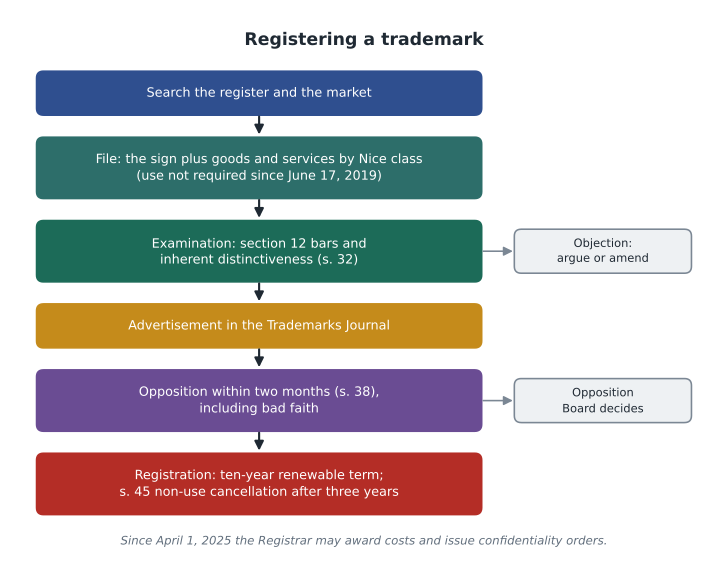
An applicant files an application identifying the trademark and listing the goods and services in ordinary commercial terms, grouped according to the Nice Classification. Fees depend on the number of classes. The applicant need not have used the mark or even intend a particular date of use. The Registrar examines the application for compliance with the formal requirements, registrability under section 12, confusion with registered or earlier-filed marks and, since 2019, inherent distinctiveness under section 32. The examiner may object, and the applicant may respond with argument, evidence or amendments. Applications that pass examination are advertised in the Trademarks Journal. CIPO has faced long examination backlogs in recent years, so applicants often wait a long time for a first examination.
Opposition
Within two months after advertisement, any person may oppose the application by filing a statement of opposition with the Registrar. The grounds are set out in section 38(2). They include that the application does not conform to the requirements of section 30, that the application was filed in bad faith, that the trademark is not registrable, that the applicant is not the person entitled to registration because the mark is confusing with a trademark previously used or made known in Canada or previously applied for by another, that the trademark is not distinctive, that the applicant was not using and did not propose to use the mark, and that the applicant was not entitled to use the mark. The opposition is heard by the Trademarks Opposition Board on written evidence, with cross-examination on affidavits and an optional hearing.
The bad faith ground, added in 2019, responds to the risk that dropping the use requirement would allow trademark squatting: filing for marks others are using or are likely to want, in order to sell them or block competitors. Bad faith is also a ground for invalidating a registration under section 18(1)(e). Kaplinsky tells the class that Kettlebrook should watch the Trademarks Journal for the advertisement of Sonavant's KETTLEBORNE application and oppose it on several grounds: confusion with the registered mark KETTLEBROOK, non-entitlement based on Kettlebrook's prior use and, if the evidence supports it, bad faith, given that Sonavant hired Kettlebrook's former engineer and chose a name one syllable away.
The 2025 changes to proceedings
On April 1, 2025, amendments gave the Registrar new powers in opposition, cancellation and geographical indication objection proceedings. The Registrar may now award costs on request at the end of a proceeding in exceptional cases, such as where a party's unreasonable conduct caused undue delay or expense, or where an application is refused for bad faith. The Registrar may issue confidentiality orders for sensitive evidence on a test similar to the Supreme Court's test for court confidentiality orders, and may case-manage proceedings. Appeals to the Federal Court under section 56 now require leave to file new evidence, which ends the old practice of saving the real evidence for the appeal. The Registrar may also remove an official mark on its own initiative if the owner is not, or is no longer, a public authority, addressing long-standing concern about official marks that block ordinary registrations indefinitely.
Registration, term and renewal
Registration lasts ten years from the registration date and may be renewed for further ten-year periods. Registrations granted before June 17, 2019 had fifteen-year terms and move to ten-year terms on renewal. A registration gives its owner the exclusive right to use the trademark throughout Canada in respect of the registered goods and services under section 19, and supports claims for infringement and depreciation of goodwill, discussed in lesson 9. Registration is also prima facie evidence of validity, though the presumption is weak and can be displaced in an expungement proceeding.
Losing a registration
A registration can be lost in several ways. Under section 45, at any time three years after registration, the Registrar may, and on the request of any person who pays a fee must, give notice requiring the owner to show by affidavit or statutory declaration that the mark has been used in Canada with each of the registered goods and services during the three years before the notice, or that there were special circumstances excusing non-use. The procedure is summary and inexpensive, and its purpose is to clear 'deadwood' from the register. The evidentiary threshold is low, but bare assertions of use are not enough; the owner must show facts from which use can be found. Goods and services for which use is not shown are deleted.
Under section 57, the Federal Court may expunge or amend a registration on the application of any person interested, on grounds in section 18: the trademark was not registrable at the registration date, it is not distinctive at the time proceedings begin, it has been abandoned, the applicant was not the person entitled to secure the registration, or the application was filed in bad faith. Loss of distinctiveness can happen through use by others without enforcement, through licensing without control or through the mark becoming the generic name for the goods. Since April 1, 2025, an owner suing under sections 19, 20 or 22 within three years after registration must show that the mark was used in Canada, or that special circumstances excused non-use, which prevents owners of unused registrations from enforcing them against real businesses.
Assignment and licensing
Trademarks are transferable, with or without the goodwill of the business, under section 48, and the transfer may be registered. But an assignment that results in two different owners using confusing marks can destroy distinctiveness. Licensing is common in franchising and merchandising. Under section 50, use by a licensee is deemed to be use by the owner if the owner has control of the character or quality of the goods or services, and public notice that the use is licensed creates a presumption of control. Without control, licensed use can make the mark lose distinctiveness.
Unregistered rights and international filing
Registration is not the only source of rights. An unregistered trademark that has acquired goodwill in Canada is protected by passing off at common law and under section 7(b), discussed in the next lesson, and prior use of an unregistered mark can defeat a later application or registration. Since June 17, 2019, Canadian businesses can file international applications through the Madrid Protocol designating other member countries, and foreign owners can designate Canada. Domain names are governed by registrar contracts and, for the .ca domain, by the Canadian Internet Registration Authority's dispute resolution policy, which allows complainants to recover domain names registered in bad faith that are confusingly similar to their marks.
Quebec's language rules
Trademark owners selling in Quebec must also consider the Charter of the French Language. Amendments made in 2022, with regulations that took effect on June 1, 2025, narrowed the exception that allowed trademarks in other languages to appear on products and signs. A trademark in a language other than French may appear on a product without translation only if it is a registered trademark and no French version is on the register, and generic or descriptive terms included in the trademark must appear in French elsewhere on the product. On outdoor signs, French must be markedly predominant where a trademark in another language appears. Businesses have responded by registering marks rather than relying on use, and by adding French descriptors. These rules are provincial and apply alongside federal trademark law.
| Proceeding | Forum | Key point |
|---|---|---|
| Opposition | Trademarks Opposition Board | Within two months of advertisement; grounds include bad faith |
| Section 45 cancellation | Registrar (summary) | Available three years after registration; owner must show use |
| Expungement under section 57 | Federal Court | Grounds in section 18, including non-distinctiveness and bad faith |
| Appeal under section 56 | Federal Court | New evidence now needs leave (since April 1, 2025) |
| Infringement and depreciation | Federal Court or superior court | Within three years of registration, proof of use is needed |
Worked problem
Protecting the Kettlebrook brand
Tolland wants to know (1) whether Kettlebrook can register its kettle logo now, after years of use; (2) whether it could register the green colour of its ear cups or the click sound the hinge makes; (3) how to stop Sonavant's KETTLEBORNE application; and (4) whether its 2022 registration for KETTLEBROOK is safe from a section 45 notice.
Show solution
- Logo (1). Yes. Kettlebrook can apply now; prior use strengthens its position in any opposition and supports entitlement, and use is not required anyway. The logo is a design mark and is likely inherently distinctive.
- Colour and sound (2). Both are signs under section 2, but a single colour or a sound may require evidence of acquired distinctiveness under section 32, and the click must not be dictated primarily by the hinge's function under section 12(2). Registration is possible but would require consumer survey and sales evidence.
- Opposition (3). Watch for advertisement and oppose within two months, pleading non-registrability for confusion with the registered KETTLEBROOK mark, non-entitlement based on prior use, non-distinctiveness and bad faith. Gather evidence of reputation, sales and the circumstances of the choice of name.
- Section 45 (4). The registration became vulnerable three years after its 2022 registration date. Kettlebrook should keep dated evidence of use with every registered good and service, such as invoices, photos of products bearing the mark and web pages; any goods not actually sold should be deleted or supported by special circumstances.
- Enforcement timing. Because the registration is more than three years old by late 2025 or 2026, the April 2025 proof-of-use rule for early enforcement may not apply, but Kettlebrook should still be ready to prove use.
- Licensing. If Kettlebrook licenses the mark to a distributor, the licence must give Kettlebrook control over quality to preserve distinctiveness under section 50.
Common mistakes
MistakeTelling a client it cannot apply for a trademark until it starts using it.
InsteadSince June 17, 2019, use is not required for registration, though use matters for section 45, enforcement and distinctiveness.
MistakeAssuming any shape or colour can be registered as easily as a word.
InsteadThe Registrar may require evidence of acquired distinctiveness under section 32, and functional features are barred by section 12(2).
MistakeForgetting that registration terms changed to ten years.
InsteadNew registrations last ten years; older fifteen-year registrations move to ten years on renewal.
MistakeLicensing a mark without quality control.
InsteadSection 50 deems licensed use to be the owner's use only if the owner controls character or quality.
Practice problems
Work each problem on paper first, then reveal the answer to check.
What is the test for whether a mark is clearly descriptive?
Show answer
Whether, on the immediate first impression of the ordinary consumer and considering the mark as a whole and in context, it plainly describes an intrinsic characteristic of the goods or services.
What does section 45 require of a registered owner who receives a notice?
Show answer
Evidence, by affidavit or statutory declaration, of use in Canada with each registered good and service in the three years before the notice, or special circumstances excusing non-use.
Name three changes to trademark proceedings that took effect on April 1, 2025.
Show answer
Registrar costs awards in exceptional cases, confidentiality orders and case management, leave required for new evidence on appeal, removal of official marks of non-public authorities, and proof of use for enforcement within three years of registration.
Summary and key terms
- A trademark is a sign or combination of signs used or proposed to be used to distinguish goods or services; signs now include colours, shapes, sounds, scents, tastes, textures, holograms and moving images.
- Use is defined by section 4 and is no longer required for registration, but it remains central to section 45, enforcement, distinctiveness and licensing under section 50.
- Section 12 bars names and surnames, clearly descriptive or deceptively misdescriptive marks, generic names, confusing marks, prohibited marks and functional features; section 32 allows the Registrar to require evidence of distinctiveness.
- Applications are examined, advertised and open to opposition, including on the bad faith ground added in 2019; the April 2025 amendments added costs, confidentiality, case management and new appeal and enforcement rules.
- Registrations last ten years and can be cancelled for non-use under section 45 or expunged under sections 18 and 57; unregistered marks are protected by passing off, and Quebec's language rules affect use there.
- Sign
- Any of the items listed in section 2, from words to scents, that can make up a trademark.
- Use
- For goods, marking at the time of transfer in the normal course of trade; for services, use or display in their performance or advertising.
- Clearly descriptive
- Plainly describing an intrinsic characteristic of the goods or services on first impression.
- Opposition
- A proceeding before the Trademarks Opposition Board challenging an advertised application.
- Section 45 proceeding
- A summary procedure requiring a registered owner to show recent use or lose the registration.
- Official mark
- A mark adopted by a public authority under section 9(1)(n)(iii) that bars confusing registrations.
Lesson quiz · 5 questions
Score 60% or more to complete this lesson.
Create a free account to save your progress, take quizzes and earn a certificate.