
LAWC-312 · Lesson 4 of 12 · 21 min
Moral rights, technology and copyright remedies
▶ Video coming soon A video version of this lesson is on the way.
Kaplinsky opens the fourth class with an image on the screen: a striking illustration of a green kettle exploding into musical notes. Kettlebrook's marketing manager generated it with an image tool earlier in 2026 by typing a prompt describing the company's logo, then posted it on social media. Ottavio Bramley, the photographer, is unhappy, because it looks like a distorted version of one of his photographs. 'Three questions,' Kaplinsky says. 'Does anyone own this image? Did making it infringe Bramley's rights, including his moral rights? And what could anyone actually recover?' The lesson moves from moral rights through the rules that govern copyright online, to generative artificial intelligence, and finally to remedies.
Moral rights
Moral rights protect the personal connection between authors and their works. Section 14.1 of the Copyright Act gives the author of a work the right to the integrity of the work and, where reasonable in the circumstances, the right to be associated with it as its author by name or under a pseudonym, and the right to remain anonymous. Performers received similar rights in their live performances and recorded performances in 2012. Moral rights cannot be assigned, but they can be waived in whole or in part, and they pass on the author's death. They last as long as the copyright in the work. Assigning the copyright does not by itself waive moral rights, so a client who buys copyright from a contractor should also obtain a written waiver.
Under section 28.2, the right to integrity is infringed only if the work is, to the prejudice of the honour or reputation of the author, distorted, mutilated or otherwise modified, or used in association with a product, service, cause or institution. Prejudice is deemed in the case of a painting, sculpture or engraving that is distorted, mutilated or modified. A change in the physical location of a work, or steps taken in good faith to restore or preserve it, are not by that alone a distortion. The classic case is Snow v. Eaton Centre Ltd. (1982), in which the Ontario High Court ordered the removal of red ribbons that the Eaton Centre had tied around the necks of Michael Snow's sculpture of sixty Canada geese for the Christmas season. The Court accepted that the artist's opinion of prejudice must be reasonably arrived at, and found it was, supported by other artists and experts.
Moral rights also protect against use of a work in association with a product or cause. If Kettlebrook altered Bramley's photograph in a way that harmed his reputation, or used his work to promote a cause he opposed, he could have a claim even after assigning his economic rights, unless he waived his moral rights. That is why professional assignments in Canada almost always include a moral rights waiver in favour of the buyer, its successors and licensees.
Technological protection measures
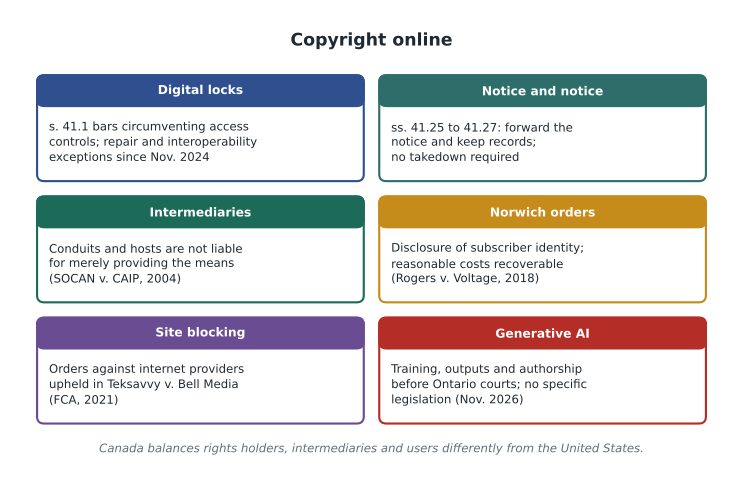
The Copyright Modernization Act of 2012 introduced protection for technological protection measures, commonly called digital locks. Section 41 defines a technological protection measure as any effective technology, device or component that controls access to a work and whose use is authorized by the owner, or that restricts infringing acts. Section 41.1 prohibits circumventing an access control, offering services to the public to circumvent any protection measure, and manufacturing, importing or selling devices primarily designed to circumvent. The prohibition on circumventing an access control applies even if the user's ultimate purpose would not infringe, which is why the relationship between digital locks and fair dealing is so contested.
The Act contains exceptions for law enforcement, interoperability of computer programs, encryption research, protection of personal information, security testing, persons with perceptual disabilities, broadcasters' temporary recordings and unlocking wireless devices. On November 7, 2024, two private members' bills received royal assent and added further exceptions. Bill C-244 permits circumvention for the sole purpose of diagnosing, maintaining or repairing a product in which a computer program is embedded, and Bill C-294 permits circumvention to make a program or device interoperable with another program, device or component. Both are often described as 'right to repair' reforms, though they address only copyright, not the separate question of whether manufacturers must supply parts, manuals or tools. In the same year, amendments to the Competition Act gave the Competition Tribunal new powers to order suppliers to make the means of diagnosis and repair available in some circumstances.
In 2017 the Federal Court applied the prohibition in Nintendo of America Inc. v. King, 2017 FC 246, awarding statutory damages of 11.7 million dollars against a business that sold devices and services to circumvent the locks on Nintendo game consoles, together with punitive damages. The Court held that statutory damages for trafficking are calculated per work protected by the circumvented measure.
Internet intermediaries and the notice and notice regime
Canada does not use the American 'notice and takedown' system. Instead, sections 41.25 to 41.27, in force since January 2, 2015, establish a 'notice and notice' regime. A copyright owner may send a notice of claimed infringement to an internet service provider or host. The provider must forward the notice electronically to the subscriber, tell the owner it has done so, and retain records identifying the subscriber for six months, or longer if the owner sues. The provider need not remove content or reveal the subscriber's identity. Providers that fail to comply face statutory damages of 5,000 to 10,000 dollars, but that is their only liability under the regime.
Sections 2.4(1)(b) and 31.1 protect intermediaries that merely provide the means of telecommunication, caching or hosting, so long as they do not know of a court decision finding that the hosted material infringes. In Society of Composers, Authors and Music Publishers of Canada v. Canadian Assn. of Internet Providers, 2004 SCC 45, the Court held that internet providers acting as conduits do not communicate the works their users send, and that the place of a communication is determined by its real and substantial connection to Canada.
To sue an anonymous downloader, a rights holder needs the subscriber's identity, which providers will release only under a court order, often called a Norwich order after the English case Norwich Pharmacal. In Rogers Communications Inc. v. Voltage Pictures, LLC, 2018 SCC 38, the Supreme Court held that a provider may recover its reasonable costs of complying with a Norwich order, but not the costs of performing its statutory notice and notice obligations, which include the work needed to identify the subscriber accurately.
Site blocking
Canada has no statutory site-blocking regime, but the Federal Court has developed one through its equitable jurisdiction. In Teksavvy Solutions Inc. v. Bell Media Inc., 2021 FCA 100, the Federal Court of Appeal upheld an order requiring major internet providers to block access to GoldTV, an unauthorized streaming service, holding that the Court had power to grant such an injunction against non-party providers and that the order did not breach freedom of expression or net neutrality principles. Since then the Federal Court has issued 'dynamic' and 'live' blocking orders that allow rights holders to add new addresses during sports seasons, under court supervision. The Court continues to refine the conditions, including monitoring and limits on overblocking.
Generative artificial intelligence
Generative artificial intelligence raises at least three copyright questions. The first is whether training a model on copyrighted works infringes. Training usually involves copying works into datasets and memory, which is a reproduction unless an exception applies. Canada has no specific text and data mining exception. Developers rely on fair dealing for research, on the temporary reproduction exception in section 30.71 and on arguments about the purpose and character of the copying; rights holders argue that wholesale copying of their works for a commercial product is neither research nor fair. The second question is whether outputs infringe, which depends on whether an output reproduces a substantial part of a particular work under Cinar. The third question is who, if anyone, owns copyright in an output. Because originality requires an author's skill and judgment, a purely machine-generated output may have no author and no copyright; where a human makes significant expressive choices in selecting, arranging or editing the output, that human may be an author of those contributions.
The questions are now before Canadian courts. In November 2024 a coalition of Canadian news publishers, including Torstar, Postmedia, The Globe and Mail, The Canadian Press and CBC/Radio-Canada, sued OpenAI in the Ontario Superior Court of Justice, alleging that it copied their articles to train its models, breached their websites' terms of use and circumvented technological protection measures. OpenAI challenged the Ontario court's jurisdiction. The Superior Court held in 2025 that it had jurisdiction, and on November 13, 2026 the Court of Appeal for Ontario dismissed OpenAI's appeal, so the case will proceed in Ontario. In October 2026 several of the same publishers filed a similar action in Ontario against Anthropic, the developer of the Claude models. Neither case has reached a decision on the merits. The CIPPIC application concerning the SURYAST registration, described in lesson 2, raises the authorship question.
On the policy side, the federal government held a consultation on copyright in the age of generative artificial intelligence from October 2023 to January 2024 and published a 'What We Heard' report in February 2025. Creators generally asked for consent, credit and compensation; technology companies generally asked for a text and data mining exception. A House of Commons committee report in 2026 recommended more transparency about training data and stronger consent and licensing requirements. The national artificial intelligence strategy released in June 2026 did not address copyright, and as of November 2026 no bill to amend the Copyright Act for artificial intelligence had been introduced. Kaplinsky tells the class to treat every statement about artificial intelligence and copyright as provisional and to check for developments before advising.
Applied to the exploding kettle image, the analysis runs as follows. If the image reproduces a substantial part of Bramley's photograph, for example its particular composition and lighting, then making and posting it may infringe his copyright regardless of how it was produced, subject to any licence Kettlebrook holds and any exception. If it distorts his work in a way that prejudices his honour or reputation, it may also infringe his moral right of integrity. Whether Kettlebrook owns copyright in the image depends on how much human skill and judgment went into it; a short prompt alone is unlikely to be enough, but a marketing manager who iterated, selected and edited carefully may be an author of the result.
Remedies
Section 34 provides that an owner whose copyright is infringed is entitled to all remedies by way of injunction, damages, accounts, delivery up and otherwise that are or may be conferred by law. Interlocutory injunctions are available under the usual test from RJR-MacDonald Inc. v. Canada: a serious issue to be tried, irreparable harm and a balance of convenience favouring the order. Anton Piller orders permitting search and seizure of evidence are available in exceptional cases, and in 2025 the Federal Court jailed defendants who defied such an order in Bell Media Inc. v. Macciacchera, 2025 FC 1378, a case about an unauthorized streaming service.
Under section 35, an infringer is liable for the damages the owner suffered and for any profits the infringer made that were not taken into account in calculating the damages. The owner must prove only the infringer's receipts, and the infringer must prove any deductible costs. Under section 38.1, the owner may elect at any time before final judgment to recover statutory damages instead of damages and profits. For infringements for commercial purposes, the court may award between 500 and 20,000 dollars per work. For non-commercial infringement by an individual, the range is 100 to 5,000 dollars for all infringements involved in the proceeding, for all works. The court considers good or bad faith, the conduct of the parties and the need for deterrence, and may reduce the award if the infringer was unaware or if a large number of works makes the minimum grossly disproportionate.
Punitive damages are available for high-handed, malicious or reprehensible conduct. In Cinar, the Supreme Court upheld a punitive award and confirmed that disgorgement of profits is joint and several only where the defendants acted as a collectivity. Section 39 limits innocent infringers to an injunction unless the work was registered, as lesson 2 explained. Section 42 makes knowing commercial infringement a criminal offence, with fines of up to one million dollars and imprisonment of up to five years on indictment. Under section 43.1, civil proceedings must be commenced within three years after the plaintiff knew or could reasonably have known of the infringement.
Worked problem
Choosing between statutory and actual damages
Kettlebrook's online store discovers that a reseller, Pondfield Electronics, has been selling counterfeit Loom instruction booklets bundled with grey-market headphones. Investigators find about 400 copies sold over eight months. Kettlebrook's lost sales are hard to prove, and Pondfield's profits on the booklets alone are small. Advise on remedies under the Copyright Act.
Show solution
- Identify the works. The instruction booklet is one literary and artistic work owned by Kettlebrook, because an employee created it in the course of employment.
- Identify the infringement. Pondfield's copies are reproductions and, if Pondfield did not make them, its sales are secondary infringement under section 27(2) if it knew or should have known they were infringing.
- Actual damages and profits. Under section 35, Kettlebrook could recover its losses plus Pondfield's profits not already counted, but both are small and hard to prove for the booklets alone.
- Statutory damages. Kettlebrook can elect before final judgment to claim 500 to 20,000 dollars per work for commercial infringement. With one work, the maximum is 20,000 dollars, which may exceed provable losses and supports deterrence.
- Other remedies. Seek an injunction, delivery up of the remaining copies and, if Pondfield acted deliberately and deceptively, punitive damages; consider trademark claims for the counterfeit goods themselves, which may be more valuable.
- Limitation and evidence. Sue within three years of discovering the infringement; preserve test purchases and records, and consider registering the copyright now to strengthen evidence for future cases.
Common mistakes
MistakeAssuming an assignment of copyright transfers moral rights.
InsteadMoral rights cannot be assigned; the buyer needs a written waiver.
MistakeTelling a client that Canadian internet providers must remove infringing content on notice.
InsteadCanada's notice and notice regime requires providers only to forward notices and retain records.
MistakeSaying Canadian law has settled whether training artificial intelligence on copyrighted works is fair dealing.
InsteadAs of November 2026 the question was before Ontario courts in the OpenAI and Anthropic cases, with no merits decision and no legislation.
MistakeTreating statutory damages for non-commercial infringement as calculated per work.
InsteadFor non-commercial infringement by an individual, 100 to 5,000 dollars covers all works and all infringements in the proceeding.
Practice problems
Work each problem on paper first, then reveal the answer to check.
When is the right to integrity infringed under section 28.2?
Show answer
When the work is distorted, mutilated or otherwise modified, or used in association with a product, service, cause or institution, to the prejudice of the author's honour or reputation; prejudice is deemed for paintings, sculptures and engravings that are distorted or modified.
What did Rogers v. Voltage decide about costs?
Show answer
Providers may recover reasonable costs of complying with a Norwich order but not the costs of their statutory notice and notice obligations.
What did the November 2024 amendments add to the Copyright Act?
Show answer
Exceptions permitting circumvention of technological protection measures for diagnosis, maintenance and repair of products, and for interoperability.
Summary and key terms
- Moral rights of integrity and attribution belong to authors and performers, cannot be assigned and can be waived; integrity requires prejudice to honour or reputation (Snow v. Eaton Centre).
- Section 41.1 protects technological protection measures, with exceptions that since November 2024 include repair and interoperability.
- Canada uses notice and notice rather than takedown; intermediaries are protected when they merely provide the means, and site-blocking orders are available (Teksavvy v. Bell Media).
- Generative artificial intelligence raises unresolved questions of training, output infringement and authorship, now before Ontario courts with no specific legislation.
- Remedies include injunctions, damages and profits, statutory damages under section 38.1, punitive damages, criminal penalties and a three-year limitation period.
- Moral rights
- An author's rights of integrity and attribution, which cannot be assigned but can be waived.
- Technological protection measure
- An effective technology that controls access to a work or restricts infringing acts.
- Forwarding regime
- The Canadian notice and notice regime requiring internet providers to forward infringement notices to subscribers and retain records.
- Norwich order
- A court order compelling a third party, such as an internet provider, to disclose information identifying a wrongdoer.
- Statutory damages
- Damages within a range set by section 38.1 that an owner may elect instead of proving actual loss.
- Text and data mining
- Automated copying and analysis of large collections of works, such as in training artificial intelligence models.
Lesson quiz · 5 questions
Score 60% or more to complete this lesson.
Create a free account to save your progress, take quizzes and earn a certificate.