
LAWC-312 · Lesson 10 of 12 · 21 min
Industrial designs
▶ Video coming soon A video version of this lesson is on the way.
Kaplinsky begins the tenth class with an apology to Kettlebrook. 'This is the lesson where the client made a mistake,' she says, holding up an ear cup from the Loom. Its shape, a rounded rectangle with a gentle twist toward the back and a raised ridge along the edge, is what reviewers noticed first. It is also what Sonavant's new headphones seem to copy. Kettlebrook never applied to register the shape as an industrial design, and it showed the headphones to the public at a Toronto trade fair in April 2025. 'By the time we finish today,' she says, 'you will know why that matters, what the company can still do, and how you would advise the next client before it launches anything.'
What an industrial design is
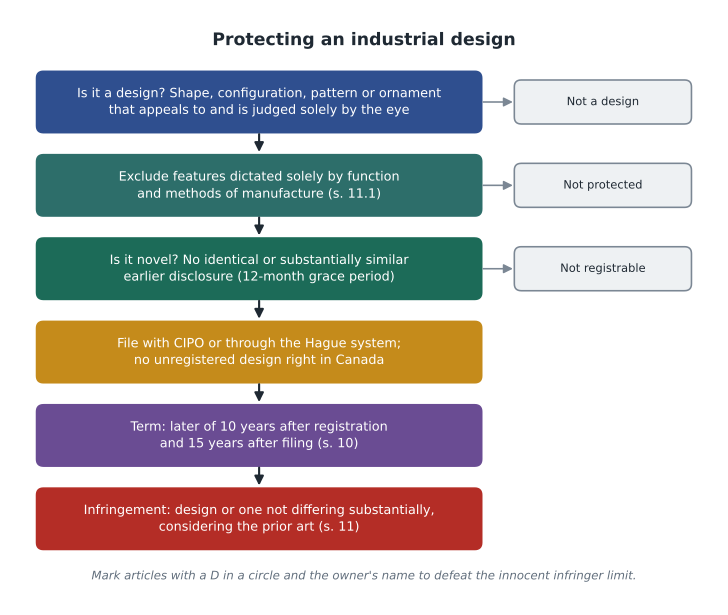
The Industrial Design Act protects the appearance of manufactured articles. Section 2 defines a design as features of shape, configuration, pattern or ornament and any combination of those features that, in a finished article, appeal to and are judged solely by the eye. An article is anything that is made by hand, tool or machine. Shape and configuration refer to the three-dimensional form of an article; pattern and ornament refer to surface decoration. The phrase 'judged solely by the eye' signals that the protection is for visual appeal, not for how the article works.
Since amendments that took effect on November 5, 2018, applicants may register a design for part of an article, such as the handle of a mug or the ear cup of a pair of headphones, rather than only for the article as a whole. The same amendments brought Canada into the Hague Agreement Concerning the International Registration of Industrial Designs, so that a single international application filed through the World Intellectual Property Organization can designate Canada and other member countries. Designs for computer-generated animated images and graphical user interfaces can also be registered when they are shown in association with a finished article such as a screen, which has made design protection more important for software companies.
Functional features and methods of manufacture
Section 11.1 provides that no protection is afforded by the Act to features applied to a useful article that are dictated solely by a utilitarian function of the article, or to any method or principle of manufacture or construction. The exclusion keeps the design system from protecting function, which is the domain of patents. The word 'solely' is important. A feature that serves a function but could have taken other visual forms is not excluded; only features whose appearance is dictated entirely by function are. The English House of Lords case Amp Inc. v. Utilux Pty. Ltd. (1971), about electrical terminals shaped entirely by engineering needs, is the classic example of a design rejected because its features were dictated solely by function.
In Zero Spill Systems (Int'l) Inc. v. Heide, 2015 FCA 115, the Federal Court of Appeal held that the trial judge had erred in law by requiring the design owner to show which features were not dictated solely by function. The burden lies on the party alleging that features are functional. Functional features are not ignored entirely when designs are compared, but the scope of protection extends only to the visual features that remain. The Court sent the infringement question back for redetermination.
Registrability
A design is registrable if the applicant is the proprietor and the design is novel. Novelty is measured against designs disclosed anywhere before the filing date or the priority date: the design must not be identical to, or not differ substantially from, a design that was previously disclosed. A disclosure by the proprietor, or by someone who obtained the design from the proprietor, within the twelve months before the filing date does not count against the application. That twelve-month grace period is the rule that Kettlebrook missed. Its April 2025 public disclosure began the grace period, which expired in April 2026, and the design cannot now be registered in Canada. Foreign applicants may claim priority from a first filing in a Paris Convention country if they file in Canada within six months.
Before 2018 the Act also required that a design be 'original', and the courts interpreted that word to require some spark of inspiration beyond mere novelty. In Bodum USA, Inc. v. Trudeau Corporation (1889) Inc., 2012 FC 1128, the Federal Court held registrations for double-walled drinking glasses invalid because they did not differ substantially from earlier designs and lacked the required originality, and found the defendant's glasses did not infringe. The 2018 amendments reframed registrability in terms of novelty measured against prior disclosures, but the comparison with earlier designs, and the question of whether the differences are substantial, remain at the heart of every case.
Examination, publication and term
Applications are examined by CIPO for compliance with formal requirements and for registrability, including a search of prior designs. Applicants may request deferral of registration and publication for up to thirty months from the filing or priority date, which allows them to keep a design confidential until launch. Section 10 sets the term: protection begins on the later of the registration date and the date the application becomes available to the public, and ends on the later of ten years after registration and fifteen years after the filing date, subject to payment of maintenance fees. Fees not paid on time cause the term to be treated as expired. In practice, most designs registered under the current rules last fifteen years from filing.
Registration is the only source of industrial design rights; there is no unregistered design right in Canada, unlike in the United Kingdom and the European Union. That makes the decision to file, and the timing of the filing, critical. Kaplinsky tells the class that every product launch checklist for a design-driven client should include an industrial design review at least a month before the first public showing, whether at a trade fair, in a crowdfunding campaign or in a social media post.
Ownership
The proprietor of a design is its author unless the author executed the design for another person for good and valuable consideration, in which case the other person is the proprietor. Designs created by employees in the course of employment, or commissioned and paid for, therefore usually belong to the employer or commissioner, a different rule from the Copyright Act. Designs may be assigned, and assignments should be recorded with CIPO.
Infringement
Section 11(1) provides that no person may, without the licence of the owner, make, import for the purpose of trade or business, or sell, rent, or offer or expose for sale or rent, any article in respect of which the design is registered and to which the design or a design not differing substantially from it has been applied, and it extends the same rule to kits that can be assembled into such an article. Under section 11(2), in determining whether differences are substantial, the court may take into account the extent to which the registered design differs from any previously published design. A design that is only a small step from the prior art receives narrow protection; a design that departs boldly from earlier designs receives wider protection.
Courts compare the registered design and the accused article through the eyes of an informed consumer, a person familiar with the kind of article and with the prior art, who notices differences an ordinary member of the public might not. In Bodum, the Federal Court rejected an 'imperfect recollection' approach borrowed from trademark law and applied the informed consumer standard. The comparison is visual and holistic, but features dictated solely by function are excluded from the comparison.
Remedies and the innocent infringer
The proprietor or an exclusive licensee may sue in the Federal Court or a provincial superior court. Under section 15.1, the court may grant an injunction, damages or profits, punitive damages and the disposal of infringing articles or kits. Section 17 limits the remedy against a defendant who establishes that, at the time of the infringement, it was not aware and had no reasonable grounds to suspect that the design was registered: the court may grant only an injunction. That limit does not apply if the articles, their labels or packaging were marked with a capital D in a circle and the proprietor's name. Section 18 bars any remedy for acts committed more than three years before the action began.
Designs and copyright
Because a design usually begins as a drawing or sculpture, it often has copyright as an artistic work. Section 64 of the Copyright Act manages the overlap. It provides that it is not an infringement of copyright in a design applied to a useful article, or in an artistic work from which the design is derived, to reproduce the design or the useful article, or to do anything with it, if the article has been reproduced in a quantity of more than fifty with the authority of the copyright owner. The rule channels mass-produced designs into the industrial design system, with its registration requirement and shorter term. Section 64(3) lists exceptions where copyright continues to apply: graphic or photographic representations applied to the face of an article, trademarks, labels, material with a woven or knitted pattern or suitable for piece goods, architectural works, representations of real or fictitious beings, events or places applied to an article as a feature of shape, configuration, pattern or ornament, and articles sold as a set if not more than fifty sets are made, among others. Section 64.1 adds that features dictated solely by function, and methods of manufacture, are not protected by copyright in a useful article.
Daniel asks whether Kettlebrook's designer's sketches of the ear cup give it any rights against Sonavant. Kaplinsky says the sketches are artistic works with copyright, but because Kettlebrook has made far more than fifty pairs of Loom headphones, section 64 prevents it from using that copyright against Sonavant's manufacture of a similar ear cup. The exceptions do not help, because the ear cup is a shape, not a graphic, a textile, a label or a representation of a character.
What Kettlebrook can still do
The lost design right leaves Kettlebrook three avenues. First, trademark protection for the shape: a three-dimensional shape is a sign, and if consumers have come to identify the Loom ear cup shape with Kettlebrook, the company could apply to register it, though it would likely need evidence of acquired distinctiveness under section 32 and would face the bar in section 12(2) on features dictated primarily by function. Second, passing off: if the shape has acquired goodwill and Sonavant's product misrepresents its source, Kettlebrook could sue under section 7(b) or at common law, but Kirkbi warns that functional features cannot be protected that way. Third, the patent: if the shape contributes to the folding mechanism, the hinge patent may cover the relevant features. Kaplinsky adds a fourth step for the future: Kettlebrook's next model should be the subject of design applications in Canada and, through the Hague system, abroad before any public disclosure.
Other sui generis rights
Two other specialized regimes complete the picture. The Plant Breeders' Rights Act protects new plant varieties that are new, distinct, uniform and stable. Amendments in 2015 brought Canada into line with the 1991 version of the International Convention for the Protection of New Varieties of Plants, lengthening the term to twenty-five years for trees and vines and twenty years for other varieties, and preserving a farmers' privilege to save and reuse harvested seed on their own holdings. The Integrated Circuit Topography Act protects the original three-dimensional configuration of electronic circuits in semiconductor chips for ten years, a regime rarely litigated but part of Canada's international obligations.
| Question | Industrial design | Copyright in a useful article |
|---|---|---|
| How obtained | Registration only | Automatically on creation |
| Key deadline | File within 12 months of first disclosure | None |
| Term | Later of 10 years from registration and 15 years from filing | Life plus 70, but section 64 removes protection after 50 authorized copies |
| Functional features | Excluded by section 11.1 | Excluded by section 64.1 |
| Owner of commissioned work | Person who paid for it | Author, unless assigned in writing |
Worked problem
Advising a new client before launch
Gwendolyn Fennick, a Corwin furniture maker, plans to unveil a new chair at a design show in Montreal in eight weeks and sell it in Canada, the United States and Europe. The chair has a curved backrest with a carved wave pattern, a patented folding mechanism and a name, TIDELINE, that she has not searched. Her designer is a freelance industrial designer paid by the hour. Advise her.
Show solution
- Identify the design features. The backrest's curve and the carved wave pattern are features of shape and ornament that appeal to the eye; the folding mechanism is functional and belongs to the patent.
- File before disclosure. File Canadian design applications, for the whole chair and for the backrest as a part, before the show, and consider a Hague international application designating the United States and the European Union; request deferred publication until the launch if secrecy matters.
- Ownership. Under the Industrial Design Act, a design executed for another for good and valuable consideration belongs to the person who paid, but Fennick should still obtain a written assignment of design rights and copyright from the freelance designer, with a moral rights waiver.
- Copyright. The designer's drawings have copyright, but once more than fifty chairs are made, section 64 will prevent copyright from stopping copies of the chair's shape; the carved pattern may fall within an exception only if it is a representation of a real or fictitious being or a textile pattern, which it is not.
- Trademark. Search TIDELINE in Canada and abroad, then file applications; use is not required to apply in Canada.
- Marking. Mark the chairs or their labels with a D in a circle and Fennick's name once registered, to avoid the innocent infringer limit in section 17.
Common mistakes
MistakeAssuming design rights arise automatically like copyright.
InsteadCanada has no unregistered design right; protection requires registration, and the application must be filed within twelve months of the first public disclosure.
MistakeRelying on copyright in drawings to stop copying of a mass-produced product.
InsteadSection 64 of the Copyright Act removes that protection once more than fifty copies are made with authority, subject to listed exceptions.
MistakeTreating any feature that has a function as unprotectable.
InsteadOnly features dictated solely by function are excluded, and the party alleging functionality bears the burden (Zero Spill).
MistakeComparing designs through the eyes of a hurried shopper.
InsteadDesigns are compared through the eyes of an informed consumer familiar with the prior art (Bodum).
Practice problems
Work each problem on paper first, then reveal the answer to check.
How long does a Canadian industrial design registration last?
Show answer
From the later of registration and the application becoming public, until the later of ten years after registration and fifteen years after filing, if maintenance fees are paid.
What does section 17 of the Industrial Design Act provide?
Show answer
That an innocent infringer who did not know and had no reasonable grounds to suspect registration is liable only to an injunction, unless the articles or packaging were marked with a D in a circle and the proprietor's name.
Name three categories in section 64(3) of the Copyright Act where copyright continues to protect designs applied to useful articles.
Show answer
Graphic or photographic representations on the face of an article, trademarks, labels, textile patterns, architectural works, and representations of real or fictitious beings, events or places.
Summary and key terms
- An industrial design is features of shape, configuration, pattern or ornament that, in a finished article, appeal to and are judged solely by the eye; partial designs and Hague filings have been available since November 5, 2018.
- Features dictated solely by function and methods of manufacture are excluded (section 11.1); the party alleging functionality bears the burden (Zero Spill).
- A design must be novel, with a twelve-month grace period for the proprietor's own disclosure; there is no unregistered design right in Canada.
- Protection lasts until the later of ten years from registration and fifteen years from filing; infringement covers articles bearing the design or one not differing substantially from it, judged by an informed consumer in light of the prior art.
- Section 64 of the Copyright Act removes copyright protection from designs applied to useful articles made in more than fifty copies, subject to exceptions; plant varieties and circuit topographies have their own regimes.
- Industrial design
- Visual features of a finished article that appeal to and are judged solely by the eye, protected by registration.
- Partial design
- A registered design for part of an article, permitted since 2018.
- Informed consumer
- The person, familiar with the article and the prior art, through whose eyes designs are compared.
- Useful article
- An article with a utilitarian function, whose designs are channelled by section 64 into the industrial design system.
- Hague system
- The international registration system for industrial designs administered by WIPO.
- Plant breeders' rights
- Rights in new, distinct, uniform and stable plant varieties under the Plant Breeders' Rights Act.
Lesson quiz · 5 questions
Score 60% or more to complete this lesson.
Create a free account to save your progress, take quizzes and earn a certificate.