
LAWC-312 · Lesson 11 of 12 · 21 min
Trade secrets
▶ Video coming soon A video version of this lesson is on the way.
Kaplinsky starts the eleventh class with a forensic report. Kettlebrook's IT contractor found that in the two weeks before Odhran Eskola resigned in August 2026, his work laptop synchronized a folder called 'tuning-final' to a personal cloud storage account. The folder contained the source code and test data for the company's sound-profile algorithm, which adjusts the headphones' output in real time to a listener's preferences and which Kettlebrook has never patented or published. Three weeks after Eskola joined Sonavant, Sonavant announced an app update that, according to Tolland, does exactly the same thing. 'There is no trade secrets statute for this in Canada,' Kaplinsky says. 'So what law protects Kettlebrook?' The answer is a combination of equity, contract, fiduciary law and, at the margins, criminal law.
Why keep a secret instead of patenting
A business that develops valuable information has a choice. It can patent an invention, gaining a strong right for twenty years at the price of full public disclosure, or it can keep the information secret, gaining protection that lasts as long as secrecy lasts but that does not stop independent development or reverse engineering. Secrecy is attractive for information that cannot easily be discovered from the product, such as manufacturing processes, recipes, customer data, pricing and source code, and for information that may not be patentable at all, such as business know-how or a mathematical model. Kettlebrook chose secrecy for its algorithm because the algorithm runs on its servers and inside compiled code, because a mathematical method alone could not be patented under section 27(8), and because a patent would have shown competitors how it worked.
Breach of confidence
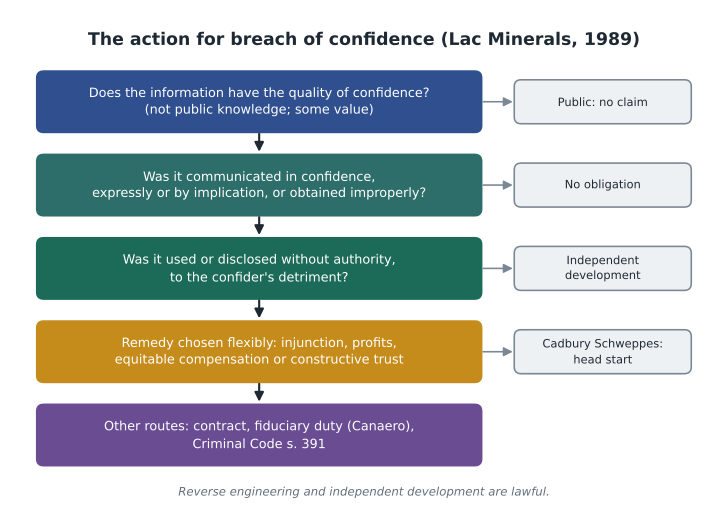
The core of Canadian trade secret law is the equitable action for breach of confidence. In Lac Minerals Ltd. v. International Corona Resources Ltd., [1989] 2 S.C.R. 574, Corona, a junior mining company, shared geological information about a promising property with Lac, a major mining company, during negotiations for a joint venture. Lac then acquired the neighbouring land itself and developed what became the Williams mine at Hemlo, Ontario. The Supreme Court held Lac liable for breach of confidence. Justice La Forest, adopting the test from the English case Coco v. A.N. Clark (Engineers) Ltd., held that the plaintiff must show three things: that the information conveyed was confidential; that it was communicated in confidence; and that it was misused by the party to whom it was communicated, to the detriment of the confider. The Court imposed a constructive trust over the mine as the remedy, because Corona would have acquired the property but for Lac's breach and because the property was unique.
Information has the quality of confidence if it is not common knowledge or publicly available, even if it is made from public materials through skill and work, and if it has some value to the owner. A compilation of public information can be confidential, as can a customer list or a technique that competitors could discover only by significant effort. The obligation of confidence can arise from an express agreement, from the circumstances of the communication, such as a business negotiation or employment, or from improper acquisition. A person who receives information knowing that it was disclosed in breach of confidence can also be bound. The third element, misuse, does not require that the defendant copy the information exactly; using it as a springboard to save time and expense in developing a competing product is enough.
Remedies: Cadbury Schweppes
In Cadbury Schweppes Inc. v. FBI Foods Ltd., [1999] 1 S.C.R. 142, the defendant had held a licence to make Clamato juice using the plaintiff's recipe. After the licence ended, the defendant launched its own juice, Caesar Cocktail, made with a recipe developed using the confidential Clamato recipe. The trial judge found breach of confidence but refused a permanent injunction. The Supreme Court agreed with that result. Justice Binnie held that breach of confidence has a unique, sui generis character drawing on equity, contract, property and tort, and that the court has flexibility to fashion the remedy that best fits the case. Because the confidential information was 'nothing very special' and could have been replicated by a competent food technologist within about a year, the appropriate remedy was equitable compensation for the head start the defendant gained, measured by the plaintiff's losses during that period, rather than a permanent injunction. The Court distinguished Lac Minerals, where the information led to a unique asset.
Remedies for breach of confidence therefore include interlocutory and permanent injunctions, an accounting of the defendant's profits, equitable compensation for the plaintiff's losses, damages in lieu of an injunction, delivery up or destruction of materials containing the information, and, in rare cases, a constructive trust over property acquired through the breach. Courts often limit an injunction to the 'springboard' period, the time it would have taken the defendant to develop the information independently, so that the defendant is not permanently barred from a market it could have entered lawfully.
Contract
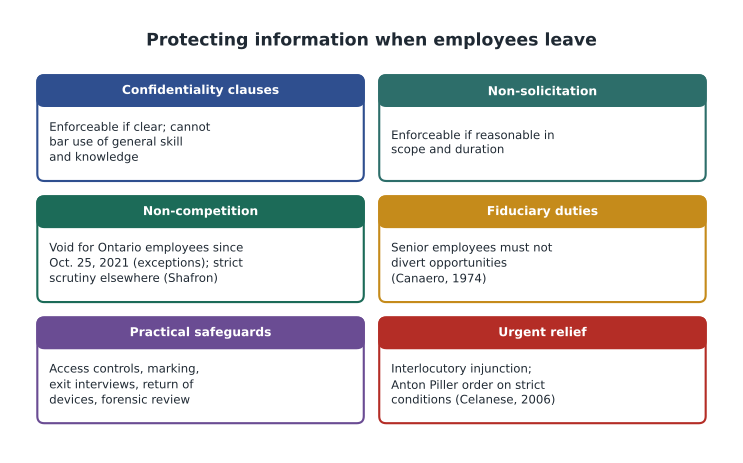
Most trade secret disputes also involve a contract. Employment agreements, non-disclosure agreements, licences and joint venture agreements commonly include confidentiality clauses. A contractual claim can be broader than equity: the parties can define confidential information expansively and specify obligations such as return of materials. Courts enforce confidentiality clauses that are reasonably clear and that protect information the employer has a legitimate interest in protecting, but they will not enforce a clause that, in substance, prevents an employee from using general skill, experience and knowledge acquired in the job, because that would operate as an unreasonable restraint of trade.
Restrictive covenants that limit competition receive close scrutiny. In Shafron v. KRG Insurance Brokers (Western) Inc., 2009 SCC 6, the Supreme Court held that a restrictive covenant in an employment contract is prima facie unenforceable unless it is reasonable between the parties and with reference to the public interest, that ambiguous covenants are unenforceable, and that courts will not rewrite an overbroad covenant through 'notional severance'. In that case, a non-competition clause covering 'the Metropolitan City of Vancouver', a term without legal meaning, was struck down. Non-solicitation clauses are more readily enforced than non-competition clauses, because they protect customer relationships without barring the employee from working in the field.
In Ontario, section 67.2 of the Employment Standards Act, 2000, in force since October 25, 2021, prohibits employers from entering into employment contracts or other agreements with employees that include a non-compete agreement, with exceptions for the sale of a business where the seller becomes an employee of the buyer, and for executives in the most senior positions. Confidentiality and non-solicitation clauses remain permitted. Eskola's 2022 employment agreement with Kettlebrook includes a confidentiality clause defining confidential information to include 'all source code, algorithms, test data and tuning parameters', an obligation to return all company information on departure, and a twelve-month non-compete. Kaplinsky tells the class that the non-compete is void under the Ontario statute, because Eskola was the lead engineer, not an executive, but the confidentiality clause and the return obligation remain enforceable.
Fiduciary duties
Senior employees, directors and officers may owe fiduciary duties to their employer. In Canadian Aero Service Ltd. v. O'Malley, [1974] S.C.R. 592, the president and executive vice-president of a company resigned and, through a new company, obtained a government mapping contract that their former employer had been pursuing. The Supreme Court held that they had breached fiduciary duties by diverting a maturing business opportunity, and that the duty survived their resignation where the departure was influenced by a wish to acquire the opportunity. Ordinary employees do not owe such duties, though all employees owe a duty of good faith and fidelity during employment and must not misuse confidential information afterwards. Whether Eskola, a lead engineer with significant autonomy and access, was a fiduciary is debatable; Kaplinsky says Kettlebrook should plead it but rely mainly on breach of confidence and contract.
The Criminal Code
Confidential information is not 'property' that can be stolen under the general theft provisions. In R. v. Stewart, [1988] 1 S.C.R. 963, the Supreme Court held that a person who tried to obtain a list of hotel employees' names and addresses for a union could not be convicted of counselling theft, because confidential information is not property for the purposes of the theft offence. Parliament responded in part in 2020, when the Canada-United States-Mexico Agreement Implementation Act added section 391 to the Criminal Code. It is an offence to knowingly obtain, communicate or make available a trade secret by deceit, falsehood or other fraudulent means, and to knowingly obtain, communicate or make available a trade secret knowing that it was obtained by such an offence. A trade secret is defined as information that is not generally known in the trade, has economic value because it is not generally known, and is the subject of reasonable efforts to maintain its secrecy. Independent development and reverse engineering are expressly excluded. The offence carries a maximum penalty of fourteen years' imprisonment on indictment. Prosecutions have been rare, and most businesses rely on civil remedies, but the provision shows that Canadian law now recognizes trade secrets as a distinct legal category.
Reverse engineering and independent development
Breach of confidence protects only against misuse of information obtained in confidence or improperly. A competitor that buys a product on the open market and takes it apart to learn how it works does not breach any confidence, unless it agreed by contract not to do so, and a competitor that develops the same information independently is free to use it. That is the fundamental weakness of trade secret protection compared with patents. It also shapes litigation strategy: a defendant accused of misusing a secret will almost always claim independent development, and the plaintiff must prove access and similarity sufficient to support an inference of misuse. Kettlebrook's forensic evidence that Eskola copied the 'tuning-final' folder, together with the speed with which Sonavant matched the algorithm's function, gives it a strong case for an inference of misuse.
Interlocutory relief
Trade secret cases often turn on what happens in the first weeks. A plaintiff may seek an interlocutory injunction restraining use or disclosure of the information, applying the RJR-MacDonald test, and courts have shown more willingness to find irreparable harm in confidential information cases because once a secret is spread it cannot be recalled. In urgent cases, an Anton Piller order may permit the plaintiff's lawyers, supervised by an independent solicitor, to enter the defendant's premises and preserve evidence; the Supreme Court set strict conditions for these orders in Celanese Canada Inc. v. Murray Demolition Corp., 2006 SCC 36. Courts may also order forensic imaging of devices and accounts, and protective orders limiting who may see the plaintiff's confidential information during the litigation.
Building a trade secret programme
Kaplinsky closes the lesson with practical advice. Courts are more likely to find that information is confidential, and that a recipient knew it, when the owner has treated it as secret. A business should identify its most valuable information, restrict access on a need-to-know basis, mark documents and files as confidential, use non-disclosure agreements with suppliers and partners, include clear confidentiality and return-of-information clauses in employment agreements, train employees, monitor unusual downloads, and conduct exit interviews at which departing employees confirm in writing that they have returned all company information. The same steps also satisfy the 'reasonable efforts to maintain secrecy' element in section 391 of the Criminal Code.
| Route | What must be shown | Typical remedy |
|---|---|---|
| Breach of confidence | Confidential information, communicated in confidence, misused to the detriment of the confider (Lac Minerals) | Injunction, equitable compensation, profits or constructive trust |
| Breach of contract | A valid confidentiality or return clause and its breach | Damages, injunction, specific performance of return |
| Fiduciary duty | A fiduciary relationship and diversion of an opportunity (Canaero) | Accounting of profits, constructive trust |
| Criminal Code section 391 | Knowing acquisition or disclosure by fraudulent means, beyond reasonable doubt | Conviction and sentence |
| Restrictive covenant | A reasonable, unambiguous clause (Shafron); non-competes void in Ontario employment since 2021 | Injunction or damages |
Worked problem
The Eskola files
Kettlebrook wants to act quickly against Eskola and Sonavant over the sound-profile algorithm. It has the forensic report, Eskola's 2022 employment agreement and Sonavant's announcement. Outline the claims, the forum and the first steps.
Show solution
- Confidential quality. The algorithm's source code and tuning data were not public, had economic value and were protected by access restrictions and a confidentiality clause, so they have the necessary quality of confidence.
- Obligation and misuse. Eskola received the information as an employee under an express confidentiality clause; copying it to a personal account before resigning, and Sonavant's rapid release of matching functionality, support an inference of misuse. Sonavant is bound if it knew or ought to have known the information was confidential.
- Contract and fiduciary claims. Plead breach of the confidentiality and return clauses against Eskola; the non-compete is void under section 67.2 of Ontario's Employment Standards Act, 2000 and should not be relied on. Plead breach of fiduciary duty in the alternative.
- Forum. Because breach of confidence and contract are provincial matters, sue Eskola and Sonavant in the Ontario Superior Court of Justice, which can also hear the patent and trademark claims if Kettlebrook wants one action; otherwise coordinate with the Federal Court action.
- Urgent relief. Seek an interlocutory injunction restraining use and disclosure, an order for return of the information and forensic imaging of Eskola's personal accounts and Sonavant's relevant repositories, with a protective order. Consider an Anton Piller order only if there is strong evidence that evidence will be destroyed.
- Remedy at trial. Under Cadbury Schweppes, expect the court to tailor relief to the head start Sonavant gained; if a competent team could have built the function in six months, damages for that period may replace a permanent injunction.
Common mistakes
MistakeSaying Canada has a federal civil trade secrets statute like the United States' Defend Trade Secrets Act.
InsteadCivil protection comes from provincial law of equity and contract; the federal contribution is the criminal offence in section 391 of the Criminal Code.
MistakeAssuming a non-compete clause will protect an Ontario employer's secrets.
InsteadNon-compete agreements with Ontario employees have been prohibited since October 25, 2021, except for executives and sales of a business; confidentiality and non-solicitation clauses remain available.
MistakeExpecting a permanent injunction in every breach of confidence case.
InsteadCadbury Schweppes gives courts flexibility; where the information was not special, compensation for the head start may be the remedy.
MistakeTreating reverse engineering of a lawfully bought product as misuse.
InsteadReverse engineering and independent development are lawful, absent a contractual promise, and are excluded from section 391.
Practice problems
Work each problem on paper first, then reveal the answer to check.
State the three elements of breach of confidence from Lac Minerals.
Show answer
The information was confidential, it was communicated in confidence, and it was misused by the recipient to the detriment of the confider.
Why did the Supreme Court refuse a permanent injunction in Cadbury Schweppes?
Show answer
Because the confidential recipe was nothing very special and could have been replicated within about a year, so compensation for the head start was the appropriate remedy.
What did R. v. Stewart decide?
Show answer
That confidential information is not property that can be the subject of theft under the Criminal Code.
Summary and key terms
- Trade secrets are protected as long as they stay secret, but not against independent development or reverse engineering; businesses choose secrecy for information that is hard to discover or not patentable.
- Breach of confidence requires confidential information, communicated in confidence, and misuse to the confider's detriment (Lac Minerals).
- Remedies are flexible and may be limited to the springboard period (Cadbury Schweppes), or extend to a constructive trust where the information produced a unique asset (Lac Minerals).
- Contracts, restrictive covenants (Shafron), Ontario's 2021 ban on non-competes and fiduciary duties (Canaero) supplement the equitable action.
- Section 391 of the Criminal Code, added in 2020, criminalizes obtaining or communicating trade secrets by fraudulent means, responding in part to R. v. Stewart.
- Breach of confidence
- The equitable action for misuse of information received in confidence.
- Springboard
- The head start a defendant gains by using confidential information, which can limit or measure the remedy.
- Equitable compensation
- A monetary remedy in equity compensating the plaintiff for loss caused by a breach of confidence or fiduciary duty.
- Constructive trust
- A proprietary remedy requiring the defendant to hold property for the plaintiff.
- Restrictive covenant
- A contractual restraint on an employee's or seller's future activities, such as a non-compete or non-solicit.
- Anton Piller order
- A civil search order permitting preservation of evidence at the defendant's premises under strict conditions.
Lesson quiz · 5 questions
Score 60% or more to complete this lesson.
Create a free account to save your progress, take quizzes and earn a certificate.