
LAWC-312 · Lesson 12 of 12 · 23 min
Capstone: an intellectual property problem
▶ Video coming soon A video version of this lesson is on the way.
Kaplinsky hands out the final problem in the twelfth class and tells the cohort that it is the kind of file a junior lawyer at an intellectual property firm might receive on a Monday morning, with an answer due to the partner by Friday. Before they read it, she writes five rules on the board, which she says apply to every intellectual property problem. First, identify every right that could protect each asset, using the five words from the first class: make, name, shape, say, keep. Second, settle ownership and validity before infringement, because a client that does not own a valid right has nothing to enforce. Third, apply the leading test for each issue in the courts' own steps, naming the case that sets the test. Fourth, deal with defences and exceptions, including fair dealing, functionality, independent development and territoriality. Fifth, end every issue with a remedy, a forum and a concrete next step. 'Clients do not pay for doctrine,' she says. 'They pay for what to do next.'
The facts
Hollowmere Ceramics Ltd. is a fictional pottery business in Corwin, Ontario, founded in 2019 by Branwen Quillan, a ceramicist. It makes stoneware mugs and bowls sold online, through independent shops across Canada and at craft fairs. In 2021 it registered the word mark HOLLOWMERE for 'ceramic tableware, namely mugs, bowls and plates' and for 'online retail store services featuring ceramic tableware'. It has always sold its mugs in a distinctive blue speckled glaze with a narrow white rim, packed in plain brown boxes stamped with a small heron logo, which is not registered.
In January 2026, Quillan finished designing a new mug with a sculpted thumb rest on the top of the handle and a gentle inward taper near the base. In February 2026, before showing the mug anywhere, Hollowmere filed a Canadian industrial design application for the handle as a partial design. The design was registered in August 2026. Hollowmere first showed the mug publicly at a Toronto craft fair in March 2026 and launched it online in April 2026. It has sold about 6,000 mugs since then at 38 dollars each.
Hollowmere's glaze is made from a recipe developed over three years by Linus Marchmont, a chemist Hollowmere hired in 2022. The recipe is written in a binder kept in a locked cabinet and in a password-protected file. Marchmont's employment agreement includes a clause stating that 'all glaze formulas, firing schedules and test results are confidential and remain Hollowmere's property', a duty to return all documents on leaving, and a two-year non-compete covering Ontario. Marchmont is not an officer or director. Quillan also invented an adjustable kiln-loading rack that lets her fire twice as many mugs per load; Hollowmere filed a Canadian patent application in May 2025, which was laid open in November 2026, and examination is under way.
Hollowmere's product photographs were taken in 2024 and 2026 by Aurel Pashko, a freelance photographer and a friend of Quillan's, who was paid by the shoot. There is no written agreement; Pashko's invoices say 'product photos for website and social media'.
In June 2026 Marchmont resigned and joined Kilnhouse Supply Inc., a large Toronto-based homeware retailer. In October 2026 Kilnhouse launched a range of mugs called HOLLOWMOOR, made by a contract manufacturer in Portugal and imported into Canada, at 16 dollars each. The mugs have a thumb-rest handle that Quillan says is almost identical to hers, though slightly thicker, and a blue speckled glaze that a ceramics expert says is chemically very close to Hollowmere's. Kilnhouse's product pages use two of Pashko's photographs of Hollowmere mugs, cropped, under a banner reading 'Love the Hollowmere look? Get it for half the price.' Kilnhouse's Portuguese manufacturer uses racks that appear to match the design in Hollowmere's patent application. Kilnhouse's online reviews include comments such as 'I thought this was a cheaper Hollowmere line.' Quillan wants to stop Kilnhouse, recover money and protect the business. Advise her.
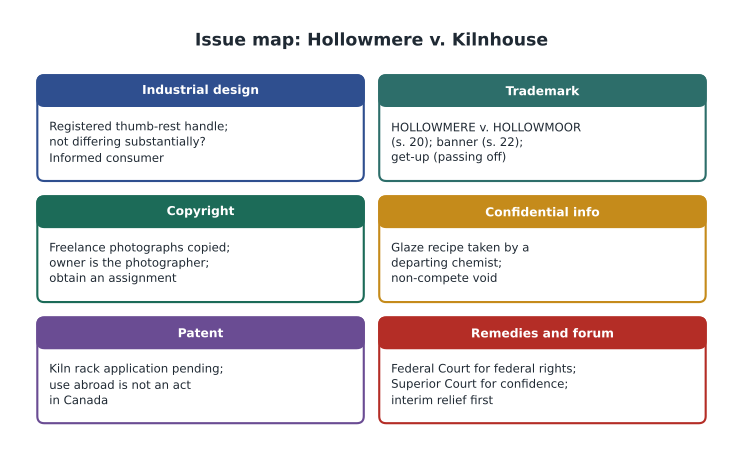
Model answer
Kaplinsky distributes a model answer after the class has worked on the problem. It follows the five rules, taking each asset in turn.
1. The handle: industrial design
Issue. Does Kilnhouse infringe Hollowmere's registered design for the handle? Rule. Under section 11 of the Industrial Design Act, no person may, without licence, make, import for trade or sell an article bearing the registered design or a design not differing substantially from it, and under section 11(2) the court may consider how far the registered design differs from the prior art. Designs are compared through the eyes of an informed consumer (Bodum), and features dictated solely by function are excluded under section 11.1, with the burden on the party alleging functionality (Zero Spill). Application. Hollowmere filed in February 2026, before its first disclosure in March 2026, so the twelve-month grace period is not even needed and the design is novel unless earlier mugs with similar handles exist. Kilnhouse will argue the thumb rest is functional, but a thumb rest can take many visual forms, so its particular sculpted shape is not dictated solely by function. The slightly thicker handle is unlikely to be a substantial difference to an informed consumer if the overall shape, taper and thumb rest are the same, especially if the design departed boldly from earlier mugs, which gives it wider protection. Kilnhouse imports and sells the mugs, both listed acts. Conclusion. Hollowmere has a strong design infringement claim. Kilnhouse may counterclaim for invalidity based on prior art, so Hollowmere should search for earlier handles now. Remedy. Injunction, damages or profits under section 15.1, and disposal of infringing mugs. Section 17's innocent infringer limit is unlikely to apply to Kilnhouse, which hired Hollowmere's former chemist and referred to Hollowmere in its own advertising, but Hollowmere should mark future mugs or packaging with a D in a circle and its name.
2. HOLLOWMOOR and the blue speckled look: trademarks and passing off
Issue. Does HOLLOWMOOR infringe the HOLLOWMERE registration, and does Kilnhouse's banner depreciate its goodwill? Can Hollowmere protect its unregistered get-up? Rule. Section 20 prohibits selling or advertising goods in association with a confusing trademark, judged under section 6 by the first impression of the casual consumer somewhat in a hurry, starting with resemblance (Masterpiece); fame is a factor but not a trump (Mattel). Section 22 requires use of the registered mark, significant goodwill, a link and likely depreciation (Veuve Clicquot). Section 7(b) and passing off require goodwill, misrepresentation causing confusion and damage (Ciba-Geigy, Kirkbi), and a valid trademark under section 7(b) (2K4). Application. HOLLOWMERE and HOLLOWMOOR share the first and dominant element HOLLOW and differ in endings that sound and mean much the same, a mere and a moor both being features of a landscape. The goods are identical, the channels overlap online, and the customer reviews are evidence of actual confusion, which is not required but is powerful. Section 20 confusion is very likely. The banner uses the registered mark HOLLOWMERE itself to promote a cheaper rival, inviting a link and suggesting that Hollowmere's look can be had for less, a classic depreciation claim in the line of Clairol, though Hollowmere must prove its mark has significant goodwill, through sales, press and survey evidence. For the blue speckled glaze with white rim and the heron logo, Hollowmere has no registration, so it must rely on passing off. It must show that consumers associate that get-up with Hollowmere, which is plausible after seven years of consistent use, and that Kilnhouse's similar glaze misrepresents its source. The glaze is decorative, not functional, so Kirkbi is not an obstacle. Conclusion. Strong section 20 claim; arguable section 22 claim; credible passing off claim. Hollowmere should also apply to register its heron logo and consider applying for its glaze appearance as a sign, which would likely require evidence of acquired distinctiveness under section 32. Section 45 vulnerability: Hollowmere's 2021 registration is more than three years old, so it should confirm use with plates as well as mugs and bowls, or expect a counterclaim to delete plates.
3. The photographs: copyright
Issue. Who can sue for Kilnhouse's use of Pashko's photographs? Rule. Copyright subsists in original photographs (CCH). The author is the first owner unless an employee acting in the course of employment (section 13(3)); the commissioned-work rule was repealed in 2012; assignments must be in writing (section 13(4)). Infringement requires reproduction of a substantial part (Cinar). Fair dealing for criticism or review requires mention of the source and author and fairness (CCH, section 29.1). Application. Pashko owns the copyright; Hollowmere has only an implied non-exclusive licence for its website and social media. Kilnhouse reproduced and communicated cropped versions, which still take the heart of each photograph. Kilnhouse is unlikely to rely successfully on fair dealing: it gives no attribution, its purpose is to sell competing products and it used whole images. Conclusion. Pashko can sue; Hollowmere cannot unless it obtains a written assignment or exclusive licence. Next step. Obtain a written assignment from Pashko, including the right to sue for past infringements, and a moral rights waiver; then claim statutory damages of 500 to 20,000 dollars per photograph for commercial infringement under section 38.1, which may exceed actual losses.
4. The glaze recipe: confidential information
Issue. Did Marchmont and Kilnhouse misuse Hollowmere's confidential glaze recipe? Rule. Breach of confidence requires confidential information, communicated in confidence and misused to the confider's detriment (Lac Minerals). Remedies are flexible and may be limited to the head start (Cadbury Schweppes). Contractual confidentiality and return clauses are enforceable if clear; non-competes with Ontario employees are void under section 67.2 of the Employment Standards Act, 2000. A third party that knows information was disclosed in breach of confidence is also bound. Application. The recipe was kept locked and password-protected and was described as confidential in Marchmont's agreement, so it has the necessary quality of confidence and was communicated in confidence. The chemical closeness of Kilnhouse's glaze, Marchmont's move to Kilnhouse and the timing support an inference of misuse; Kilnhouse will claim independent development or reverse engineering, since glazes can be analyzed chemically. Hollowmere needs evidence that Kilnhouse's glaze was developed using the recipe, for example through discovery of Kilnhouse's development records and its communications with the Portuguese manufacturer. The two-year non-compete is void, because Marchmont is not an executive and the sale-of-business exception does not apply, but the confidentiality and return clauses stand. Marchmont is probably not a fiduciary (Canaero), being neither officer nor senior manager. Conclusion. A credible breach of confidence and breach of contract claim against Marchmont, and a breach of confidence claim against Kilnhouse if it knew or ought to have known the recipe's origin. If the court concludes that a competent chemist could have matched the glaze by analysis within, say, a year, the remedy may be compensation for the head start rather than a permanent injunction. The Criminal Code offence in section 391 requires proof of fraudulent means beyond a reasonable doubt and is unlikely to be pursued.
5. The kiln rack: patent
Issue. Can Hollowmere stop Kilnhouse's manufacturer using the rack, or stop imports of mugs made with it? Rule. Patents are territorial; infringement requires acts in Canada. Before grant, section 55(2) gives only reasonable compensation for acts after laying open that would infringe a granted patent. Claims are purposively construed (Free World Trust). Application. Hollowmere's patent is still an application, laid open in November 2026, so it has no exclusive right yet, only a potential claim for reasonable compensation from November 2026 if and when a patent is granted. The rack is used in Portugal, which is not an act in Canada. The rack is an apparatus used to make mugs; the mugs themselves are not the invention. Whether importing mugs fired on a rack patented in Canada infringes is doubtful, because the courts have extended infringement to imported products made by patented processes, not to products made with the help of patented equipment, and the mugs carry no trace of the rack. Hollowmere also did not file in Portugal or the European Union, and its Canadian filing date in May 2025 means the twelve-month Paris priority window closed in May 2026. Conclusion. The patent gives Hollowmere little leverage against Kilnhouse now. Next step. Pursue examination, review the claims to ensure they cover the commercial embodiment, and consider whether any future improvement should be filed in Canada and abroad before disclosure.
6. Remedies, forum and strategy
The design, trademark and copyright claims are federal, and the Federal Court can hear them together, grant an injunction effective throughout Canada and, if needed, expunge any HOLLOWMOOR registration. The breach of confidence and contract claims are provincial and must be brought in the Ontario Superior Court of Justice unless they are so closely tied to a federal claim that the Federal Court can hear them, which is doubtful for a stand-alone claim against an ex-employee. A single Superior Court action could include all the claims, since the Superior Court has concurrent jurisdiction over infringement, though it cannot order expungement. The choice depends on speed, cost and which court's procedures fit best.
Interim relief should come first. An interlocutory injunction against HOLLOWMOOR, supported by the reviews showing actual confusion and evidence of irreparable harm to Hollowmere's reputation and market, is realistic under RJR-MacDonald, especially given Kilnhouse's deliberate reference to Hollowmere. For the glaze, Hollowmere should seek an order restraining use and disclosure of the recipe and requiring Marchmont to return all materials, with forensic review of his devices and accounts under a protective order; an Anton Piller order would be justified only by strong evidence that records will be destroyed (Celanese). At trial, Hollowmere would choose among damages, an accounting of profits and, for the photographs, statutory damages, and would seek delivery up of infringing mugs and packaging. Border measures under the Combating Counterfeit Products Act are designed for counterfeit goods bearing identical or near-identical marks and may not suit HOLLOWMOOR mugs, but Hollowmere could explore a request for assistance if Kilnhouse continues importing.
Practical steps this week: preserve evidence, including screenshots of Kilnhouse's website and reviews, test purchases and the forensic report on Marchmont's last weeks; obtain Pashko's written assignment; search the prior art for mug handles; check use of HOLLOWMERE for all registered goods; file trademark applications for the heron logo; send a carefully drafted demand letter to Kilnhouse and Marchmont that identifies the rights without overstating them; and diary the deadlines, including the two-month opposition window for any HOLLOWMOOR application once advertised, the three-year limitation periods for copyright and industrial design claims and the six-year period for patent claims.
| Asset | Right | Strength | First step |
|---|---|---|---|
| Thumb-rest handle | Registered industrial design | Strong | Prior art search; plead sections 11 and 15.1 |
| HOLLOWMERE name | Registered trademark | Strong (section 20); arguable (section 22) | Gather confusion and goodwill evidence |
| Glaze look and heron logo | Passing off; logo unregistered | Credible | File for the logo; collect reputation evidence |
| Photographs | Copyright owned by Pashko | Strong once assigned | Obtain written assignment |
| Glaze recipe | Confidential information and contract | Credible; depends on proof of misuse | Seek preservation and return orders |
| Kiln rack | Pending patent | Weak against Kilnhouse | Continue examination |
Reflections
Kaplinsky ends the course by asking each student to name the lesson they will use most. Theo says the ownership rules, because every file he saw as a law clerk began with a missing assignment. Hannah says the balance in Théberge, because it tells her which way an unclear provision will be read. Arjun says purposive construction, because it is how engineers and lawyers finally meet. Sophie says the Quebec language rules and moral rights, because they show that intellectual property is also about identity. Daniel says the overlaps, because a single object can carry five different rights and a lawyer's job is to know which one will hold. Kaplinsky sets the headphones from the first class back on the lectern and reminds them that, in practice, most intellectual property problems are won or lost long before litigation: in what the client filed, what it signed and what it kept secret.
Worked problem
Writing the short client email
The partner asks for a 200-word email to Branwen Quillan summarizing the advice in plain language. What should it say?
Show solution
- Lead with the bottom line: Hollowmere has strong claims against Kilnhouse over the handle design and the HOLLOWMOOR name, a credible claim over the glaze recipe, and a photograph claim that depends on Pashko.
- Explain the most urgent step: preserving evidence and seeking a court order quickly to stop HOLLOWMOOR sales and any further use of the recipe.
- Explain the ownership fix: ask Pashko to sign a short assignment of his photograph copyright, which also lets Hollowmere claim statutory damages.
- Manage expectations: the kiln rack patent is not yet granted and cannot stop activity in Portugal, and the non-compete in Marchmont's contract is not enforceable in Ontario.
- Give the cost and forum decision: one action in the Federal Court for the federal rights and one in the Ontario Superior Court for the recipe, or a single Superior Court action, with a recommendation.
- Close with the next meeting and the documents she should bring, such as sales records, press coverage and Marchmont's employment file.
Common mistakes
MistakeStarting with infringement before confirming ownership and validity.
InsteadA client without a valid, owned right has nothing to enforce; deal with assignments, registration and validity first.
MistakeTreating every asset as protected by every right.
InsteadMatch each asset to the right that actually protects it, and note the limits, such as section 64 for designs and territoriality for patents.
MistakeRelying on an Ontario employee non-compete.
InsteadSection 67.2 of the Employment Standards Act, 2000 makes it void except for executives and sales of a business; use confidentiality and return clauses.
MistakeEnding an answer with doctrine rather than advice.
InsteadFinish each issue with a remedy, a forum and a concrete next step for the client.
Practice problems
Work each problem on paper first, then reveal the answer to check.
Why can Hollowmere not sue Kilnhouse for patent infringement now?
Show answer
Because its patent has not been granted, so it has only a possible claim for reasonable compensation from laying open, and the rack is used in Portugal, outside Canada.
What evidence will be most useful for the section 20 claim against HOLLOWMOOR?
Show answer
Evidence of resemblance and of actual confusion, such as customer reviews saying the mugs seemed to be a Hollowmere line, plus evidence of overlapping goods and channels.
Which court can expunge a HOLLOWMOOR registration if one issues?
Show answer
Only the Federal Court, under section 57 of the Trademarks Act.
Summary and key terms
- Answer intellectual property problems in five steps: identify the rights, settle ownership and validity, apply the leading tests, address defences, and finish with a remedy, a forum and a next step.
- A timely design filing gave Hollowmere a strong design claim; Kettlebrook's earlier failure to file shows the cost of missing the twelve-month window.
- Trademark claims under sections 20 and 22 and passing off complement each other; evidence of actual confusion and goodwill is decisive.
- Copyright claims turn on ownership; freelance work requires a written assignment before the client can sue.
- Trade secret claims require proof of misuse and receive tailored remedies; patents are territorial and give no exclusive right before grant.
- Issue map
- A list of every right, issue and party in a problem, used to plan a structured answer.
- Demand letter
- A letter asserting rights and requesting that the recipient stop infringing, drafted to avoid overstatement.
- Get-up
- The overall appearance of a product or its packaging, protectable through passing off if distinctive.
- Concurrent jurisdiction
- The shared power of the Federal Court and provincial superior courts to hear infringement claims.
- Interlocutory injunction
- An order restraining conduct until trial, granted under the RJR-MacDonald test.
- Request for assistance
- A filing with the Canada Border Services Agency enabling detention of suspected counterfeit goods.
Lesson quiz · 5 questions
Score 60% or more to complete this lesson.
Create a free account to save your progress, take quizzes and earn a certificate.