
LAWC-312 · Lesson 2 of 12 · 22 min
Copyright
▶ Video coming soon A video version of this lesson is on the way.
Kaplinsky starts the second class by reading aloud from the Kettlebrook Loom instruction booklet. 'Fold the ear cups inward until you hear a soft click. Store in a cool, dry place.' She asks whether those sentences are protected by copyright. Theo says they are so ordinary that nobody could own them. Arjun says the booklet as a whole, with its diagrams and layout, took someone days to produce. Both are partly right, Kaplinsky says, and the difference between them is the subject of this lesson: what copyright protects, who owns it and for how long.
The statutory scheme
Copyright in Canada is purely statutory. Section 89 of the Copyright Act says that no person is entitled to copyright otherwise than under and in accordance with the Act. There is no common law copyright, and courts cannot create new rights by analogy. That makes the words of the statute decisive, and the Supreme Court has repeatedly said that the Act must be read in its entire context, in its grammatical and ordinary sense, harmoniously with its scheme and object, with the balance described in Théberge in mind.
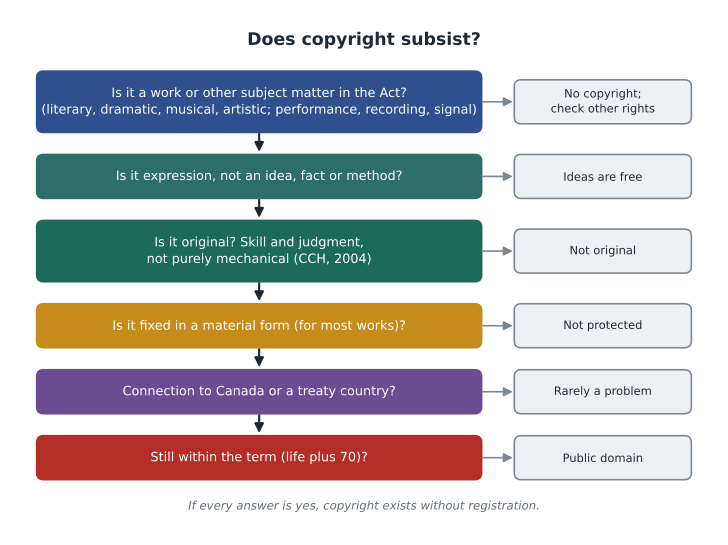
Section 5 provides that copyright subsists in every original literary, dramatic, musical and artistic work, if the conditions in the section are met. The Act also protects, in Part II, three kinds of other subject matter often called neighbouring rights: performers' performances, sound recordings and communication signals of broadcasters. Section 2 defines each category broadly. A 'literary work' includes tables, compilations of literary works and computer programs. An 'artistic work' includes paintings, drawings, maps, charts, plans, photographs, engravings, sculptures, works of artistic craftsmanship, architectural works and compilations of artistic works. A 'dramatic work' includes choreography, mime and cinematographic works. A 'musical work' is any work of music or musical composition, with or without words.
Expression, not ideas
Copyright protects the expression of ideas, not the ideas themselves, nor facts, nor methods, systems or processes. A cookbook's recipes can be followed freely; the author's particular words and photographs cannot be copied. The principle keeps copyright from becoming a monopoly over knowledge and leaves inventions to the patent system. It is not always easy to apply, because the line between an idea and its expression is a matter of degree. A plot outline described at a high level of generality is an idea; a detailed sequence of scenes, characters and dialogue is expression. Where an idea can be expressed in only one or a few ways, the courts sometimes say the idea and expression have merged, so that copying the expression is permitted because otherwise the idea itself would be owned.
Kaplinsky applies the principle to the instruction booklet. The instruction to fold the ear cups until they click is close to a pure statement of a method, and there are few other ways to say it. The booklet's diagrams, the way the steps are grouped and illustrated, and the explanatory text around them are expression. A competitor could write its own instructions for its own hinge but could not photocopy Kettlebrook's booklet.
Originality after CCH
Originality is the threshold for protection. Before 2004 Canadian courts were split between two approaches. Some followed the English 'sweat of the brow' tradition, under which labour and expense alone were enough. Others followed the United States Supreme Court's decision in Feist Publications v. Rural Telephone (1991), which required a modicum of creativity and denied protection to an alphabetical white pages directory. The Federal Court of Appeal had applied a standard close to Feist in Tele-Direct (Publications) Inc. v. American Business Information, Inc. in 1997, holding that a yellow pages directory's selection and arrangement of headings showed too little skill and judgment.
The Supreme Court settled the issue in CCH Canadian Ltd. v. Law Society of Upper Canada, 2004 SCC 13. Chief Justice McLachlin, writing for a unanimous Court, held that an original work must be more than a mere copy and must be the product of an author's exercise of skill and judgment. Skill means the use of one's knowledge, developed aptitude or practised ability in producing the work. Judgment means the use of one's capacity for discernment or ability to form an opinion by comparing different possible options. The exercise must not be so trivial that it could be characterized as a purely mechanical exercise. Creativity in the sense of novelty or uniqueness is not required. The Chief Justice described this as a middle path between sweat of the brow, which shifts the balance too far toward owners, and a creativity standard, which risks importing a novelty requirement into copyright.
Applying the test, the Court held that the publishers' headnotes, case summaries, topical index and compilation of reported judicial decisions were original works: each required skill and judgment in choosing what to include and how to express it. The edited judicial reasons themselves were not, because correcting minor errors, adding parallel citations and the like were too trivial to count. The case remains the leading authority on originality and is cited whenever a compilation, database, technical drawing or short text is in issue.
Short phrases, titles and slogans are rarely protected, both because they reflect little skill and judgment and because protecting them would let someone monopolize common expressions; trademark law is the usual tool for protecting a slogan. Compilations are protected if the selection or arrangement of their contents reflects skill and judgment, but the protection extends only to that selection or arrangement, not to the underlying facts or data. Photographs are generally original because the photographer chooses subject, angle, lighting, timing and composition, even if the subject is an ordinary object like a pair of headphones.
Fixation and connection to Canada
Most works must be expressed in some material form capable of identification and having a more or less permanent endurance. The requirement comes from cases such as Canadian Admiral Corp. v. Rediffusion Inc. (1954), in which a live broadcast of a football game was held not to be a protected work because it was not fixed. Fixation is easy to satisfy: a file on a server or a recording on a phone is enough. Some subject matter, such as a performer's performance, is protected even if not fixed.
The work must also have a connection to Canada or a treaty country. Under section 5, the author must have been a citizen, subject or ordinary resident of Canada or a treaty country when the work was made, or, for a published work, first publication must have occurred in such a country. Because almost every country belongs to the Berne Convention or the World Trade Organization, nearly every work qualifies, and foreign works are protected in Canada on the same footing as Canadian works.
No formalities, but registration helps
Copyright arises automatically when an original work is created and fixed. Registration with CIPO is voluntary, inexpensive and not examined for validity. It still matters in litigation. Under section 53, a certificate of registration is evidence that copyright subsists and that the registered person is the owner. Under section 39, a defendant who was not aware and had no reasonable ground for suspecting that copyright subsisted is liable only for an injunction, not damages, unless the work was registered at the time of infringement. Registration therefore defeats an innocent infringement defence. The copyright symbol is not required in Canada, but it can help show that a defendant had reasonable grounds to suspect copyright existed.
Authorship
The Act does not define 'author', but the courts treat the author as the person who exercises the skill and judgment that make the work original. Usually that is the person who actually expresses the work. A person who contributes only ideas or general instructions is not an author; the person who turns them into expression is. Joint authorship requires a work produced by the collaboration of two or more authors in which the contribution of one is not distinct from the contribution of the others. Courts generally ask whether each person made a significant original contribution of expression and whether the parties intended to be joint authors. For photographs, the author is the person who took the photograph, and for computer programs it is the programmer or team who wrote the code.
Whether a non-human can be an author is now a live question. Canadian courts have long linked authorship to a natural person, partly because the term of protection is tied to the author's life. In July 2024 the Samuelson-Glushko Canadian Internet Policy and Public Interest Clinic (CIPPIC) applied to the Federal Court to expunge or correct a copyright registration that lists an artificial intelligence program as a co-author of an image called SURYAST. As of November 2026 the application had not been decided, and no Canadian court has held that a machine can be an author. The issue returns in lesson 4.
First ownership
Section 13(1) makes the author the first owner of copyright. The most important exception is in section 13(3): where the author was in the employment of another person under a contract of service and the work was made in the course of that employment, the employer is the first owner in the absence of an agreement to the contrary. The exception applies only to employees, not to independent contractors, and only to works made in the course of employment. A different rule once applied to commissioned engravings, photographs and portraits, making the person who ordered and paid for them the first owner; Parliament repealed that rule in 2012, so photographers who are independent contractors now own copyright in commissioned photographs unless they assign it.
Ownership can be transferred. Under section 13(4), an assignment or exclusive licence must be in writing and signed by the owner or the owner's agent. A non-exclusive licence can be oral or implied from conduct. Courts often find an implied licence when a client pays a contractor to create a work for a known purpose, but the licence extends only to that purpose. Assignments can be limited by territory, medium or time. Under section 14, if the author is the first owner and assigns the copyright other than by will, the rights revert to the author's estate twenty-five years after death, and any agreement to the contrary is void. The reversionary interest is a quirk inherited from the 1911 English Act that remains in force.
The Kettlebrook file shows why this matters. Eskola, an employee, wrote the tuning software and drafted the hinge drawings in the course of his employment, so Kettlebrook owns that copyright under section 13(3). Ottavio Bramley, the freelance photographer, owns copyright in his product photos unless he signed an assignment; Kettlebrook has at most an implied licence to use them on its website and in advertising. Céleste Varenne, the contractor who wrote the first version of the app, owns copyright in her code unless her contract assigned it. Sophie asks whether Kettlebrook's later versions of the app infringe her copyright. Kaplinsky says it depends on how much of Varenne's original code survives in the later versions and on the scope of any implied licence, which is why lawyers ask for written assignments at the start of every contractor relationship.
| Creator | First owner | Why |
|---|---|---|
| Employee writing code at work | Employer | Section 13(3), unless an agreement says otherwise |
| Freelance photographer | Photographer | Section 13(1); the commissioned-work rule was repealed in 2012 |
| Contractor writing an app | Contractor | Section 13(1); an assignment must be in writing under section 13(4) |
| Two collaborators with merged contributions | Both, as joint owners | A work of joint authorship |
| Crown employee preparing a government report | The Crown | Section 12, Crown copyright |
Term
The general term of copyright is now the life of the author, the remainder of the calendar year in which the author dies, and a further 70 years. Parliament extended the term from life plus 50 to life plus 70 years effective December 30, 2022, to meet Canada's obligation under the Canada-United States-Mexico Agreement. The extension did not revive copyright in works that had already entered the public domain, so the works of an author who died in 1971 or earlier remain free. For works of joint authorship, the term is measured from the death of the last surviving author. Different rules apply to some anonymous and pseudonymous works, to Crown works and to neighbouring rights. Since 2015, rights in published sound recordings and performances fixed in them have lasted 70 years after first publication, subject to an overall limit of 100 years after fixation.
Hannah asks why the term is tied to the author's life, which bears no relation to the work's commercial value. Kaplinsky says that is a fair criticism, and that economists generally doubt that the extra twenty years add any incentive to create, since few works earn money that long. The answer is mainly historical and diplomatic: life-based terms come from the Berne Convention, and Canada's partners pressed for the longer term.
The economic rights
Section 3 sets out the rights that make up copyright: the sole right to produce or reproduce the work or any substantial part of it in any material form, to perform it in public, and, if it is unpublished, to publish it. It then lists specific rights, including translation, conversion of a dramatic work into a novel or of a novel into a play, making sound recordings and films, communicating the work to the public by telecommunication, presenting an artistic work at a public exhibition, and renting out computer programs and sound recordings. The rights are independent: a licence to reproduce a work does not include the right to communicate it by telecommunication. Section 2.4(1.1), added in 2012, provides that communication to the public by telecommunication includes making a work available in a way that allows members of the public to access it from a place and at a time individually chosen by them. Lesson 3 explains how the Supreme Court interpreted that provision in 2022.
Worked problem
Who owns the Kettlebrook photographs?
Kettlebrook paid Ottavio Bramley 4,000 dollars in March 2025 for a set of thirty product photographs under an email exchange that said only, 'Photos for the website launch, usual rate.' Kettlebrook now wants to use the photos on packaging, in a print advertising campaign and on a large billboard, and Sonavant has copied two of them for a comparison chart on its own website. Advise Kettlebrook.
Show solution
- Subsistence. Each photograph is an artistic work; Bramley's choices of lighting, angle, background and timing are an exercise of skill and judgment under CCH, even though the subject is an ordinary product.
- Authorship and first ownership. Bramley is the author. He is an independent contractor, not an employee, so section 13(3) does not apply, and the commissioned-work rule was repealed in 2012. He is the first owner under section 13(1).
- Transfer. There is no signed written assignment, so section 13(4) is not satisfied and Kettlebrook does not own the copyright. It has an implied non-exclusive licence for the purpose both sides contemplated: use on the website for the launch.
- Scope of the licence. Packaging, print advertising and billboards go beyond 'photos for the website launch'. Kettlebrook should negotiate a written assignment or a broad licence before using the photos for those purposes.
- Standing against Sonavant. A non-exclusive licensee cannot sue for infringement in its own name. Bramley, as owner, can sue; Kettlebrook could sue only if it obtained an assignment or an exclusive licence in writing, which also gives the licensee an interest under section 13(7).
- Practical result. Kettlebrook should obtain a written assignment of copyright from Bramley, with a waiver of moral rights, and then decide whether to pursue Sonavant, perhaps after registering the copyright to strengthen its evidence and remove any innocent infringement defence.
Common mistakes
MistakeSaying copyright requires creativity or novelty.
InsteadCCH requires only an exercise of skill and judgment that is more than mechanical; novelty is a patent concept.
MistakeAssuming the person who pays for a work owns the copyright.
InsteadThe author is the first owner unless the author is an employee acting in the course of employment; a contractor's work must be assigned in writing.
MistakeTreating registration as a condition of protection.
InsteadCopyright arises automatically; registration is evidence of subsistence and ownership and defeats the innocent infringement defence in section 39.
MistakeSaying the 2022 term extension revived older works.
InsteadThe extension applies only to works still protected on December 30, 2022; works already in the public domain stayed there.
Practice problems
Work each problem on paper first, then reveal the answer to check.
State the CCH test for originality.
Show answer
The work must originate from the author, not be a mere copy, and be the product of an exercise of skill and judgment that is not so trivial as to be purely mechanical; creativity in the sense of novelty is not required.
What must an assignment of copyright contain to be valid?
Show answer
Under section 13(4) it must be in writing and signed by the owner of the right or the owner's duly authorized agent.
How long does copyright last in a novel whose sole author died on March 3, 2023?
Show answer
Until the end of 2093: the rest of the calendar year of death plus 70 years.
Summary and key terms
- Copyright is entirely statutory and subsists in original literary, dramatic, musical and artistic works, plus neighbouring rights in performances, sound recordings and signals.
- It protects expression, not ideas, facts or methods; where an idea can be expressed in only one way, the expression may be free to copy.
- Under CCH, originality requires an exercise of skill and judgment that is more than mechanical, a middle path between sweat of the brow and creativity.
- Most works must be fixed, and connection to Canada or a treaty country is almost always satisfied; registration is voluntary but carries evidentiary benefits.
- The author is the first owner unless section 13(3) gives the copyright to an employer; assignments must be written and signed, and the general term is life plus 70 years since December 30, 2022.
- Originality
- The CCH standard: a work that originates from the author and reflects a non-trivial exercise of skill and judgment.
- Idea-expression distinction
- The principle that copyright protects the form in which ideas are expressed but not the ideas themselves.
- Merger
- The situation in which an idea can be expressed in so few ways that protecting the expression would protect the idea.
- Fixation
- Expression of a work in a material form with some permanence, required for most works.
- Contract of service
- An employment relationship, under which section 13(3) makes the employer the first owner of works made in the course of employment.
- Neighbouring rights
- Rights in performers' performances, sound recordings and communication signals under Part II of the Act.
Lesson quiz · 5 questions
Score 60% or more to complete this lesson.
Create a free account to save your progress, take quizzes and earn a certificate.