
LAWC-312 · Lesson 3 of 12 · 23 min
Copyright infringement, fair dealing and exceptions
▶ Video coming soon A video version of this lesson is on the way.
On the morning of the third class, Kaplinsky shows two web pages side by side on the screen. The first is Kettlebrook's product page for the Loom headphones. The second is a page on Sonavant's website comparing the Loom with Sonavant's new model. Sonavant has copied two of Bramley's product photographs and three paragraphs of Kettlebrook's marketing copy, and has added its own commentary under the heading 'Why reviewers prefer Sonavant'. 'Is that infringement,' she asks, 'or is it fair dealing for the purpose of criticism?' The question frames the whole lesson.
Primary infringement
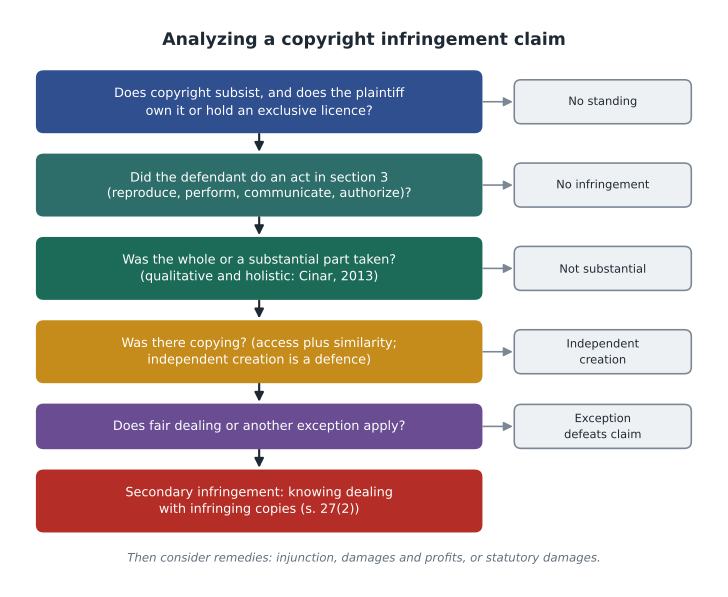
Section 27(1) of the Copyright Act provides that it is an infringement of copyright for any person to do, without the consent of the owner, anything that by the Act only the owner has the right to do. Primary infringement therefore requires four things: a work in which copyright subsists, owned by the plaintiff or held under an exclusive licence; an act within one of the exclusive rights in section 3, such as reproduction, public performance or communication to the public by telecommunication; that the act concerned the whole or a substantial part of the work; and that the defendant copied, rather than independently created, the material. Knowledge and intention are not elements. A defendant who copies innocently still infringes, though innocence may affect the remedy.
Copying is usually proved by circumstantial evidence: access to the plaintiff's work combined with similarity sufficient to make independent creation unlikely. Striking similarity, such as the same errors or the same arbitrary choices, can support an inference of copying even where access is not directly proved. Copying can also be subconscious. Independent creation is a complete defence: two people who write the same sentence without copying each other both own copyright in it.
Substantial part after Cinar
The leading case on substantial taking is Cinar Corporation v. Robinson, 2013 SCC 73. Claude Robinson, a Montreal artist, developed a children's television series called Robinson Curiosité and shared his drawings, scripts and synopses with Cinar while seeking financing. Years later Cinar and its partners produced Robinson Sucroë, an animated series with a different look but strong similarities in characters, setting and plot structure. The Supreme Court upheld the finding of infringement. Chief Justice McLachlin held that a substantial part is a flexible notion assessed qualitatively and holistically. The question is whether the defendant reproduced a substantial part of the skill and judgment of the author expressed in the work, not whether the two works look alike when their differences are listed. A trial judge may consider the cumulative effect of the features copied, and need not dissect the work into protectable and unprotectable parts and compare only the former. Expert evidence of the overall similarity is often useful.
The Court also warned against focusing on differences. A copier who takes the heart of a work and adds new material does not escape liability because the result contains much that is new. On the other hand, taking only an idea, a general theme or unoriginal elements does not infringe. Applied to the Sonavant page, Kaplinsky says, copying two complete photographs plainly takes a substantial part of each, and copying three full paragraphs of marketing text probably does too, since those paragraphs are the expressive core of the copy.
Authorization
Section 3 also gives the owner the sole right to authorize any of the protected acts, and section 27(1) makes unauthorized authorization an infringement. In CCH, the Supreme Court held that to authorize means to sanction, approve and countenance, and that a person does not authorize infringement merely by providing the means that could be used to infringe. The Law Society did not authorize infringement by placing photocopiers in the Great Library with a notice disclaiming responsibility for infringing copies, because courts presume that a person who authorizes an activity does so only so far as it is in accordance with the law. That presumption can be rebutted by a relationship of control and by evidence that the defendant knew of and approved specific infringements.
Secondary infringement
Section 27(2) makes it an infringement to sell or rent out, distribute to the extent of prejudicially affecting the owner, by way of trade distribute, expose or offer for sale or rental, exhibit in public, possess for any of those purposes, or import into Canada for any of those purposes, a copy that the person knows or should have known infringes copyright or would infringe if made in Canada. Secondary infringement requires a primary infringement, knowledge or constructive knowledge, and one of the listed dealings. In Euro-Excellence Inc. v. Kraft Canada Inc., 2007 SCC 37, the Court held that Kraft could not use copyright in chocolate bar wrapper logos to block parallel imports of genuine Toblerone and Côte d'Or bars, because the copies abroad had been made with the authority of the owner there and so would not have infringed if made in Canada by that owner. Several judges also expressed concern about using copyright in a logo to achieve what was really a trademark or distribution objective.
Section 27(2.3), added in 2012, creates a separate kind of secondary liability for providing a service primarily for the purpose of enabling acts of infringement over the internet or another digital network, if an actual infringement occurs. The courts weigh factors such as whether the service was marketed as a way to infringe, whether it had other significant uses, its ability to limit infringement and the benefits it received from infringement.
Fair dealing: a user's right
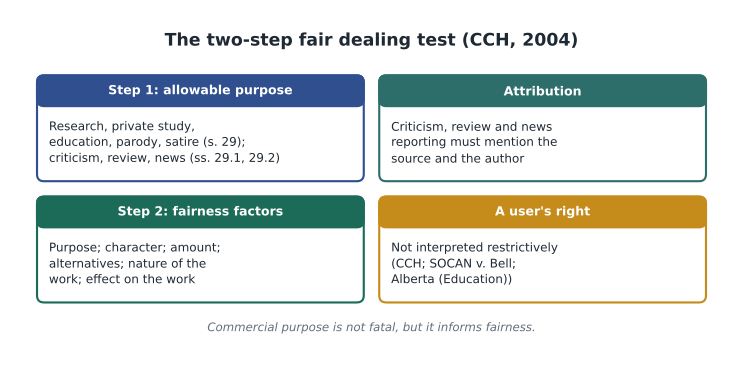
Fair dealing is the most important exception in Canadian copyright law. Section 29 provides that fair dealing for the purpose of research, private study, education, parody or satire does not infringe copyright. Section 29.1 covers fair dealing for criticism or review, and section 29.2 covers news reporting; both of those require that the source, and the author if given in the source, be mentioned. Education, parody and satire were added by the Copyright Modernization Act in 2012.
In CCH, the Supreme Court held that fair dealing is not a mere defence but an integral part of the Copyright Act and is better understood as a user's right. Like other exceptions, it must not be interpreted restrictively, and the allowable purposes must be given a large and liberal interpretation. Research, for example, is not limited to non-commercial or private contexts: a lawyer researching for a client is doing research. The Court set out a two-step test. First, the dealing must be for an allowable purpose. Second, it must be fair. Fairness is a question of fact assessed through six factors, drawn from the Court's review of the case law: the purpose of the dealing, the character of the dealing, the amount of the dealing, alternatives to the dealing, the nature of the work, and the effect of the dealing on the work. Not every factor will be relevant in every case. The Court held that the Great Library's custom photocopy service, which copied single copies of cases and articles for lawyers and judges under an access policy, was fair dealing for research.
The 2012 pentalogy
In July 2012 the Supreme Court released five copyright decisions on the same day. Two are essential for fair dealing. In Society of Composers, Authors and Music Publishers of Canada v. Bell Canada, 2012 SCC 36, online music services offered thirty- to ninety-second previews of songs so that consumers could decide whether to buy them. The Court held that research must be given a large and liberal interpretation, that it need not be for creative purposes, and that consumers using previews to identify music to purchase were engaged in research. The previews were fair: they were short, streamed rather than downloaded, and helped sales rather than replacing them. The purpose is assessed from the perspective of the ultimate user, though the provider's purpose is also relevant.
In Alberta (Education) v. Canadian Copyright Licensing Agency (Access Copyright), 2012 SCC 37, teachers photocopied short excerpts from textbooks for students in their classes. The Copyright Board had found that the copying was not fair, largely because the teachers' purpose was instruction rather than the students' private study. The Supreme Court, by a five-four majority, held that the Board had erred: teachers and students share a symbiotic purpose of research and private study, and the copies served the students' learning. The Court also held that the fact that schools could buy more books was not a realistic alternative, and that the Board had not shown that the copying reduced textbook sales. The matter was sent back to the Board.
Education after 2012
After education became an allowable purpose, many universities adopted fair dealing guidelines that permitted copying of a short excerpt of a work, such as up to ten percent or one chapter, for students. Access Copyright, a collective society, challenged York University's guidelines and sought to enforce an interim tariff. In York University v. Canadian Copyright Licensing Agency (Access Copyright), 2021 SCC 32, the Supreme Court held that tariffs approved by the Copyright Board for collective societies are not mandatory against users who choose not to take a licence, so Access Copyright could not enforce the tariff against York. The Court declined to grant York's counterclaim for a declaration that its guidelines were fair, because there was no live dispute with a party able to sue for infringement. But Justice Abella, for the Court, added guidance: the Federal Court of Appeal had erred by examining fair dealing mainly from the institution's perspective, and the analysis should recognize that students' education is the purpose, while also attending to whether the institution's practices actually ensure fairness. The guidelines remain contested.
Fair dealing and technological locks
Whether fair dealing can justify getting around a digital lock is unsettled. In 2024 the Federal Court held, in a case brought against the federal government by the news publisher Blacklock's Reporter, that a Parks Canada employee's sharing of an article obtained through a colleague's paid subscription password was fair dealing for research, and that using a password lawfully obtained is not circumvention of a technological protection measure. On March 19, 2026, in 2026 FCA 56, the Federal Court of Appeal set aside the declarations because Blacklock's had discontinued its infringement claim and there was no live controversy, without deciding the substantive questions. The trial reasons remain on the record but have no binding force on these points.
Parody, satire and user-generated content
Parody and satire were added to fair dealing in 2012 without definition. Courts have described parody as evoking an existing work while being noticeably different and expressing mockery or humour, and satire as using humour or exaggeration to criticize something, which need not be the work itself. In United Airlines, Inc. v. Cooperstock, 2017 FC 616, a consumer activist ran a website mocking United Airlines that copied its design and logo. The Federal Court accepted that the site was a parody but held that copying the logo and page design so closely was not fair, partly because the site was likely to confuse visitors and because less copying would have made the point.
Section 29.21 creates a separate exception for non-commercial user-generated content: an individual may use an existing published work to create a new work for non-commercial purposes and disseminate it, if the source is mentioned where reasonable, the original was not infringing, and the new work does not have a substantial adverse effect on the exploitation of the original. This is sometimes called the 'mash-up' or 'YouTube' exception.
Other exceptions
The Act contains many specific exceptions. Section 29.22 permits reproduction for private purposes of a work an individual lawfully owns, such as copying a song from a purchased download to a phone, if no lock is circumvented. Section 29.23 permits recording a broadcast for later viewing, and section 29.24 permits backup copies. Section 30.71 permits temporary reproductions that form an essential part of a technological process. Sections 29.4 to 30.04 cover educational institutions, including displays for instruction and lessons delivered online. Libraries, archives and museums have exceptions in sections 30.1 to 30.5. Section 32 permits copies in alternative formats for persons with perceptual disabilities. Section 30.6 permits copying a computer program for compatibility or backup by its lawful owner. Each exception has conditions, and lawyers read them closely.
Communication and making available after SOCAN v. ESA
In Society of Composers, Authors and Music Publishers of Canada v. Entertainment Software Association, 2022 SCC 30, the Court interpreted section 2.4(1.1), the making available provision added in 2012. The Copyright Board had held that making a work available online triggered a separate communication right, so that a download could require payment for both reproduction and communication. The Supreme Court disagreed. It held that the provision clarifies that the communication right covers making works available for on-demand streaming, but that a download is a reproduction only, and that making a work available for download does not engage the communication right. The Court reaffirmed the principle of technological neutrality, under which the Act should be applied in the same way to functionally equivalent forms of a work regardless of technology, and stressed that each exclusive right protects a distinct interest. The Court also held that, because courts and the Board share first-instance jurisdiction over these questions, the Board's interpretation is reviewed for correctness, an exception to the Vavilov presumption of reasonableness.
Back to the Sonavant page
Sophie leads the analysis. Bramley owns the photographs; Kettlebrook owns its marketing copy, written by an employee. Sonavant reproduced and communicated them online, which is within section 3. The photographs are copied in full and the paragraphs taken are the heart of the copy, so a substantial part has been taken. Sonavant will argue fair dealing for criticism or review. That is an allowable purpose, but section 29.1 requires mention of the source, and Sonavant did not credit Kettlebrook or Bramley. Even if it had, the fairness factors weigh against it: the purpose is commercial comparative advertising, the amount is the whole of each photograph, Sonavant could have used its own photographs or a short quotation, and the effect is to promote a competing product using Kettlebrook's own material. Hannah points out that commercial purpose is not fatal after CCH. Kaplinsky agrees, but says commercial context still informs fairness, and that a court would likely find this dealing unfair.
Worked problem
Ranking the strongest arguments
Sonavant's lawyer sends a reply letter arguing that (a) facts about headphone features cannot be owned, (b) the photographs show only an ordinary product, (c) the dealing was fair comparison and criticism, and (d) Sonavant has removed the page, so nothing remains to litigate. Evaluate each argument.
Show solution
- Facts cannot be owned (argument a). True, but Sonavant copied Kettlebrook's expression of those facts, three paragraphs of particular wording, not merely the facts. The argument fails as to the text, though Sonavant may state the same facts in its own words.
- Ordinary subject (argument b). Under CCH, a photograph of an ordinary product is original if the photographer exercised skill and judgment in lighting, angle and composition. The argument fails, though it may affect damages if the photos have little independent value.
- Fair dealing (argument c). Criticism and review are allowable purposes, but section 29.1 requires mention of the source and author, which Sonavant omitted. Even with attribution, copying whole photographs for comparative advertising is unlikely to be fair under the CCH factors.
- Removal (argument d). Removal reduces the need for an injunction but does not erase past infringement. Bramley can still claim damages or statutory damages, and an undertaking not to repeat the conduct may be sought.
- Standing. The claim for the photographs belongs to Bramley unless Kettlebrook obtains a written assignment or exclusive licence; Kettlebrook can sue over its marketing text.
- Strategy. Kettlebrook should secure the assignment from Bramley, then propose a settlement including an undertaking, a modest payment and an agreed statement, reserving litigation for any repetition.
Common mistakes
MistakeComparing two works by listing their differences.
InsteadCinar requires a qualitative and holistic assessment of whether a substantial part of the author's skill and judgment was taken; added material does not cure copying of the heart of a work.
MistakeTreating fair dealing as a narrow defence that the defendant must squeeze into.
InsteadCCH treats fair dealing as a user's right, and the allowable purposes receive a large and liberal interpretation.
MistakeForgetting the attribution requirement for criticism, review and news reporting.
InsteadSections 29.1 and 29.2 require mention of the source and, if given in the source, the author.
MistakeSaying making a song available for download engages both reproduction and communication.
InsteadSOCAN v. ESA holds that a download is a reproduction only; the making available provision applies to on-demand streams.
Practice problems
Work each problem on paper first, then reveal the answer to check.
List the six fairness factors from CCH.
Show answer
The purpose, character and amount of the dealing, alternatives to the dealing, the nature of the work, and the effect of the dealing on the work.
What did SOCAN v. Bell decide about song previews?
Show answer
That consumers using short previews to decide what to buy are engaged in research under a large and liberal interpretation, and that the previews were fair dealing.
Why could Access Copyright not enforce its tariff against York University?
Show answer
Because tariffs approved for collective societies are not mandatory against users who do not choose to take a licence.
Summary and key terms
- Primary infringement requires doing, without consent, an act reserved to the owner in relation to the whole or a substantial part of a work, proved through access and similarity; independent creation is a defence.
- Cinar requires a qualitative and holistic assessment of whether a substantial part of the author's skill and judgment was copied.
- Authorizing infringement means sanctioning, approving and countenancing it; providing equipment is not enough (CCH); secondary infringement requires knowledge and a listed dealing.
- Fair dealing is a user's right with a two-step test (allowable purpose, then fairness factors); SOCAN v. Bell and Alberta (Education) gave research and private study a broad reading, and York held tariffs are not mandatory.
- Specific exceptions cover user-generated content, private copying, backups, technological processes, education, libraries and accessibility; SOCAN v. ESA held that downloads engage only reproduction.
- Substantial part
- A qualitatively important part of the author's skill and judgment expressed in a work, assessed holistically.
- Authorization
- Sanctioning, approving and countenancing an infringing act, which is itself an infringement.
- Secondary infringement
- Dealing commercially with copies the defendant knows or should know infringe copyright.
- Fair dealing
- A user's right to deal with a work for an allowable purpose in a fair manner without infringing.
- Technological neutrality
- The principle that the Act applies in the same way to functionally equivalent uses regardless of technology.
- Making available
- Offering a work so that the public can access it at a time and place of their choosing, treated as communication for on-demand streams.
Lesson quiz · 5 questions
Score 60% or more to complete this lesson.
Create a free account to save your progress, take quizzes and earn a certificate.