
LAWC-311 · Lesson 9 of 12 · 23 min
Expert witnesses
▶ Video coming soon A video version of this lesson is on the way.
Inverarity begins the expert witness class by holding up two reports. One is from Dr. Anjali Rao, the forensic pathologist in Calder. The other is from Dr. Lisbeth Arnfield, the meteorologist retained by Rosa Ingram's lawyers. 'In both cases,' he says, 'the expert knows more about the key scientific question than anyone else in the courtroom, including the judge. That is the point of calling them, and it is also the danger. Your job as advocates is to make sure the court hears expertise, not advocacy dressed up as science.'
Experts appear in a large share of trials: pathologists and toxicologists in criminal cases; physicians, engineers, accountants and actuaries in civil cases. Their evidence can decide a case. Canadian courts have learned, sometimes painfully, that expert evidence can also mislead. Wrongful convictions in the 1990s and 2000s, examined by public inquiries such as the Goudge Inquiry into pediatric forensic pathology in Ontario, showed what happens when flawed expert opinion goes unchallenged. This lesson explains the legal framework for admitting expert evidence, how to qualify and examine your own expert, how to cross-examine the other side's, and the procedural rules for expert reports.
The admissibility framework
Opinion evidence is generally inadmissible: witnesses testify to facts, and the trier of fact draws the inferences. Expert opinion is an exception, admitted where the trier of fact needs help to understand matters beyond ordinary knowledge. The modern framework comes from three Supreme Court of Canada decisions: R. v. Mohan, [1994] 2 S.C.R. 9; White Burgess Langille Inman v. Abbott and Haliburton Co., 2015 SCC 23; and, in Ontario, R. v. Abbey, 2009 ONCA 624, whose two-stage structure White Burgess adopted.
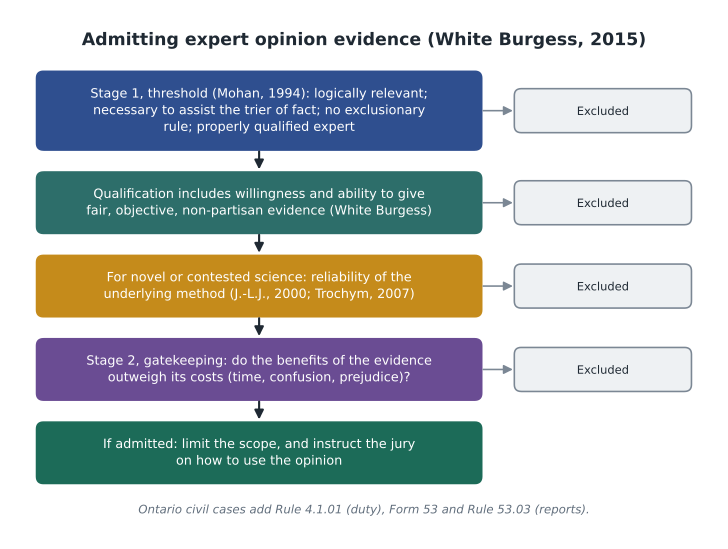
At the first stage, the party proposing the expert must establish the Mohan threshold requirements: the evidence must be logically relevant; it must be necessary to assist the trier of fact, meaning it provides information likely outside the experience and knowledge of a judge or jury; it must not be excluded by another rule of evidence; and the witness must be a properly qualified expert. For novel science, or science used for a novel purpose, the party must also show that the underlying science is reliable for that purpose (R. v. J.-L.J., 2000 SCC 51; R. v. Trochym, 2007 SCC 6).
White Burgess added an important element to the qualification requirement. An expert owes a duty to the court to give fair, objective and non-partisan opinion evidence. An expert who is unable or unwilling to meet that duty is not properly qualified and their evidence is inadmissible. The threshold is not particularly onerous: once the expert attests or testifies that they understand and will fulfil the duty, the burden shifts to the opposing party to show a realistic concern that the expert cannot or will not comply. Concerns about independence that do not meet this threshold go to weight. Examples of disqualifying interests include a direct financial interest in the outcome, a close family relationship with a party, or a situation in which the expert would be assessing their own work.
At the second stage, the trial judge acts as gatekeeper. Even if the threshold requirements are met, the judge must decide whether the benefits of admitting the evidence outweigh its potential risks, such as consuming time, confusing the issues, or being given more weight than it deserves because of its scientific aura. The judge considers the importance of the evidence to the issues, its reliability, and the extent to which it might distort the fact-finding process.
The gatekeeping role is continuing. A judge who admits expert evidence must keep it within the bounds of the expert's qualifications and the subject of the opinion, and in a jury trial must instruct the jury that it is not bound to accept the expert's opinion and should weigh it like any other evidence. Abbey itself later returned to the Court of Appeal: in R. v. Abbey, 2017 ONCA 640, the court admitted fresh evidence undermining the expert opinion relied on at trial and set aside the murder conviction, illustrating how flawed expertise can taint a verdict.
Procedural rules for expert evidence
Expert evidence is subject to notice and disclosure rules, so the other side can prepare to respond.
In criminal cases, section 657.3 of the Criminal Code requires a party intending to call an expert to give notice at least thirty days before trial, including the expert's name, area of expertise, and a statement of qualifications. The Crown must provide a copy of the expert's report or a summary of the anticipated opinion within a reasonable time before trial. The accused must provide a report or summary no later than the close of the Crown's case. If these requirements are not met, the court may adjourn, order the expert recalled, or make other orders to ensure fairness.
In Ontario civil actions, Rule 4.1.01 of the Rules of Civil Procedure sets out the expert's duty: to provide opinion evidence that is fair, objective and non-partisan, related only to matters within the expert's area of expertise, and to provide additional assistance the court may reasonably require. The duty prevails over any obligation owed to the party who retained the expert. The expert must sign an acknowledgment of the duty in Form 53. Rule 53.03 requires a party intending to call an expert to serve the report not less than ninety days before the pre-trial conference; a responding expert's report is due not less than sixty days before, and supplementary reports not less than thirty days before. The report must contain specified information, including the expert's qualifications, the instructions provided, the nature of the opinion sought, the factual assumptions, and the reasons for the opinion. An expert who has not served a compliant report may not testify without leave.
Counsel's role in preparing expert reports was addressed in Moore v. Getahun, 2015 ONCA 55. The trial judge had criticized defence counsel for reviewing and suggesting changes to the expert's draft report. The Court of Appeal held that consultation between counsel and experts in preparing reports is not improper and is often necessary to make sure the report addresses the right issues in a usable form. What counsel may not do is influence the substance of the opinion. Draft reports and communications with experts need not routinely be disclosed, absent a factual foundation for a reasonable suspicion of improper influence.
The Advocates' Society has published principles governing communications with testifying experts, which reflect the same balance: counsel may explain the legal issues and the format required, but must respect the expert's independence and must not attempt to shape the opinion.
Qualifying your expert
Before an expert can give opinion evidence, the court must accept their qualifications in a defined area. Counsel should propose a clear, specific area: not 'medicine,' but 'forensic pathology, including the determination of cause of death and the interpretation of head injuries.' The area matters because the expert may not give opinions outside it.
Qualifying an expert usually involves a short voir dire, sometimes in the jury's presence if qualifications are not contested. Counsel leads the expert through their education, training, professional experience, publications and prior testimony, then asks the court to qualify them in the proposed area. Opposing counsel may cross-examine on qualifications and argue for a narrower area.
A good qualification examination is brief and relevant. Juries are not impressed by long lists of credentials; they are impressed by experience directly related to the question. 'Dr. Rao, how many autopsies involving head injuries have you performed?' is more persuasive than a recitation of every conference attended.
Examining your expert in chief
An expert's examination-in-chief should teach. The expert is the person in the courtroom who understands the science, and their job is to explain it in terms the judge or jury can understand. Inverarity suggests a structure.
Start with the conclusion. Unlike lay witnesses, experts should state their opinion early: 'Dr. Rao, did you form an opinion about the cause of Mr. Dorey's death?' 'Yes. He died of a subdural hematoma caused by blunt force trauma to the back of the head, consistent with striking the curb in a fall.' Then explain the basis: what the expert examined, what tests were done, what the findings were. Then explain the reasoning: how the findings support the opinion. Use plain language and visual aids, such as diagrams of the skull. Address the obvious challenges: Dr. Rao should explain Dorey's thin skull and why it does not change the cause of death.
Limit the expert to their area and their report. If Dr. Rao strays into whether the push was forceful or whether Dorey was walking away, she is outside her expertise, and the defence will object. An expert must not give an opinion on the ultimate issue in a way that usurps the trier of fact's role, such as whether the accused is guilty. Courts allow experts to testify on matters close to the ultimate issue if necessary, but are cautious.
Cross-examining the other side's expert
Cross-examining an expert is one of the most demanding tasks in trial work, because the expert knows more about the subject than counsel. Inverarity's advice is to avoid fighting the expert on their own ground. Instead, focus on what the expert assumed, what the expert did not consider, and the limits of the opinion.
Assumptions. Every expert opinion rests on factual assumptions. If the assumptions are wrong or unproven, the opinion falls with them. Dr. Arnfield's opinion in Ingram that freezing drizzle began at about 7:30 a.m. rests on weather station data from the Corwin airport, about eight kilometres from the plaza. The defence can establish that local conditions can vary, that she had no data from the plaza itself, and that she cannot say exactly when ice formed on the walkway.
Scope. Get concessions about what the expert cannot say. 'Doctor, you cannot tell the jury how hard Mr. Dorey was pushed.' 'No.' 'Your findings are equally consistent with Mr. Dorey falling after being pushed by someone he was moving toward, as with being pushed from behind.' 'The injury tells me how he hit the curb, not why he fell.' Those concessions may be more valuable than any attack.
Qualifications and independence. If the expert lacks specific experience, or has a relationship with the party, or has testified only for one side, those facts go to weight. Under White Burgess, serious concerns may go to admissibility. Cross-examination on fees should be done carefully; it is fair game, but juries may see it as petty unless the fees are unusual.
Authoritative texts. Canadian courts permit counsel to cross-examine an expert using a text or article that the expert recognizes as authoritative, or that is shown to be authoritative. If the expert's opinion conflicts with a recognized authority, the expert must explain why. The text is not itself evidence of its contents unless the expert adopts it.
Opposing experts. Often the best response to an expert is another expert. Where both sides call experts, the trier of fact must decide which is more persuasive. Ontario courts have experimented with concurrent expert evidence, sometimes called hot-tubbing, in which experts testify together and respond to each other's opinions, particularly in complex civil cases.
| Cross-examination target | Example in Calder or Ingram | Goal |
|---|---|---|
| Assumptions | Arnfield relied on airport data eight km away | Show the opinion may not fit the plaza |
| Scope | Rao cannot say why Dorey fell or how hard he was pushed | Confine the opinion to its proper reach |
| Methodology | A biomechanical expert's model ignored the crowd | Show the method was incomplete |
| Qualifications | An engineer offering medical causation opinions | Exclude or limit opinions outside expertise |
| Independence | An expert who has a financial stake in the outcome | Challenge admissibility (White Burgess) or weight |
Experts in the two running files
In Calder, the Crown's pathologist, Dr. Rao, is unlikely to be seriously challenged on cause of death. The defence's interest is in her concessions: the injury is consistent with a fall from a push from the front or the back, she cannot assess the force, and, if the toxicology shows significant intoxication, alcohol can affect a person's balance. The defence may consider calling a biomechanics expert to explain how a person moving forward who is pushed in the chest falls, but Inverarity warns that such evidence would face a demanding necessity and reliability analysis, and might simply give the Crown a target.
In Ingram, both sides will probably call meteorologists, and possibly experts on winter maintenance standards. The plaintiff's expert explains when ice formed; the defence's expert may say that conditions at the plaza could have differed from the airport, and that the early salting would have lasted for some hours. The case may turn on which expert better accounts for the guard's observation that no salt was visible.
Worked problem
Qualifying and examining Dr. Arnfield for the plaintiff
Dr. Lisbeth Arnfield is a meteorologist with a doctorate in atmospheric science, twelve years with a federal weather service, and six years as a consultant. She has served a Rule 53.03 report with a signed Form 53. Plan her qualification and the core of her evidence.
Show solution
- Propose a specific area: 'meteorology, including the analysis of historical weather data and the formation of ice on surfaces.'
- Qualification: education, years forecasting winter weather for the federal service, consulting on ice conditions, prior qualification by Ontario courts. Keep it to a few minutes.
- Duty: confirm that she signed Form 53 and understands that her duty to the court prevails over any duty to the plaintiff (Rule 4.1.01).
- Conclusion first: 'Did you form an opinion about weather conditions at Corwin Plaza on the morning of February 4, 2026?' 'Yes. Freezing drizzle began at about 7:30 a.m. and continued until about 11:00.'
- Basis and reasoning: the airport station data, radar images, temperature readings, and how freezing drizzle forms ice on cold pavement; use a timeline chart.
- Front the limit: 'The airport is eight kilometres from the plaza. Does that affect your opinion?' Let her explain why the regional pattern makes it unlikely the plaza escaped the drizzle, and what she cannot say.
Common mistakes
MistakeAssuming an expert's evidence is admissible because the expert is well qualified.
InsteadApply the full Mohan threshold and the White Burgess gatekeeping stage; necessity and the cost-benefit balance matter.
MistakeLetting the expert drift beyond the area of qualification.
InsteadPropose a specific area and object when the expert strays outside it.
MistakeTrying to beat the expert on their own science in cross-examination.
InsteadFocus on assumptions, scope, methodology and concessions.
MistakeBelieving counsel may never review an expert's draft report.
InsteadMoore v. Getahun permits consultation on drafts; counsel must not influence the substance of the opinion.
MistakeMissing the notice deadlines for expert evidence.
InsteadCriminal Code s. 657.3 requires thirty days' notice; Rule 53.03 sets deadlines before the pre-trial conference in Ontario civil cases.
Practice problems
Work each problem on paper first, then reveal the answer to check.
What are the four Mohan threshold requirements?
Show answer
Logical relevance, necessity to assist the trier of fact, absence of an exclusionary rule, and a properly qualified expert.
What did White Burgess add to the qualification requirement?
Show answer
That an expert must be able and willing to give fair, objective and non-partisan evidence; an expert who cannot or will not do so is not properly qualified.
What is the second stage of the admissibility analysis?
Show answer
The gatekeeping stage, at which the judge decides whether the benefits of the evidence outweigh its risks, such as time, confusion and undue weight.
What did Moore v. Getahun decide?
Show answer
That counsel may consult with experts and review draft reports, provided counsel does not influence the substance of the opinion; drafts need not be routinely disclosed.
What does section 657.3 of the Criminal Code require?
Show answer
Thirty days' notice before trial of the intention to call an expert, with name, area and qualifications; the Crown must give a report or summary before trial and the accused by the close of the Crown's case.
Summary and key terms
- Expert opinion is admitted only where the trier of fact needs help beyond ordinary knowledge.
- Stage 1 (Mohan): relevance, necessity, no exclusionary rule, a properly qualified expert, plus reliability for novel science (J.-L.J.; Trochym).
- White Burgess (2015) requires experts to be able and willing to give fair, objective and non-partisan evidence; stage 2 is a cost-benefit gatekeeping analysis (Abbey).
- Criminal Code s. 657.3 and Ontario Rules 4.1.01 and 53.03 (with Form 53) govern notice, duty and reports; Moore v. Getahun permits counsel's consultation on drafts.
- Qualify experts in a specific area, have them state conclusions first, explain the basis and reasoning in plain language, and keep them within their area.
- Cross-examine experts on assumptions, scope, methodology, qualifications and independence; seek concessions rather than scientific battles.
- Expert witness
- A witness permitted to give opinion evidence on matters requiring specialized knowledge.
- Mohan criteria
- Relevance, necessity, absence of an exclusionary rule, and a properly qualified expert.
- Gatekeeping
- The trial judge's role in excluding expert evidence whose risks outweigh its benefits.
- Form 53
- The acknowledgment of expert's duty signed by experts in Ontario civil proceedings.
- Ultimate issue
- The final question the trier of fact must decide, on which expert opinion is approached with caution.
- Concurrent evidence
- A procedure in which opposing experts testify together and respond to each other, sometimes called hot-tubbing.
Lesson quiz · 5 questions
Score 60% or more to complete this lesson.
Create a free account to save your progress, take quizzes and earn a certificate.