
LAWC-311 · Lesson 4 of 12 · 24 min
Opening statements
▶ Video coming soon A video version of this lesson is on the way.
Sophie Tremblay-Hart stands at the lectern in the Lister Room with four pages of notes. She is opening for Rosa Ingram, and Inverarity, sitting as the judge, has told the class to imagine a civil jury of six in the box. She begins: 'Members of the jury, this case is about negligence. Negligence is the failure to take reasonable care.' Three sentences later Inverarity raises a hand. 'Stop. The judge will tell them what negligence is. What happened to Rosa?'
The opening statement is counsel's first chance to tell the trier of fact what the case is about. Done well, it gives the judge or jury a framework for understanding the evidence as it comes in, witness by witness, often out of order and over several days. Done badly, it bores, confuses, overpromises, or crosses into argument and draws an objection. This lesson explains the purpose and limits of an opening, how to structure one, and how openings differ in criminal and civil, jury and judge-alone trials. It begins with the step that comes before openings in a jury trial: selecting the jury.
Before the opening: selecting a jury
In a criminal jury trial, twelve jurors are selected from a panel. The 2019 amendments to the Criminal Code in Bill C-75, in force on September 19, 2019, abolished peremptory challenges, which had allowed each side to excuse a set number of prospective jurors without giving reasons. Parliament's concern was that peremptory challenges could be used to exclude jurors on discriminatory grounds. The amendments also gave the trial judge, rather than two lay triers, the task of deciding challenges for cause, and allowed the judge to stand aside jurors to maintain public confidence in the administration of justice.
In R. v. Chouhan, 2021 SCC 26, the Supreme Court of Canada upheld the abolition of peremptory challenges against a challenge under sections 11(d) and 11(f) of the Charter. The accused's right to an impartial jury is protected by other tools, including challenges for cause, the judge's power to stand jurors aside, and jury instructions. The court also confirmed that challenges for cause may be used to explore whether prospective jurors hold biases, including racial prejudice, that could affect their impartiality.
For the advocate, jury selection is now largely about challenges for cause. Counsel must decide whether there is a realistic potential for partiality on a particular ground, such as pre-trial publicity or racial prejudice where the accused is a member of a racialized group, and if so, ask the judge to permit a short, standard question to each prospective juror. Elaborate questioning in the American style is not permitted.
Civil juries in Ontario have six members, and a verdict may be given by five of the six. Selection is simpler: each party has a small number of peremptory challenges under the Juries Act and the Courts of Justice Act, and challenges for cause are rare. Many actions are tried without a jury, either because no party served a jury notice or because the action proceeds under the simplified procedure in Rule 76, where juries are not available. Ingram, with damages of about 175,000 dollars, falls within the simplified procedure limit of 200,000 dollars, so it would actually be tried by a judge alone. For this exercise, Inverarity has imagined it as an ordinary action with a jury notice, so the students can practise both forms.
What an opening is for
An opening statement is a preview of the evidence. It tells the trier of fact who the witnesses are, what they will say, and how their evidence fits together. It is not argument. Counsel may not, in opening, argue about the credibility of witnesses, the inferences the jury should draw, or how the law applies. Those belong in closing.
The distinction between preview and argument is sometimes put as a test: could a witness say it? 'Hollis will tell you he saw Calder shove Dorey with both hands' is a preview; Hollis can say it. 'Hollis is the only sober, neutral witness, and you should believe him' is argument; no witness can say it. The test is not perfect, but it is a good guide.
Why does the rule exist? Because at the opening stage no evidence has been heard. Counsel is speaking with the authority of the lawyer, not the authority of evidence, and the trier of fact has no way to check what counsel says. The jury is told, repeatedly, that what lawyers say is not evidence. Counsel who argues in opening is asking the jury to accept a conclusion before hearing anything that supports it.
The structure of an opening
Inverarity offers one structure, while stressing that there are others.
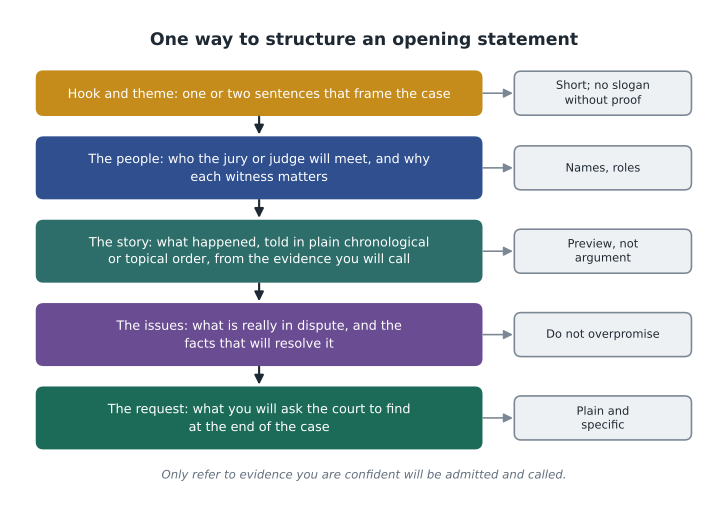
The hook and theme. Start with something that captures attention and frames the case: a moment, an image, a fact. Avoid starting with 'May it please the court' and a summary of the law. Tremblay-Hart's second attempt: 'On the morning of February 4, Rosa Ingram parked her car in the Corwin Plaza lot, as she had done a hundred times before, and walked toward the pharmacy. She never got there.' Then the theme: 'The plaza knew the ice was coming. Nobody checked.'
The people. Introduce the parties and the witnesses, and give the trier of fact a reason to care about each: who they are and why their evidence matters. Use names and roles: 'You will hear from Anwar Hossain, the plaza's security guard, who was on duty that morning and wrote a report.' A juror who knows why a witness is being called listens better.
The story. Tell what happened, in plain language and in an order that makes sense, usually chronological. Tell it from the evidence you will actually call. Use the present or past tense consistently; many counsel use the present tense for vividness ('Rosa gets out of her car. The pavement looks wet.'). Avoid legal language.
The issues. Identify what is really in dispute. In Ingram: whether the plaza took reasonable steps between the drizzle starting and Rosa's fall. Telling the jury what the dispute is helps them focus on the evidence that matters. Acknowledge the obvious weakness if the other side will certainly raise it: 'You will hear that Rosa wasn't staring at the ground as she walked. Most of us don't, in a parking lot we know well.' This is called fronting, and it takes the sting out of the other side's point.
The request. End by telling the trier of fact what you will ask them to find. 'At the end of this trial, we will ask you to find that the plaza failed to keep its parking lot safe that morning, and that this failure caused Rosa's injury.' Keep it specific and modest.
The limits of an opening
Some limits on opening statements are rules; others are good judgment.
Only refer to evidence you expect to be admitted. If counsel tells the jury about a piece of evidence that is later excluded, or a witness who never testifies, the opposing party may seek a correcting instruction or, in serious cases, a mistrial. In Calder, the Crown cannot mention Calder's statement to police in opening unless its admissibility has already been determined on a voluntariness voir dire. Prudent counsel resolve admissibility questions before openings or leave contested evidence out of the opening.
Do not express personal opinions. Counsel must not tell the jury what they personally believe about the evidence, the credibility of witnesses or the guilt of the accused. Boucher, discussed in lesson 1, was a case about a Crown's closing address, but the principle applies equally to openings. 'I believe,' 'I think' and 'I'm sure' do not belong in a jury address.
Do not inflame. An opening that appeals to emotion, prejudice or sympathy rather than evidence risks an objection and, in a criminal case, a mistrial. A Crown opening in Calder can describe Mark Dorey's death plainly; it cannot ask the jury to imagine the grief of his family or invite them to send a message about violence outside bars.
Do not overpromise. If counsel promises that a witness will say something and the witness does not, opposing counsel will remind the jury in closing. The promise becomes a broken promise, and the case loses credibility. 'Hollis will tell you Dorey was walking away' is a safe promise only if Hollis has said so consistently. If there is doubt, describe what the witness will be asked about rather than promising an answer.
Do not mention the other side's burden or evidence in a way that shifts the burden. A defence opening in a criminal case should not promise that the accused will testify unless the decision has been made, and even then counsel should be cautious: if the accused later decides not to testify, the promise cannot be undone, and the Crown cannot comment on the accused's silence (Canada Evidence Act, s. 4(6)).
Openings in criminal trials
In a criminal jury trial, the Crown opens before calling evidence. The Crown's opening should be fair and measured, consistent with its role. It typically describes the charge, the main facts the Crown expects to prove and the witnesses it will call.
Defence counsel's opening usually comes at the start of the defence case, if the defence calls evidence. Trial judges have discretion to allow the defence to open immediately after the Crown's opening, and some defence counsel ask to do so, especially where the defence theory needs to be in the jury's mind as the Crown witnesses testify, for example where self-defence will be raised through cross-examination of Crown witnesses. Such openings must be brief, and counsel must be careful not to commit the defence to calling evidence it may later decide not to call.
Whitecloud, for the Calder defence, debates whether to ask for an early opening. The defence theory, self-defence, will emerge largely through cross-examination of Hollis, Pruitt and Halloran. If the jury does not know where the defence is going, those cross-examinations may seem like nitpicking. But an early opening would hint that Calder will testify, and the defence has not decided. Inverarity suggests a middle course: a short early opening, if permitted, that identifies self-defence as the issue and tells the jury to listen to what each witness saw of the moments before the shove, without promising that Calder will testify.
Openings in civil trials
In a civil jury trial, the plaintiff's counsel opens first. Defence counsel may open immediately after the plaintiff's opening or at the start of the defence case. Many defence counsel prefer to open immediately so the jury hears both sides before the evidence begins.
In a judge-alone civil trial, openings tend to be short and practical. Judges often welcome a brief written opening statement that identifies the issues, the witnesses, the order in which they will be called, and the key documents. Counsel should still tell a story, but the judge will be more interested in the issues and the law than in rhetoric. Many judges also ask counsel to confirm agreed facts and admissions at this stage, which can shorten the trial.
Delivery
An opening is delivered, not read. Counsel should know it well enough to speak from brief notes, looking at the jury or judge. Plain language works better than legal jargon. Short sentences work better than long ones. Concrete details work better than abstractions. Visual aids, such as a diagram of the parking lot or a timeline, can help if they have been disclosed and their use agreed or approved by the judge in advance.
Length matters. Openings in most trials should be short: ten to twenty minutes for a jury trial of a few days, less for a judge-alone trial. The jury's attention is limited, and every minute spent on detail that does not matter is a minute taken from the points that do.
Kowalczyk, opening for the defence in Ingram, makes a striking choice. She begins by agreeing with the plaintiff: 'Rosa Ingram was hurt, and nobody in this courtroom wishes it had happened. But the question you will be asked is not whether she was hurt. It is whether Corwin Plaza did what a careful property owner would do. And the evidence will show that it did.' Inverarity notes the technique: conceding what cannot be denied, and redirecting the jury to the real question.
| Element of an opening | Plaintiff (Ingram) | Defence (Ingram) |
|---|---|---|
| Hook | Rosa walks toward the pharmacy on an icy morning | A plaza that hired professionals and paid them to salt |
| Theme | 'They knew the ice was coming. Nobody checked.' | 'Careful owners hire experts and trust them to do the job.' |
| Key witnesses | Rosa, the security guard, the meteorologist | Northline's driver (GPS logs), the property manager |
| Issue | What did the plaza do after 7:30 a.m.? | Was the early salting reasonable care for that morning? |
| Fronting | Rosa wasn't staring at the ground | The guard's note about no visible salt |
| Request | Find the plaza failed to keep the lot safe | Find the plaza took reasonable care |
Worked problem
Turning argument into preview
A draft Crown opening in Calder includes these sentences: 'Owen Calder is a violent man who couldn't control his temper. He lied to the police. Brendan Hollis is the only honest witness in this case, and he will tell you the truth: that Dorey was walking away.' Rewrite it as a proper opening.
Show solution
- Remove character attacks: 'a violent man who couldn't control his temper' is inadmissible propensity reasoning and argument. Calder's prior conviction cannot be mentioned in the Crown's opening.
- Remove the credibility argument: 'He lied to the police' and 'the only honest witness' are conclusions for closing; no witness can say them.
- Replace with preview: 'You will hear from Brendan Hollis, who was working the door that night. He will tell you what he saw: Mark Dorey turning away from Owen Calder, and Calder shoving him in the back with both hands.'
- Add a fair description of Calder's statement only if it has been ruled admissible: 'You will also see a video of Mr. Calder's interview with police, and you can compare what he said with the other evidence.'
- End with the request: 'At the end of the trial, the Crown will ask you to find that Owen Calder unlawfully assaulted Mark Dorey and caused his death.'
Common mistakes
MistakeOpening with a lecture on the law of negligence or the elements of the offence.
InsteadThe judge will instruct on the law; the opening should tell the story the evidence will prove.
MistakeArguing about witness credibility in opening.
InsteadOpening is a preview; credibility arguments belong in closing. Ask: could a witness say it?
MistakeMentioning evidence whose admissibility has not been decided.
InsteadResolve admissibility first or leave the evidence out; referring to excluded evidence can lead to a mistrial.
MistakePromising that the accused will testify.
InsteadIf he later does not, the promise cannot be undone and the Crown cannot comment on his silence; be cautious about such promises.
MistakeAssuming peremptory challenges are available in a criminal jury trial.
InsteadThey were abolished in 2019 (upheld in Chouhan, 2021); challenges for cause and the judge's stand-aside power remain.
Practice problems
Work each problem on paper first, then reveal the answer to check.
What is the difference between a preview and argument in an opening?
Show answer
A preview describes what the evidence will show, in terms a witness could say; argument draws conclusions about credibility, inferences or the law, which belong in closing.
What did R. v. Chouhan decide?
Show answer
That Parliament's abolition of peremptory challenges in 2019 did not violate sections 11(d) or 11(f) of the Charter; impartiality is protected by challenges for cause, stand-asides and jury instructions.
Why should counsel avoid overpromising in an opening?
Show answer
If the evidence does not match the promise, opposing counsel will point it out in closing and the party loses credibility.
When does defence counsel usually open in a criminal jury trial?
Show answer
At the start of the defence case, if the defence calls evidence; the judge may permit a brief opening immediately after the Crown's opening.
Why would Ingram, as pleaded, normally be tried without a jury?
Show answer
Its damages of about 175,000 dollars fall within the 200,000 dollar limit of the simplified procedure in Rule 76, under which juries are not available.
Summary and key terms
- Criminal juries are selected without peremptory challenges since 2019; the judge decides challenges for cause and may stand jurors aside (upheld in Chouhan, 2021).
- An opening is a preview of the evidence, not argument; a useful test is whether a witness could say it.
- One structure: hook and theme, the people, the story, the issues, and the request.
- Refer only to evidence that will be admitted; avoid personal opinions, inflammatory appeals and overpromising.
- The Crown opens before its evidence; the defence usually opens at the start of its case, sometimes earlier with leave; in civil trials the defence may open after the plaintiff.
- Judge-alone openings are shorter and more issue-focused; written openings are common.
- Opening statement
- Counsel's preview of the evidence at the start of a party's case.
- Fronting
- Raising a weakness in your own case before the other side does, to reduce its impact.
- Peremptory challenge
- A challenge to a prospective juror without reasons; abolished in Canadian criminal trials in 2019.
- Challenge for cause
- A challenge to a prospective juror on a ground such as partiality, decided by the trial judge.
- Stand aside
- The judge's power to direct a prospective juror to step aside to maintain public confidence in the administration of justice.
- Mistrial
- The termination of a trial before verdict because of an error or event that makes a fair verdict impossible.
Lesson quiz · 5 questions
Score 60% or more to complete this lesson.
Create a free account to save your progress, take quizzes and earn a certificate.