
LAWC-311 · Lesson 11 of 12 · 23 min
Appellate advocacy: factums and oral argument
▶ Video coming soon A video version of this lesson is on the way.
For one week the Lister Room becomes the Court of Appeal for Ontario. Inverarity sits in the middle of a three-person panel, flanked by Professor Tobias Renaud, who taught Section B civil procedure, and Professor Ruth Castellano, who taught them criminal law and procedure. The hypothetical: Owen Calder was convicted of manslaughter. On appeal, he argues that the trial judge erred by instructing the jury that it could consider defence counsel's failure to put Calder's version to Brendan Hollis in assessing Calder's evidence. Sophie Tremblay-Hart argues for the appellant. Hannah Kowalczyk argues for the Crown.
Appellate advocacy is different from trial advocacy. There are no witnesses and no jury. The record is fixed. The audience is a panel of judges who have read the factums and often the key parts of the record, who know the law, and who will ask questions. Persuasion happens mostly in writing, through the factum, and is tested in oral argument. This lesson explains how appeals work, the standards of review that shape every appeal argument, how to write a factum, and how to present oral argument.
What an appeal is
An appeal is not a new trial. The appellate court reviews the decision below for error, on the record created at trial. It does not hear witnesses, and it generally does not receive new evidence. The appellant must identify a legal error, or a factual error of the kind that appellate courts may correct, that affected the result.
The routes of appeal vary. In civil cases in Ontario, appeals from final orders of the Superior Court of Justice usually go to the Court of Appeal; appeals from final orders for the payment of money up to 50,000 dollars, and from many interlocutory orders with leave, go to the Divisional Court. In criminal cases, appeals from indictable convictions and acquittals go to the Court of Appeal under Part XXI of the Criminal Code. An accused may appeal a conviction on a question of law, and with leave on questions of fact or mixed fact and law (s. 675). The Crown may appeal an acquittal only on a question of law alone (s. 676). Further appeals to the Supreme Court of Canada are by leave, granted for matters of public importance under section 40 of the Supreme Court Act, or as of right in criminal cases where a judge of the court of appeal dissented on a question of law (Criminal Code s. 691 and s. 693).
Standards of review
The most important concept in appellate advocacy is the standard of review: the degree of deference the appellate court owes to the decision below. Every ground of appeal must be framed with the standard in mind, because a strong argument under the wrong standard will fail.
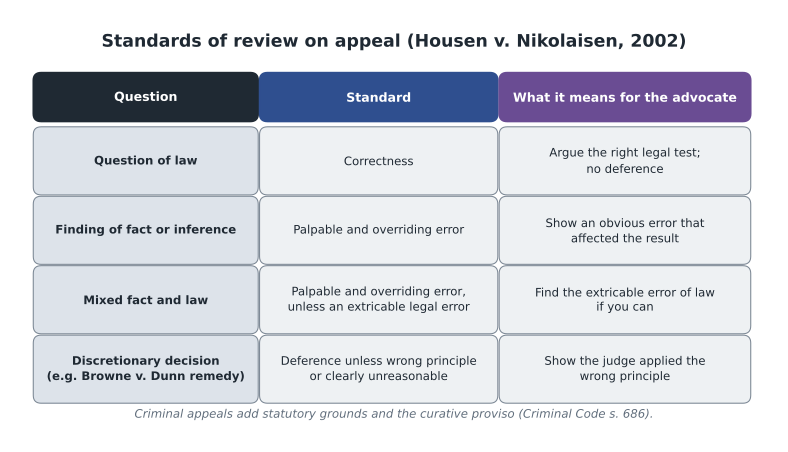
In Housen v. Nikolaisen, 2002 SCC 33, the Supreme Court of Canada set the framework for appeals from trial judges. Questions of law are reviewed for correctness: the appellate court substitutes its own view. Findings of fact, including inferences drawn from the evidence, are reviewed for palpable and overriding error: an error that is obvious and that affected the outcome. Questions of mixed fact and law are reviewed for palpable and overriding error, unless the judge made an extricable error of law, such as applying the wrong legal test, which is reviewed for correctness. Discretionary decisions, such as whether to grant an adjournment, or what remedy to give for a breach of Browne v. Dunn, receive deference unless the judge erred in principle or the decision was clearly unreasonable.
The practical lesson is to look for errors of law. An appellant who argues only that the trial judge should have believed a different witness faces a very high bar. An appellant who can show that the judge applied the wrong legal test, misdirected the jury on the law, or failed to consider a legal requirement has a much better chance.
Criminal appeals add statutory grounds. Under section 686(1)(a) of the Criminal Code, the court of appeal may allow an appeal against conviction if the verdict is unreasonable or cannot be supported by the evidence, if there was a wrong decision on a question of law, or if there was a miscarriage of justice. The unreasonable verdict ground asks whether the verdict is one that a properly instructed jury, acting judicially, could reasonably have rendered (R. v. Biniaris, 2000 SCC 15). Even where there was an error of law, the court may dismiss the appeal under the curative proviso in section 686(1)(b)(iii) if no substantial wrong or miscarriage of justice occurred, typically because the error was harmless or the evidence of guilt was overwhelming.
In the Calder moot, Tremblay-Hart frames the issue as an error of law: the trial judge misdirected the jury by giving a Browne v. Dunn instruction that undermined the accused's testimony without a proper basis. Kowalczyk responds that the choice of remedy was discretionary and attracts deference (Quansah; Lambert), and that in any event the proviso applies because the instruction was balanced and the evidence against Calder was strong. Each side has chosen the standard that helps it. The panel will have to decide which characterization is right.
Preserving issues at trial
Appellate advocacy begins at trial. Issues not raised at trial are generally not considered on appeal. If counsel did not object to an instruction at the pre-charge conference or after the charge, the appellate court may treat the failure as a sign that the instruction was not considered problematic at the time, although failure to object is not determinative in a criminal case. If counsel did not seek a ruling on admissibility, the record may not contain what the appellate court needs.
Appellate courts may in rare cases raise new issues themselves. In R. v. Mian, 2014 SCC 54, the Supreme Court held that an appellate court should raise a new issue only where failing to do so would risk an injustice, and must give the parties notice and an opportunity to respond. Advocates cannot count on this.
Fresh evidence on appeal is admitted only exceptionally. Under Palmer v. The Queen, [1980] 1 S.C.R. 759, the evidence generally should not be admitted if it could have been adduced at trial with due diligence; it must be relevant to a decisive or potentially decisive issue, credible, and such that, if believed, it could reasonably have affected the result. R. v. Abbey, 2017 ONCA 640, discussed in lesson 9, is an example of fresh expert evidence admitted on appeal.
Writing the factum
The factum is the heart of an appeal. Judges read it before the hearing, often several times, and many appeals are decided largely on the factums. Rule 61.11 of the Rules of Civil Procedure sets out the required parts of an appellant's factum in civil appeals, and the Criminal Appeal Rules of the Court of Appeal for Ontario set out similar requirements for criminal appeals.
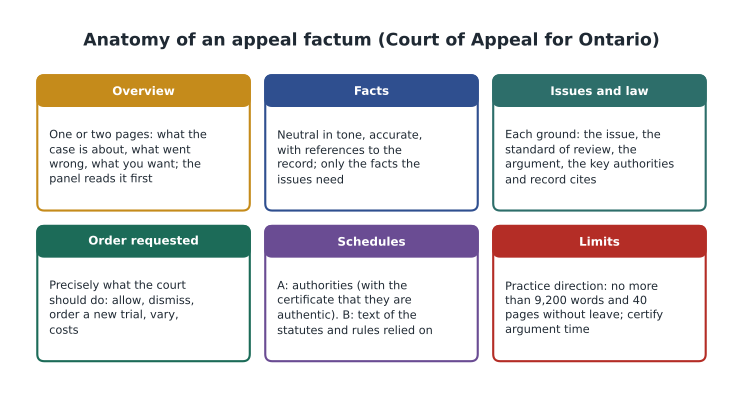
The Court of Appeal for Ontario's practice direction for civil appeals provides that a party's factum cannot exceed 9,200 words and 40 pages, except with leave of the court, and that factums must certify a realistic estimate of the time required for oral argument. The appellant must also file an appeal book and compendium containing the documents and transcript excerpts referred to in the factum, organized so the court can easily find them. Since December 1, 2024, factums must include the lawyer's certification that the authorities cited are authentic (rule 4.06.1(2.1)).
Inverarity offers principles for factum writing.
Lead with the overview. The overview, one or two pages at the start of the factum, is the most important part. It should tell the panel, in plain language, what the case is about, what the trial judge did wrong, and what the appellant wants. A judge who reads only the overview should understand the appeal.
State the facts fairly. The statement of facts should be accurate, neutral in tone, and supported by precise references to the record. Advocacy in the facts comes from selection and order, not adjectives. A misleading statement of facts destroys credibility, because the other side will point it out and the panel will check.
Frame each issue precisely. State each issue as a question the court can answer: 'Did the trial judge err in law by instructing the jury that it could consider defence counsel's failure to cross-examine Mr. Hollis in assessing the accused's evidence?' Then state the standard of review, the applicable law, and the argument.
Use authorities with discipline. Cite the leading authority for each proposition, not every case. Pin-cite to the paragraph. Quote briefly, and only where the words matter. Address the authorities against you; the duty of candour requires disclosure of binding adverse authority, and the other side will cite it anyway.
Be concise. Shorter is better. Judges are busy, and a focused factum on two strong grounds is more persuasive than a long one on eight.
Ask for specific relief. The order requested should say exactly what the appellant wants: 'that the appeal be allowed, the conviction set aside and a new trial ordered.'
| Factum element | Weak version | Strong version |
|---|---|---|
| Overview | A list of eight grounds of appeal | Two paragraphs: the case, the key error, why it mattered, the relief |
| Facts | 'The Crown's star witness, who was obviously confused...' | 'Mr. Hollis testified that he was checking identification when he heard shouting (Transcript, p. 112).' |
| Issue | 'The trial was unfair.' | 'Did the trial judge err in law in giving a Browne v. Dunn instruction without first considering recall of the witness?' |
| Authorities | Twenty cases on general principles | The leading case for each step, with pinpoint citations |
| Relief | 'Such other relief as the court deems just' | 'Allow the appeal, set aside the conviction and order a new trial' |
Oral argument
Oral argument in the Court of Appeal is short. The court allots time based on counsel's estimates. Counsel should expect questions from the start, and should treat the hearing as a conversation with the panel, not a speech.
Prepare a roadmap. Begin by telling the panel what issues you will address and in what order: 'I intend to make two submissions: first, that the instruction was an error of law; second, that the proviso cannot save the conviction.' Then start with your strongest point, because time may run out.
Answer questions directly. When a judge asks a question, stop and answer it immediately, even if it interrupts your planned argument. Answer yes or no first, then explain. Evasion is the worst response; judges ask questions because they want to know the answer, and often because the question identifies their concern about your case. A question is an opportunity to persuade the judge who asked it.
Know the record. Judges will ask where something is in the record. Counsel should be able to take the panel to the page of the transcript or the exhibit immediately, using the compendium.
Concede what must be conceded. If a point is weak, concede it and explain why it does not matter. Refusing to concede an obvious point damages credibility on the points that matter.
Do not read the factum. The panel has read it. Oral argument should focus on the key issues, respond to the other side's factum, and address the panel's concerns.
Reply briefly. The appellant usually has a short reply. Use it only to answer new points raised by the respondent. Do not repeat the main argument.
The Calder moot
Tremblay-Hart opens with a roadmap and two submissions. Two minutes in, Castellano interrupts: 'Counsel, isn't the remedy for a Browne v. Dunn breach a matter of discretion? Why should we intervene?' Tremblay-Hart answers directly: 'Yes, the choice of remedy is discretionary. But the trial judge did not exercise that discretion; he never considered recalling Mr. Hollis, which Quansah identifies as the first option. That is an error in principle, and it attracts no deference.' Castellano nods and writes something down.
Kowalczyk, for the Crown, faces a question from Renaud about the proviso: 'If we find an error, what makes this case so strong that we can be sure the jury would have convicted anyway?' She identifies Hollis's evidence, Pruitt's recorded statement, and the physical evidence, and concedes that the self-defence issue was genuinely contested. Inverarity later praises the concession: 'You lost nothing by admitting the obvious, and gained credibility for everything else.'
Worked problem
Drafting an overview for the appellant in Calder
Write the overview paragraph for the appellant's factum in the hypothetical appeal described in this lesson.
Show solution
- Identify the case: 'The appellant, Owen Calder, was convicted of manslaughter after a jury trial arising from a confrontation outside a bar in Corwin, in which Mark Dorey fell and suffered a fatal head injury.'
- Identify the central issue: 'The only live issue at trial was self-defence. The appellant testified that Mr. Dorey moved toward him and that he pushed him away.'
- Identify the error: 'The trial judge instructed the jury that it could consider defence counsel's failure to put the appellant's account to the Crown's main witness when assessing the appellant's evidence. He did so without considering whether to recall the witness, and without telling the jury that the appellant was not responsible for counsel's choices.'
- Explain why it matters: 'The instruction struck at the heart of the defence by undermining the appellant's credibility on the only contested issue.'
- State the relief: 'The appellant asks that the appeal be allowed, the conviction set aside and a new trial ordered.'
Common mistakes
MistakeArguing on appeal that the trial judge should have believed a different witness.
InsteadFindings of fact attract deference (palpable and overriding error); look for errors of law, misdirection or extricable legal errors.
MistakeRaising an issue for the first time on appeal without explanation.
InsteadPreserve issues at trial; appellate courts rarely consider new issues and raise them themselves only to avoid injustice (Mian).
MistakeWriting a factum with eight grounds of appeal.
InsteadFocus on the strongest grounds; a short, precise factum is more persuasive.
MistakeDelaying an answer to a judge's question until later in the argument.
InsteadAnswer immediately and directly; the question reveals what the judge needs to be persuaded about.
MistakeExceeding the factum limits or citing authorities without checking them.
InsteadThe practice direction caps factums at 9,200 words and 40 pages without leave, and counsel must certify that authorities are authentic.
Practice problems
Work each problem on paper first, then reveal the answer to check.
What are the standards of review under Housen v. Nikolaisen?
Show answer
Correctness for questions of law; palpable and overriding error for findings of fact and for mixed fact and law, unless there is an extricable legal error, which is reviewed for correctness.
List the grounds for allowing a conviction appeal under section 686(1)(a) of the Criminal Code.
Show answer
The verdict is unreasonable or cannot be supported by the evidence; a wrong decision on a question of law; or a miscarriage of justice.
What is the curative proviso?
Show answer
Section 686(1)(b)(iii), which allows an appellate court to dismiss an appeal despite an error of law where no substantial wrong or miscarriage of justice occurred.
What are the Palmer criteria for fresh evidence?
Show answer
Due diligence (generally not admitted if it could have been adduced at trial), relevance to a decisive or potentially decisive issue, credibility, and that it could reasonably have affected the result if believed.
What are the factum limits in the Court of Appeal for Ontario's civil practice direction?
Show answer
No more than 9,200 words and 40 pages, except with leave; factums must also certify an estimate of oral argument time.
Summary and key terms
- An appeal reviews the decision below for error on the trial record; it is not a new trial.
- Housen sets the standards of review: correctness for law, palpable and overriding error for facts and mixed questions, unless there is an extricable legal error; discretionary rulings receive deference.
- Criminal appeals turn on s. 686: unreasonable verdict, error of law or miscarriage of justice, subject to the curative proviso; the Crown appeals acquittals only on questions of law alone.
- Preserve issues at trial; new issues on appeal are exceptional (Mian) and fresh evidence must meet Palmer.
- A factum should lead with a strong overview, state facts fairly with record references, frame issues precisely with the standard of review, use authorities with discipline and request specific relief, within the practice direction's limits.
- Oral argument is a conversation: give a roadmap, start with the best point, answer questions immediately, know the record, concede the obvious and keep reply short.
- Standard of review
- The degree of deference an appellate court gives to the decision under review.
- Palpable and overriding error
- An obvious error that affected the result, the standard for appellate review of findings of fact.
- Curative proviso
- Criminal Code s. 686(1)(b)(iii), permitting dismissal of an appeal despite a legal error if no substantial wrong occurred.
- Factum
- The written argument filed by a party on an appeal or motion.
- Compendium
- A collection of the key record excerpts and authorities referred to in a factum or oral argument.
- Fresh evidence
- Evidence not before the trial court that a party asks the appellate court to admit.
Lesson quiz · 5 questions
Score 60% or more to complete this lesson.
Create a free account to save your progress, take quizzes and earn a certificate.