
LAWC-311 · Lesson 5 of 12 · 24 min
Examination-in-chief
▶ Video coming soon A video version of this lesson is on the way.
Arjun Mehta is calling Rosa Ingram, played by a second-year student, in the plaintiff's case. He has prepared forty questions. His first is: 'Ms. Ingram, on February 4 of this year you parked in the Corwin Plaza lot, didn't you?' Inverarity, as the judge, looks over at Kowalczyk, who is playing defence counsel. She stands. 'Objection, leading.' Inverarity sustains it, then turns to the class. 'Think about what just happened. That was a harmless fact, and Ms. Kowalczyk could have let it go. But Mr. Mehta has told the jury that he puts words in his client's mouth. That impression will last longer than the question.'
Examination-in-chief is the heart of a party's case. It is where the facts that support the case theory come in, from the people who know them. It is also, paradoxically, the hardest skill to do well, because the advocate must step back and let the witness tell the story. This lesson explains the rule against leading questions and its exceptions, how to structure and phrase an examination-in-chief, how to deal with weaknesses, how to conduct re-examination, and what to do when your own witness turns against you.
The rule against leading questions
A leading question is one that suggests the answer, usually by stating a fact and inviting the witness to agree. 'You parked in the plaza lot, didn't you?' and 'Was the pavement icy?' both suggest their answers. In examination-in-chief, leading questions on contentious matters are generally improper. The reason is that the witness is presumed to be friendly to the party calling them, and a friendly witness will readily adopt counsel's version. The trier of fact wants to hear the witness's account, not counsel's.
The rule has well-established exceptions. Counsel may lead on introductory matters (name, occupation, background), on matters that are not in dispute, to direct the witness to a topic ('I want to ask you about the morning of February 4'), and to help a witness who is having difficulty, such as a child or a witness with a communication difficulty, with leave of the court. Counsel may also be permitted to lead a witness in order to contradict a statement made by another witness, by asking the witness directly whether something said by an earlier witness occurred. Under section 9 of the Canada Evidence Act and the common law, counsel may cross-examine their own witness in some circumstances, discussed below.
Leading questions are not inadmissible in the sense that the answer is excluded. The usual consequence of an improperly leading question is an objection, a ruling and a rephrased question. But answers obtained by leading on important matters may carry little weight, and the trier of fact may draw an unfavourable impression of the witness and counsel. In a serious case, a judge may refuse to give any weight to evidence obtained by persistent leading.
Questions that let the witness talk
The best examinations-in-chief use open questions that let the witness tell the story in their own words. Open questions begin with who, what, where, when, why, how, or with 'describe,' 'explain' or 'tell us.' They invite narrative.
But wholly open questions ('Tell us everything that happened that day') can produce rambling answers. Skilled examiners combine open questions with three techniques.
Headlines. A headline is a short statement or question that tells the witness and the trier of fact where the examination is going: 'Let's turn to what happened in the parking lot.' Headlines are not leading because they direct to a topic rather than suggest an answer. They help the trier of fact follow the evidence.
Looping. Looping repeats a key word or phrase from the witness's last answer in the next question: 'When you saw the ice, what did you do?' It emphasizes important evidence without being leading, because the witness has already given the fact.
Sensory detail. Questions about what the witness saw, heard, felt and smelled make testimony vivid and credible. 'What did the pavement look like? Where was the nearest salt? How did it feel under your feet?' Detail persuades because it shows the witness was really there.
Mehta tries again. 'Ms. Ingram, where do you live?' (introductory, fine). 'Let me take you to the morning of February 4. Where were you going?' 'To the pharmacy at Corwin Plaza, to pick up a prescription.' 'How did you get there?' 'I drove.' 'Where did you park?' 'In the lot, maybe forty feet from the pharmacy door.' 'Describe the lot that morning.' 'It was grey, sort of shiny. I thought it was wet.' 'What happened when you got out of your car?' The story begins to come from the witness.
Structuring the examination
An examination-in-chief should have a clear structure. Most follow one of two patterns: chronological, telling the story in the order events happened, or topical, organizing the evidence by subject. Chronological order works best for event witnesses, such as Rosa describing her fall or Hollis describing the fight. Topical order works better for witnesses who give evidence on several distinct matters, such as a property manager describing the contract with the snow contractor, the plaza's inspection practices and what was done after the fall.
Inverarity offers a checklist for every examination-in-chief. Start by humanizing the witness: a few questions about who they are, so the trier of fact sees a person. Set the scene: where and when, with enough detail to orient the listener. Tell the action: the key events, in detail, slowing down at the moments that matter. Address the aftermath: what happened next, including injuries, reports or statements. Front the weaknesses. End strong: the last answer should be one the trier of fact will remember.
Primacy and recency apply. People remember best what they hear first and last. Put the most important evidence near the start and end of the examination, and bury routine but necessary material in the middle.
Fronting weaknesses
Every witness has weaknesses: a prior inconsistent statement, a reason to be biased, a gap in their memory, a criminal record, an embarrassing fact. If the other side will certainly raise it in cross-examination, it is usually better to raise it in chief, where the witness can explain it calmly and in context.
Rosa's weakness is her discovery answer that she 'wasn't really looking at the ground.' Mehta fronts it: 'Ms. Ingram, as you walked from your car, what were you looking at?' 'Toward the pharmacy, I guess. And I'd taken out my phone to check the prescription was ready.' 'Were you looking at the ground?' 'Not really. I'd walked across that lot a hundred times.' 'Did you see any salt?' 'No. If I had, I'd have known to be careful.'
Fronting has two benefits. It shows the trier of fact that the party is being candid, which builds credibility. And it takes away the drama of the cross-examiner's revelation; the defence can only repeat what the jury has already heard.
Fronting should be done with judgment. Not every weakness needs to be fronted. If the other side may not know about it or may choose not to raise it, fronting it may simply draw attention to it. Where a criminal record is involved, the decision whether to front it should follow a Corbett ruling, so counsel knows what will come in.
Exhibits and demonstrative aids in chief
Examination-in-chief is often the moment when exhibits are introduced. Photographs, diagrams, documents and recordings each require a foundation from a witness who can identify them. Lesson 6 covers foundations in detail. For now, the advocate's point is that exhibits should be woven into the story, not dumped at the end. 'Ms. Ingram, I'm showing you a photograph. Do you recognize it?' 'Yes, that's the lot, near the pharmacy.' 'Does it fairly show how the lot looked that morning?' 'It's from later, but yes, that's about where I fell.' A diagram on which the witness marks where she parked and where she fell lets the trier of fact see the story.
Re-examination
After cross-examination, the party who called the witness may re-examine. Re-examination is limited to matters that arose in cross-examination; it is not a chance to repeat the examination-in-chief or to introduce new topics. Its purposes are to clarify answers that were confused in cross, to give the witness a chance to explain answers that seemed damaging, and to put into context a part of a prior statement that was used in cross-examination.
Good re-examination is short and surgical. If cross-examination did no real damage, the best re-examination is often none at all: 'No re-examination, Your Honour.' If cross did damage, counsel should identify the one or two points that need repair and address them with open questions. 'In cross-examination, you agreed you were looking at your phone. How long had you been looking at it before you fell?' 'Just a second or two. I'd just taken it out.'
New matters cannot be raised in re-examination without leave. If counsel forgot something in chief, the remedy is to ask the judge for leave to reopen the examination, and the other side will then be entitled to cross-examine on the new matter.
When your own witness turns
Sometimes a witness called by a party gives evidence that is inconsistent with what they said before trial, or becomes openly uncooperative. The rule against impeaching your own witness is loosened by statute and common law in these situations, and the procedures are a common feature of criminal trials.
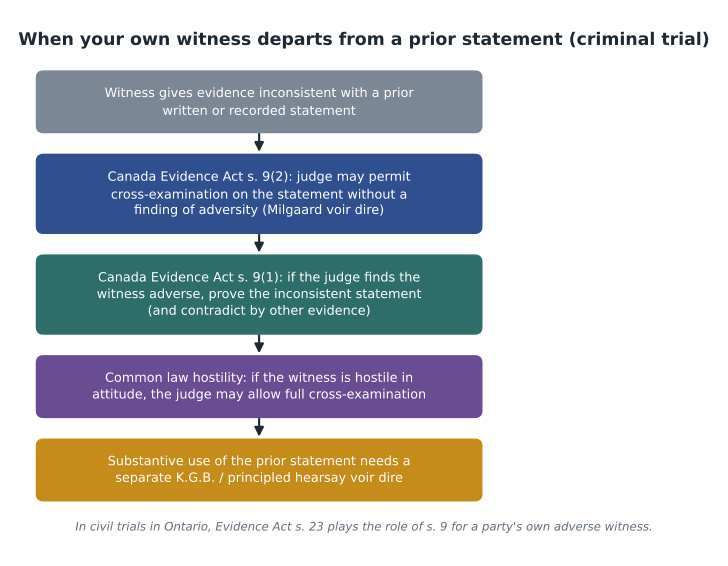
Under section 9(1) of the Canada Evidence Act, a party producing a witness may not impeach the witness's credit by general evidence of bad character, but if the witness, in the opinion of the court, proves adverse, the party may contradict the witness by other evidence, or, with leave of the court, prove that the witness made a prior inconsistent statement. 'Adverse' means opposed in interest or unfavourable in the sense of opposite in position; it is wider than hostile. In deciding adversity, the judge can consider the prior statement itself.
Section 9(2) creates a special procedure for prior statements in writing, reduced to writing, or recorded on audio or video. Where a party's witness is alleged to have made such a statement inconsistent with their present testimony, the court may, without proof that the witness is adverse, grant leave to cross-examine the witness on the statement, and may consider the cross-examination in deciding whether the witness is adverse. The procedure for a section 9(2) application was set out in R. v. Milgaard (1971), 2 C.C.C. (2d) 206 (Sask. C.A.): in the absence of the jury, counsel advises the court of the application, the judge examines the statement to decide whether it is inconsistent, the party proves the statement, opposing counsel may cross-examine on the circumstances in which it was made, and the judge decides whether to permit cross-examination before the jury.
The common law also permits a party to cross-examine a witness who is hostile, meaning one who shows an attitude of hostility or unwillingness to tell the truth. A finding of hostility permits full cross-examination, including leading questions, on all matters.
Importantly, cross-examination under section 9 goes only to the witness's credibility. If the party wants the prior statement to be used for the truth of its contents, it must apply to have it admitted under the principled approach to hearsay. R. v. K.G.B., [1993] 1 S.C.R. 740, held that a prior inconsistent statement may be admitted for its truth where it meets threshold reliability, typically shown by the statement being made under oath or solemn affirmation following a warning about the consequences of lying, being video-recorded, and the witness being available for cross-examination at trial. Section B studied K.G.B. in Evidence; trial advocates need to know how to run the application.
In civil trials in Ontario, section 23 of the Evidence Act plays the role of section 9: a party producing a witness may not impeach the witness's credit by general evidence of bad character, but if the witness proves adverse in the judge's opinion, the party may contradict them by other evidence or, with leave, prove a prior inconsistent statement.
In Calder, the Crown expects to face this problem with Leah Pruitt. If she testifies that she did not see the start of the encounter, the Crown will apply under section 9(2) to cross-examine her on her recorded statement, and may apply under K.G.B. to have the statement admitted for its truth. The Crown should prepare the application before trial, with the recording, a transcript, and evidence of the circumstances of the statement from the officer who took it.
| Situation | Tool | What it allows |
|---|---|---|
| Witness departs from a written or recorded statement | CEA s. 9(2), Milgaard procedure | Cross-examination on the statement without a finding of adversity |
| Witness is adverse (opposite in position) | CEA s. 9(1); Ontario Evidence Act s. 23 (civil) | Contradiction by other evidence; with leave, proof of the prior inconsistent statement |
| Witness is hostile in attitude | Common law | Full cross-examination, including leading questions |
| Party wants the prior statement for its truth | Principled hearsay; K.G.B. | Substantive use if threshold reliability is shown |
Worked problem
Examining Brendan Hollis in chief for the Crown
Hollis, the bouncer, will say that he saw Calder shove Dorey from behind as Dorey was walking away. His written statement to police says he was 'checking IDs at the door' when the shouting started. Plan the key part of the examination-in-chief.
Show solution
- Humanize: 'Mr. Hollis, what do you do for a living? How long have you worked at the bar?' (introductory; leading permitted but open questions work better).
- Set the scene: 'Where were you standing at about 11:30 that night? What was the lighting like? How far were you from the curb?'
- Front the weakness: 'What were you doing when you first noticed Mr. Calder and Mr. Dorey?' 'Checking IDs.' 'What made you look up?' 'Shouting.'
- Slow down at the key moment: 'When you looked up, what did you see?' 'Dorey was turning away, toward the street.' 'What happened next?' 'Calder came after him and shoved him with both hands.' 'Show the jury how.' (demonstration, describing it for the record).
- Aftermath: 'What happened to Mr. Dorey? What did you do? Who did you speak to?'
- End strong: 'When Mr. Calder shoved him, where was Mr. Dorey facing?' 'Away from him. Toward the street.'
Common mistakes
MistakeLeading on contested facts in chief because the witness is nervous.
InsteadUse open questions; leading on contested matters is objectionable and reduces the weight of the answers.
MistakeAsking wholly open questions and letting the witness ramble.
InsteadCombine open questions with headlines, looping and requests for sensory detail.
MistakeUsing re-examination to cover topics forgotten in chief.
InsteadRe-examination is limited to matters arising from cross; new matters need leave to reopen.
MistakeTreating cross-examination under section 9 as making the prior statement evidence of its truth.
InsteadSection 9 cross-examination goes to credibility; substantive use requires a K.G.B. or principled hearsay application.
MistakeEquating 'adverse' with 'hostile'.
InsteadAdverse means opposite in position and is wider; hostility requires an attitude of hostility and permits full cross-examination.
Practice problems
Work each problem on paper first, then reveal the answer to check.
Name four situations in which counsel may lead in examination-in-chief.
Show answer
Introductory matters, undisputed matters, to direct the witness to a topic, and to help a witness with difficulty (with leave); also, in some cases, to contradict another witness's evidence.
What are headlines and looping?
Show answer
Headlines are short signposts directing the witness and trier of fact to a topic; looping repeats a key word from the witness's last answer in the next question for emphasis.
What is the scope of re-examination?
Show answer
Matters arising in cross-examination: clarifying, explaining, or putting a prior statement in context; new matters need leave to reopen.
Describe the Milgaard procedure under section 9(2).
Show answer
In the jury's absence, counsel advises of the application; the judge reviews the statement for inconsistency; the party proves it; opposing counsel may cross-examine on its circumstances; the judge decides whether to permit cross-examination before the jury.
What does K.G.B. add to section 9?
Show answer
It permits a prior inconsistent statement to be admitted for its truth, not only for credibility, if threshold reliability is established, typically through an oath or warning, a video record and availability for cross-examination.
Summary and key terms
- Leading questions on contentious matters are improper in chief; exceptions include introductory and undisputed matters, directing to a topic, and helping a witness with difficulty.
- Effective chief uses open questions combined with headlines, looping and sensory detail, letting the witness tell the story.
- Structure examinations chronologically or topically; humanize, set the scene, tell the action, cover the aftermath, front weaknesses and end strong.
- Re-examination is limited to matters arising in cross-examination and should be short or omitted.
- Under CEA s. 9(2) a party may cross-examine its own witness on a prior written or recorded statement (Milgaard procedure); s. 9(1) applies to adverse witnesses; the common law allows full cross-examination of hostile witnesses.
- Substantive use of a prior inconsistent statement requires a K.G.B. or principled hearsay application; in Ontario civil trials, Evidence Act s. 23 parallels s. 9.
- Examination-in-chief
- The questioning of a witness by the party who called them.
- Leading question
- A question that suggests its answer.
- Looping
- Repeating a word from a witness's answer in the next question to emphasize it.
- Re-examination
- Questioning by the calling party after cross-examination, limited to matters arising from it.
- Adverse witness
- A witness whose evidence is opposite in position to the party calling them, under CEA s. 9(1) or Ontario Evidence Act s. 23.
- Hostile witness
- A witness who shows hostility or unwillingness to tell the truth, permitting full cross-examination by the calling party.
Lesson quiz · 5 questions
Score 60% or more to complete this lesson.
Create a free account to save your progress, take quizzes and earn a certificate.