
LAWC-311 · Lesson 6 of 12 · 24 min
Refreshing memory, exhibits and objections
▶ Video coming soon A video version of this lesson is on the way.
Daniel Whitecloud is calling Anwar Hossain, the Corwin Plaza security guard, for the defence in Ingram. Hossain is asked what time he walked the lot that morning. He hesitates. 'I'm not sure. Maybe nine? Maybe earlier.' Whitecloud reaches for the incident report. Inverarity, on the bench, stops him. 'Before you hand him that, Mr. Whitecloud, what exactly are you doing with it? Are you refreshing his memory, or are you trying to put the report in? Those are different things, with different rules, and opposing counsel is about to ask.'
This lesson covers three practical skills that arise in almost every trial: helping a witness who cannot remember, introducing exhibits, and making and responding to objections. All three depend on evidence law Section B learned in second year, but here the focus is on how they work on the floor of the courtroom.
Refreshing memory: two different things
Witnesses forget. When they do, the law offers two routes, which are often confused. The first is present memory revived: the witness looks at something that jogs their memory, and then testifies from their revived memory. The second is past recollection recorded: the witness has no present memory of the event, but made or adopted a record at the time, and can vouch that it was accurate when made. The record itself then becomes evidence.
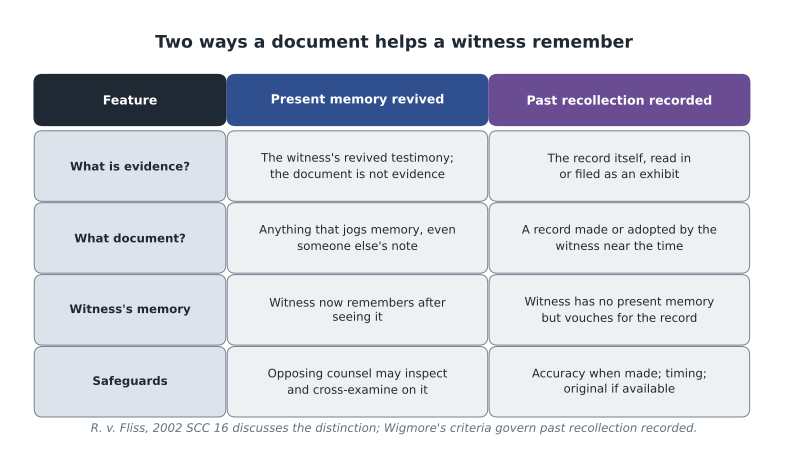
With present memory revived, the evidence is the witness's testimony, not the document. Almost anything can be used to refresh memory: the witness's own notes, someone else's report, a photograph, even a song. Because the document is not evidence, it need not meet any test of reliability. The safeguard is that opposing counsel is entitled to see the document and cross-examine on it, which may reveal that the witness is not genuinely remembering but simply adopting what the document says. If the document was used to refresh memory before trial, rather than in the witness box, opposing counsel may also be entitled to see it, though the rules are less clear; prudent counsel assume disclosure.
With past recollection recorded, the record is the evidence. The common law, following Wigmore, sets conditions: the record must have been made or verified by the witness reasonably close to the event, while the event was fresh in memory; the witness must be able to say that the record was accurate when made; the witness must have no present memory, or not enough to testify fully; and the original should be used if it is available. Canadian courts have applied these criteria in cases such as R. v. Meddoui (1990), 61 C.C.C. (3d) 345 (Alta. C.A.), and the Supreme Court discussed the distinction between the two routes in R. v. Fliss, 2002 SCC 16. In Fliss, an undercover officer testified about a conversation with the accused using a transcript of an unlawfully obtained recording. The court held that he was not genuinely testifying from revived memory, and that the transcript could not be used as a past recollection recorded to bring the excluded recording in by another door.
Fliss teaches advocates a practical point: the line between refreshing memory and reading a document into evidence matters, and judges watch it. If a witness looks at a note, puts it down, and then says something they could not say before, memory has been revived. If the witness keeps reading from the note, the judge may conclude that the note, not the memory, is the evidence, and it must then meet the past recollection recorded criteria or another exception.
Refreshing memory in practice
The procedure for refreshing memory in the witness box is simple but must be followed. Inverarity walks Whitecloud through it.
First, establish that the witness's memory is exhausted. 'Do you remember what time you walked the lot?' 'No, not exactly.' Second, establish that something would help. 'Is there anything that would help you remember?' 'My incident report.' Third, show the document to opposing counsel, then to the witness. 'I'm showing you a document. Please read it to yourself, and tell me when you're done.' Fourth, take the document back, or ask the witness to put it down. Fifth, ask the question again. 'Do you now remember what time you walked the lot?' 'Yes, it was 9:15. I always do the rounds at quarter past.'
Opposing counsel may then cross-examine on the document. In Ingram, Mehta for the plaintiff will want to: the report says 'no salt visible near entrance,' a phrase that helps Rosa. Using the report to refresh Hossain's memory gives Mehta a basis to explore its contents.
Police officers routinely refresh their memory from their notes. Officers are expected to make detailed notes at or near the time of events. The notes are disclosed to the defence, and cross-examination often focuses on what the notes do not say: if an officer testifies to a detail that is not in their notes, the defence will ask why. In Calder, Detective Constable Ian Mercer will testify about Calder's interview from the video, but about the scene from his notes, and the defence will scrutinize any difference.
Exhibits and foundations
Physical objects, documents, photographs, recordings and electronic records can all be evidence, but only if a witness lays a foundation: evidence that the item is what it is claimed to be and that it is relevant. The foundation required depends on the item.
| Kind of exhibit | Typical foundation | Key authority or rule |
|---|---|---|
| Physical object (for example, the hoodie in Calder) | Identification by a witness who recognizes it; for items seized and analyzed, continuity of possession | Common law authentication and continuity |
| Photograph or video | A witness who can say it fairly and accurately depicts what it shows; for surveillance video, evidence of how it was recorded and kept | R. v. Nikolovski, [1996] 3 S.C.R. 1197 (video can be used by the trier of fact to identify the accused) |
| Business record | Made in the usual and ordinary course of business; notice to the other side | Canada Evidence Act s. 30; Ontario Evidence Act s. 35 |
| Electronic document (email, text, GPS log) | Evidence capable of supporting a finding that it is what it purports to be; integrity of the system that recorded or stored it | Canada Evidence Act ss. 31.1 to 31.8; Ontario Evidence Act s. 34.1 |
| Demonstrative aid (diagram, model, chart) | A witness who says it fairly illustrates their evidence; disclosure in advance | Trial judge's discretion |
Authentication is a low threshold. Under section 31.1 of the Canada Evidence Act, the person seeking to admit an electronic document has the burden of proving its authenticity by evidence capable of supporting a finding that the document is what it is purported to be. Questions of reliability, such as whether the text messages were altered or who actually sent them, usually go to weight, not admissibility. Section 31.2 adapts the best evidence rule to electronic documents: the rule is satisfied by proof of the integrity of the electronic documents system by or in which the document was recorded or stored, or by a printout that has been manifestly or consistently acted on or relied on as the record.
In Ingram, Northline's GPS logs are electronic documents. To admit them, the defence will call someone from Northline who can explain how the system records truck locations and how the log was retrieved. Rosa's text message ('Wiped out in the Plaza lot, ice everywhere, no salt at all, think my wrist is broken') is also an electronic document. Rosa herself can authenticate it by identifying it as the message she sent. Whether it is admissible for its truth is a separate hearsay question. Rosa's own statement offered by the plaintiff is self-serving, but as she testifies and can be cross-examined, its use may be limited to narrative or to rebut an allegation of recent fabrication. Section B studied these rules in Evidence.
Continuity matters for physical evidence that has been seized and tested. In Calder, if the Crown relies on blood found on Calder's jacket, it must show who seized the jacket, where it was kept, and who tested it, so that the court can be satisfied the item tested is the item seized and has not been contaminated. Gaps in continuity go to weight, unless they are so serious that the item has no probative value.
Marking and filing exhibits
Practice varies, but in most courts an item that has been identified but not yet admitted is marked as a lettered exhibit for identification ('Exhibit A for identification'). Once admitted, it becomes a numbered exhibit ('Exhibit 4'). Counsel should keep a running list. At the end of the case, the exhibits are the evidence the trier of fact will take into deliberations, so a missing or confused exhibit can be a serious problem.
Agreed facts and agreed books of documents save time. In civil cases, the parties often agree on a joint book of documents and on whether the documents are admitted for their truth or only as authentic copies. In criminal cases, the defence may admit facts under section 655 of the Criminal Code, which relieves the Crown of proving them. Admissions are useful when the fact is undisputed and proving it would only highlight something harmful to the defence, such as gruesome photographs.
Objections
Objections are how counsel keep inadmissible or improper evidence out of the record and preserve issues for appeal. They are also a tactical tool that can annoy a jury if overused. Inverarity's rule: 'Object when it matters and when you'll win. Otherwise sit still.'
The mechanics are standard. Counsel stands and says 'Objection,' followed by a brief statement of the ground: 'Objection, leading,' 'Objection, hearsay,' 'Objection, calls for speculation.' The objection should be made as soon as the problem is apparent, ideally before the witness answers. If argument is needed, counsel asks to make it in the absence of the jury. The judge rules. If the objection is sustained, the questioner rephrases or moves on. If it is overruled, the objecting party has preserved the issue for appeal; there is no need to object again to the same line of questioning, though counsel may ask for a continuing objection.
| Objection | When it applies | Typical response |
|---|---|---|
| Leading | Question suggests the answer on a contested matter in chief or re-examination | Rephrase with an open question |
| Hearsay | Out-of-court statement offered for its truth without an exception | Identify a non-hearsay purpose or an exception |
| Speculation | Witness asked to guess about something outside their knowledge | Ask what the witness actually observed |
| Improper opinion | Lay witness asked for an opinion beyond ordinary experience (R. v. Graat, [1982] 2 S.C.R. 819, permits compendious lay opinion such as speed or intoxication) | Ask for observations; qualify an expert if needed |
| Privilege | Question seeks solicitor-client, litigation or other privileged information | Withdraw or argue waiver or an exception |
| Relevance | Question has no tendency to prove a material fact | Explain the link to an issue |
| Argumentative | Question argues with the witness rather than seeking facts | Ask a factual question |
| Asked and answered | Repeating a question already answered to emphasize or badger | Move on |
| Beyond the scope | Re-examination raises new matters | Seek leave or limit to matters from cross |
Some objections must be anticipated before trial. If counsel knows the other side will try to introduce an accused's statement, prior discreditable conduct, or a disputed expert opinion, the issue should be raised in a pre-trial motion or a voir dire before the witness testifies. Admissibility rulings made in advance allow both sides to plan their openings and examinations.
When improper evidence slips in before an objection can be made, counsel may ask the judge to tell the jury to disregard it, or, in a serious case, may move for a mistrial. In a judge-alone trial, the judge is presumed to disregard inadmissible evidence, so objections are fewer and less dramatic, but still necessary to preserve the record.
Responding to an objection is a skill too. The questioner should listen to the ground, decide quickly whether the objection is right, and if it is, simply rephrase. Arguing a bad point wastes time and credibility. If the objection is wrong, the questioner states the response briefly: 'It's not offered for its truth, Your Honour, but to explain why the officer went to the address.' Then the judge rules.
Back to the guard
Whitecloud starts again. He establishes that Hossain does not remember the time of his rounds, that the incident report would help, shows it to Mehta, then to Hossain, takes it back, and asks again. Hossain now remembers: 9:15. Mehta, in cross-examination, picks up the report. 'Mr. Hossain, you used this report to remember the time. Let's look at what else you wrote. You wrote: no salt visible near entrance. That was true, wasn't it?' Whitecloud has opened a door. Inverarity says it was still the right decision: the report would have been disclosed anyway, and Hossain's evidence about the time of his rounds was important. 'Every exhibit cuts both ways. Use it if, on balance, it helps.'
Worked problem
Laying the foundation for Northline's GPS log
Corwin Plaza wants to prove that Northline's truck salted the lot at 6:15 a.m. on February 4, 2026. It has a printout of the truck's GPS log. How does it get the log admitted?
Show solution
- Call a witness from Northline who can explain the system: how GPS units are installed in trucks, how they record location and time, and where the data is stored.
- Establish authenticity (CEA s. 31.1 in criminal cases; Ontario Evidence Act s. 34.1 in civil cases): the witness retrieved the log for the truck assigned to Corwin Plaza that morning, and the printout is a true copy.
- Satisfy the best evidence rule for electronic documents: evidence that the system was operating properly and reliably, and that Northline relies on the logs for billing.
- Address hearsay: the log may also be admissible as a business record (Ontario Evidence Act s. 35), with notice to the other side; the plaintiff may then attack its weight.
- Have the driver testify, if available, to what he actually did: arriving at the lot is not the same as salting the entrance walkway.
Common mistakes
MistakeLetting a witness read from a document while claiming to refresh memory.
InsteadAfter refreshing, the document is put away and the witness testifies from memory; reading from it may turn it into evidence that must meet another exception (Fliss).
MistakeRefusing to let opposing counsel see a document used to refresh memory.
InsteadOpposing counsel is entitled to inspect it and cross-examine on it.
MistakeTreating authentication of an electronic document as proving it is true or reliable.
InsteadAuthentication is a low threshold (CEA s. 31.1); reliability and hearsay are separate questions.
MistakeObjecting to every technical flaw in front of a jury.
InsteadObject when it matters and the ground is sound; overuse annoys juries and wastes credibility.
MistakeFailing to raise a known admissibility issue until the witness is testifying.
InsteadAnticipate it with a pre-trial motion or voir dire.
Practice problems
Work each problem on paper first, then reveal the answer to check.
What is the key difference between present memory revived and past recollection recorded?
Show answer
With present memory revived, the witness's revived testimony is the evidence and the document is not; with past recollection recorded, the witness has no present memory and the record itself becomes evidence.
List the conditions for past recollection recorded.
Show answer
The record was made or verified by the witness near the event; the witness vouches for its accuracy when made; the witness lacks present memory; the original is used if available.
What does section 31.1 of the Canada Evidence Act require?
Show answer
The person seeking to admit an electronic document must prove its authenticity by evidence capable of supporting a finding that it is what it purports to be.
What did R. v. Graat decide?
Show answer
That a lay witness may give a compendious opinion on matters within ordinary experience, such as whether a person was impaired, as a shorthand for observed facts.
What should counsel do if an objection is overruled?
Show answer
Accept the ruling; the issue is preserved for appeal. Counsel need not repeat the objection to the same line of questioning, though a continuing objection may be noted.
Summary and key terms
- Present memory revived uses any document to jog memory; the testimony is the evidence and opposing counsel may inspect the document.
- Past recollection recorded admits the record itself when the witness has no memory but made or adopted an accurate record near the time (Wigmore criteria; Meddoui; Fliss).
- Exhibits need a foundation: identification, continuity for seized items, accurate depiction for photographs and video, and authentication and system integrity for electronic documents (CEA ss. 31.1 to 31.8; Ontario Evidence Act s. 34.1).
- Business records may be admitted under CEA s. 30 or Ontario Evidence Act s. 35; admissions under Criminal Code s. 655 relieve the Crown of proving facts.
- Objections should be prompt, brief and made for reasons that matter; argument occurs in the jury's absence, and an overruled objection preserves the issue.
- Anticipate admissibility disputes with pre-trial motions or voir dires.
- Present memory revived
- Using a document or other item to jog a witness's memory so they can testify from memory.
- Past recollection recorded
- Admitting a record made or adopted by a witness near the event when the witness has no present memory.
- Foundation
- Evidence that an exhibit is what it is claimed to be and is relevant.
- Continuity
- Proof of the chain of possession of a physical item from seizure to trial.
- Authentication
- Proof that an item is what it purports to be, a low threshold for admission.
- Voir dire
- A hearing within a trial, usually without the jury, to decide the admissibility of evidence.
Lesson quiz · 5 questions
Score 60% or more to complete this lesson.
Create a free account to save your progress, take quizzes and earn a certificate.