
LAWC-311 · Lesson 8 of 12 · 24 min
Impeachment and the rule in Browne v. Dunn
▶ Video coming soon A video version of this lesson is on the way.
Professor Rosalind Quaye, who taught Section B evidence in second year, sits on the bench for this class. Inverarity has asked her to preside because, he says, 'impeachment is where evidence law and advocacy meet, and I want a judge who knows the evidence law better than I do.' Arjun Mehta, for the defence in Calder, is about to cross-examine Brendan Hollis on his police statement. Quaye looks over her glasses. 'Mr. Mehta, before you begin, tell me the provision under which you propose to do this.'
Impeachment means attacking a witness's credibility or reliability. The most common and powerful form of impeachment is confronting a witness with a prior inconsistent statement. This lesson explains how to do it, the statutory rules that govern it, the other ways a witness can be impeached, and the rule in Browne v. Dunn, which requires cross-examining counsel to put contradictions to a witness before attacking the witness's evidence later.
Ways to impeach a witness
A witness's evidence may be attacked in several ways. Perception: the witness did not have a good opportunity to see or hear what they describe. Memory: the witness's recollection is incomplete or has changed over time. Bias or interest: the witness has a reason to favour one side, such as a relationship, a financial stake or animosity. Prior inconsistent statements: the witness has said something different before. Prior convictions: under section 12 of the Canada Evidence Act, any witness may be questioned about prior convictions, which go to credibility. Contradiction by other evidence: other witnesses or exhibits show that the witness's account is wrong.
Some of these attacks can be pursued with extrinsic evidence, meaning evidence from other witnesses or exhibits. Others are limited by the collateral facts rule. Under that rule, when a witness is cross-examined on a matter that is collateral, meaning relevant only to credibility and not to a fact in issue, the witness's answer is final: the cross-examiner may not call other evidence to contradict it. The rule exists to keep trials focused. The Supreme Court discussed it in R. v. Krause, [1986] 2 S.C.R. 466, in the context of the limits on Crown reply evidence.
There are important exceptions to the collateral facts rule. Bias and interest are never collateral: if a witness denies a relationship with a party, the cross-examiner may prove it. Prior convictions may be proved if denied (Canada Evidence Act, s. 12(1.1)). And a prior inconsistent statement on a matter relevant to the case may be proved if the witness does not admit making it.
Prior inconsistent statements: the statutory framework
Sections 10 and 11 of the Canada Evidence Act govern cross-examination on prior inconsistent statements in criminal proceedings. Section 10 deals with statements in writing, reduced to writing, or recorded on audio or video. A witness may be cross-examined on such a statement without it being shown to them, but if counsel intends to contradict the witness with the statement, the witness's attention must first be drawn to the parts of the statement that are to be used for that purpose. The judge may also require production of the statement for inspection.
Section 11 deals with oral statements. If a witness, on cross-examination about a former statement inconsistent with their present testimony, does not distinctly admit making it, proof may be given that they did make it. But before that proof is given, the circumstances of the supposed statement, sufficient to designate the particular occasion, must be mentioned to the witness, and the witness must be asked whether they made the statement.
In civil proceedings in Ontario, sections 20 and 21 of the Evidence Act contain parallel rules for oral and written statements.
Quaye nods when Mehta cites section 10. 'Proceed.'
Commit, credit, confront
Trial advocates teach a three-step method for impeaching with a prior inconsistent statement.
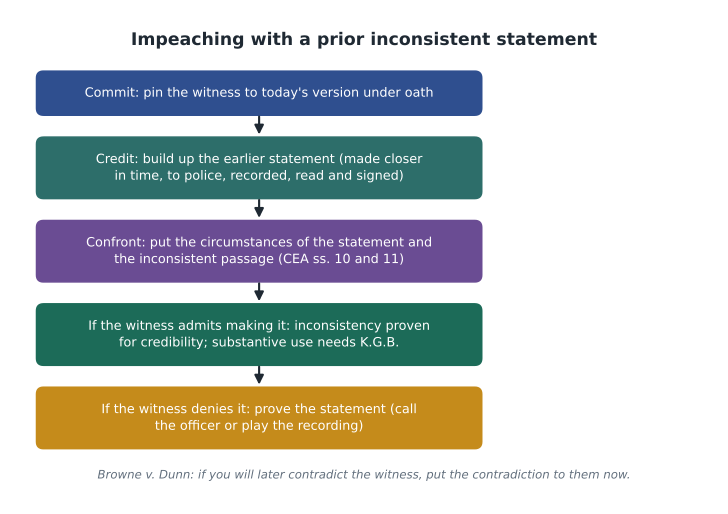
Commit. First, pin the witness to the version they have just given. In chief, Hollis said he had been watching Calder and Dorey argue 'for a minute or so' before the shove. Mehta begins: 'Mr. Hollis, you told the jury this morning that you had been watching the two men argue for about a minute before Mr. Calder pushed Mr. Dorey.' 'That's right.' 'You're sure of that.' 'Yes.' The commitment prevents the witness from later saying they meant something else.
Credit. Second, build up the importance and reliability of the earlier statement, so that the inconsistency matters. 'You spoke to the police that night.' 'Yes.' 'Within an hour of what happened.' 'About that.' 'Your memory was fresh.' 'I suppose.' 'You knew a man had been badly hurt.' 'Yes.' 'You knew it was important to be accurate.' 'Yes.' 'The officer wrote down what you said, and you read it over.' 'Yes.' 'And you signed it.' 'Yes.' The witness has now agreed that the statement was made carefully, close in time, about something serious.
Confront. Third, read the inconsistent passage accurately and ask the witness to confirm it. Under section 10, the witness's attention must be drawn to the relevant part. 'I'm showing you that statement. Is that your signature at the bottom?' 'Yes.' 'Please follow along as I read from the second paragraph. You told the officer: I was checking IDs at the door when I heard shouting and looked up. That's what you told the officer.' 'Yes, but...' 'Thank you.'
The key is not to ask the witness to explain the inconsistency. 'Why did you say something different then?' gives the witness a chance to reconcile the two versions. The cross-examiner has shown the inconsistency; the Crown can try to repair it in re-examination, and the jury will evaluate both.
If the witness denies making the statement, counsel must be prepared to prove it, typically by calling the officer who took the statement or by playing the recording. If the witness admits it, the inconsistency is proven.
What the inconsistency proves
A prior inconsistent statement admitted only for impeachment goes to credibility. The jury is told it may consider the fact that the witness said different things on different occasions in deciding whether to believe the witness's trial evidence, but may not treat the earlier statement as proof of what it says. In Calder, the defence is not trying to prove through Hollis's statement that he was checking IDs; it is trying to show that his trial account of watching for a minute is unreliable.
If a party wants a prior inconsistent statement to be used for its truth, it must satisfy the principled approach to hearsay, as K.G.B. established for statements meeting threshold reliability. Usually this arises when the party that called the witness wants to rely on the earlier statement, as the Crown might with Leah Pruitt (lesson 5). It can also arise when the prior statement is the accused's own: statements by an accused, if voluntary, are admissible against the accused for their truth as admissions.
Other forms of impeachment in practice
Bias and interest. In Calder, Tess Halloran is Calder's girlfriend. The Crown will cross-examine on the relationship, how long it has lasted, whether they live together, and whether she has discussed the case with him. If she denies discussing it, and the Crown has evidence that she did, it can prove it, because bias is not collateral.
Prior convictions. Under section 12 of the Canada Evidence Act, a witness may be asked whether they have been convicted of an offence, and if they deny or refuse to answer, the conviction may be proved. Counsel may ask about the nature of the offence and the sentence, but not, generally, the underlying facts. For an accused who testifies, the trial judge may exclude some or all convictions on a Corbett application if their prejudicial effect outweighs their probative value on credibility.
Character for untruthfulness. Canadian law allows limited evidence of a witness's general reputation for untruthfulness, but it is rarely used. More commonly, counsel shows specific reasons to doubt a witness's honesty through cross-examination, such as a history of lies told to the police in the same investigation.
The rule in Browne v. Dunn
The rule in Browne v. Dunn takes its name from an 1893 House of Lords decision, Browne v. Dunn (1893), 6 R. 67 (H.L.). Stated simply: if a cross-examiner intends to impeach a witness's evidence by calling contradictory evidence or by arguing that the witness is lying or mistaken on a significant point, the cross-examiner should put the contradiction to the witness, giving the witness a chance to respond.
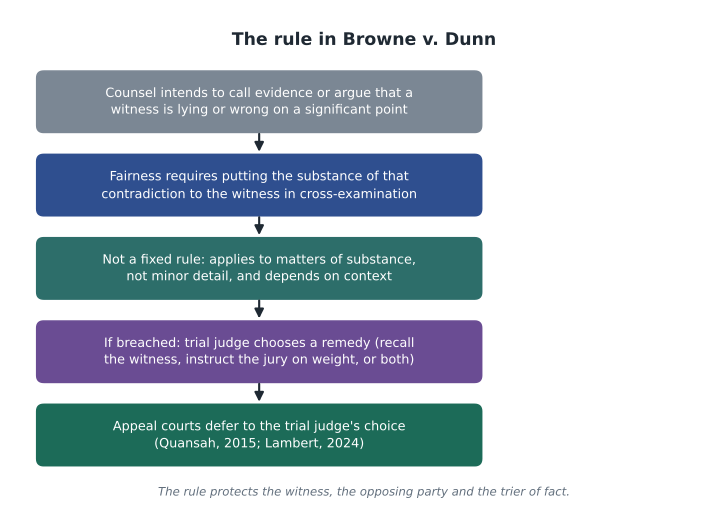
The rule has three purposes. It is fair to the witness, who should have a chance to explain before being called a liar or contradicted. It is fair to the party who called the witness, who should know the case they have to meet and may want to call evidence in response. And it helps the trier of fact, who is better able to assess credibility after hearing the witness's response.
In Canada, the rule is not applied rigidly. In R. v. Quansah, 2015 ONCA 237, the Court of Appeal for Ontario reviewed the principles. The rule is one of fairness, not a fixed rule of law. Its application depends on the circumstances, including the significance of the matter, how clearly the contradiction was otherwise put, and whether the witness was on notice of the challenge. It applies to matters of substance, not to minor details. When a breach occurs, the trial judge has a discretion to choose a remedy: allowing the witness to be recalled to respond, instructing the jury that it may take the failure to cross-examine into account in assessing the contradicting evidence, or both. The trial judge's decision attracts deference on appeal.
The Court of Appeal returned to the rule in R. v. Lambert, 2024 ONCA 391, describing it as part of the common law that ensures trial fairness and confirming that trial judges deserve considerable deference in applying it. The court rejected an argument that the jury should have been told not to hold the accused responsible for his counsel's failure to confront a witness.
Section B is reminded that in criminal cases, the rule can apply against the defence. If the accused testifies to facts that contradict a Crown witness on a significant matter, and defence counsel never put those facts to the Crown witness in cross-examination, the Crown may ask for a remedy. The Crown might seek to recall the witness, or the judge might instruct the jury that it may consider the failure to cross-examine in weighing the accused's evidence. Judges must be careful with such instructions, because the accused may not be responsible for counsel's choices, and because a strong instruction may unfairly undermine the accused's testimony.
Applying Browne v. Dunn in Calder
Mehta, cross-examining Hollis, has a decision to make. The defence may call Calder, who will say Dorey came at him and he pushed Dorey away. If the defence will rely on that evidence, it should put the substance of it to Hollis: 'Mr. Hollis, I suggest to you that Mr. Dorey moved toward Mr. Calder just before Mr. Calder pushed him.' 'No, he was walking away.' 'I suggest you didn't see that moment, because you were looking at an ID.' 'I saw it.' The answers do not matter; the contradiction has been put.
Mehta worries about committing to Calder testifying. Quaye points out that putting a suggestion to a witness does not commit the accused to testifying; it puts the witness on notice of the defence position. Counsel needs a good faith basis for the suggestion, which Calder's account provides, even if Calder ultimately does not testify.
Repairing impeachment in re-examination
The party who called an impeached witness may try to repair the damage in re-examination. Common techniques include giving the witness a chance to explain the inconsistency ('When you told the officer you were checking IDs, what did you mean?'), showing that the statement was made under stress, or putting the inconsistent passage in context by referring to other parts of the same statement. Prior consistent statements are generally inadmissible to bolster credibility, but they may be admitted to rebut an allegation that the witness's evidence was recently fabricated.
The Crown, re-examining Hollis, asks: 'When you said you were checking IDs when you heard shouting, how long had the shouting been going on before you looked up?' 'Not long. A few seconds, I think.' 'After you looked up, how long did you watch before the push?' 'Maybe thirty seconds. It felt longer when I told the jury.' The repair is partial. The jury now has two versions and an explanation, and will decide.
| Impeachment method | Extrinsic proof allowed? | Authority |
|---|---|---|
| Prior inconsistent statement on a relevant matter, not admitted | Yes, after laying the foundation | CEA ss. 10 and 11; Ontario Evidence Act ss. 20 and 21 |
| Prior conviction, denied | Yes | CEA s. 12 |
| Bias or interest, denied | Yes; never collateral | Common law |
| Collateral matter relevant only to credibility | No; the answer is final | Collateral facts rule (Krause) |
| Contradiction on a significant point by later evidence | Yes, but put it to the witness first | Browne v. Dunn; Quansah; Lambert |
Worked problem
Impeaching Rosa Ingram with her discovery evidence
At trial, Rosa Ingram testifies in chief that she was 'watching where I was going, as I always do.' At her examination for discovery, under oath, she said she 'wasn't really looking at the ground.' The defence wants to impeach her. Plan the impeachment.
Show solution
- Commit: 'Ms. Ingram, you told the court you were watching where you were going, as you always do.' 'Yes.'
- Credit: 'You attended an examination for discovery in this action. You were under oath. Your lawyer was with you. You knew your answers could be used at trial. The examination was about eight months after the fall, when your memory was fresher than today.'
- Confront: show the transcript to opposing counsel, then to the witness. 'Please look at page 47, question 212. You were asked: were you looking at the ground as you walked? Your answer was: I wasn't really looking at the ground. Did I read that correctly?' 'Yes.'
- Stop. Do not ask her to explain. Her counsel may re-examine.
- Alternatively or additionally, read the answer in as an admission under the Rules of Civil Procedure, which permits an adverse party's discovery evidence to be used at trial.
Common mistakes
MistakeAsking the witness why their earlier statement was different.
InsteadCommit, credit and confront, then stop; let the other side try to repair it in re-examination.
MistakeTreating a prior inconsistent statement used to impeach as proof of its contents.
InsteadIt goes to credibility; substantive use requires a hearsay ruling such as K.G.B.
MistakeCalling a witness to contradict an answer on a collateral matter.
InsteadThe answer is final under the collateral facts rule, except for bias, prior convictions and relevant prior statements.
MistakeFailing to put the defence version to a Crown witness, then leading contradictory evidence.
InsteadBrowne v. Dunn requires putting significant contradictions to the witness; otherwise the judge may order recall or instruct the jury.
MistakeTreating Browne v. Dunn as an absolute rule that always requires a jury instruction.
InsteadIt is a flexible rule of fairness; the trial judge chooses the remedy and is owed deference (Quansah; Lambert).
Practice problems
Work each problem on paper first, then reveal the answer to check.
What are the three steps of impeachment with a prior inconsistent statement?
Show answer
Commit the witness to the trial version, credit the earlier statement, then confront the witness with the inconsistent passage.
What does section 11 of the Canada Evidence Act require before proving an oral prior inconsistent statement?
Show answer
The circumstances of the statement, sufficient to designate the occasion, must be mentioned to the witness, and the witness must be asked whether they made it.
What is the collateral facts rule and its main exceptions?
Show answer
A witness's answer on a matter relevant only to credibility is final; exceptions include bias or interest, prior convictions, and prior inconsistent statements on relevant matters.
State the rule in Browne v. Dunn.
Show answer
If counsel intends to contradict a witness's evidence on a significant point with other evidence or argument, counsel should put the contradiction to the witness in cross-examination so the witness can respond.
According to Quansah, what remedies are available for a breach of Browne v. Dunn?
Show answer
Recalling the witness to respond, instructing the jury that it may consider the failure to cross-examine in weighing the contradicting evidence, or both, in the trial judge's discretion.
Summary and key terms
- Witnesses can be impeached on perception, memory, bias, prior inconsistent statements, prior convictions and contradiction by other evidence.
- The collateral facts rule makes answers on purely credibility matters final, except for bias, prior convictions and relevant prior statements.
- CEA ss. 10 and 11 (and Ontario Evidence Act ss. 20 and 21) govern cross-examination on written and oral prior inconsistent statements.
- Use commit, credit, confront; do not ask the witness to explain; prove the statement if the witness denies it.
- A prior inconsistent statement used to impeach goes to credibility only, unless admitted for its truth under K.G.B. or as an accused's admission.
- Browne v. Dunn requires putting significant contradictions to a witness; it is a flexible fairness rule with discretionary remedies (Quansah, 2015; Lambert, 2024).
- Impeachment
- Attacking a witness's credibility or reliability.
- Prior inconsistent statement
- A witness's earlier statement that differs from their trial evidence.
- Collateral facts rule
- The rule that a witness's answer on a matter relevant only to credibility cannot be contradicted by other evidence.
- Rule in Browne v. Dunn
- The fairness rule that a witness should be confronted with contradictory evidence or allegations before they are relied on.
- Extrinsic evidence
- Evidence from a source other than the witness being cross-examined, such as another witness or an exhibit.
- Prior consistent statement
- A witness's earlier statement consistent with their testimony, generally inadmissible to bolster credibility except to rebut recent fabrication.
Lesson quiz · 5 questions
Score 60% or more to complete this lesson.
Create a free account to save your progress, take quizzes and earn a certificate.