
LAWC-311 · Lesson 10 of 12 · 23 min
Closing arguments
▶ Video coming soon A video version of this lesson is on the way.
Theo Marchetti has waited all term to close for the Crown in Calder. He has notes on index cards, a timeline on a flip chart, and a theme he has polished for weeks: 'He chose force when he could have walked away.' He begins well. Ten minutes in, he says: 'I've been doing this kind of work for ten years, and I can tell you, I've never seen a clearer case.' Whitecloud, for the defence, is on his feet before Inverarity can say anything. 'Objection. Personal opinion.'
The closing argument is the only stage of the trial where counsel is permitted to argue: to tell the trier of fact what the evidence means, which witnesses to believe, what inferences to draw and how the law applies. It is the last chance to persuade, and for many advocates the most satisfying part of a trial. It is also hedged with limits, because the trier of fact has just heard the evidence and is most vulnerable to improper influence. This lesson explains the purpose, structure and limits of closing arguments, the order of addresses, and how closings interact with the judge's charge.
What a closing is for
A closing argument shows the trier of fact how the evidence proves the party's case theory, or fails to prove the other side's, and why the law requires the result the party seeks. It is argument, so counsel may now do what was forbidden in opening: comment on credibility, urge inferences, explain why one witness should be believed over another, and connect the evidence to the legal elements.
A closing is not a summary of the evidence. Judges and jurors have just heard the witnesses and do not need a recitation. They need a reason to decide, and a framework for deciding. Inverarity calls the closing 'a map for deliberations': it tells the trier of fact which questions they must answer, in what order, and how the evidence answers each one.
The order of addresses
In a criminal jury trial, the order of closing addresses is set by section 651 of the Criminal Code. If the accused calls evidence, defence counsel addresses the jury first and the Crown addresses last. If the accused calls no evidence, the Crown addresses first and the defence last. Where two or more accused are tried together and any of them calls evidence, every accused addresses the jury before the Crown.
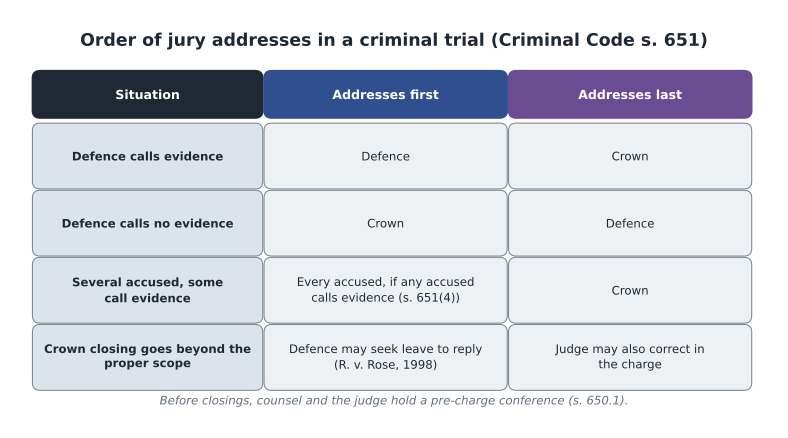
The rule gives the defence a tactical reason to call no evidence: if it calls none, it has the last word. In R. v. Rose, [1998] 3 S.C.R. 262, the Supreme Court of Canada held that requiring the defence to address first when it has called evidence does not violate the accused's right to make full answer and defence. The court recognized, however, that if the Crown's closing raises something new or improper that the defence had no opportunity to answer, the trial judge has a discretion to permit the defence to reply, and can also correct improper Crown argument in the charge to the jury.
Before closing addresses, the judge holds a pre-charge conference with counsel, as required by section 650.1 of the Criminal Code in jury trials. The judge tells counsel what the charge will say about the law, the defences that will be left with the jury, and the evidence that will be reviewed. Counsel can make submissions. The pre-charge conference matters to the closing, because counsel must not tell the jury the law differs from what the judge will say.
In civil jury trials, the order of addresses is governed by the Rules of Civil Procedure and the trial judge's directions. In judge-alone trials, the judge decides how submissions will be made, often asking for written submissions on the law, followed by oral argument.
Structuring a closing
Inverarity suggests a structure built around the questions the trier of fact must answer.
Start with the theme. Return to the theme from the opening and remind the trier of fact of the story the evidence has told. 'In my opening, I told you this case was about a choice. You've now heard the evidence. Owen Calder had a choice, and he chose force.'
Set out the questions. Identify the issues the trier of fact must decide, preferably in the order the judge will put them in the charge. In Calder: Did Calder commit an assault on Dorey, or did he act in self-defence? If it was an assault, would a reasonable person have foreseen a risk of bodily harm? Did the assault cause Dorey's death? Then concede what is not in dispute: 'You will have no trouble with the third question. Dr. Rao's evidence on cause of death was not challenged.'
Answer each question with the evidence. For each contested issue, explain how the evidence answers it. Use specific evidence: names, words, exhibits. Explain why the witnesses who support you should be believed and why those who do not should not be, using the factors judges tell juries to consider: opportunity to observe, consistency, interest, demeanour (with caution), and whether the account makes sense.
Deal with the other side's best points. Anticipate and answer the strongest arguments the other side will make, especially if you address first and they will have the last word. 'The defence will tell you Hollis was checking IDs. He was. And he looked up when the shouting started, which is exactly when you'd look up. What he saw then is what matters.'
End with a clear request. Tell the trier of fact exactly what verdict you seek and why. Return to the theme.
Using the law
Counsel may refer to the law in closing, but must not misstate it, and in a jury trial must not contradict what the judge will say. The safe practice is to tell the jury the judge will instruct them on the law, and to describe it in terms consistent with the pre-charge conference. Defence counsel commonly remind the jury of the presumption of innocence and the meaning of reasonable doubt, which the judge will explain using the language of R. v. Lifchus, [1997] 3 S.C.R. 320: proof beyond a reasonable doubt is not proof to an absolute certainty, but it is much closer to absolute certainty than to proof on a balance of probabilities.
Only defences with an air of reality go to the jury. In R. v. B.F., 2025 SCC 41, the Supreme Court restored a conviction for attempted murder, holding that the trial judge did not have to instruct the jury on aiding suicide, an alternative theory the defence had raised, because there was no evidence on which a properly instructed jury could reasonably accept it. For closing advocates, the lesson is that a theory without an evidentiary foundation will not be left to the jury, and arguing it may draw a correction in the charge. Counsel should build closings on theories the judge has agreed, at the pre-charge conference, have an air of reality.
The limits of a closing
The limits on closing arguments are enforced by objections, corrective instructions and, in serious cases, mistrials or appeals.
No personal opinion. Counsel must not tell the trier of fact what they personally believe about the evidence, the credibility of witnesses, or the guilt or liability of a party. Boucher, discussed in lesson 1, set aside a conviction partly because the Crown expressed its personal belief in the accused's guilt. Marchetti's comment about his ten years of experience is exactly this problem: it invites the jury to rely on counsel's authority rather than the evidence. The cure is to say 'the evidence shows' rather than 'I believe' or 'I've never seen.'
No facts outside the evidence. Counsel must argue only from the evidence admitted at trial and reasonable inferences from it. Referring to facts not in evidence, such as what a witness who was not called would have said, is improper.
No inflammatory or prejudicial appeals. Counsel must not appeal to the jury's emotions, prejudices or fears in a way that distracts from the evidence. Crown closings that ask the jury to protect the community, send a message, or avenge the victim are improper. Civil counsel must not ask jurors to put themselves in the plaintiff's shoes and award what they would want for themselves; that kind of argument invites jurors to abandon objectivity.
No comment on the accused's silence. Section 4(6) of the Canada Evidence Act prohibits the judge and the prosecution from commenting on the failure of the accused, or the spouse of the accused, to testify. The Crown must also not invite the jury to draw an adverse inference from the accused's exercise of the right to silence before trial.
No denigration of opposing counsel. Suggesting that the other side's lawyer is trying to trick the jury, or attacking counsel personally, is improper and, after Groia, may also be professional misconduct if done in an uncivil way.
No misstatement of evidence. Counsel must describe the evidence accurately. Mischaracterizing what a witness said is improper and damages counsel's credibility, because the trier of fact heard the evidence.
The Crown is held to a particularly high standard, because of its role. A Crown closing that crosses these lines can lead to a new trial even if the evidence of guilt is strong, although appellate courts consider whether the judge's charge corrected the problem and whether the remarks, viewed in the context of the whole trial, compromised its fairness. Defence counsel are also bound by the limits, though appellate review of defence closings is less common, because the Crown's right to appeal an acquittal is limited to questions of law alone. In practice, trial judges correct improper defence argument in the charge.
Persuasion techniques
Within the limits, closings can and should be persuasive.
Use the evidence vividly. Quote the witnesses' own words. Use exhibits: show the photograph of the curb, the timeline, the incident report. Juries remember what they see.
Use rhetorical questions carefully. 'If Mr. Dorey was walking away, why does Ms. Halloran say he was moving toward Owen?' A good rhetorical question highlights a problem in the other side's case. But it can backfire if the other side has a good answer and gets the last word.
Use analogies and common sense. Jurors bring their own experience to deliberations. An analogy that connects the evidence to everyday life can make an argument stick: 'If you've ever been jostled in a crowd, you know you push back before you think.'
Be honest about weaknesses. A closing that concedes the obvious and explains why it does not matter is more credible than one that pretends there are no problems.
Be brief. Closings in short trials should be measured in minutes, not hours. Inverarity's guidance for the mock trials is twenty minutes, maximum.
Two closings in Calder
| Element | Crown closing (addresses last if defence calls evidence) | Defence closing |
|---|---|---|
| Theme | 'He chose force when he could have walked away.' | 'A man backed against a wall has the right to push free.' |
| Main issue | Was the shove an assault, not self-defence? | Has the Crown disproved self-defence beyond a reasonable doubt? |
| Key evidence | Hollis: Dorey was turning away; Pruitt's recorded statement if admitted for its truth | Hollis's ID-checking; Halloran's account; Dorey's shouting; the speed of events |
| Answering the other side | Hollis looked up at the shouting, which is when the key moment happened | Hollis saw seconds, not the whole encounter; honest mistake |
| Law | Section 34 factors: other means available, Dorey's position | W.(D.); reasonable doubt on self-defence is enough to acquit |
| Request | A verdict of guilty of manslaughter | A verdict of not guilty |
Marchetti's second attempt at the Crown closing avoids personal opinion. 'The evidence shows,' he says, 'that Mr. Dorey was turning toward the street when Mr. Calder came after him.' He deals with the ID-checking point head-on and explains why Hollis's account is still reliable. He reminds the jury that the judge will explain self-defence and that the Crown must disprove it beyond a reasonable doubt, and argues that it has: Calder had another option, which was to step back into the bar, and Dorey was not threatening anyone when he was pushed.
Whitecloud's defence closing focuses on reasonable doubt. 'You don't have to decide exactly what happened in those few seconds. You don't have to be sure Owen was defending himself. If you have a reasonable doubt about whether he was, you must acquit.' He walks the jury through the W.(D.) framework without naming it, and ends with the theme.
Worked problem
Fixing improper passages in a Crown closing
A draft Crown closing in Calder contains these passages: (1) 'I've never seen a clearer case.' (2) 'Mark Dorey's mother sat in this courtroom every day. Think of her when you deliberate.' (3) 'Mr. Calder could have told you his side. He chose not to.' (4) 'Ms. Halloran is his girlfriend. Of course she'd say that.' Identify which passages are improper and rewrite them.
Show solution
- Passage 1 is improper personal opinion (Boucher). Rewrite: 'The evidence on this point is clear.'
- Passage 2 is an improper emotional appeal. Remove it; the jury must decide on the evidence, not sympathy.
- Passage 3 is an improper comment on the accused's failure to testify, prohibited by section 4(6) of the Canada Evidence Act. Remove it entirely.
- Passage 4 is proper in substance: bias or interest is a legitimate basis for assessing credibility. Rewrite to tie it to evidence: 'Ms. Halloran told you she lives with Mr. Calder and spoke with him about this case. You can consider that relationship in deciding how much weight to give her account.'
- Check the whole closing against the pre-charge conference to make sure the law is described as the judge will describe it.
Common mistakes
MistakeUsing the closing to summarize all the evidence witness by witness.
InsteadOrganize the closing around the issues the trier of fact must decide and show how the evidence answers each.
MistakeTelling the jury what counsel personally believes.
InsteadArgue what the evidence shows; personal opinions are improper (Boucher).
MistakeCommenting on the accused's failure to testify.
InsteadCanada Evidence Act s. 4(6) prohibits it; the Crown must also not rely on pre-trial silence.
MistakeArguing a defence theory the judge has decided lacks an air of reality.
InsteadBuild closings on theories the judge will leave to the jury (B.F., 2025); the charge will correct unsupported theories.
MistakeAssuming the defence always speaks last.
InsteadUnder s. 651, the defence addresses last only if it calls no evidence; if it calls evidence, the Crown speaks last.
Practice problems
Work each problem on paper first, then reveal the answer to check.
Under section 651 of the Criminal Code, who addresses the jury last if the defence calls evidence?
Show answer
The Crown; if the defence calls no evidence, the defence addresses last.
What did R. v. Rose decide?
Show answer
That requiring the defence to address first when it has called evidence does not violate the right to make full answer and defence; the trial judge may permit a defence reply where the Crown's closing raises something new or improper.
What is the purpose of the pre-charge conference?
Show answer
To let counsel know what the judge will say about the law and the defences in the charge, and to receive submissions, so that closings are consistent with the charge (s. 650.1).
List four improper kinds of closing argument.
Show answer
Personal opinion, reference to facts not in evidence, inflammatory or emotional appeals, and comment on the accused's failure to testify (also denigrating opposing counsel and misstating the evidence).
What does R. v. B.F. (2025) teach closing advocates?
Show answer
Only theories with an air of reality go to the jury; the trial judge need not instruct on an alternative theory unsupported by evidence, so closings should rely on theories with an evidentiary foundation.
Summary and key terms
- The closing is the only stage for argument: credibility, inferences and the application of law.
- Under Criminal Code s. 651 the defence addresses first if it calls evidence and last if it does not; Rose upheld the rule and recognized a discretionary right of reply.
- A pre-charge conference (s. 650.1) sets the legal framework; counsel must not contradict the judge's charge.
- Structure closings around the issues: theme, questions, evidence for each, answers to the other side, and a clear request.
- Improper argument includes personal opinion (Boucher), facts not in evidence, inflammatory appeals, comment on the accused's silence (CEA s. 4(6)), denigration of counsel and misstatement of evidence.
- Only theories with an air of reality go to the jury (B.F., 2025); persuasive closings use the evidence vividly, concede weaknesses and stay brief.
- Closing argument
- Counsel's final address, in which argument on the evidence and law is permitted.
- Pre-charge conference
- A meeting between the judge and counsel before the charge to discuss the legal instructions.
- Charge to the jury
- The judge's instructions to the jury on the law and the evidence.
- Right of reply
- A discretionary opportunity for the defence to respond to new or improper matters in the Crown's closing.
- Golden rule argument
- An improper civil jury argument asking jurors to put themselves in a party's position.
- Reasonable doubt
- The criminal standard; proof much closer to absolute certainty than to a balance of probabilities (Lifchus).
Lesson quiz · 5 questions
Score 60% or more to complete this lesson.
Create a free account to save your progress, take quizzes and earn a certificate.