
LAWC-311 · Lesson 12 of 12 · 28 min
Capstone: a mock trial
▶ Video coming soon A video version of this lesson is on the way.
The last two weeks of the course are the mock trial. Inverarity distributes a new file, entirely fictional, so that no one has an advantage from two years of living with Calder and Ingram. Professor Rosalind Quaye will preside. Arjun Mehta and Hannah Kowalczyk are the Crown. Theo Marchetti and Sophie Tremblay-Hart are defence counsel. Daniel Whitecloud acts as registrar during the trial and then writes a short memorandum on the issues that would matter on appeal. Inverarity's instruction to all of them: 'Theory. Theme. Proof. Then sit down.'
This lesson sets out the file, then works through the trial in the order it unfolds, answering the key questions in the form of a memorandum: issue, rule, application, conclusion. It draws on every earlier lesson.
The file: R. v. Vasari (hypothetical)
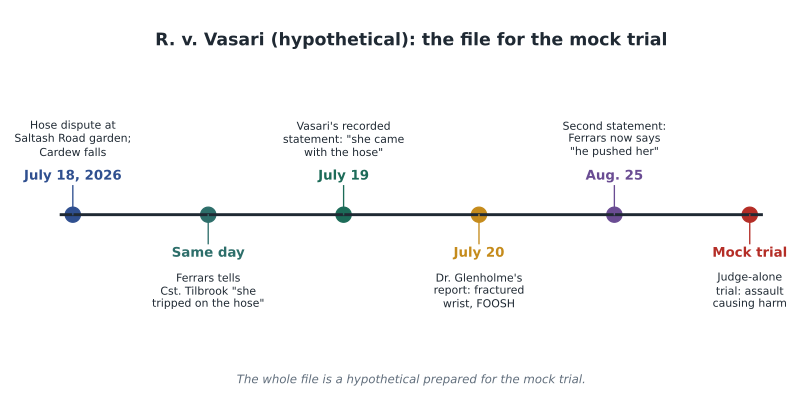
Imre Vasari, 44, is a landscaper who has had a plot at the Saltash Road community garden in Corwin for nine years. Ysolde Cardew, 38, joined the garden in the spring of 2026. The garden has one water tap. During a dry spell in July 2026, the garden committee posted a rota limiting each plot holder to thirty minutes of tap use. Vasari runs a long green hose from the tap to his plot. He bought the hose himself and leaves it coiled at the tap.
On Saturday, July 18, 2026, at about 6:30 p.m., Cardew arrived during what she says was her rota slot. Vasari's hose was attached to the tap and running to his plot. Cardew disconnected it, attached the end to her watering can and began filling it. Vasari, at his plot about fifteen metres away, saw the water stop, walked over and, according to Cardew, said: 'That's my hose. Put it down.' What happened next is disputed.
Cardew's account (police statement, July 18): Vasari grabbed her by the upper arms with both hands and shoved her backward. She fell onto the gravel path, putting out her right hand to break her fall. She felt her wrist snap.
Wilfrid Ferrars, 71, a retired bus driver with the neighbouring plot, was kneeling in his bed about eight metres away. Constable Bryony Tilbrook, who attended at 7:05 p.m., recorded in her notebook that Ferrars told her: 'She had the hose in her hand. He grabbed the hose and yanked it. She tripped on the hose and went down.' Ferrars did not sign anything that day. On August 25, after a call from Cardew, Ferrars went to the police station and gave a written statement: 'He grabbed her and pushed her. She fell backwards.' Asked about the difference, he told the officer that he had been shaken on the day and had thought about it since.
Vasari's recorded statement (July 19, after a caution and his right to counsel): 'I said it's my hose. She wouldn't give it to me. I took hold of it and pulled it back. She was holding on and she came with it. Then she was on the ground. I never touched her.'
Dr. Ilario Glenholme, an emergency physician at Corwin General, treated Cardew on July 18. His report of July 20 records a distal radius fracture of the right wrist, typical of a fall on an outstretched hand. In a short supplementary report, he says the injury is consistent with a fall from a push or a trip and that he cannot say which. There are faint bruises on Cardew's upper arms, which he noted but did not photograph.
Vasari is charged with assault causing bodily harm under section 267(b) of the Criminal Code. The Crown proceeded summarily, so the trial is before a judge of the Ontario Court of Justice without a jury. Vasari has no criminal record. Cardew has no record. Ferrars has known Vasari for nine years and has, according to a garden committee member, complained that Vasari's hose 'takes over the whole tap.'
Issue 1: what are the case theories?
Rule. Assault causing bodily harm requires proof beyond a reasonable doubt that the accused intentionally applied force to the complainant, directly or indirectly, without her consent (s. 265(1)(a)), and that the assault caused bodily harm, defined in section 2 as any hurt or injury that interferes with health or comfort and is more than merely transient or trifling. A fractured wrist is plainly bodily harm. Defence of property under section 35 of the Criminal Code is available where the accused believes on reasonable grounds that he is in peaceable possession of property and that another person is about to take it or is taking it, acts for the purpose of preventing the taking or retaking it, and acts reasonably in the circumstances. Once the defence has an air of reality, the Crown must disprove it beyond a reasonable doubt.
Application, Crown. Mehta and Kowalczyk adopt a simple theory: Vasari lost his temper over the hose and shoved Cardew with both hands. Their theme: 'It was only a hose. He put his hands on her anyway.' They will rely on Cardew, the bruises noted by Dr. Glenholme, and Ferrars's August statement. They anticipate the defence and plan to argue that even on Vasari's own account, yanking an object from someone's grip so hard that she falls is an intentional application of force to her, indirectly, through the hose; and that pulling the hose so violently was not a reasonable response to a dispute over a garden rota.
Application, defence. Marchetti and Tremblay-Hart have two layers. First, there was no assault: Vasari pulled his own hose, and Cardew's fall was an accident caused by her holding on and tripping, as Ferrars told the officer on the day. Second, in the alternative, if pulling the hose was an application of force, it was a reasonable act to retake his own property under section 35. Their theme: 'He took back his own hose. She held on, and she fell.' They concede that Cardew was hurt and that the injury is bodily harm. They focus on what Vasari did with his hands.
Conclusion. Both theories are legally sufficient if accepted. The trial will turn on whether the judge is satisfied beyond a reasonable doubt that Vasari pushed Cardew, or, if he only pulled the hose, whether the Crown has disproved defence of property.
Issue 2: openings
Rule. An opening is a preview, not argument; refer only to evidence that will be admitted (lesson 4). In a judge-alone trial, openings are short and focused on issues.
Application. Kowalczyk's Crown opening takes four minutes. She describes the garden, the rota, the hose, the confrontation and the injury, introduces the witnesses, and identifies the issue: 'Did Mr. Vasari push Ms. Cardew?' She does not mention Vasari's statement, because its admissibility will be decided on a voir dire. Marchetti reserves the defence opening until the start of the defence case, because the defence has not decided whether Vasari will testify.
Conclusion. Both openings stay within proper limits.
Issue 3: the voir dire on Vasari's statement
Rule. A statement made by an accused to a person in authority is admissible for the Crown only if the Crown proves beyond a reasonable doubt that it was voluntary, considering threats or promises, oppression, the operating mind requirement and police trickery (R. v. Oickle, 2000 SCC 38). Where the Crown tenders a statement containing both inculpatory and exculpatory parts, the whole statement goes in, and the trier of fact must consider the exculpatory parts too.
Application. The recording shows a caution, a call to duty counsel and a calm fifteen-minute interview. The defence concedes voluntariness. The statement is a mixed statement: it admits pulling the hose, but denies touching Cardew. The Crown tenders it because it places Vasari at the tap, confirms the dispute and admits a forceful pull. The defence welcomes it, because it puts Vasari's account before the judge without his testifying.
Conclusion. The statement is admitted. Its exculpatory portion must be considered under W.(D.), even if Vasari does not testify.
Issue 4: examining Cardew in chief and cross
Rule. Chief uses open questions and fronts weaknesses (lesson 5). Cross uses leading questions in chapters (lesson 7). Under Browne v. Dunn, the defence must put its version to Cardew if it will contradict her on a significant point (lesson 8).
Application, chief. Mehta fronts the obvious weakness, that Cardew disconnected Vasari's hose. 'Whose hose was it?' 'His, I suppose. But it was my time on the tap.' 'What did you do with it?' 'I took it off the tap and put it on my can.' Then he slows down at the key moment: 'When Mr. Vasari reached you, what did he do with his hands?' 'He grabbed my arms, here, and shoved me.' 'What happened to the hose?' 'I don't know. I think I dropped it.'
Application, cross. Tremblay-Hart's cross has three chapters. Chapter 1, the hose: 'The hose belongs to Mr. Vasari. You knew that. You disconnected it without asking him. You were holding it when he came over.' Chapter 2, the pull: 'He took hold of the hose. You didn't let go. He pulled it toward himself. You were still holding it.' Cardew disagrees with the last two propositions. Chapter 3, Browne v. Dunn: 'I suggest to you that Mr. Vasari never put his hands on your arms.' 'He did.' 'I suggest you fell because you held on to the hose as he pulled it, and your foot caught in the hose.' 'No.' The answers do not matter; the defence version has been put fairly.
Conclusion. The defence has complied with Browne v. Dunn and obtained useful concessions about ownership and the start of the encounter.
Issue 5: Ferrars and the prior inconsistent statement
Rule. A Crown witness may be cross-examined by the defence on a prior inconsistent oral statement under section 11 of the Canada Evidence Act; the circumstances must be put and the witness asked whether he made it, and if he does not distinctly admit it, it may be proved (lesson 8). Bias is not collateral. If the Crown wished to rely on Ferrars's August statement for its truth after he testified differently, it would need section 9 and K.G.B.; here the problem runs the other way.
Application. In chief, Ferrars says Vasari 'grabbed her and pushed her.' Marchetti cross-examines using commit, credit, confront. Commit: 'You told the court this morning that Mr. Vasari grabbed Ms. Cardew and pushed her.' Credit: 'Constable Tilbrook spoke to you about thirty-five minutes after it happened. It was fresh in your mind. You knew someone had been hurt. You wanted to help the officer.' Confront: 'You told Constable Tilbrook: she had the hose in her hand; he grabbed the hose and yanked it; she tripped on the hose and went down. You said that.' Ferrars says he does not remember saying exactly that. Marchetti then establishes bias: Ferrars has complained about Vasari's hose taking over the tap, and he gave his August statement after Cardew called him. Because Ferrars did not distinctly admit the earlier statement, the defence will prove it through Constable Tilbrook's evidence and notebook, which she uses to refresh her memory.
Conclusion. Ferrars's trial evidence is seriously undermined. His earlier oral statement goes to his credibility; it is not, on this record, evidence of its truth for the defence, but its effect on his credibility is significant. Constable Tilbrook's notes, made at the time, help prove what he said.
Issue 6: Dr. Glenholme
Rule. A treating physician who gives opinion evidence must be qualified as an expert and satisfy Mohan and White Burgess; the party calling him must give notice under section 657.3 of the Criminal Code (lesson 9).
Application. The Crown gave notice and served both reports. The defence does not contest his qualifications in emergency medicine, including the assessment of fractures and their mechanisms. In chief, he describes the fracture and the bruises. In cross, Tremblay-Hart seeks concessions: 'The fracture is typical of a fall on an outstretched hand. It tells you how she landed, not why she fell. It is equally consistent with a trip as with a push. You did not photograph the bruises. You cannot say how old they were or what caused them.' He agrees with each.
Conclusion. The expert evidence proves bodily harm but does not resolve the push-or-trip question. The bruises are some support for Cardew, but their weight is limited.
Issue 7: should Vasari testify?
Rule. The accused decides whether to testify, after advice. If he testifies, he faces cross-examination, but he has no record, so Corbett is not engaged. His mixed statement is already in evidence.
Application. Marchetti and Tremblay-Hart weigh the decision. Vasari's statement already puts his account before the judge. Ferrars's credibility has been damaged, and Dr. Glenholme cannot say whether Cardew was pushed. Testifying would let Vasari explain the hose and the rota, but would expose him to cross-examination about his temper and why he pulled so hard. They advise him that the case is in reasonable shape without his evidence, and he decides not to testify. Under section 4(6) of the Canada Evidence Act, the Crown may not comment on that choice. The defence calls no evidence and therefore closes last (Criminal Code s. 651).
Conclusion. Not testifying is a reasonable choice on this record, made by the client after advice.
Issue 8: closings and the likely result
Rule. The trier of fact applies W.(D.): if the judge believes the exculpatory parts of Vasari's statement, or is left in reasonable doubt by them, or is not convinced beyond a reasonable doubt on the whole of the evidence, she must acquit. Section 35 is left to the trier of fact if it has an air of reality (lesson 10).
Application. Kowalczyk closes for the Crown first. She argues that Cardew was clear and consistent, that the bruises corroborate her, and that even on Vasari's account, yanking the hose so hard that Cardew fell was an indirect application of force and an unreasonable response over a garden hose. She avoids personal opinion and inflammatory language. Marchetti closes for the defence: Ferrars's first account, given within the hour, matches Vasari's statement; his later account came after Cardew called him and from a man who resented the hose; the doctor cannot say she was pushed; and taking back one's own hose is not a crime. On the alternative argument, he says that Vasari was in peaceable possession of his hose, that Cardew was taking it, and that pulling it back was a reasonable response, not a blow.
Conclusion. Quaye, as the trial judge, would likely find that the Crown had not proved beyond a reasonable doubt that Vasari pushed Cardew, given Ferrars's first account and the medical evidence. The harder question is whether pulling the hose while Cardew held it was an assault and whether section 35 applies. A reasonable judge might find that the pull was an indirect application of force but that the Crown had not disproved that it was a reasonable act to retake property, or might find the Crown had proved the force unreasonable. The students are graded on their advocacy, not the verdict.
Issue 9: Whitecloud's appeal memorandum
Whitecloud identifies the issues that would matter on appeal. If Vasari were convicted, possible grounds include whether the judge properly applied W.(D.) to the exculpatory parts of his statement, whether the judge erred in law in her approach to section 35 (for example, by requiring an imminent threat rather than considering reasonableness in all the circumstances), and whether the reasons adequately explained why Ferrars's first account was rejected. If Vasari were acquitted, the Crown could appeal only on a question of law alone (s. 676), such as a legal error in defining indirect application of force; disagreement with credibility findings would not suffice. Every issue depends on the trial record, which is why trial counsel's objections, the defence's compliance with Browne v. Dunn, and the clarity of the closing submissions on section 35 all matter.
| Trial stage | Lesson | Key move in R. v. Vasari |
|---|---|---|
| Case theory | 2 | Crown: he shoved her; defence: he pulled his own hose, and section 35 in the alternative |
| Opening | 4 | Crown omits the statement pending the voir dire; defence reserves its opening |
| Voluntariness voir dire | 6 | Statement admitted as a mixed statement; exculpatory parts considered |
| Chief and cross of Cardew | 5, 7, 8 | Ownership fronted; defence version put under Browne v. Dunn |
| Impeaching Ferrars | 6, 8 | Commit, credit, confront; bias; prior statement proved through the officer |
| Expert | 9 | Doctor concedes the injury fits a push or a trip |
| Defence election | 3, 10 | No evidence called; defence closes last; no comment on silence |
| Closings | 10 | W.(D.) and section 35; no personal opinion |
| Appeal issues | 11 | Legal errors in applying W.(D.) and section 35; Crown limited to law alone |
Inverarity's last class
After the verdicts are delivered, Inverarity collects the banker's box from the counsel table. He writes the three words on the board one last time. 'Theory: you built them. Theme: you found them. Proof: you put it in, one witness at a time, and you kept out what didn't belong. And all of you did it without once misleading the court. That last part is the one that will still matter in thirty years.'
Worked problem
Planning the defence cross-examination of Constable Tilbrook
Ferrars has not distinctly admitted his statement to Constable Tilbrook. The defence must now prove it through her. Plan the cross-examination.
Show solution
- Credit the notes: 'You make notes so you can record what witnesses say accurately. You made these notes at the scene, while speaking to Mr. Ferrars. You wrote down his words as he said them.'
- Refresh if needed: if she does not recall the exact words, follow the procedure for refreshing memory with her notebook (lesson 6), after showing the notes to the Crown.
- Prove the statement: 'Mr. Ferrars told you: she had the hose in her hand; he grabbed the hose and yanked it; she tripped on the hose and went down.'
- Constructive points: 'Mr. Ferrars did not tell you that Mr. Vasari grabbed Ms. Cardew's arms. He did not say pushed. You did not photograph the bruises on Ms. Cardew's arms.'
- Stop. Do not ask her which version she believes; that is for the judge.
Common mistakes
MistakeBuilding the defence around the theory that Cardew was lying.
InsteadThe stronger theory is that she is honestly mistaken about a fast, chaotic moment; attacking her honesty risks alienating the trier of fact.
MistakeFailing to put the defence version to Cardew before relying on Ferrars's first account.
InsteadBrowne v. Dunn requires putting significant contradictions to the witness.
MistakeTreating Ferrars's first oral statement as proof that Cardew tripped.
InsteadUsed to impeach, it goes to his credibility; substantive use would require a separate hearsay ruling.
MistakeCommenting in the Crown closing on Vasari's decision not to testify.
InsteadCanada Evidence Act s. 4(6) prohibits it.
MistakeIgnoring the exculpatory part of the accused's statement because he did not testify.
InsteadA mixed statement tendered by the Crown goes in whole, and W.(D.) applies to its exculpatory parts.
Practice problems
Work each problem on paper first, then reveal the answer to check.
What are the elements of assault causing bodily harm?
Show answer
An intentional application of force, directly or indirectly, without consent (s. 265(1)(a)), causing bodily harm, meaning hurt or injury that interferes with health or comfort and is more than transient or trifling (s. 2).
What are the elements of defence of property under section 35?
Show answer
A reasonable belief that the accused is in peaceable possession of property, a reasonable belief that another is about to take or is taking it, an act for the purpose of preventing the taking or retaking it, and an act that is reasonable in the circumstances.
Why does the Crown tender Vasari's statement, and why does the defence welcome it?
Show answer
The Crown wants the admissions of the dispute and the forceful pull; the defence welcomes the exculpatory denial of touching Cardew, which must be considered under W.(D.) without Vasari testifying.
How does the defence prove Ferrars's first statement if he does not admit it?
Show answer
Under section 11 of the Canada Evidence Act, after putting the circumstances to him, by calling Constable Tilbrook, who may refresh her memory from her contemporaneous notes.
On what basis could the Crown appeal an acquittal of Vasari?
Show answer
Only on a question of law alone (Criminal Code s. 676), such as a legal error in defining indirect application of force or in applying section 35.
Summary and key terms
- The mock trial brings every skill together: case theory, opening, voir dire, chief, cross, impeachment, experts, the defence election and closing.
- In R. v. Vasari, the Crown's theory is a push; the defence's is a pull of the accused's own hose, with defence of property under section 35 in the alternative.
- The accused's mixed statement is admitted after a voluntariness voir dire (Oickle), and its exculpatory parts are considered under W.(D.).
- The defence complies with Browne v. Dunn by putting its version to the complainant, and impeaches Ferrars with commit, credit, confront, bias and proof of his earlier oral statement.
- The expert proves bodily harm but concedes the injury fits a push or a trip; the defence calls no evidence and closes last, and the Crown may not comment on the accused's silence.
- Appeal issues depend on the trial record: legal errors in applying W.(D.) and section 35 are reviewable, and the Crown can appeal an acquittal only on a question of law alone.
- Mixed statement
- An accused's statement containing both inculpatory and exculpatory parts, admitted as a whole when tendered by the Crown.
- Defence of property
- The justification in Criminal Code s. 35 for reasonable acts to prevent the taking of, or to retake, property in peaceable possession.
- Bodily harm
- Any hurt or injury that interferes with health or comfort and is more than merely transient or trifling (Criminal Code s. 2).
- Indirect application of force
- Force applied to a person through an object or other means, which can amount to an assault.
- Voluntariness
- The requirement that the Crown prove beyond a reasonable doubt that an accused's statement to a person in authority was voluntary (Oickle).
- Defence election
- The defence decision, after the Crown closes its case, whether to call evidence.
Lesson quiz · 5 questions
Score 60% or more to complete this lesson.
Create a free account to save your progress, take quizzes and earn a certificate.