
LAWC-311 · Lesson 1 of 12 · 26 min
The advocate's role and duties
▶ Video coming soon A video version of this lesson is on the way.
The first class of Advocacy and Trial Practice meets in the Lister Room, the moot court at Ashgrove Hall that Section B first saw as nervous 1L students. Professor Ludovic Inverarity has spent twenty-four years as trial counsel, first prosecuting in Toronto and then running a civil and criminal practice in Corwin. He walks to the counsel table, sets down a single banker's box, and writes three words on the whiteboard: 'Theory. Theme. Proof.'
'By April,' he tells the class, 'every one of you will stand up in this room, call a witness, cross-examine another and close to a judge. Before any of that, I want you to understand what you are allowed to do when you stand up, and what you are never allowed to do, however much your client wants it.' He points to the box. 'This holds the files you have lived with for two years: R. v. Calder and Ingram v. Corwin Plaza Holdings. This term we try them.'
Theo Marchetti, who spent ten years as a litigation clerk before law school, has watched hundreds of trials from the back of the courtroom. Arjun Mehta has watched none. Inverarity says that is fine: advocacy is a skill learned by doing, but it rests on rules, and the rules come first. This lesson explains what an advocate is for, the duties that shape every step of a trial, and the structure of the trials the course will work through.
What advocacy is for
Canadian trials are adversarial. The parties, not the judge, choose the issues, gather the evidence and present it. The judge or jury decides on what the parties put before them. The system rests on a claim that truth and fairness are best served when each side has a skilled representative who presents its case as strongly as the law and the evidence allow, and who tests the other side's case rigorously.
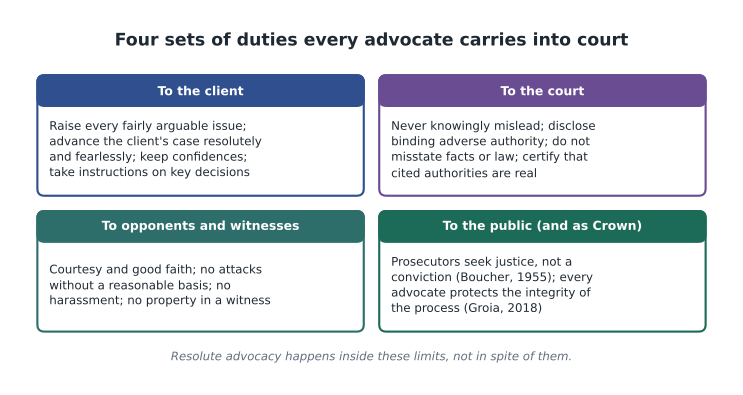
That claim works only if advocates follow rules. An advocate who hides evidence, misstates the law, coaches witnesses or attacks people without basis does not make the system more accurate; she corrupts it. The Law Society of Ontario's Rules of Professional Conduct capture this balance in rule 5.1-1: when acting as an advocate, a lawyer must represent the client resolutely and honourably within the limits of the law, while treating the tribunal with candour, fairness, courtesy and respect. The commentary describes the lawyer's role as raising fearlessly every issue, advancing every argument and asking every question, however distasteful, that the lawyer thinks will help the client's case, but always by fair and honourable means.
Inverarity calls this 'the two halves of the job.' The first half is commitment: the client is entitled to an advocate who cares about winning. The second half is restraint: the advocate is also an officer of the court, and some things cannot be done to win.
Duties to the client
The client is entitled to competent, committed representation. In trial work that means preparation: knowing the facts better than anyone in the room, knowing the law, anticipating the other side, and planning each witness. It also means taking the client's instructions on decisions that belong to the client. In a criminal case, the accused decides how to plead, whether to testify and whether to elect a jury where an election is available. Counsel decides tactical matters such as which witnesses to call and what questions to ask, after consulting the client where appropriate.
Defence counsel in a criminal case may test the Crown's case even when the client has admitted guilt to counsel. The commentary to rule 5.1-1 explains that a lawyer defending an accused is entitled to rely on the presumption of innocence and to hold the Crown to its burden. What counsel may not do, after such an admission, is assert something counsel knows to be false: counsel may not suggest that someone else committed the offence or call evidence that counsel believes to be false, and may not set up an affirmative case inconsistent with the admission, such as an alibi the client has said is untrue.
Confidentiality and privilege also shape trial work. Counsel cannot reveal what the client said in confidence, and many trial decisions, such as whether to call the client as a witness, depend on what counsel knows from privileged conversations. Lessons 3 and 7 return to the difficult situations this creates.
Duties to the court
Candour to the court is the line an advocate may never cross. Rule 5.1-2 of the Ontario rules lists conduct that is prohibited when acting as an advocate. Among other things, a lawyer must not knowingly attempt to deceive a tribunal by offering false evidence, misstating facts or law, or relying on false or misleading information; must not knowingly misstate the contents of a document, the testimony of a witness, the substance of an argument or the provisions of a statute; and must not knowingly permit a witness or party to be presented in a false or misleading way.
The duty of candour includes the law. If there is binding authority directly on point that the other side has not cited, the advocate must draw it to the court's attention, even if it hurts the client. The advocate is free to argue that the authority is distinguishable or wrongly decided, but not to hide it.
A recent development illustrates how seriously courts take accuracy. Since December 1, 2024, Ontario's Rules of Civil Procedure require a factum to include a statement by the lawyer certifying that the authorities cited are authentic (rule 4.06.1(2.1), added by Ontario Regulation 384/24). The amendment responded to cases in which lawyers filed material containing non-existent cases produced by generative AI tools. In Ko v. Li, 2025 ONSC 2766, the Superior Court of Justice began a contempt proceeding against a lawyer whose factum cited cases that did not exist or did not say what was claimed; the lawyer accepted responsibility and the court found she had purged her contempt. The lesson is simple, and Inverarity writes it on the board: 'If you didn't read it, you can't cite it.' Professor Saltire used the same words in first-year legal research, and they apply with full force at trial.
Duties to opposing parties, counsel and witnesses
The adversary system is not a licence for incivility. The rules require courtesy and good faith toward opposing counsel, and they prohibit conduct such as making allegations against another person without a reasonable basis, harassing a witness, or asking questions that are only intended to insult or humiliate.
The leading case on incivility is Groia v. Law Society of Upper Canada, 2018 SCC 27. Joseph Groia defended a mining executive in a long securities prosecution and repeatedly accused the prosecutors of misconduct in strong and sarcastic terms. The Law Society found him guilty of professional misconduct. The Supreme Court of Canada held that the Law Society's finding was unreasonable. The majority set out a context-specific approach: a law society assessing courtroom incivility should consider what was said, the manner and frequency of the conduct, the presiding judge's reaction, and whether allegations of impropriety were made in good faith and with a reasonable basis. Allegations of prosecutorial misconduct that are made in good faith and have a reasonable basis are not professional misconduct merely because they turn out to be wrong, though making them in a rude or insulting way can be. Groia's mistaken legal views about the prosecutors' disclosure obligations were sincerely held and supported his good faith.
Groia does not invite rudeness. It tells advocates that they may say hard things about the other side's conduct when they have a basis, but that the manner of saying them matters. Inverarity's version: 'You can tell the judge the other side hid documents if you can prove it. You cannot roll your eyes while you do it.'
Witnesses are owed honesty and fairness too. There is no property in a witness: either side may interview any witness who is willing to talk, though counsel must not discourage a witness from speaking to the other side or suggest that the witness should not cooperate. Rule 5.3-1 of the Ontario rules permits a lawyer to seek information from any potential witness, provided the lawyer discloses the lawyer's interest and does not encourage the witness to suppress evidence or to refuse to give information to others. Lesson 3 develops these rules.
The Crown's special duty
Crown prosecutors are advocates, but of a special kind. In Boucher v. The Queen, [1955] S.C.R. 16, the Supreme Court of Canada quashed a murder conviction because the prosecutor's address to the jury included his personal opinion of the accused's guilt and inflammatory comments. Justice Rand's description of the Crown's role has been quoted ever since: the purpose of a criminal prosecution is not to obtain a conviction but to lay before a jury what the Crown considers credible evidence relevant to what is alleged to be a crime; the role of prosecutor excludes any notion of winning or losing.
Rule 5.1-3 of the Ontario rules puts the same idea in professional terms: when acting as a prosecutor, a lawyer must act for the public and the administration of justice resolutely and honourably within the limits of the law. The Crown must make timely and full disclosure under R. v. Stinchcombe, [1991] 3 S.C.R. 326, must not present evidence it believes to be false, and must present its case fairly. That does not make the Crown timid. A Crown can cross-examine vigorously and argue forcefully. What it cannot do is treat a conviction as a victory to be won at any cost.
Defence counsel, by contrast, owes no duty to help the Crown prove its case. The asymmetry is deliberate. The state has enormous resources and the power to imprison; the accused has the presumption of innocence and the right to make full answer and defence.
Self-represented litigants and the court's duty of fairness
Many trials now involve at least one party without a lawyer, especially in family and civil matters. In Pintea v. Johns, 2017 SCC 23, the Supreme Court endorsed the Canadian Judicial Council's Statement of Principles on Self-represented Litigants and Accused Persons, which calls on judges to ensure that self-represented parties understand the process and are not disadvantaged by their lack of representation. For the advocate on the other side, the duties of candour and courtesy are heightened in practice: the rules require a lawyer dealing with an unrepresented person to make clear that the lawyer does not act for that person, and judges watch closely to see that counsel does not take unfair advantage.
The structure of a trial
Inverarity spends the second half of the class on the shape of a trial, because every advocacy skill belongs to a particular stage. Criminal trials follow a structure fixed largely by the Criminal Code and the common law. Civil trials in Ontario follow the Rules of Civil Procedure and the Courts of Justice Act. The shape is similar.
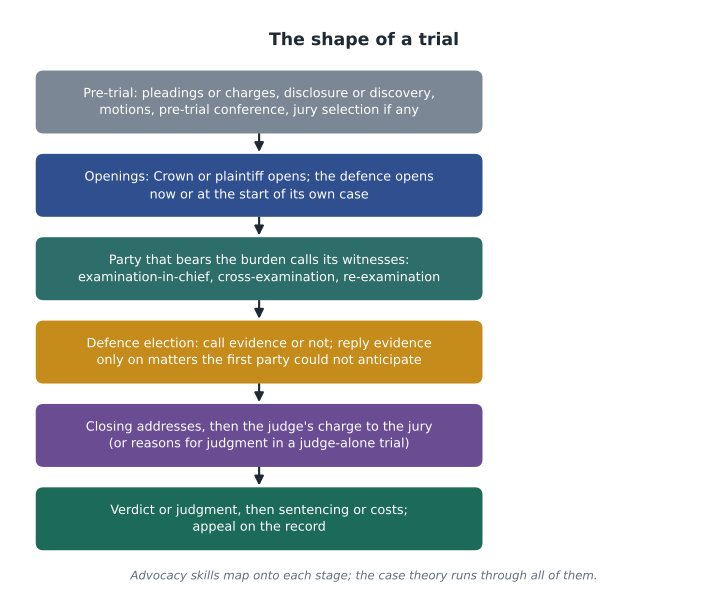
Before trial, the parties define the issues: in a civil action through pleadings, discovery and motions; in a criminal case through the information or indictment, Crown disclosure, and pre-trial applications such as Charter motions and voir dires on the admissibility of statements. A pre-trial conference narrows the issues and estimates the length of trial. If there is a jury, it is selected at the start of trial.
The party with the burden of proof goes first: the Crown in a criminal case, the plaintiff in a civil action. That party opens, then calls its witnesses. Each witness is examined in chief by the party who called them, cross-examined by the other side, and may then be re-examined on matters that arose in cross-examination. When the first party closes its case, the defence decides whether to call evidence. In a criminal case the accused may call no evidence at all and argue that the Crown has not proved its case beyond a reasonable doubt; in a civil case a defendant may also elect to call no evidence, though that choice has consequences discussed in later lessons. Reply evidence is limited to matters the first party could not reasonably have anticipated.
After the evidence, counsel make closing addresses. In a jury trial the judge then charges the jury on the law, and the jury deliberates. In a judge-alone trial the judge gives reasons for judgment, sometimes immediately, more often after reserving. A criminal conviction leads to sentencing; a civil judgment leads to costs submissions. Appeals are decided on the record made at trial, which is why lesson 11 insists that trial counsel think about appeal issues as the trial unfolds.
Hannah Kowalczyk asks whether all this structure leaves room for creativity. Inverarity says it leaves room for nothing else. 'The structure is fixed. What you build inside it is yours. Two good lawyers given the same file will try two different cases.'
Civil and criminal trials compared
| Feature | Criminal trial | Civil trial (Ontario) |
|---|---|---|
| Who must prove the case | The Crown, beyond a reasonable doubt | The plaintiff, on a balance of probabilities |
| Disclosure | Crown disclosure under Stinchcombe; limited defence disclosure (for example, alibi and expert notice) | Mutual: affidavits of documents, oral discovery, expert reports under Rule 53.03 |
| Jury | Accused may elect a jury for most indictable offences; twelve jurors; unanimous verdict | Either party may serve a jury notice in many actions; six jurors; five of six may decide; no jury under simplified procedure (Rule 76) |
| Accused or defendant as witness | Accused cannot be compelled; no adverse inference from silence at trial | Defendant can be compelled; failing to testify may support an adverse inference |
| Professional duties | Crown: seek justice (Boucher); defence: full answer and defence | Both sides: candour, fairness and the obligations in the Rules of Professional Conduct |
The table is a map, not a list to memorize. Each row will matter: the burden of proof shapes the case theory (lesson 2); the jury shapes openings and closings (lessons 4 and 10); the accused's right to remain silent shapes defence strategy and the limits on Crown argument (lesson 10).
Civil procedure in Ontario is changing. The Civil Rules Review released a final policy report in late 2025 proposing a new framework that would front-load written evidence and change how trials are run. As of November 2026 those proposals are not in force; the government has announced a staged approach that begins with targeted amendments. This course teaches the rules as they stand, and flags where reform may change trial practice.
Inverarity's first assignment
Before the next class, each student must read the two files in the box and write a one-page note answering three questions for one side of one case: What must we prove or disprove? What is our best evidence? What is the worst fact we face? Daniel Whitecloud takes the defence in Calder; Sophie Tremblay-Hart takes the plaintiff in Ingram. Marchetti, inevitably, asks for the Crown. 'Good,' says Inverarity. 'You'll have to persuade me you deserve to win without wanting to win too much.'
Worked problem
Spotting the ethical line
In the Ingram file, Rosa Ingram tells her lawyer at Pardee & Lowe LLP, during trial preparation, that she was looking at her phone when she fell. At discovery she said she 'wasn't really looking at the ground.' Before trial she asks whether she can testify that she was watching where she was going. What should her lawyer do?
Show solution
- Identify the duty engaged: the lawyer must not knowingly permit a witness or party to be presented in a false or misleading way, and must not offer evidence the lawyer knows to be false (rule 5.1-2).
- Explain the problem to the client: testifying that she was watching where she was going would be false, and the lawyer cannot lead that evidence or let it stand.
- Identify what is permitted: the lawyer can prepare her to tell the truth clearly, including that she glanced at her phone, and can build a case theory that the ice was there whether or not she was looking down (an occupier must keep premises reasonably safe for visitors who are not perfectly careful).
- Address contributory negligence honestly: her inattention may reduce damages under the Negligence Act, but a truthful account protects her credibility, which matters far more than one fact.
- If the client insists on giving false evidence, the lawyer must refuse to lead it and may have to withdraw, while protecting the client's confidences.
Common mistakes
MistakeBelieving that zealous advocacy means doing whatever the client wants.
InsteadThe client controls key decisions, but the advocate must act within the law and the Rules of Professional Conduct; candour to the court is never negotiable.
MistakeAssuming defence counsel cannot defend a client who has admitted guilt.
InsteadCounsel may test the Crown's case and hold it to its burden, but may not assert facts known to be false or present an inconsistent affirmative defence.
MistakeTreating the Crown as an ordinary adversary trying to win.
InsteadThe Crown acts for the public; its role excludes any notion of winning or losing (Boucher), and it owes full disclosure (Stinchcombe).
MistakeReading Groia as permission to be rude in court.
InsteadGroia protects good-faith allegations with a reasonable basis; the manner, frequency and context of incivility still matter.
MistakeCiting a case from a summary or an AI tool without reading it.
InsteadOntario factums must certify that authorities are authentic, and courts sanction fictitious citations (Ko v. Li).
Practice problems
Work each problem on paper first, then reveal the answer to check.
State the balance that rule 5.1-1 strikes for advocates.
Show answer
A lawyer must represent the client resolutely and honourably within the limits of the law, while treating the tribunal with candour, fairness, courtesy and respect.
What did Boucher v. The Queen decide about the Crown's role?
Show answer
That the Crown's purpose is to lay credible, relevant evidence before the jury, not to obtain a conviction; the role excludes any notion of winning or losing. A conviction was quashed because of the prosecutor's personal opinion and inflammatory address.
List the factors Groia identified for assessing courtroom incivility.
Show answer
What the lawyer said, the manner and frequency of the conduct, the presiding judge's reaction, and whether allegations of impropriety were made in good faith with a reasonable basis.
What does Ontario rule 4.06.1(2.1) require?
Show answer
That a factum include the lawyer's certification that the authorities cited are authentic; it was added by Ontario Regulation 384/24, in force December 1, 2024.
In what order do the parties present evidence at trial?
Show answer
The party with the burden (Crown or plaintiff) opens and calls its witnesses, each examined in chief, cross-examined and re-examined; the defence then elects whether to call evidence; reply is limited to matters that could not be anticipated; closings follow.
Summary and key terms
- Canadian trials are adversarial: the parties present the evidence and the judge or jury decides on it, which works only if advocates follow rules.
- Rule 5.1-1 requires resolute and honourable advocacy within the limits of the law, with candour, fairness, courtesy and respect toward the tribunal.
- Advocates must never knowingly mislead the court about facts or law, must disclose binding adverse authority, and in Ontario must certify that the authorities in a factum are authentic.
- Groia (2018) adopts a context-specific approach to incivility; good-faith allegations with a reasonable basis are protected, but manner still matters.
- The Crown acts for the public and seeks justice, not convictions (Boucher), and owes full disclosure (Stinchcombe); defence counsel owes no duty to help prove the Crown's case.
- Every trial follows the same broad shape: pre-trial, openings, the first party's evidence, the defence election, closings, the charge or reasons, and judgment.
- Adversarial system
- A system in which the parties choose the issues and present the evidence, and an impartial judge or jury decides.
- Officer of the court
- The status of a lawyer as owing duties to the court and the administration of justice, not only to the client.
- Duty of candour
- The obligation never to mislead the court about facts or law, including disclosing binding adverse authority.
- Full answer and defence
- The accused's constitutional right to respond fully to the Crown's case, protected by sections 7 and 11(d) of the Charter.
- Reply evidence
- Evidence called by the party with the burden after the defence case, limited to matters it could not reasonably have anticipated.
- Pre-trial conference
- A meeting with a judge before trial to narrow the issues, explore settlement or resolution, and plan the trial.
Lesson quiz · 5 questions
Score 60% or more to complete this lesson.
Create a free account to save your progress, take quizzes and earn a certificate.