
LAWC-311 · Lesson 3 of 12 · 25 min
Preparing witnesses
▶ Video coming soon A video version of this lesson is on the way.
In the third week, Inverarity arrives with a stopwatch and a volunteer from the Brannock theatre department, an actor who has agreed to play Brendan Hollis, the bouncer in Calder. Marchetti, for the Crown, is given ten minutes to prepare him for his evidence. He spends eight of them telling Hollis what the defence will try to do to him and two asking what Hollis actually saw. Inverarity stops the clock. 'You've prepared him to fight. You haven't prepared him to tell the truth clearly. Those are different things, and only one of them is allowed.'
Witnesses win and lose trials. Most witnesses have never testified, are frightened of the courtroom, and do not know what is expected of them. Preparing them is not only permitted; it is part of competent representation. But preparation has limits. A lawyer who suggests what a witness should say, or rehearses answers until the witness's memory is replaced by the lawyer's script, corrupts the evidence and breaches professional rules. This lesson explains how to prepare a witness properly, the rules about interviewing and communicating with witnesses, and the special measures available for vulnerable witnesses.
Why preparation is permitted and expected
A witness who has never seen a courtroom, does not know what cross-examination is, and has not reviewed their own prior statement is likely to give evidence that is confused and incomplete, not because they are dishonest, but because they are unprepared. Courts recognize that counsel may meet witnesses before trial, review their anticipated evidence, refresh their memory with their own prior statements and documents, and explain what will happen in court.
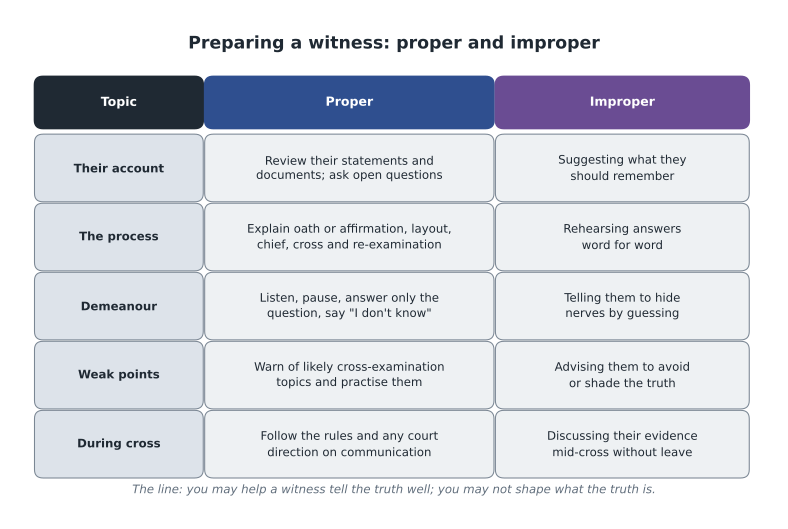
The test is not whether the lawyer talked to the witness, but whether the lawyer influenced the substance of the evidence. Inverarity's formula is the one on the slide: you may help a witness tell the truth well; you may not shape what the truth is.
Interviewing witnesses
There is no property in a witness. Either side may interview any person with relevant information, including a person the other side intends to call, provided the person is willing to talk. Rule 5.3-1 of the Law Society of Ontario's Rules of Professional Conduct permits a lawyer to seek information from any potential witness, whether under subpoena or not, but the lawyer must disclose the lawyer's interest and must take care not to subvert or suppress any evidence or procure the witness to stay out of the way. A lawyer may not tell a witness not to speak to the other side, though a lawyer may tell the witness that the choice is theirs.
Represented parties are different. A lawyer must not communicate about the matter with a person the lawyer knows is represented by another lawyer, except through or with the consent of that lawyer (rule 7.2-6). This matters especially in civil litigation, where the opposing party and, in some situations, its current employees are represented by counsel. In criminal cases, defence counsel may interview Crown witnesses, including the complainant, but must do so carefully and should usually ensure that the interview is witnessed or recorded, to protect against later allegations of influence.
Daniel Whitecloud asks whether defence counsel in Calder may interview Leah Pruitt, who gave the police a recorded statement implicating Calder. The answer is yes, if she is willing. But counsel must identify themselves and their role, must not pressure her, and must be prepared for the possibility that anything she says will be the subject of cross-examination if she later testifies differently. Many defence counsel bring a colleague or an investigator to such interviews.
The stages of witness preparation
Inverarity divides witness preparation into five stages, which he calls 'learn, explain, review, practise, reassure.'
Learn. Begin with open questions, before showing the witness any documents. 'Tell me what you saw that night.' Let the witness give an uninterrupted account. Only then ask follow-up questions, and keep them open: 'What happened next?' 'Where were you standing?' The goal is to learn what the witness actually remembers, unshaped by counsel's theory. Take notes, but remember that notes of witness interviews may be disclosable in some circumstances, particularly for the Crown, which must disclose any new information obtained from witnesses during trial preparation.
Explain. Describe the process. Most witnesses fear the unknown more than the questions. Explain the oath or affirmation; the layout of the courtroom; who will ask questions and in what order; that the witness should speak to the judge or jury, not to counsel; that they may ask for a question to be repeated or explained; and that they should never guess. Explain what an objection is and that the witness should stop talking when one is made.
Review. Show the witness their own prior statements, notes and relevant documents. A witness is entitled to review their own police statement or discovery transcript before testifying, and it is good practice to do so; a witness who has forgotten what they said earlier is easily impeached. In Calder, Hollis gave a written statement to police the night of the incident. Reviewing it with him before trial ensures he will not be surprised when the defence confronts him with it.
Practise. Run through the anticipated examination-in-chief with open questions, and conduct a mock cross-examination on the likely topics. The purpose is to let the witness experience the pressure of cross-examination, not to script answers. If the witness's answers in practice differ from their earlier statements, explore why; do not tell them which version to give.
Reassure. End by reminding the witness that their only job is to tell the truth as they remember it. 'If you don't know, say so. If you don't remember, say so. If you're asked something you can't answer, that's fine.'
The line between preparation and coaching
The line is easier to describe than to apply. Proper preparation includes telling a witness that a question may be asked, practising answers to difficult questions, and pointing out that the witness's account is inconsistent with a document so the witness can consider it. Improper coaching includes suggesting what the witness should say, telling a witness that other witnesses have said something different and implying they should conform, rehearsing answers until they are memorized, and encouraging the witness to be vague about facts that hurt the client.
| Situation | Proper | Improper |
|---|---|---|
| The witness is unsure of a time | Show their notes or the 911 log and ask if it refreshes their memory | Tell them the time to give |
| The witness uses a damaging word | Ask what they meant by it and whether it is accurate | Tell them to use a softer word |
| Another witness gives a different account | Ask the witness to describe what they saw, without revealing the other account | Tell them what the other witness said and suggest they reconsider |
| The witness is nervous | Explain the process and practise with a mock cross-examination | Tell them to answer confidently even if unsure |
| A fact hurts the case | Warn that they will be asked about it and should answer truthfully | Suggest they say they don't remember |
Kowalczyk raises a hard case. In Ingram, the security guard's incident report says 'no salt visible near entrance.' At a preparation meeting, the guard says he isn't sure he looked carefully; he might have written that because he didn't see anyone salting. May the defence lawyer suggest that he testify only that he 'did not notice' salt? Inverarity says no. Counsel may ask the guard what he actually observed, may explore the basis for the note, and may elicit his uncertainty if it is genuine. Counsel may not offer a formula designed to soften the evidence. If the guard genuinely does not know whether there was salt, he should say exactly that, in his own words.
Communicating with a witness during testimony
Once a witness begins testifying, the rules tighten. Rule 5.4-2 of the Ontario rules and its commentary set out guidance on communicating with witnesses giving evidence, subject to any direction of the tribunal. In broad terms, a lawyer may discuss with their own witness matters not yet covered during examination-in-chief, but once cross-examination by the other side has begun, the lawyer should not discuss the witness's evidence with them until the cross-examination is completed, except with leave or the consent of opposing counsel. The commentary sets out further guidance for other stages, such as re-examination.
The purpose is to prevent a witness from being coached to repair damage done in cross-examination. In practice, if a trial breaks for the day in the middle of cross-examination, counsel should tell the witness not to discuss their evidence with anyone, including counsel, until cross-examination is finished, and should seek a direction from the judge if there is a legitimate need to communicate.
Judges also routinely make orders excluding witnesses from the courtroom until they testify, so that witnesses do not hear and tailor their evidence to each other's. An exclusion order is generally made on request. A party's lawyer must explain the order to the witnesses and tell them not to discuss their evidence with other witnesses. Violating an exclusion order does not automatically make the evidence inadmissible, but it can seriously affect the weight the trier of fact gives it.
The oath, affirmation and competence
Every witness must testify under oath or solemn affirmation. Under the Canada Evidence Act, a witness may affirm instead of swearing an oath (s. 14), and the Ontario Evidence Act has a similar provision for civil proceedings. A witness should be asked in advance which they prefer, and counsel should make sure the courtroom staff know. Children and persons whose mental capacity is challenged are governed by section 16 and section 16.1 of the Canada Evidence Act: a child under fourteen is presumed to have the capacity to testify and testifies on a promise to tell the truth, without being asked questions about the nature of the promise. Preparation for child witnesses must be particularly careful, given the risk of suggestive questioning.
Witnesses who need an interpreter are entitled to one. Section 14 of the Charter guarantees an accused or witness who does not understand the language of proceedings the assistance of an interpreter, and R. v. Tran, [1994] 2 S.C.R. 951, held that interpretation must be continuous, precise, competent, impartial and contemporaneous. Arranging interpretation is part of preparing a witness, and counsel should test whether the witness is comfortable with the interpreter's dialect and terminology.
Vulnerable witnesses and testimonial aids
The Criminal Code provides a set of testimonial aids for vulnerable witnesses. A judge may permit a support person to be present and close to a witness (s. 486.1), allow a witness to testify outside the courtroom by closed-circuit television or behind a screen so they need not see the accused (s. 486.2), and order that a self-represented accused not personally cross-examine a witness, appointing counsel to do it instead (s. 486.3). For witnesses under eighteen and witnesses with a disability that affects their ability to communicate, some of these aids must be ordered on application unless they would interfere with the proper administration of justice; for other witnesses, the judge has discretion based on factors such as the nature of the offence, the relationship between the witness and the accused, and whether the aid is needed to obtain a full and candid account.
Section 715.1 permits a video-recorded statement of a witness who was under eighteen at the time of the offence, made within a reasonable time after the alleged offence and describing the acts complained of, to be admitted if the witness, while testifying, adopts its contents. Preparing such a witness includes having them review the recording before trial.
Testimony by video link is increasingly common. Section 714.1 of the Criminal Code allows a witness in Canada to testify by audio-visual link if the court considers it appropriate, having regard to factors including the location and circumstances of the witness, the costs of attendance, and the nature of the evidence. In civil proceedings in Ontario, Rule 1.08 allows hearings and steps to be conducted by video. Preparing a remote witness includes testing the technology, ensuring the witness has no notes or other people in the room unless permitted, and explaining how exhibits will be shown.
Preparing your own client
The client is a special witness. In a criminal trial, the accused decides whether to testify, after advice from counsel. If the accused testifies, he is cross-examined like any witness and may be asked about his criminal record under section 12 of the Canada Evidence Act, subject to the judge's discretion to limit it under R. v. Corbett, [1988] 1 S.C.R. 670. Calder has an assault conviction from eight years ago. Preparation for his testimony must address how he will answer questions about it, honestly and without minimization, and must also explore whether a Corbett application might exclude it.
Civil parties are compellable and may be called by the other side. In Ingram, Rosa Ingram will be cross-examined on her discovery evidence that she 'wasn't really looking at the ground.' Her lawyers must review her discovery transcript with her and prepare her to explain that answer truthfully, not to retreat from it.
The ethical limits on preparing a client are the same as for any witness, and the stakes are higher. Counsel may not present evidence counsel knows to be false. If a client insists on testifying to something counsel knows is untrue, counsel must refuse to lead it and may have to withdraw.
What Marchetti does differently
After the class, Marchetti tries again with the actor playing Hollis. He starts with a blank page: 'Tell me about that night.' He listens for five minutes without interrupting. Then he asks about the lighting outside the bar, where Hollis was standing, and what he was doing just before he saw the shove. Only then does he show Hollis his police statement. Hollis notices something on his own: in his statement he said he was 'checking IDs' when the argument started, which means he may have looked up only when he heard shouting. Marchetti does not tell him what to make of it. He says: 'The defence will ask you about that. Just tell them what you remember.'
Inverarity nods. 'That's preparation. He knows what's coming, and he'll answer honestly. The jury will believe him more because of it.'
Worked problem
Preparing Leah Pruitt as a Crown witness in Calder
Leah Pruitt gave a recorded police statement saying Dorey 'didn't do anything, Owen just shoved him.' At a preparation meeting with the Crown, she says she has been thinking about it and is no longer sure; she was in her car with her son and may have only seen the end. How should the Crown proceed?
Show solution
- Listen first: ask her, in open terms, to describe what she remembers now and why she is less sure.
- Do not pressure her to return to her original account or suggest what she should say.
- Review her statement with her, as she is entitled to do, and ask whether it refreshes her memory.
- Disclose: the change in her account is new information that must be disclosed promptly to the defence under Stinchcombe.
- Plan for trial: if she departs from her statement on the stand, the Crown may apply under section 9 of the Canada Evidence Act to cross-examine her on it, and may seek to admit the recorded statement for its truth under K.G.B. (lessons 5 and 8).
- Reassure her that her only job is to tell the truth as she now remembers it.
Common mistakes
MistakeShowing a witness the documents before hearing their account.
InsteadLearn first with open questions; review documents afterwards so their memory is not shaped by counsel's materials.
MistakeTelling a witness what another witness said so they can 'get on the same page.'
InsteadThat invites tailoring; ask each witness what they saw, independently.
MistakeTelling a witness not to speak to the other side.
InsteadThere is no property in a witness; the choice is theirs (rule 5.3-1).
MistakeDiscussing the witness's evidence with them during an overnight break in cross-examination.
InsteadOnce cross-examination has begun, counsel should not discuss the evidence without leave or consent (rule 5.4-2 and commentary).
MistakeAssuming the Crown can keep a witness's changed account to itself until trial.
InsteadNew information from witness preparation must be disclosed to the defence (Stinchcombe).
Practice problems
Work each problem on paper first, then reveal the answer to check.
What does 'there is no property in a witness' mean?
Show answer
Neither side owns a witness; either may interview a willing witness, and a lawyer must not discourage a witness from speaking to the other side.
List Inverarity's five stages of witness preparation.
Show answer
Learn (open questions first), explain (the process), review (prior statements and documents), practise (chief and mock cross), reassure (the job is to tell the truth).
When does the restriction on communicating with a witness about their evidence become strictest?
Show answer
Once cross-examination by the opposing party has begun; the witness's own counsel should not discuss the evidence until it is finished, except with leave or consent.
Name three testimonial aids available under the Criminal Code.
Show answer
A support person (s. 486.1), testimony outside the courtroom or behind a screen (s. 486.2), and appointment of counsel so a self-represented accused does not personally cross-examine the witness (s. 486.3).
What did R. v. Tran require of interpretation?
Show answer
That it be continuous, precise, competent, impartial and contemporaneous.
Summary and key terms
- Preparing witnesses is part of competent advocacy; coaching them is prohibited. The test is whether counsel influenced the substance of the evidence.
- There is no property in a witness; a lawyer may interview any willing witness but must disclose their interest and not suppress evidence (rule 5.3-1).
- Prepare in stages: learn the witness's account with open questions, explain the process, review prior statements, practise, and reassure.
- Once cross-examination has begun, counsel should not discuss the witness's evidence without leave or consent; exclusion orders keep witnesses from hearing each other.
- Witnesses testify under oath or affirmation; children under fourteen testify on a promise to tell the truth (CEA s. 16.1); interpreters must meet the Tran standard.
- The Criminal Code provides testimonial aids for vulnerable witnesses (ss. 486.1 to 486.3), video statements for young witnesses (s. 715.1) and video-link testimony (s. 714.1).
- Witness preparation
- Meeting a witness before testimony to learn their evidence, explain the process and review their prior statements.
- Coaching
- Improperly influencing the substance of a witness's evidence, for example by suggesting answers or encouraging tailoring.
- Exclusion order
- An order that witnesses remain outside the courtroom until they testify, so they do not hear one another.
- Solemn affirmation
- A non-religious promise to tell the truth, with the same legal effect as an oath.
- Testimonial aid
- A measure such as a screen, closed-circuit television or support person that helps a witness give evidence.
- Corbett application
- An application to limit cross-examination of an accused on their criminal record under section 12 of the Canada Evidence Act.
Lesson quiz · 5 questions
Score 60% or more to complete this lesson.
Create a free account to save your progress, take quizzes and earn a certificate.