
LAWC-311 · Lesson 2 of 12 · 24 min
Case theory
▶ Video coming soon A video version of this lesson is on the way.
Inverarity opens the second class by reading aloud from Whitecloud's one-page note on the Calder defence. It is careful and thorough, listing eleven weaknesses in the Crown's evidence. 'Excellent,' Inverarity says. 'Now tell me in one sentence why Owen Calder should be acquitted.' Whitecloud starts, stops, and starts again. 'That,' says Inverarity, 'is the problem this class is about.'
A list of weaknesses is not a defence. A pile of evidence is not a case. What turns facts and law into persuasion is a case theory: a coherent account of what happened and why, under the law, that account requires the result you seek. Every decision at trial, from which witnesses to call to which questions to ask in cross-examination to what to say in closing, should be tested against it. This lesson explains how to build a case theory, how to test it, and how to choose a theme.
Three parts of a case theory
Trial advocacy teachers describe the case theory in slightly different ways, but most agree on three parts. The legal theory identifies the cause of action, offence or defence and its elements. The factual theory is the story of what happened that, if the trier of fact accepts it, satisfies every element you must prove or defeats at least one element the other side must prove. The theme is a short, memorable expression of why the result you seek is right.
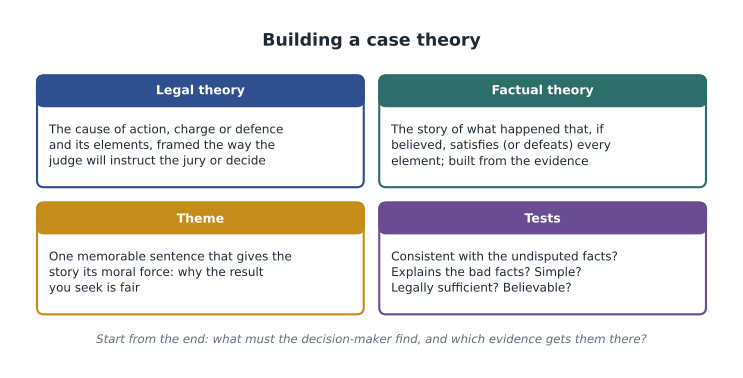
The legal theory comes first because it tells you what matters. In Calder, the Crown must prove manslaughter: an unlawful act that caused death, where a reasonable person would have foreseen a risk of bodily harm that is neither trivial nor transitory (R. v. Creighton, [1993] 3 S.C.R. 3). The unlawful act alleged is an assault, the shove outside the bar on Ridley Street. In Ingram, the plaintiff must prove that Corwin Plaza Holdings, as occupier, failed to take such care as in all the circumstances was reasonable to see that she was reasonably safe while on the premises (Occupiers' Liability Act, s. 3(1)), and that the failure caused her injury.
Start from the end. In a jury trial, the best guide to the legal theory is the charge the judge will give. Criminal practitioners use the Canadian Judicial Council's model jury instructions and widely used specimen instructions to see exactly how the judge will describe each element and defence. Inverarity tells the class to draft the relevant parts of the charge before they plan a single question. 'If you know what the judge will tell the jury to decide,' he says, 'you know what your evidence must do.' In a judge-alone trial, the same discipline applies: identify precisely what the judge must find, and in what order.
The factual theory
The factual theory is a story, but not an invented one. It must be built from evidence that will actually be admitted, and it must account for the facts that cannot be disputed. A good factual theory has a few characteristics. It is consistent with the undisputed facts and the physical evidence. It explains, rather than ignores, the facts that hurt you. It is simple enough to be told in a minute. It is legally sufficient, meaning that if it is accepted, you win. And it is believable: it fits how people actually behave.
Mehta, the former engineer, proposes a method. 'List every fact in the file,' he says, 'and sort them into three columns: good for us, bad for us, and undisputed.' Inverarity approves, adding a fourth column: facts that will probably be in dispute and will turn on credibility. The undisputed facts are the frame every theory must fit. The disputed facts are where the trial will be fought.
In Calder, the undisputed facts include that Calder and Mark Dorey argued outside the bar, that Calder's hands made contact with Dorey's chest, that Dorey fell and struck his head on the curb, and that Dorey died of a subdural hematoma. Dr. Anjali Rao, the forensic pathologist, found that Dorey had an unusually thin skull. Under the thin skull rule, the accused takes the victim as he finds him (R. v. Smithers, [1978] 1 S.C.R. 506), so the defence cannot win by arguing that a normal person would have survived.
What is disputed is what happened in the seconds before the shove. Brendan Hollis, the bouncer, says Dorey was walking away when Calder shoved him. Leah Pruitt told police in a recorded statement that Dorey 'didn't do anything, Owen just shoved him,' but she has since told the Crown she is unsure. Calder told police in a long interview that Dorey came at him and he pushed him off. Tess Halloran, Calder's girlfriend, says Dorey was shouting and moving toward Calder.
Choosing the ground to fight on
A key insight of case theory is that you do not have to contest everything. Indeed, you usually should not. Contesting facts you cannot win on costs credibility. The jury notices when counsel fights over the obvious, and begins to doubt counsel on the issues that matter.
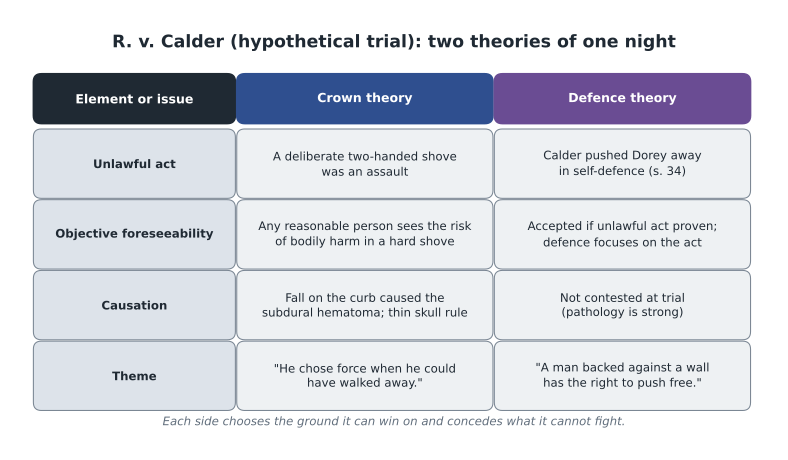
The Calder defence illustrates this. The pathology is strong and the thin skull rule defeats any causation argument based on Dorey's fragility. Objective foreseeability of bodily harm from a hard shove near a curb is difficult to dispute. The defence's best ground is the unlawful act. If Calder acted in lawful self-defence, there was no assault and no manslaughter. Under section 34 of the Criminal Code, as interpreted in R. v. Khill, 2021 SCC 37, the jury must ask whether Calder believed on reasonable grounds that force was being used or threatened against him, whether he acted for the purpose of defending himself, and whether his act was reasonable in the circumstances, considering the factors listed in section 34(2), including the nature of the threat, whether there were other means to respond, the size and capabilities of the parties, and the person's role in the incident. Once there is an air of reality to self-defence, the Crown must disprove it beyond a reasonable doubt.
The Crown, meanwhile, will concede nothing that matters but will not waste time on what is not in dispute. It will build its case on Hollis's vantage point as a sober, trained observer, Pruitt's recorded statement (possibly admitted for its truth under the principled approach to hearsay, as Section B learned in Evidence), and Calder's own statement to police that he pushed Dorey.
Whitecloud's second attempt at a one-sentence theory: 'Owen Calder pushed Mark Dorey away because Dorey was coming at him, and a man who pushes away an angry attacker has not committed a crime, even when the result is tragic.' Inverarity writes it on the board. 'Now we have something to test.'
Testing the theory
The best way to test a case theory is to attack it the way the other side will. Inverarity assigns each student to argue against a classmate's theory. Kowalczyk, playing the Crown, attacks Whitecloud's: 'If Dorey was coming at him, why did Calder tell the officer at the scene that Dorey had been mouthing off? Why didn't he mention an attack until his lawyer arrived? And why does the bouncer say Dorey was walking away?'
Each attack exposes a fact the defence theory must explain. Inverarity lists the questions every theory must answer. Does it account for every undisputed fact? Does it explain the worst facts in a way that is believable? Does it depend on a witness who will not be believed? Does it require the trier of fact to accept something improbable? And, crucially, is it legally sufficient: if the jury accepts it entirely, does the law require the verdict you want?
The defence answers Kowalczyk's attack by refining the theory, not abandoning it. Calder's first words at the scene were said in shock, to a police officer, minutes after his friend's acquaintance lay unconscious on the pavement. Hollis was dealing with another patron at the door and saw the end of the encounter, not its start. The theory survives, but now it includes an explanation for its weak points.
The theme
A theme is the case theory in a few words, chosen so that the trier of fact remembers it and finds it fair. Good themes appeal to shared values: responsibility, fairness, honesty, caution. They are not slogans. A theme repeated in opening, built through the evidence, and returned to in closing gives the case coherence.
Tremblay-Hart offers a theme for Rosa Ingram: 'Corwin Plaza knew the ice would come, and paid someone else to worry about it.' Inverarity likes the first half better than the second. 'Juries don't punish people for hiring contractors. They punish people for not checking that the work got done.' The final version: 'They knew the ice was coming. Nobody checked.'
For the defence in Ingram, Marchetti suggests: 'The plaza did what a careful owner does: hired professionals, who salted at dawn.' It is a theme about reasonable care, which is the legal standard. Inverarity points out that the defence theme also carries a risk. Under section 6(1) of the Occupiers' Liability Act, an occupier is not liable for damage caused by the negligence of an independent contractor if it exercised reasonable care in selecting and supervising the contractor and took the steps it reasonably ought to have taken to satisfy itself that the contractor was competent and that the work had been properly done. The defence theme therefore invites the question: did anyone check the salting?
Case theory and the burden of proof
The burden and standard of proof shape every case theory. In a criminal trial, the defence need not prove anything. A defence theory can be a complete alternative account, or it can be simply that the Crown's evidence leaves a reasonable doubt. The jury instruction in R. v. W.(D.), [1991] 1 S.C.R. 742, tells jurors that if they believe the accused's evidence, or if they do not believe it but are left in reasonable doubt by it, or if on the whole of the evidence they are not convinced beyond a reasonable doubt, they must acquit. A defence theory can live entirely in the second and third branches.
In a civil trial, the plaintiff must prove each element on a balance of probabilities, the single civil standard confirmed in F.H. v. McDougall, 2008 SCC 53. A plaintiff's theory must therefore be affirmatively persuasive. A defendant's theory may contest a single element, such as breach or causation, or offer an affirmative defence such as contributory negligence, which the defendant must prove.
Inverarity warns against a common error: a defence theory that takes on a burden it does not have. If the Calder defence promises in opening to prove that Dorey attacked Calder, and then cannot, the jury may conclude that the defence failed, even though the Crown still bore the burden of disproving self-defence. Better to promise what the evidence will show: that there is good reason to believe Calder was defending himself, and that the Crown cannot prove otherwise beyond a reasonable doubt.
Using the theory to plan the trial
Once the theory is settled, it becomes the test for every decision. Which witnesses must be called? Only those who advance the theory or are needed to satisfy the legal elements. What should each witness be asked? Only what advances the theory. What should be conceded? Whatever is undisputed and does not hurt the theory. Which objections are worth making? Those that keep out evidence that damages the theory.
| Trial stage | How the theory guides it |
|---|---|
| Opening statement | Tells the story of the factual theory and introduces the theme |
| Examination-in-chief | Each witness supplies part of the story; weaknesses are fronted in a way the theory explains |
| Cross-examination | Each chapter extracts a concession that supports the theory or undermines the other side |
| Objections | Made when evidence threatens the theory and the ground is sound |
| Closing argument | Shows how the evidence proves the theory and how the law requires the verdict |
Inverarity ends the class with a warning. A case theory is not a script. It may need to change as the trial unfolds, if a witness says something unexpected or a ruling excludes key evidence. But it should change deliberately, not drift. 'Before every witness, ask: what does this witness add to my theory? After every witness, ask: is my theory still true?'
Worked problem
Building the plaintiff's theory in Ingram
Rosa Ingram slipped on ice in the Corwin Plaza parking lot on Wednesday, February 4, 2026, and broke her wrist. Northline Snow Services, Corwin Plaza's contractor, says it salted at 6:15 a.m., and its GPS logs confirm a visit. A meteorologist will say freezing drizzle began at about 7:30 a.m. Rosa fell at about 9:40 a.m. The plaza's security guard wrote an incident report noting 'no salt visible near entrance.' Rosa said at discovery that she 'wasn't really looking at the ground.' Build the plaintiff's case theory.
Show solution
- Legal theory: the occupier owed a duty under section 3 of the Occupiers' Liability Act to take reasonable care for visitors' safety; hiring a contractor protects the occupier only if it exercised reasonable care in selection and supervision and took reasonable steps to satisfy itself that the work had been properly done (section 6(1)).
- Undisputed facts: a contractor salted at about 6:15 a.m.; drizzle began around 7:30; Rosa fell around 9:40 near the entrance; the guard saw no salt.
- Factual theory: early salting was washed out or covered by the freezing drizzle; for more than two hours the plaza did nothing, although its guard was on site and its contract with Northline required a return visit for new precipitation.
- Explaining the bad fact: Rosa may not have been looking at the ground, but the ice was clear, untreated and in a main walkway; at most, inattention reduces damages under the Negligence Act; it does not excuse the plaza.
- Theme: 'They knew the ice was coming. Nobody checked.'
- Test: if the court accepts this account, every element is satisfied: a duty, a failure of reasonable care in the period after the drizzle, and an injury caused by the untreated ice.
Common mistakes
MistakeTreating a list of the other side's weaknesses as a case theory.
InsteadA theory is a coherent, legally sufficient account of what happened; weaknesses are useful only as part of it.
MistakeContesting every fact, including undisputed ones.
InsteadChoose the ground you can win on and concede what you cannot fight; fighting the obvious costs credibility.
MistakeBuilding the theory before working out the legal elements.
InsteadStart from the end: draft the jury charge or list the findings the judge must make, then build the theory to meet them.
MistakePromising to prove something the defence has no burden to prove.
InsteadIn a criminal case, promise what the evidence will show and remind the trier of fact where the burden lies (W.(D.)).
MistakeChoosing a clever slogan as a theme.
InsteadA theme expresses why the result is fair, appeals to shared values and is supported by the evidence.
Practice problems
Work each problem on paper first, then reveal the answer to check.
What are the three parts of a case theory?
Show answer
A legal theory (the elements of the claim, offence or defence), a factual theory (the story that satisfies or defeats those elements), and a theme (a short statement of why the result is right).
Why should counsel draft the jury charge before planning witness examinations?
Show answer
Because the charge sets out exactly what the jury must decide; knowing it tells counsel what the evidence must prove or disprove.
What does the thin skull rule mean for the Calder defence?
Show answer
Under Smithers, the accused takes the victim as he finds him, so the defence cannot avoid liability by arguing that a normal person would have survived; causation is not a good ground to fight on.
What are the three questions for self-defence under section 34, as interpreted in Khill?
Show answer
Whether the accused believed on reasonable grounds that force was used or threatened (the catalyst), whether he acted to defend himself (the purpose), and whether the act was reasonable in the circumstances (the response), considering the section 34(2) factors.
How does section 6(1) of the Occupiers' Liability Act affect the defence theme in Ingram?
Show answer
An occupier escapes liability for an independent contractor's negligence only if it took reasonable care in selecting and supervising the contractor and reasonable steps to satisfy itself the work was properly done; so the theme of hiring professionals invites the question whether the plaza checked.
Summary and key terms
- A case theory combines a legal theory, a factual theory and a theme into a coherent account that, if accepted, requires the result you seek.
- Start from the end: identify what the judge or jury must find, ideally by drafting the relevant parts of the charge.
- The factual theory must fit the undisputed facts, explain the bad facts, be simple, believable and legally sufficient.
- Choose the ground to fight on; conceding undisputed points preserves credibility for the real issues.
- The burden of proof shapes the theory: the criminal defence need only raise a reasonable doubt (W.(D.)); a civil plaintiff must prove each element on a balance of probabilities (McDougall).
- Test the theory by attacking it, then use it to decide every trial question, from witnesses to objections to closing.
- Case theory
- A coherent account of the facts and law that, if accepted, requires the result a party seeks.
- Legal theory
- The cause of action, offence or defence relied on, and its elements.
- Factual theory
- The story of what happened, built from admissible evidence, that satisfies or defeats the legal elements.
- Theme
- A short, memorable expression of why the party's result is fair, used throughout the trial.
- Thin skull rule
- The principle that a wrongdoer takes the victim as found, including unusual vulnerability to injury.
- Air of reality
- The threshold of evidence that must exist before a defence is left to the trier of fact.
Lesson quiz · 5 questions
Score 60% or more to complete this lesson.
Create a free account to save your progress, take quizzes and earn a certificate.