
LAWC-311 · Lesson 7 of 12 · 24 min
Cross-examination
▶ Video coming soon A video version of this lesson is on the way.
Hannah Kowalczyk has been waiting for this class. She stands to cross-examine Brendan Hollis for the Calder defence, and her first question is: 'Mr. Hollis, why should the jury believe you?' Hollis, played with relish by the theatre student, leans forward. 'Because I was there, I was sober, and I saw him shove a man in the back who was walking away.' Inverarity calls a halt. 'Ms. Kowalczyk, you've just given the Crown's best witness a chance to repeat his evidence, with emphasis, in his own words. What did you want from him?'
Cross-examination is the advocacy skill most associated with trials, and the one most misunderstood. Television teaches that cross-examination is about breaking witnesses. In real courtrooms, it is about obtaining specific, limited pieces of evidence that support your case theory, and about showing, calmly, why parts of the other side's evidence should not be accepted. This lesson explains the purposes of cross-examination, the rules and techniques that make it effective, and the legal and ethical limits on it.
Why cross-examination matters
The right to cross-examine is fundamental to trial fairness. In criminal cases, it is part of the accused's right to make full answer and defence under sections 7 and 11(d) of the Charter. In R. v. Lyttle, 2004 SCC 5, the Supreme Court of Canada described cross-examination as an essential safeguard: it is often the only way to test the truth of a witness's evidence. The right is not unlimited, but it is protected, and trial judges must be cautious about restricting it.
Cross-examination also matters because it is the main tool for putting the defence theory before the jury when the defence calls no evidence. In Calder, if Calder does not testify, the jury will learn the defence version of the night almost entirely through what Kowalczyk can obtain from the Crown's own witnesses.
Two purposes: constructive and destructive
Cross-examination has two broad purposes. Constructive cross-examination obtains facts from the witness that help your case. Destructive cross-examination shows why the witness's evidence, or parts of it, should not be relied on. Most good cross-examinations do both, and constructive points usually come first, while the witness is still cooperative.
In Calder, Hollis is a Crown witness, but he can supply facts that help the defence. He was working the door and checking identification when the argument started. He looked up when he heard shouting. Dorey was shouting. Dorey had been drinking for several hours. Dorey was bigger than Calder. The area outside the bar was crowded. None of these facts contradicts Hollis's evidence; each fits the defence theory that Dorey was the aggressor and that Hollis saw only the end of the encounter.
Destructive cross-examination of Hollis would focus on his opportunity to observe: his vantage point, the lighting, the distance, his distraction, and the speed of events. It might also explore inconsistencies with his written statement, which lesson 8 addresses. What it should not do is call him a liar. Hollis has no apparent motive to lie. The defence theory is not that he is dishonest, but that he is honestly mistaken about what he saw in a few seconds of chaos.
Kowalczyk's first question failed because it had no purpose. It invited Hollis to repeat and reinforce his evidence. Inverarity's rule: before every cross-examination, write down in one sentence what you need from this witness to argue in closing. If you cannot write it, consider not cross-examining at all.
The working rules
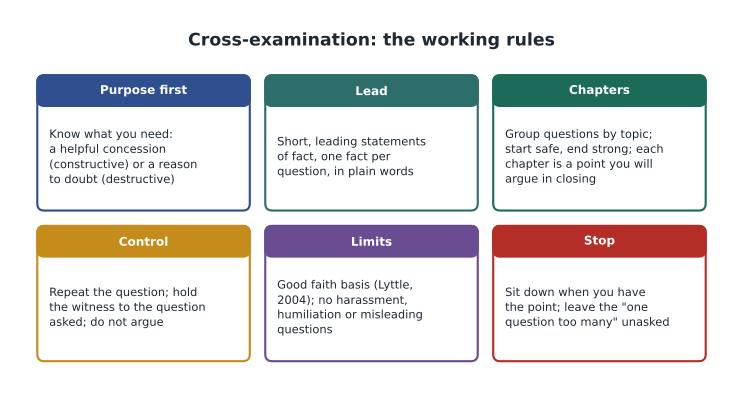
Trial advocacy teachers have developed working rules for cross-examination, often traced to Irving Younger's 'ten commandments' and similar lists. They are guides, not laws, and experienced advocates know when to break them. But students should learn them before breaking them.
Lead. In cross-examination, leading questions are permitted and are usually the best tool. A leading question is a short statement of fact that the witness is invited to agree with: 'You were checking IDs at the door.' 'You were looking at the ID, not at the street.' 'You looked up when you heard shouting.' Each question contains one fact. The witness's role is to say yes. The cross-examiner is, in effect, telling the story, with the witness confirming it.
Use short questions in plain words. Long or complicated questions give the witness room to qualify, explain or disagree. 'Isn't it fair to say that, given the lighting conditions and the number of people present and your duties at the time, you might not have seen everything that happened?' invites a speech. 'The light over the door was behind you.' 'The street was darker than the doorway.' 'There were about twenty people outside.' Each gets a yes.
Know the answer, or not care what it is. Asking a question when you do not know the answer is dangerous, because the answer may hurt. The safest questions are ones the witness has already answered in a statement, at discovery, or at a preliminary inquiry, or that are proved by other evidence. If the witness disagrees, you can prove the answer another way. A question to which any answer helps is also safe.
Do not ask why. 'Why' questions invite explanation, and explanations favour the witness. 'Why didn't you call the police?' lets the witness explain. 'You didn't call the police' is a fact. In closing, counsel can argue what the fact means.
Do not ask the one question too many. Cross-examiners often get the point they need and then ask a final question that lets the witness undo it. The classic example: having established that the witness did not see the accused bite off the victim's nose, the cross-examiner asks 'Then how can you say he bit it off?', and the witness answers 'Because I saw him spit it out.' Get the fact. Save the conclusion for closing.
Organizing in chapters
A cross-examination should be organized into chapters, each dealing with one topic and building to one point. A chapter on Hollis's vantage point might run: 'You were standing in the doorway. The doorway is set back from the street. There's a step down to the sidewalk. The curb is about fifteen feet from the door. Between you and the curb, people were standing on the sidewalk. You were looking at a driver's licence when the shouting started.' The point, which counsel will argue in closing, is that Hollis did not have a clear, continuous view.
Chapters should be ordered with care. Many advocates start with safe, constructive chapters, when the witness is likely to cooperate, and move to more challenging destructive chapters later. They end with a strong chapter, so the last thing the trier of fact hears is a point that helps. Primacy and recency apply here as in examination-in-chief.
Each chapter should be short and self-contained. Transitions can be signalled with headlines, even in cross-examination: 'I want to ask you about where you were standing.' Headlines help the trier of fact understand why the questions matter.
Controlling the witness
Witnesses under cross-examination often try to avoid giving the answer counsel wants. They may give long explanations, answer a different question, or repeat their evidence-in-chief. Control techniques help.
Repeat the question. If the witness does not answer, ask the same question again, in exactly the same words. 'You were looking at the ID when the shouting started.' 'Well, I was keeping an eye on everything.' 'You were looking at the ID when the shouting started.' Most witnesses answer the second or third time, and the trier of fact sees the evasion.
Use the witness's own words. Short questions that use the witness's own words from earlier evidence or statements are hard to deny.
Do not argue. If the witness disagrees, do not debate. Move on, or prove the point another way. Arguing with a witness invites an objection and makes counsel look like a bully.
Ask the judge for help sparingly. If a witness persistently refuses to answer, counsel may ask the judge to direct the witness to answer the question. Judges will usually do so, but counsel should first try the control techniques.
Limits on cross-examination
Cross-examination is wide, but not unlimited.
Good faith basis. In Lyttle, the Supreme Court held that counsel may put a suggestion to a witness in cross-examination without being able to prove it, provided counsel has a good faith basis for the question. A good faith basis can come from counsel's information, belief or reasonable inference, even if the information is not admissible evidence itself. What counsel may not do is put suggestions they know to be false, or that are reckless and without any basis. In Lyttle, the trial judge had wrongly required defence counsel to produce evidence supporting the defence theory before allowing it to be put to Crown witnesses, and a new trial was ordered.
Fairness and dignity. Questions designed only to humiliate, to harass, or to mislead are improper. Rule 5.1-2 of the Law Society of Ontario's Rules of Professional Conduct prohibits harassment of a witness. Trial judges have a duty to control cross-examination that is abusive, repetitive or irrelevant. Cross-examination of an accused by the Crown is subject to particular limits. In R. v. Fanjoy, [1985] 2 S.C.R. 233, a conviction was set aside because the Crown cross-examined the accused in a way that was designed to show that he was the type of person likely to commit the offence, which deprived him of a fair trial. The Crown also may not ask an accused to comment on the credibility of Crown witnesses ('Is the officer lying?'), because it places an unfair burden on the accused.
Statutory limits. In sexual offence cases, sections 276 to 278.97 of the Criminal Code restrict questioning about a complainant's other sexual activity and private records, and require advance applications. Section 486.3 allows the court to appoint counsel so that a self-represented accused does not personally cross-examine certain witnesses. Prior convictions of any witness may be put under section 12 of the Canada Evidence Act; for an accused, the judge may limit this under Corbett.
Collateral facts. Answers on collateral matters, which go only to credibility and not to an issue in the case, are generally final: counsel may ask, but may not call other evidence to contradict the answer. This rule, discussed further in lesson 8, limits how far cross-examination can be followed up.
Cross-examining the accused and parties
When an accused testifies, the Crown may cross-examine on any relevant matter, including matters not raised in chief, and on the accused's criminal record (subject to Corbett). But the Crown's cross-examination must be fair. It must not be sarcastic or demeaning, must not invite the jury to reason that the accused is the sort of person who commits crimes, and must not comment on the accused's exercise of the right to silence before trial.
In civil trials, parties may be cross-examined on their discovery evidence. A party's discovery answers can also be read into evidence by the opposing party as admissions. In Ingram, the defence can read in Rosa's answer that she 'wasn't really looking at the ground,' and can cross-examine her on it if she testifies differently. Because discovery transcripts are under oath, inconsistencies are powerful.
When not to cross-examine
Sometimes the best cross-examination is none. If a witness did no damage, cross-examination risks giving them a chance to do some. If the witness is sympathetic, aggressive cross-examination may turn the jury against counsel. 'No questions, Your Honour' can be a strong statement that the witness did not matter.
But counsel must be careful. If counsel intends to call evidence contradicting the witness or to argue that the witness is mistaken on a significant point, fairness may require putting that contradiction to the witness. This is the rule in Browne v. Dunn, the subject of lesson 8.
Kowalczyk tries again
Kowalczyk's second cross-examination of Hollis has three chapters. First, Dorey's conduct: he had been drinking since about eight; he was loud; he was shouting at Calder; he was bigger than Calder. Second, Hollis's vantage point: in the doorway, checking an ID, looked up at the shouting, a crowd on the sidewalk. Third, the speed of events: from the time he looked up to the time Dorey was on the ground was a few seconds; he was moving toward them during that time; he was watching where he was going on the step. She sits down after eleven minutes. Hollis has agreed to almost everything. 'Now,' says Inverarity, 'you have something to argue.'
| Chapter | Facts sought (all leading) | Closing point |
|---|---|---|
| Dorey's conduct | Drinking for hours; loud; shouting at Calder; bigger than Calder | Dorey was the aggressor, consistent with self-defence |
| Vantage point | In the doorway; looking at an ID; looked up at shouting; crowd on sidewalk | Hollis saw only the end of the encounter |
| Speed of events | A few seconds from looking up to the fall; moving down the step | An honest observer could easily be mistaken about the critical moment |
Worked problem
Cross-examining the Northline driver in Ingram
The defence calls the Northline driver, Reuben Klassen, who says he salted the Corwin Plaza lot at 6:15 a.m. on February 4, 2026, including the walkway by the pharmacy. The plaintiff's meteorologist will say freezing drizzle began at 7:30. Northline's contract required a return visit if new precipitation fell. Plan a cross-examination for the plaintiff.
Show solution
- Purpose: show that whatever was done at 6:15, nothing was done after the drizzle began, and that the contract contemplated a return visit.
- Chapter 1, the route (constructive): 'You had eleven properties on your route that morning. Corwin Plaza was your second stop. You were there about twelve minutes. You used the truck spreader for the lot.'
- Chapter 2, the walkway (destructive): 'The walkway by the pharmacy is too narrow for the truck. Salting it means using a hand spreader. Your log shows the truck's position, not where you walked. You didn't write down that you did the walkway.'
- Chapter 3, the weather: 'Your dispatcher monitors the forecast. Freezing drizzle was forecast for that morning. You finished your route at about 9:00. You did not return to Corwin Plaza that morning.'
- Chapter 4, the contract: 'Your contract with the plaza requires a return visit if new precipitation falls. No one from the plaza called you that morning.'
- Stop there. Do not ask 'So the lot wasn't safe, was it?' Save the conclusion for closing.
Common mistakes
MistakeAsking open questions in cross that let the witness repeat their evidence.
InsteadUse short, leading questions, one fact at a time, that support a planned point.
MistakeCalling every opposing witness a liar.
InsteadMost witnesses are honestly mistaken, not lying; attack opportunity to observe, memory and context unless there is a real basis for dishonesty.
MistakeAsking the final question that states the conclusion.
InsteadGet the facts and stop; argue the conclusion in closing.
MistakePutting a suggestion to a witness with no basis at all.
InsteadLyttle requires a good faith basis, though counsel need not be able to prove the suggestion.
MistakeAsking an accused whether Crown witnesses are lying.
InsteadThat is improper because it shifts an unfair burden to the accused; the Crown must also avoid cross-examination aimed at bad character (Fanjoy).
Practice problems
Work each problem on paper first, then reveal the answer to check.
What are constructive and destructive cross-examination?
Show answer
Constructive cross obtains helpful facts from the witness; destructive cross shows why the witness's evidence should not be relied on.
What did R. v. Lyttle hold about the basis for questions in cross-examination?
Show answer
Counsel may put a suggestion without being able to prove it, provided there is a good faith basis from information, belief or reasonable inference; counsel may not put suggestions known to be false or without any basis.
Why should a cross-examiner avoid 'why' questions?
Show answer
They invite explanation, giving the witness control; facts can be obtained by leading and their significance argued in closing.
What is a chapter in cross-examination?
Show answer
A group of questions on one topic, building to one point that counsel will argue in closing.
What was wrong with the Crown's cross-examination in R. v. Fanjoy?
Show answer
It was designed to show the accused was the type of person likely to commit the offence, which deprived him of a fair trial.
Summary and key terms
- Cross-examination is a protected part of trial fairness (Lyttle); its purpose is to obtain helpful facts and show why evidence should not be relied on, not to break witnesses.
- Write down what you need from each witness before cross-examining; if you need nothing, consider not cross-examining.
- Use short, leading questions with one fact each; know the answer; avoid 'why'; do not ask the one question too many.
- Organize cross into chapters, starting with safe constructive points and ending strong; control the witness by repeating questions, not by arguing.
- Counsel needs a good faith basis for suggestions (Lyttle); harassment, humiliation and bad-character cross of the accused (Fanjoy) are improper; statutes limit some topics.
- Parties may be cross-examined on discovery evidence, which can also be read in as admissions.
- Cross-examination
- Questioning of a witness by a party other than the one who called them.
- Constructive cross-examination
- Cross-examination aimed at obtaining facts that help the cross-examiner's case.
- Destructive cross-examination
- Cross-examination aimed at undermining the reliability or credibility of the witness's evidence.
- Good faith basis
- A reasonable foundation in information, belief or inference for a suggestion put to a witness (Lyttle).
- Chapter
- A segment of cross-examination on one topic, building to one point.
- Collateral fact
- A matter relevant only to credibility, on which a witness's answer is generally final.
Lesson quiz · 5 questions
Score 60% or more to complete this lesson.
Create a free account to save your progress, take quizzes and earn a certificate.