
LAWC-303 · Lesson 9 of 12 · 19 min
Land transfer tax, HST and rules for non-Canadian buyers
▶ Video coming soon A video version of this lesson is on the way.
Ingleby opens the ninth class with a calculator. 'Your clients will forgive you many things,' she says, 'but not a tax bill they did not expect on the day before closing.' The taxes on a real estate deal fall into three groups: land transfer tax, payable by the buyer on almost every transfer; HST, which applies to new homes and many commercial sales but not to resale homes; and the special rules for buyers who are not Canadian, including Ontario's Non-Resident Speculation Tax and the federal prohibition on purchases by non-Canadians. The numbers in this lesson are as of November 2026, and tax rates and rebates change often, so every figure must be checked on the file.
Ontario land transfer tax
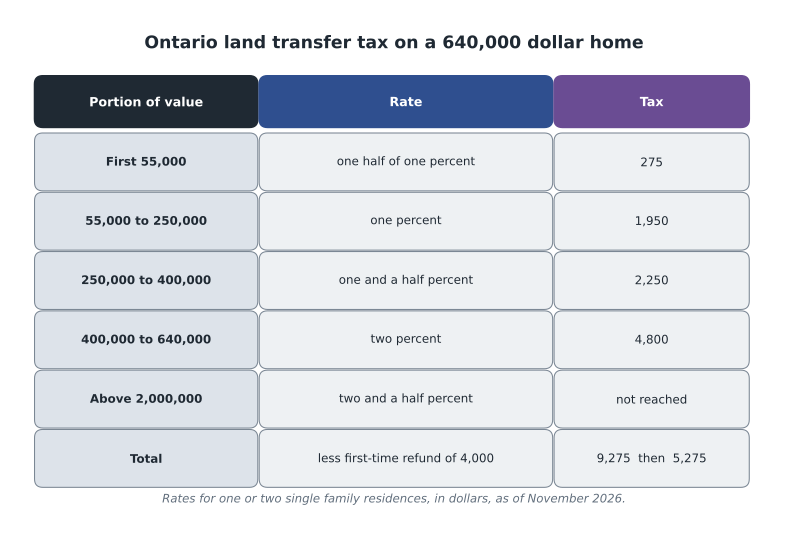
Under the Land Transfer Tax Act, a buyer who registers a conveyance of land in Ontario pays tax on the value of the consideration, usually the price. The tax is paid when the transfer is registered, and the lawyer collects it from the client and remits it through the electronic registration system, completing statements about the consideration and the buyer's status. The rates are progressive. For property containing one or two single family residences, the tax is one half of one percent on the first 55,000 dollars, one percent on the next portion up to 250,000 dollars, one and a half percent up to 400,000 dollars, two percent up to 2 million dollars, and two and a half percent on any value above 2 million dollars. For other property, the top rate is two percent above 400,000 dollars.
| Portion of the price | Rate | Tax on 640,000 dollars |
|---|---|---|
| First 55,000 dollars | One half of one percent | 275 dollars |
| 55,000 to 250,000 dollars | One percent | 1,950 dollars |
| 250,000 to 400,000 dollars | One and a half percent | 2,250 dollars |
| 400,000 to 640,000 dollars | Two percent | 4,800 dollars |
| Total before refund | 9,275 dollars | |
| First-time buyer refund (maximum) | minus 4,000 dollars | |
| Tax payable on registration | 5,275 dollars |
Arjun works through the Larkin Crescent calculation, shown in the table. The tax before any refund is 9,275 dollars. Ines and Devon are both first-time buyers, so they qualify for the first-time homebuyer refund, which can be claimed on registration and is capped at 4,000 dollars, enough to eliminate the tax entirely on a home of about 368,000 dollars. The refund requires that the buyer be at least eighteen, occupy the home as a principal residence within nine months of the transfer, and never have owned a home, or an interest in a home, anywhere in the world; a buyer's spouse must also not have owned a home while married to the buyer. If only one of two buyers qualifies, the refund is reduced in proportion to that buyer's share. Claiming a refund that the client is not entitled to exposes the client to reassessment, so the lawyer asks the questions and records the answers.
The tax also reaches some transactions that never reach the registry. A transfer of a beneficial interest in land, for example where a nominee corporation holds title and the shares or beneficial interest are sold, is taxable even though no transfer is registered, and certain long leases are treated as conveyances. Commercial lawyers must therefore consider land transfer tax on structured deals.
The Toronto municipal tax
The City of Toronto is the only Ontario municipality that levies its own land transfer tax. The municipal land transfer tax matches the provincial rates up to 3 million dollars, so a Toronto buyer effectively pays double. For transfers closing on or after April 1, 2026, the city's rates above 3 million dollars rise in steps, reaching more than eight percent on the portion above 20 million dollars. Toronto offers its own first-time buyer rebate, up to 4,475 dollars. Corwin, our fictional city, has no municipal land transfer tax, which Ines and Devon are glad to hear.
HST and new homes
Harmonized sales tax at thirteen percent, comprising the five percent federal portion and the eight percent provincial portion, applies to sales of new residential property by builders, and to most commercial property. Sales of used residential property by individuals are generally exempt, which is why Harold Abara's sale of Larkin Crescent attracts no HST, and why the standard form asks whether HST is included in the price. A house that has been substantially renovated, generally with ninety percent or more of the interior removed or replaced, may be treated as new.
Several rebates reduce the tax on new homes. Long-standing federal and Ontario new housing rebates apply to homes used as a primary residence, subject to price limits. Builders usually credit those rebates to the buyer in the price and claim them from the Canada Revenue Agency, so the agreement says that the price includes HST net of rebates assigned to the builder. Two recent programs are more generous. Federal legislation that received royal assent in March 2026 created a first-time home buyers' rebate of the GST or federal portion of HST, up to 50,000 dollars, on new homes up to 1 million dollars, phasing out between 1 million and 1.5 million dollars, for qualifying agreements made from May 27, 2025. And in March 2026, Ontario and the federal government announced temporary relief under which, for agreements entered into after March 31, 2026 and before April 1, 2027, buyers of new homes used as a primary residence, whether or not first-time buyers, may receive rebates of the full thirteen percent HST on homes up to 1 million dollars, worth up to 130,000 dollars, with reduced relief up to 1.85 million dollars. The provincial portion is delivered as an enhanced Ontario rebate administered by the Canada Revenue Agency, and the federal portion as an Ontario New Home Affordability Payment. Because the implementing legislation, forms and transitional rules were still being finalized during 2026, a lawyer on a new home file must confirm the current rules and how the agreement allocates the rebates.
Non-resident sellers
Taxes can also flow from the seller's status. Under section 116 of the Income Tax Act, a non-resident of Canada who sells taxable Canadian property, which includes Canadian real estate, must notify the Canada Revenue Agency and obtain a clearance certificate. If the seller does not, the buyer can become liable for a prescribed portion of the price on account of the seller's tax. The standard agreement therefore entitles the buyer to a declaration that the seller is not a non-resident, and if the seller is non-resident, the buyer's lawyer holds back the required amount from the price until the certificate is delivered.
Non-Canadian buyers
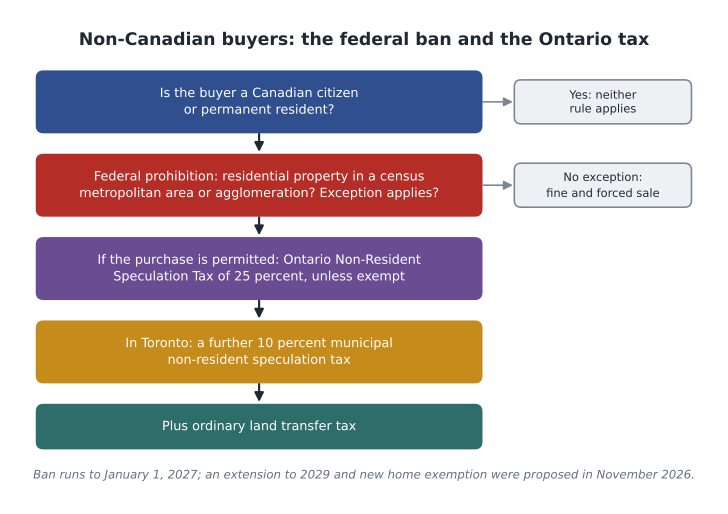
Two separate regimes restrict buyers who are not Canadian citizens or permanent residents. The first is provincial. Ontario's Non-Resident Speculation Tax, imposed under the Land Transfer Tax Act, applies to purchases of residential property containing one to six single family residences by foreign nationals, foreign corporations and taxable trustees. Since October 25, 2022, it has applied throughout Ontario at a rate of twenty-five percent of the value of the consideration, in addition to ordinary land transfer tax. A small number of exemptions apply, including for nominees under the Ontario Immigrant Nominee Program and certain spouses of Canadian citizens or permanent residents. Since January 1, 2025, Toronto has imposed its own additional ten percent municipal non-resident speculation tax, bringing the combined rate on such a purchase in Toronto to thirty-five percent on top of both land transfer taxes.
The second is federal. The Prohibition on the Purchase of Residential Property by Non-Canadians Act came into force on January 1, 2023. It prohibits non-Canadians, including foreign nationals and corporations controlled by them, from purchasing residential property, defined as buildings with three or fewer dwelling units and parts of buildings such as condominium units, in census metropolitan areas and census agglomerations. Exceptions include certain temporary residents, such as work permit holders who meet conditions, protected persons and some spouses of Canadians, and amendments in 2023 exempted vacant land and purchases for development. A non-Canadian who buys in breach of the Act, or a person who knowingly assists, may be fined up to 10,000 dollars, and a court may order the property sold. The prohibition was originally to expire after two years and was extended to January 1, 2027. In its budget of November 5, 2026, the federal government proposed extending it to January 1, 2029 and exempting purchases of new residential property. As of this course, those changes were proposals and not yet law, so a lawyer acting on a purchase by a non-Canadian in late 2026 or early 2027 must check what is in force on the closing date.
Daniel asks who has the burden of figuring this out. Ingleby answers that the buyer's lawyer must ask every buyer about citizenship and residency at the start, record the answers, and make the required statements on registration. A lawyer who completes a transfer for a buyer the lawyer knows to be prohibited risks being treated as someone who assisted, and a false statement about status in an electronic transfer is serious misconduct.
Federal housing taxes that no longer apply
The federal Underused Housing Tax, an annual tax on vacant or underused residential property owned by certain non-resident or non-Canadian owners, applied from 2022. The federal budget of November 2025 announced its elimination beginning with the 2025 calendar year, so returns are not required for 2025 and later years. Owners remain responsible for earlier years. Some municipalities, including Toronto, have their own vacant home taxes.
Other provinces
Every province taxes transfers differently. British Columbia levies a property transfer tax at tiered rates beginning at one percent, an additional property transfer tax on foreign buyers in specified regions, an annual speculation and vacancy tax in designated areas, and since January 1, 2025 a home flipping tax on profits from residential property sold within two years of purchase. Quebec municipalities levy a transfer duty, commonly called the welcome tax. Alberta and Saskatchewan have no land transfer tax and charge only registration fees based on value. The lesson for a lawyer in any province is the same: identify the client's status and the property's characteristics at the start, and calculate the taxes before the client commits to a closing budget.
Worked problem
A friend from abroad
Ines's cousin, Esteban, is a citizen of another country living in Corwin on a three-year work permit. He wants to buy a 520,000 dollar resale condominium unit in Corwin in January 2027, and asks whether he can, and what tax he would pay. Corwin is within a census metropolitan area. Advise him in outline.
Show solution
- Identify his status. Esteban is not a Canadian citizen or permanent resident, so he is a non-Canadian for the federal prohibition and a foreign national for the Ontario tax.
- Apply the federal prohibition. A condominium unit is residential property and Corwin is in a census metropolitan area, so the purchase is prohibited unless an exception applies. Check whether he meets the conditions for the work permit holder exception, which depend on the permit's validity and other requirements, and whether the prohibition is still in force on his closing date.
- If permitted, apply the Ontario tax. The Non-Resident Speculation Tax at twenty-five percent of 520,000 dollars, or 130,000 dollars, would apply unless an exemption, such as the Ontario Immigrant Nominee Program, applies.
- Add ordinary land transfer tax, about 6,875 dollars on 520,000 dollars, with no first-time buyer refund because he is not a Canadian citizen or permanent resident.
- Explain the risk of getting it wrong: a fine of up to 10,000 dollars, a possible court-ordered sale and tax reassessment.
- Suggest that he consider waiting until he obtains permanent residence, if that is likely soon, and get immigration advice.
Common mistakes
MistakeTelling clients that HST applies to every home purchase.
InsteadSales of used residential property by individuals are generally exempt; HST applies mainly to new and substantially renovated homes and commercial property.
MistakeAssuming the first-time buyer refund applies if either buyer has never owned a home.
InsteadThe refund is prorated to the share of the eligible buyer, and a spouse who owned a home while married to the buyer can disqualify both.
MistakeTreating the federal prohibition and the Ontario Non-Resident Speculation Tax as the same rule.
InsteadOne is a federal ban on purchases with fines and forced sales; the other is a provincial tax that applies to permitted purchases by foreign nationals.
MistakeRelying on budget announcements as if they were law.
InsteadBudget measures such as the proposed 2029 extension and new home exemption take effect only when enacted; check what is in force on the closing date.
Practice problems
Work each problem on paper first, then reveal the answer to check.
Calculate Ontario land transfer tax on a 400,000 dollar single family home before any refund.
Show answer
275 dollars on the first 55,000, 1,950 dollars on the next 195,000 and 2,250 dollars on the next 150,000, for a total of 4,475 dollars.
What did the federal budget of November 5, 2026 propose about the ban on purchases by non-Canadians?
Show answer
An extension from January 1, 2027 to January 1, 2029, and an exemption for purchases of new residential property; both were proposals not yet in force.
Why does a buyer's lawyer care whether the seller is a non-resident of Canada?
Show answer
Because under section 116 of the Income Tax Act the buyer can become liable for part of the seller's tax unless the seller provides a clearance certificate, so the buyer holds back the required amount if the seller is non-resident.
Summary and key terms
- Ontario land transfer tax is paid on registration at progressive rates, with a first-time homebuyer refund of up to 4,000 dollars; Toronto adds a matching municipal tax with higher rates above 3 million dollars from April 1, 2026.
- HST applies to new homes and most commercial property but not to resale homes; federal and Ontario rebates, including the 2026 temporary full rebate program, can greatly reduce it.
- Section 116 of the Income Tax Act makes a buyer from a non-resident seller hold back part of the price unless a clearance certificate is delivered.
- Ontario's Non-Resident Speculation Tax is twenty-five percent province-wide, plus ten percent in Toronto since January 1, 2025.
- The federal prohibition on purchases by non-Canadians runs to January 1, 2027, with a proposed extension to 2029 and a new home exemption announced in November 2026.
- Land transfer tax
- Ontario tax payable by a buyer on the registration of a conveyance, based on the value of the consideration.
- First-time homebuyer refund
- A refund of up to 4,000 dollars of Ontario land transfer tax for eligible first-time buyers.
- Non-Resident Speculation Tax
- An additional Ontario tax on purchases of residential property by foreign nationals, foreign corporations and taxable trustees.
- Clearance certificate
- A certificate from the Canada Revenue Agency under section 116 of the Income Tax Act confirming that a non-resident seller has dealt with the tax on a sale.
- New housing rebate
- A partial refund of HST on a new home, usually assigned by the buyer to the builder and credited in the price.
- Census metropolitan area
- A Statistics Canada area used to define where the federal prohibition on purchases by non-Canadians applies.
Lesson quiz · 5 questions
Score 60% or more to complete this lesson.
Create a free account to save your progress, take quizzes and earn a certificate.