
LAWC-303 · Lesson 2 of 12 · 21 min
Agreements of purchase and sale
▶ Video coming soon A video version of this lesson is on the way.
Ingleby starts the second class by projecting the agreement that Ines Castille and Devon Quigley signed for 14 Larkin Crescent. It is the standard Ontario Real Estate Association agreement of purchase and sale, six pages of printed clauses with blanks filled in by the agents, followed by a schedule of typed conditions. 'Most of the arguments that end up in court,' she says, 'are about the six words someone typed into Schedule A at eleven at night during a bidding war.' This lesson looks at how the agreement is formed, what the standard terms do, how conditions work, how courts interpret these contracts, and what the seller must disclose.
Formation
An agreement of purchase and sale is a contract, and the ordinary rules of offer and acceptance apply. A buyer makes a written offer that is irrevocable until a stated time. The seller may accept it, let it lapse or sign it back with changes, which is a counter-offer. Acceptance must be communicated in the manner the offer requires, and the standard form says that the agreement becomes binding when the accepted offer is communicated back to the other party or its agent. Many disputes turn on whether a signed-back change was initialled and returned before the irrevocable time expired.
Because it concerns an interest in land, the agreement must satisfy section 4 of the Statute of Frauds, which requires a written note or memorandum signed by the party to be charged, or by that party's authorized agent. The writing must contain the essential terms: the parties, the property, the price and any other terms that the parties treated as essential. Courts have long recognized a part performance exception, and in Erie Sand and Gravel Ltd. v. Seres' Farms Ltd., 2009 ONCA 709, the Court of Appeal explained that acts of part performance must point to the existence of an agreement concerning the land. Electronic signatures on agreements of purchase and sale are now routine in Ontario, and the standard form contemplates them.
The standard terms
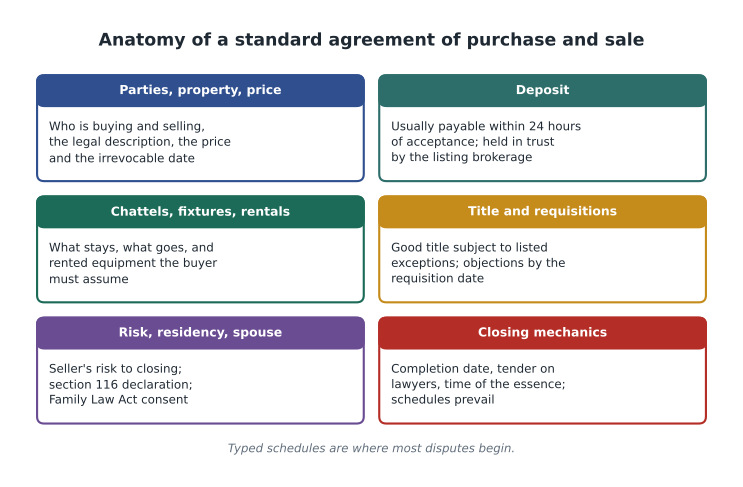
Several printed clauses do most of the work in every residential deal. The deposit clause usually requires payment within twenty-four hours of acceptance, to be held in trust by the listing brokerage. The completion date clause fixes the closing day. The chattels and fixtures clauses list what stays and what goes, which matters because, as LAWC-113 explained, fixtures pass with the land unless excluded. The rental items clause identifies equipment such as a water heater that is rented and must be assumed by the buyer.
The title clause is the heart of the agreement. The seller promises good title, free from registered restrictions, charges, liens and encumbrances, except those the buyer agrees to assume and a list of minor matters such as registered utility easements and municipal agreements that have been complied with. The buyer may examine title and deliver objections up to the requisition date, and if the seller cannot or will not remove a valid objection, the agreement ends and the deposit is returned. The buyer is taken to have accepted title except for objections made in time and objections going to the root of title. The same clause gives the buyer a later date to object to work orders, deficiency notices and zoning non-compliance, and requires the seller to consent to the buyer's lawyer requesting information from the municipality.
Other standard terms allocate risk. The property remains at the seller's risk until completion, and if it is substantially damaged before closing, the buyer may choose to terminate or to take the insurance proceeds. The residency clause addresses section 116 of the Income Tax Act: if the seller is a non-resident of Canada, the buyer may be liable for the seller's tax unless the buyer withholds part of the price or the seller obtains a clearance certificate, so the buyer is entitled to a statutory declaration of residency. The HST clause says whether HST is included in the price, which matters for new homes and some commercial deals. The family law clause requires the seller to confirm that spousal consent under section 21 of the Family Law Act is not needed, or to provide it, because a spouse who is not on title may still have a right of possession in a matrimonial home. Finally, the agreement says that time is of the essence and that tender may be made by delivering documents or funds to the other party's lawyer.
Conditions
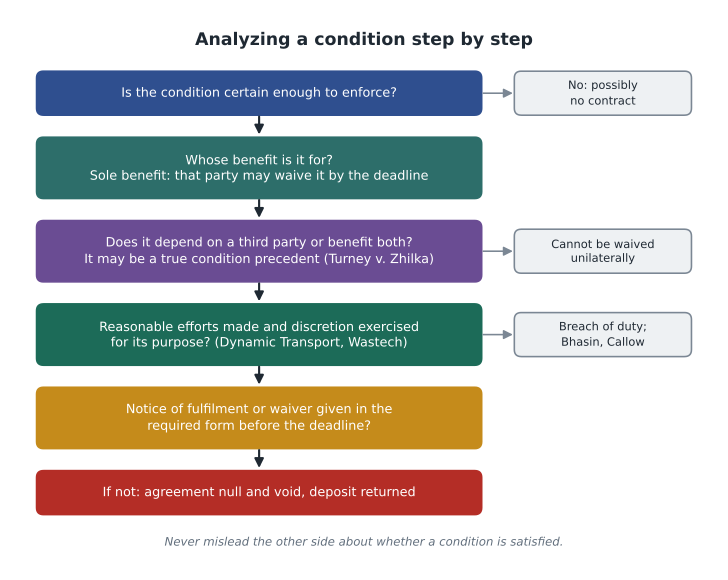
Schedule A in the Larkin Crescent deal contains two conditions. The first makes the agreement conditional on the buyers arranging a new first mortgage satisfactory to them within five banking days. The second makes it conditional on a home inspection satisfactory to the buyers in their sole and absolute discretion within the same period. Both are stated to be for the sole benefit of the buyers and may be waived by notice in writing. If no notice of fulfilment or waiver is delivered in time, the agreement becomes null and void and the deposit is returned without deduction.
Three doctrines shape how such conditions work. The first is certainty. A condition must be clear enough that a court can tell whether it has been met. In Wiebe v. Bobsien, a 1984 British Columbia decision affirmed on appeal, a condition that a buyer sell his own house was held enforceable because it carried an implied duty to take reasonable steps to sell, and the same reasoning supports financing conditions with subjective language such as 'satisfactory to the buyer'.
The second doctrine concerns waiver and true conditions precedent. In Turney v. Zhilka, [1959] SCR 578, the Supreme Court held that a buyer could not waive a condition that depended on a third party, a municipal approval of a plan, and insist on closing. The modern standard form avoids that problem by stating expressly that its conditions are for the sole benefit of one party and may be waived by that party. A lawyer drafting a condition that benefits both parties, or depends on a government approval, must decide deliberately who can waive it.
The third doctrine is good faith in performance. A party who must take steps to satisfy a condition must make reasonable efforts, as the Supreme Court held in Dynamic Transport Ltd. v. O.K. Detailing Ltd., [1978] 2 SCR 1072, where a seller had to make reasonable efforts to obtain subdivision approval. Since Bhasin v. Hrynew, 2014 SCC 71, every Canadian contract carries a duty of honest performance: a party must not lie to or knowingly mislead the other about matters directly linked to the contract. In C.M. Callow Inc. v. Zollinger, 2020 SCC 45, the Court held that this duty can be breached by active deception, including half-truths and actions that create a false impression, even without an outright lie. And in Wastech Services Ltd. v. Greater Vancouver Sewerage and Drainage District, 2021 SCC 7, the Court held that a contractual discretion must be exercised reasonably in light of the purposes for which it was granted.
Arjun Mehta works through the inspection condition on the board. The inspector reports that the basement shows signs of past water entry along the north wall and that the attic insulation is thin. Devon now wonders whether the price is too high for a house that needs work. Can the buyers rely on the inspection condition to end the deal? Wastech suggests that the discretion 'satisfactory to the buyers in their sole and absolute discretion' must be exercised for the purpose for which it was granted, which is to decide whether the buyers are satisfied with the condition of the house. An honest dissatisfaction with what the inspection showed is a legitimate exercise. But Callow is a warning about how the buyers communicate. If Devon tells the seller's agent that the inspection was fine while quietly deciding to walk away because the couple found a cheaper house, he risks a claim for breach of the duty of honest performance. The safe course is simply to let the condition expire, or to give notice that it has not been satisfied, without misleading statements.
Interpreting the agreement
Courts interpret agreements of purchase and sale under the general framework in Sattva Capital Corp. v. Creston Moly Corp., 2014 SCC 53. The goal is to determine the intention of the parties from the words used, read as a whole, in light of the surrounding circumstances known to both parties when they contracted. Surrounding circumstances can explain the words but cannot overwhelm them. Sattva also held that contractual interpretation is usually a question of mixed fact and law, reviewed on appeal for palpable and overriding error.
Standard form contracts are treated differently. In Ledcor Construction Ltd. v. Northbridge Indemnity Insurance Co., 2016 SCC 37, the Court held that the interpretation of a standard form contract, where the factual matrix is not specific to the parties, is a question of law reviewed for correctness, because the interpretation will affect many other contracts. The printed clauses of the Ontario standard form fall into that category. The typed clauses in a schedule, negotiated for one deal, remain governed by Sattva. When a typed clause conflicts with a printed one, the standard form itself says that the added schedule prevails, and the general principle that specifically negotiated terms take priority over printed terms points the same way.
What the seller must disclose
The starting point in Canadian common law is caveat emptor: let the buyer beware. A seller is not generally obliged to disclose defects that a reasonable inspection would reveal, known as patent defects. There are three main exceptions. A seller may not actively conceal a defect, for example by painting over a water stain. A seller who chooses to speak must tell the truth, and a misleading half-truth is a misrepresentation. And a seller who knows of a latent defect, one that a reasonable inspection would not reveal, that makes the house dangerous or unfit for habitation must disclose it, a principle the Court of Appeal accepted in McGrath v. MacLean (1979), 22 OR (2d) 784.
In Ontario, many sellers complete a seller property information statement, an optional form in which the seller answers questions about the property. The form helps buyers, but it is also a trap for sellers. In Krawchuk v. Scherbak, 2011 ONCA 352, sellers who answered the question about structural problems inaccurately were held liable in negligent misrepresentation when the house turned out to have serious foundation settlement, and the buyer's agent, who had not advised the buyer to investigate further despite visible signs, was also found liable. In Bowman v. Martineau, 2020 ONCA 330, the Court of Appeal held that where a negligent agent led buyers into a purchase they would otherwise have avoided, the proper measure of damages was the difference between the price paid and the value of the damaged property, plus consequential losses, rather than the full cost of repairs.
Ines asks whether Harold Abara, who answered 'no' to the information statement's question about water in the basement, misled them. Ingleby says the class does not yet know. If Harold never saw water, his answer may be honest. If he mopped up the basement every spring, it may be a misrepresentation that survives closing, depending on the agreement's wording and whether the statement was incorporated into it. An entire agreement clause, which the standard form contains, may limit claims based on representations not included in the agreement, which is one reason buyers' agents often attach the information statement as a schedule.
Cooling-off periods and other provinces
Ontario has no general cooling-off period for resale homes. A buyer of a new condominium unit from a developer may rescind within ten days of receiving the disclosure statement or the agreement, whichever is later, under section 73 of the Condominium Act, 1998. British Columbia went further: since January 3, 2023, buyers of most residential property in that province have a three business day home buyer rescission period after acceptance, and a buyer who rescinds must pay the seller a fee of one quarter of one percent of the price. Quebec's Civil Code imposes a statutory warranty against latent defects on the seller, which differs significantly from the common law approach.
Worked problem
The inspection report at Larkin Crescent
Three days after acceptance, the inspection report on 14 Larkin Crescent shows signs of past water entry in the basement and thin attic insulation. The bank has approved financing. Devon wants to end the deal because he has seen a cheaper house on the next street; Ines wants to stay if the price can come down. The seller's agent calls to ask whether the inspection went well. What should the buyers' lawyer advise?
Show solution
- Read the condition. It is for the buyers' sole benefit, is satisfied only by written notice and lapses after five banking days, making the agreement null and void.
- Identify the options. The buyers may waive the condition and proceed, let it expire and end the agreement, or propose an amendment reducing the price in exchange for waiving it.
- Apply Wastech. The discretion must be exercised for its purpose, which is the buyers' satisfaction with the inspection. Genuine dissatisfaction with water entry is a legitimate reason; there is no duty to explain it.
- Apply Bhasin and Callow. The buyers must not tell the agent that all is well if they intend to walk away, or create a false impression that they are proceeding.
- Advise on negotiation. If they want a price reduction, propose it in a written amendment signed by both parties before the deadline, and confirm that the financing condition is waived only once the amendment is signed.
- Diarize the deadline and confirm the clients' instructions in writing.
Common mistakes
MistakeTreating a condition as automatically waivable by whichever party wants to close.
InsteadA condition can be waived unilaterally only if it is for that party's sole benefit; one that depends on a third party or benefits both may be a true condition precedent under Turney v. Zhilka.
MistakeAssuming a buyer with a subjective condition may give any reason or no reason at all and say anything to the seller.
InsteadThe discretion must be exercised for its purpose (Wastech), and the buyer must not actively mislead the seller about it (Bhasin, Callow).
MistakeApplying the Sattva standard of review to the printed clauses of the standard form.
InsteadLedcor treats the interpretation of standard form clauses as a question of law reviewed for correctness; Sattva applies to negotiated terms.
MistakeTelling a buyer that the seller must disclose every defect.
InsteadCaveat emptor still applies to patent defects; exceptions cover active concealment, misrepresentation and known latent defects that make the house dangerous or unfit.
Practice problems
Work each problem on paper first, then reveal the answer to check.
What did the Supreme Court hold in Turney v. Zhilka?
Show answer
That a buyer could not unilaterally waive a condition that depended on a third party (municipal approval) and insist on closing, because it was a true condition precedent.
Who was found liable in Krawchuk v. Scherbak, and why?
Show answer
The sellers, for negligent misrepresentation in the seller property information statement about structural problems, and the buyer's agent, for failing to advise the buyer to investigate visible signs of a problem.
What cooling-off rights exist for residential buyers in Ontario and British Columbia?
Show answer
In Ontario, only buyers of new condominium units from a developer have a ten-day rescission right under section 73 of the Condominium Act, 1998; in British Columbia, buyers of most residential property have a three business day rescission period, subject to a fee of one quarter of one percent of the price.
Summary and key terms
- An agreement of purchase and sale is formed by offer and acceptance and must satisfy section 4 of the Statute of Frauds, subject to the part performance exception.
- The standard form's title, requisition, risk, residency, family law and tender clauses allocate the main risks of the transaction.
- Conditions must be certain; only conditions for one party's sole benefit can be waived unilaterally; parties must make reasonable efforts to satisfy conditions and exercise discretion for its purpose.
- Bhasin and Callow impose a duty of honest performance; Sattva governs negotiated terms and Ledcor governs printed standard form clauses.
- Caveat emptor applies, subject to active concealment, misrepresentation and known latent defects that make the house dangerous; seller information statements can create liability.
- Irrevocable date
- The time until which an offer cannot be withdrawn and may be accepted.
- Sign-back
- A counter-offer made by changing and signing an offer, which the other party may accept or reject.
- True condition precedent
- A condition depending on a third party or benefiting both parties, which neither party can waive unilaterally.
- Caveat emptor
- The principle that a buyer must inspect and take the property as found, subject to limited exceptions.
- Latent defect
- A defect that a reasonable inspection would not reveal.
- Seller property information statement
- An optional form in which a seller answers questions about the property, which can ground a misrepresentation claim if inaccurate.
Lesson quiz · 5 questions
Score 60% or more to complete this lesson.
Create a free account to save your progress, take quizzes and earn a certificate.