
LAWC-303 · Lesson 6 of 12 · 19 min
Planning, zoning and off-title searches
▶ Video coming soon A video version of this lesson is on the way.
The sixth class starts with a photograph of the basement at 14 Larkin Crescent: a small kitchen, a bedroom and a separate side door. Harold Abara rented it to graduate students for several years. Ines and Devon plan to do the same to help with their mortgage payments. 'Is it legal?' Ingleby asks. Nobody knows, and that is the point of the lesson. Many of the questions that matter most to a buyer are not answered by the parcel register at all. They are answered by the Planning Act, by municipal by-laws and records, and by the documents of a condominium corporation or a new home builder.
Subdivision control: section 50 of the Planning Act
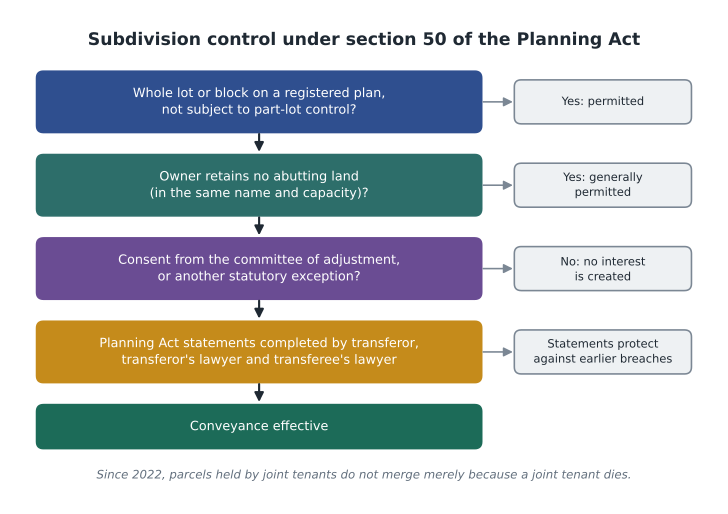
The subdivision control provisions in section 50 of the Planning Act prevent landowners from dividing land into new parcels without municipal approval. The basic rule is that a person may not convey land by way of a deed or transfer, or grant a mortgage or a lease for more than twenty-one years, unless an exception applies. The most important exceptions are that the land is a whole lot or block on a registered plan of subdivision, not subject to a part-lot control by-law, or that the owner does not retain the fee or equity of redemption in any land abutting the land being conveyed. Otherwise, the owner needs a consent, usually granted by the municipality's committee of adjustment.
The consequence of a contravention is severe. A conveyance that contravenes section 50 does not create or convey any interest in the land. Since nothing in the land registry automatically blocks such a document, the risk falls on buyers and lenders. The Act therefore provides a curative mechanism: when the transferor, the transferor's lawyer and the transferee's lawyer all complete the Planning Act statements in a transfer, confirming that to the best of their knowledge the conveyance does not contravene section 50 and that earlier conveyances did not either, those statements protect the title against a contravention in a previous conveyance. The electronic transfer contains these statements, and a lawyer who signs them must have investigated.
A common trap involves abutting lots owned by the same people. Suppose a couple own two side-by-side lots on a registered plan, and one is subject to a part-lot control by-law, or they own one whole lot and part of the next. If they hold both parcels in the same name and capacity, the lots may merge for Planning Act purposes, so that neither can be sold separately without consent. Until 2022, this often happened by accident when one joint tenant died and the survivor became the sole owner of both lots. Amendments in force on January 1, 2022 provide that parcels held by joint tenants do not merge merely because of the death of a joint tenant. The same amendments let a purchaser apply for consent if the agreement of purchase and sale expressly authorizes it, extended the time to fulfil consent conditions from one year to two years, and allowed the cancellation of consents that are no longer needed.
For LTCQ parcels, the province's guarantee of title covers Planning Act compliance up to the date of conversion, because the conversion process examined it. A searcher of an LTCQ parcel therefore focuses on conveyances after conversion. On Larkin Crescent, the class confirms that Lot 31 is a whole lot on a registered plan and that no part-lot control by-law affects it, so the Planning Act statements can be completed without difficulty.
Zoning and the use of the property
Zoning by-laws passed under section 34 of the Planning Act regulate how land may be used and what may be built on it: permitted uses, the number of units, setbacks, height and parking. A use that was lawful when it began, and has continued without interruption, may continue as a legal non-conforming use even if the by-law later prohibits it. A minor departure from a by-law can be authorized as a minor variance by the committee of adjustment under section 45. Larger changes need a by-law amendment.
The basement apartment brings in a series of provincial reforms. Ontario has required municipalities for several years to permit additional residential units, and the More Homes Built Faster Act, 2022 strengthened the rule: in most urban residential areas served by municipal water and sewers, an owner may have up to three residential units on a lot, for example a main house, a basement unit and a unit in a garage or laneway building, without a rezoning. Municipalities may still regulate matters such as setbacks, and some parking requirements for these units are restricted. But zoning permission is only one requirement. A legal basement unit also needs a building permit and must comply with the Ontario Building Code and the Fire Code, including fire separations, smoke alarms and safe exits.
Ingleby tells the class what to do on Larkin Crescent. Ask the City of Corwin for a zoning compliance letter or search the zoning by-law; ask the building department for a record of permits, including any open ones; and ask the fire department whether there is a record of an inspection of the second unit. The building department replies that a permit for a rear deck was issued in 2009 and never closed, and that it has no permit for a basement apartment. The buyers can expect that the unit will need work before it can be rented lawfully, which affects both their plans and the price they are willing to pay.
Taxes, work orders and utilities
Unpaid realty taxes do not appear on the parcel register, but they are a special lien on the land with priority over almost every other interest. The buyer's lawyer obtains a tax certificate from the municipality showing the taxes levied and any arrears, and the statement of adjustments, which we study in lesson 10, apportions the year's taxes between seller and buyer. In many municipalities, unpaid water and sewer charges can be added to the tax roll, so the lawyer also checks utility accounts.
Municipalities may issue orders to repair or comply under property standards by-laws or the Building Code Act. These work orders bind the land, so a buyer can inherit them. The standard form gives the buyer until a stated date to object to outstanding work orders and deficiency notices, and the seller must consent to municipal inquiries. Many municipalities will not release information without the owner's written authorization, which the agreement usually provides.
Two other public regimes deserve attention. Conservation authorities regulate development in or near floodplains, wetlands and shorelines, and a property near the Severn River may be partly within a regulated area where building additions require a permit. And properties designated under the Ontario Heritage Act, or listed on a municipal heritage register, face restrictions on alteration and demolition. Theo asks whether the buyers can rely on the seller's statement that 'there are no issues with the city.' Ingleby answers firmly that a buyer's lawyer makes the inquiries herself, because a seller's general statement is not a substitute for a record.
Condominiums: the status certificate
A buyer of a condominium unit is buying a share of a corporation as well as a unit, and the corporation's finances and rules matter as much as the unit's condition. Section 76 of the Condominium Act, 1998 entitles any person to request a status certificate from the condominium corporation, which must provide it within ten days on payment of the prescribed fee. The certificate states the common expenses for the unit and any arrears, any special assessments, the state of the reserve fund and the most recent reserve fund study, any legal proceedings, any changes to the common elements or assets, and the corporation's insurance, and attaches the declaration, by-laws, rules, budget and financial statements. The certificate binds the corporation as to its contents as of the date it was given.
The status certificate matters because unpaid common expenses are secured by a lien on the unit under section 85 of the Act, which a buyer may inherit, and because a weak reserve fund can lead to large special assessments after closing. A careful lawyer reads the reserve fund study and the minutes of recent meetings, not only the certificate. Resale agreements for condominium units often include a condition allowing the buyer's lawyer to review the certificate within a few days.
New homes
A buyer of a newly built home in Ontario receives a warranty under the Ontario New Home Warranties Plan Act, administered by Tarion. The warranty includes a one-year warranty on workmanship and materials, a two-year warranty on items such as water penetration and electrical and plumbing systems, and a seven-year warranty on major structural defects. Tarion also provides limited protection for deposits paid to a builder and compensation for certain closing delays. Builders and vendors of new homes must be licensed by the Home Construction Regulatory Authority under the New Home Construction Licensing Act, 2017, which has regulated licensing and conduct since February 2021, and a buyer's lawyer should confirm the builder's licence and the home's enrolment. Agreements for new homes include long addenda with early termination conditions, adjustments for development charges and utility hook-ups, and provisions about HST rebates, which lesson 9 examines.
Other provinces
The details differ across Canada, but the structure is the same. In British Columbia, a buyer of a strata lot obtains an information certificate from the strata corporation, and the Strata Property Act governs special levies and depreciation reports. Alberta's Condominium Property Act requires disclosure of the corporation's documents and reserve fund study on request. Subdivision control exists everywhere, though the mechanisms vary; in western Torrens provinces, the land titles office usually refuses to register a subdivision that has not been approved, so the risk is caught at registration rather than left to lawyers' statements.
Worked problem
The basement apartment and the open permit
Searches on 14 Larkin Crescent show no tax arrears, a 2009 building permit for a rear deck that was never closed, and no permit for the basement apartment. Ines and Devon want to rent the basement immediately after closing to help pay the mortgage. Harold says the tenants never complained. What should the buyers' lawyer advise, and what can she ask the seller to do?
Show solution
- Explain the law. Under the More Homes Built Faster Act, 2022, the zoning likely permits a second unit, but a lawful rental unit also needs a building permit and must meet the Building Code and Fire Code.
- Explain the risk. Renting an unpermitted unit exposes the owners to orders, fines and insurance problems, and fire safety is a real concern.
- Use the agreement. If the requisition or objection date has not passed, object to the open deck permit as a deficiency and ask the seller to close it or provide an inspection, or to adjust the price.
- Consider the basement. Unless the agreement represented that the basement was a legal unit, the seller has no obligation to legalize it; the buyers can negotiate a price reduction or a holdback to cover the cost of permits and work.
- Report to the lender. The lender's instructions may ask whether the property contains a rental unit; disclose the facts accurately.
- Advise the clients to obtain a contractor's estimate and to wait for a permit and inspection before renting.
Common mistakes
MistakeAssuming a conveyance that contravenes section 50 of the Planning Act is merely irregular.
InsteadIt does not create or convey any interest in the land; the Planning Act statements in the transfer are an important protection.
MistakeTelling clients that because zoning permits a second unit, the existing basement apartment is legal.
InsteadA lawful unit also needs a building permit and must meet the Building Code and Fire Code.
MistakeRelying on the parcel register to show tax arrears and work orders.
InsteadTaxes, utility arrears and work orders are off-title matters found through municipal inquiries, and unpaid taxes are a special lien with priority.
MistakeReading only the first page of a condominium status certificate.
InsteadRead the reserve fund study, budget, special assessments, legal proceedings and recent minutes to understand the corporation's finances.
Practice problems
Work each problem on paper first, then reveal the answer to check.
What changed for joint tenants under the 2022 amendments to the Planning Act?
Show answer
Abutting parcels held by joint tenants no longer merge for subdivision control purposes merely because one joint tenant dies.
What must a status certificate contain, and within what time must it be provided?
Show answer
It must state common expenses and arrears, special assessments, reserve fund information, legal proceedings, changes and insurance, and attach the governing documents and financial statements; it must be provided within ten days of the request and payment of the fee under section 76 of the Condominium Act, 1998.
What three Tarion warranty periods apply to a new home?
Show answer
One year for workmanship and materials, two years for items such as water penetration and electrical and plumbing systems, and seven years for major structural defects.
Summary and key terms
- Section 50 of the Planning Act prohibits conveying part of a lot without consent unless an exception applies, and a contravening conveyance creates no interest; the Planning Act statements in the transfer provide protection.
- The 2022 amendments prevent merger of abutting parcels on the death of a joint tenant, allow purchaser consent applications and extend the time to fulfil conditions.
- Zoning governs use, and the More Homes Built Faster Act, 2022 permits up to three units on most serviced residential lots, but permits and code compliance are still required.
- Realty taxes, utility arrears, work orders, conservation and heritage controls are investigated off title through municipal and agency inquiries.
- Condominium buyers rely on the status certificate under section 76; new home buyers rely on Tarion warranties and the builder's licence from the Home Construction Regulatory Authority.
- Subdivision control
- The Planning Act restrictions on dividing land into separate parcels without approval.
- Consent
- Approval, usually from a committee of adjustment, to sever a parcel from a larger holding.
- Legal non-conforming use
- A use that was lawful when it began and may continue despite a later zoning by-law that prohibits it.
- Minor variance
- Permission from a committee of adjustment for a minor departure from a zoning by-law.
- Work order
- A municipal order requiring an owner to repair or bring a property into compliance with standards, which binds the land.
- Status certificate
- A certificate from a condominium corporation describing a unit's common expenses and the corporation's finances and affairs.
Lesson quiz · 5 questions
Score 60% or more to complete this lesson.
Create a free account to save your progress, take quizzes and earn a certificate.