
LAWC-303 · Lesson 1 of 12 · 25 min
The real estate transaction and the lawyer's role
▶ Video coming soon A video version of this lesson is on the way.
Professor Philippa Ingleby begins the first class of Real Estate Transactions by placing a set of house keys on the lectern. 'By the end of this term,' she says, 'you will know everything that has to happen before a lawyer is allowed to hand these to a client. Most of it is invisible to the client. All of it is your responsibility.' She practised residential and commercial real estate law in Corwin for twenty-one years before joining Brannock, and she has a sentence that she writes on the board at the start of every term: 'Every deal is two promises kept on one day: the seller delivers a good title, and the buyer pays for it.'
This course is about how those promises are made, checked and kept in Ontario, with notes on how other provinces differ. It builds on first-year property law. In LAWC-113 Professor Asante taught estates in land, co-ownership, easements, covenants and the land registration systems as doctrine. Here the same rules become a file on a lawyer's desk with a closing date. This first lesson maps the transaction from beginning to end, introduces everyone involved and explains the special professional rules that apply to lawyers who do real estate work.
The class file
Ingleby runs the course around two files, which return in most lessons. The first is a residential resale. Ines Castille and Devon Quigley, a couple in their early thirties who rent an apartment in Corwin, are buying their first home: 14 Larkin Crescent, a 1960s bungalow on a quiet street near the Severn River. The seller is Harold Abara, a 76-year-old widower moving to a retirement residence. The price is 640,000 dollars, with a 30,000 dollar deposit, a financing condition and a home inspection condition. The second file is commercial. Mei Yuen owns Yuen's Bakehouse Ltd., which has outgrown its first location and is negotiating to lease Unit 4 at Dumont Square, a small plaza owned by Dumont Square Holdings Inc. Both files are hypothetical, and the class takes the role of the buyers' and the tenant's lawyers.
Theo Marchetti, who spent ten years as a litigation clerk, asks the question most of the class is thinking. 'Isn't residential real estate mostly forms? The agents fill in a standard agreement, the bank sends instructions, the clerk does the searches.' Ingleby nods. 'Most of it is forms, and the forms exist because thousands of lawyers made mistakes that someone then fixed. Your job is to know what each form is doing, so you notice the one deal in fifty where it is not enough.'
The stages of a transaction
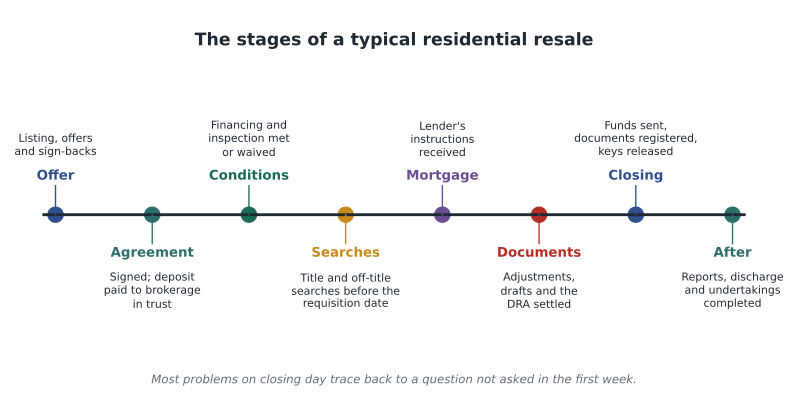
A residential resale in Ontario usually moves through recognizable stages. The seller lists the property with a brokerage, buyers make offers, and the parties sign an agreement of purchase and sale, usually on a standard form published by the Ontario Real Estate Association. The buyer pays a deposit, usually to the seller's brokerage, which holds it in trust. The agreement often contains conditions in the buyer's favour, such as arranging financing or obtaining a satisfactory home inspection, which must be satisfied or waived within a short period, often five business days. Once the conditions are gone the agreement is firm.
The buyer then retains a lawyer, if one was not involved before signing. The lawyer reviews the agreement, searches title and makes inquiries off title, and delivers requisitions to the seller's lawyer by the requisition date stated in the agreement. Meanwhile the buyer arranges the mortgage, and the lender sends instructions to the lawyer, who usually acts for the lender as well. As closing approaches, the seller's lawyer prepares a statement of adjustments, the two lawyers exchange draft documents and sign a Document Registration Agreement, and the buyer brings in the balance of the money. On closing day the buyer's lawyer sends the funds, the documents are registered electronically, and the keys are released. After closing, the lawyer reports to the client and the lender, the seller's lawyer pays off and discharges the seller's mortgage, and any undertakings given on closing are completed.
Commercial transactions follow the same logic but with more negotiation and longer timelines. A purchase of a plaza may begin with a non-binding letter of intent, followed by a negotiated agreement with a due diligence period of thirty to ninety days, environmental reports, reviews of leases and tenant estoppel certificates, and a closing that may involve several lenders. A commercial lease, which we study in lesson 11, often begins with an offer to lease and ends with a long negotiated lease document.
The players
Real estate agents are now called registrants, and they work for brokerages. In Ontario they are regulated by the Real Estate Council of Ontario, known as RECO, under the Trust in Real Estate Services Act, 2002. That statute is the renamed and amended Real Estate and Business Brokers Act, 2002, and the major amendments, together with a new code of ethics, took effect on December 1, 2023. The changes matter to lawyers because they change what agents may do. A brokerage may represent both the buyer and the seller in the same deal, called multiple representation, only with the informed written consent of both. A person who is not represented by the brokerage is now called a self-represented party, and the registrant must give that person a RECO information document explaining the risks. Sellers may also direct their brokerage to disclose the contents of competing offers, not only their number, which changed how bidding situations work.
Agents are not lawyers. They may fill in the blanks of a standard form and suggest standard clauses, but they may not give legal advice, and a court may hold an agent liable in negligence for failing to meet the standard of a reasonable agent. The Court of Appeal's decisions in Krawchuk v. Scherbak, 2011 ONCA 352, and Bowman v. Martineau, 2020 ONCA 330, both involve agents whose negligence led buyers into purchases they would have avoided, and we will study them in lesson 2.
Lenders include banks, credit unions, trust companies and private lenders. Mortgage brokers and private mortgage administrators are licensed by the Financial Services Regulatory Authority of Ontario under the Mortgage Brokerages, Lenders and Administrators Act, 2006. Title insurers issue policies that protect the owner or lender against defined title risks, including fraud, and since October 1, 2025 they have been reporting entities under the federal Proceeds of Crime (Money Laundering) and Terrorist Financing Act, which requires them to verify the identity of insured buyers and report certain transactions to FINTRAC. The Law Society told lawyers that they may help title insurers meet these duties under a written agent agreement, but must get the client's informed consent before sharing confidential information with an insurer.
The land registration system is operated by the province through ServiceOntario and Teranet, the private company that runs the electronic system under the Electronic Land Registration Services Act, 2010. Lawyers search and register through software called Teraview. Municipalities hold records of zoning, building permits, work orders and realty taxes. For a condominium unit, the condominium corporation provides a status certificate. For a new home, the builder, Tarion (the new home warranty corporation) and the Home Construction Regulatory Authority are involved.
Why a lawyer, and only a lawyer
In Ontario, providing legal services in a real estate transaction is the work of lawyers. Licensed paralegals may not act on real estate transactions, and the Law Society's rules require lawyers to supervise the law clerks who do much of the clerical work. Arjun Mehta asks why the system relies so heavily on lawyers when other jurisdictions do not. Ingleby gives two answers. First, the electronic registration system lets a lawyer change the ownership of land by signing a document with a digital key, so the system depends on a trustworthy, insured and regulated person holding that key. Second, a land transaction moves large sums through a lawyer's trust account on a single day, and the trust accounting rules in By-Law 9 and the insurance provided by LawPRO protect clients if something goes wrong.
Other provinces divide the work differently. In Quebec, a civil law jurisdiction, deeds of sale and hypothecs are executed before a notary, a separate profession, who acts impartially for both parties. In British Columbia, notaries public may also handle conveyances, and the land title system is run by the Land Title and Survey Authority. In Alberta and the other western provinces, Torrens land titles systems have existed since the late nineteenth century, and lawyers there also handle most transactions. In much of Atlantic Canada, registry systems are being converted to land titles in stages.
The Law Society's rules for real estate practice
Real estate practice has its own rules because of its history of conflicts and fraud. Three are central.
The first concerns acting for both sides. Since 2008, Ontario's rules have prohibited an individual lawyer from acting for or otherwise representing both the transferor and the transferee in a transfer of title to real property, with a short list of exceptions. The exceptions include transfers where the parties are related, transfers by an estate trustee to a beneficiary, transfers that only change how the same owners hold title, and transactions in remote areas where no other lawyer is readily available. Two lawyers in the same firm may act for the buyer and the seller, subject to the general conflict rules. The reason is simple. Buyer and seller have directly opposed interests on price, title, adjustments and closing risk, and a single lawyer cannot advocate for both.
The second concerns lenders. In most residential deals the buyer's lawyer also acts for the buyer's lender, which is permitted as a joint retainer if the lawyer discloses it, explains that information will not be kept confidential between the clients, and confirms that the lawyer will withdraw from acting for both if a conflict develops. The rules also permit a lawyer to act for a lender who is not a client in the ordinary sense, such as an institutional lender that provides standard instructions, but the lawyer must be clear about whom she represents. Problems arise when a private lender is involved, or when the lender and the borrower are related, and in those cases separate representation is often wise.
The third concerns title insurance. A lawyer may recommend title insurance, but must not receive any compensation from the insurer, must assess whether title insurance is in the client's interest, and must explain that it is not mandatory, what it covers, how it differs from a lawyer's opinion on title and what other protections exist. Since most residential buyers in Ontario now buy a title insurance policy, the lawyer's report increasingly speaks of the policy and the lawyer's search together.
| Rule area | What the rules require | Why it matters |
|---|---|---|
| Acting for both buyer and seller | An individual lawyer may not act for both transferor and transferee, except in listed cases such as related parties, estate trustee transfers and remote areas | Opposed interests on price, title and closing risk |
| Acting for lender and borrower | Permitted as a joint retainer with disclosure, no confidentiality between the clients, and withdrawal if a conflict arises | Lender instructions can require reporting facts the borrower would rather keep private |
| Title insurance | No compensation from the insurer; advise that it is optional and explain coverage and alternatives | The client must choose on independent advice |
| Electronic registration | The lawyer must keep personal control of her signing credentials and may not let a clerk sign in her name | A digital signature can transfer land in seconds |
| Client identification | Identify and verify clients and others on whose behalf funds move, under By-Law 7.1 | Title fraud often starts with a false identity |
Fraud and the lawyer as gatekeeper
Title fraud is the risk that keeps real estate lawyers awake. In a typical case, a fraudster obtains identification in the owner's name, retains a lawyer, and sells or mortgages the property, taking the money and leaving the true owner and an innocent lender to sort out the wreckage. In LAWC-113 we studied the Court of Appeal's decision in Lawrence v. Wright, 2007 ONCA 55, and the 2006 amendments to the Land Titles Act that protect the true owner from fraudulent instruments; lesson 4 returns to them from the practitioner's point of view.
For now, the point is the lawyer's role. Under By-Law 7.1, a lawyer must identify every client and, when funds are involved, verify the client's identity using reliable independent documents or methods. In real estate practice the Law Society and LawPRO publish lists of red flags: a client who wants to close quickly and does not care about price, a property with no mortgage owned for decades, identification that does not quite match, a change of address shortly before the deal, instructions to pay proceeds to a third party, or a lender who has never met the borrower. Hannah Kowalczyk asks whether a lawyer is liable if she is fooled by a very good forgery. Ingleby answers carefully. 'Not automatically. The standard is reasonable care, not perfection. But the cases are full of lawyers who saw a red flag and closed anyway, because the deal was due that day.'
Ontario has also taken some structural steps. In 2024 the Homeowner Protection Act, 2024 banned new registrations on title of notices of security interest for consumer goods such as water heaters and furnaces, effective June 6, 2024, after complaints that such notices were being used to pressure homeowners. In 2025 the province began automatically certifying routine transfers and discharges that meet its rules, so that staff can concentrate on unusual documents. And in August 2026 it amended the regulation governing the Land Titles Assurance Fund to add a category of claims for certain mortgagees deprived of their interest by the registration of a fraudulent instrument.
What the client actually needs
Sophie Tremblay-Hart, who grew up in Gatineau, notes that her parents bought their house in Quebec through a notary who explained everything to both of them at once. 'Is the Ontario system better or just different?' Ingleby suggests the class think about what a buyer like Ines or Devon actually needs from a lawyer: a valid and enforceable agreement, a title that matches what they were promised, no surprises from the city or the neighbours, a mortgage on terms they understand, the right amount of tax paid and every adjustment correct, and the keys on closing day. A notary system and a lawyer system can both deliver those things. What matters is that someone with professional duties is responsible for each one.
Daniel Whitecloud raises a different point. On many First Nation reserves, land is held under the Indian Act or under a land code adopted under the Framework Agreement on First Nation Land Management, and the provincial land registry does not apply. Ingleby agrees that this is an important limit on what this course covers. Interests in reserve land, such as certificates of possession and leases to non-members, are recorded in federal or First Nation registries, and a lawyer must check which system applies before assuming that a provincial search tells the whole story.
The file opening checklist
Ingleby closes the class by handing out a one-page file opening checklist for the Larkin Crescent purchase. It lists the questions a buyer's lawyer should answer in the first week: who exactly the clients are and how they will hold title, what the agreement requires and by when, what the lender requires, whether title insurance will be used, whether either buyer is a first-time buyer for tax purposes, whether either is a non-Canadian under the federal prohibition, and where the money is coming from. She tells the class that most problems on closing day can be traced back to a question that was not asked in the first week.
Worked problem
Opening the Larkin Crescent file
Ines Castille calls the class's hypothetical firm the morning after the agreement is signed. She and Devon want to buy 14 Larkin Crescent for 640,000 dollars, closing in sixty days. Their bank has approved a mortgage, and Devon's parents will give them 40,000 dollars toward the down payment. The seller's agent has suggested that, to save money, the seller's lawyer could act for both sides. Ines asks what the firm needs from them and whether the suggestion makes sense.
Show solution
- Confirm the retainer and identify the clients. The firm acts for Ines and Devon, and almost certainly for their bank. Both buyers must be identified and verified under By-Law 7.1, and the firm should record the source of the funds, including the gift from Devon's parents, which the bank will also want documented by a gift letter.
- Decline the suggestion. The seller's lawyer cannot act for both transferor and transferee in this transfer, because none of the exceptions applies: the parties are not related, it is not an estate transfer, and Corwin is not a remote area. Explain to Ines why separate lawyers protect her.
- Disclose the joint retainer with the lender. Tell the clients that the firm will also act for the bank, that information relevant to the loan cannot be kept from the bank, and that if a conflict arises the firm may have to stop acting for one or both.
- Read the agreement for deadlines. Note the dates for the financing and inspection conditions, the requisition date and the closing date, and diarize them.
- Ask the tax and status questions now. Are both buyers first-time buyers for the land transfer tax refund? Are both Canadian citizens or permanent residents? How do they want to hold title, as joint tenants or tenants in common?
- Discuss title insurance. Explain what a policy covers, that it is optional, and how it interacts with the search the firm will do.
Common mistakes
MistakeAssuming that because an agreement was prepared by agents on a standard form, there is nothing for the lawyer to review.
InsteadRead every agreement. Agents may not give legal advice, and the deadlines, conditions and schedules in the agreement drive the whole file.
MistakeLetting one lawyer act for the buyer and the seller to save fees.
InsteadOntario prohibits an individual lawyer from acting for both transferor and transferee, except in a short list of cases such as related parties or estate transfers.
MistakeTreating title insurance as a replacement for the lawyer's work.
InsteadA policy covers defined risks; the lawyer must still search, advise and close properly, and must explain the policy without receiving any payment from the insurer.
MistakeLeaving identification and source-of-funds questions to the week of closing.
InsteadIdentify and verify clients when the file opens under By-Law 7.1; fraud red flags are easiest to act on before a closing date creates pressure.
Practice problems
Work each problem on paper first, then reveal the answer to check.
Name three exceptions to the rule that an individual lawyer may not act for both transferor and transferee.
Show answer
Transfers between related parties, transfers by an estate trustee to a beneficiary, transfers that only change the way the same owners hold title, and transactions where the lawyer practises in a remote area with no other lawyer readily available (any three).
What changed for real estate agents in Ontario on December 1, 2023?
Show answer
Major amendments to the renamed Trust in Real Estate Services Act, 2002 and a new code of ethics took effect, including rules on multiple representation with consent, self-represented parties and the option for sellers to disclose the content of competing offers.
What new federal obligation applies to title insurers from October 1, 2025?
Show answer
They became reporting entities under the Proceeds of Crime (Money Laundering) and Terrorist Financing Act, required to verify the identity of insured buyers, keep records and report certain transactions to FINTRAC.
Summary and key terms
- A residential resale moves from offer and deposit through conditions, searches and requisitions, mortgage arrangements and document exchange to closing and post-closing reporting.
- Brokerages are regulated by RECO under the Trust in Real Estate Services Act, 2002, as amended on December 1, 2023; lenders, mortgage brokers, title insurers and the land registry each play distinct roles.
- In Ontario, legal services on real estate transactions are provided by lawyers, who hold the electronic registration credentials and handle the funds in trust.
- An individual lawyer may not act for both transferor and transferee except in listed cases; acting for lender and borrower requires disclosure of the joint retainer; title insurance must be explained without compensation from the insurer.
- Identifying and verifying clients under By-Law 7.1 and watching for fraud red flags are core duties of a real estate lawyer.
- Agreement of purchase and sale
- The contract between buyer and seller of land, usually on a standard Ontario Real Estate Association form in residential deals.
- Requisition date
- The date in the agreement by which the buyer must deliver objections to title, after which most objections are waived.
- Multiple representation
- A brokerage representing both buyer and seller in the same transaction, permitted only with informed written consent.
- Self-represented party
- Under the Trust in Real Estate Services Act, 2002, a party to a trade who is not represented by a brokerage.
- Title insurance
- An insurance policy protecting an owner or lender against defined title risks, including fraud and some off-title problems.
- Teraview
- The software through which lawyers search and register documents electronically in Ontario's land registration system.
Lesson quiz · 5 questions
Score 60% or more to complete this lesson.
Create a free account to save your progress, take quizzes and earn a certificate.