
LAWC-303 · Lesson 12 of 12 · 22 min
Capstone: a residential and commercial transaction problem
▶ Video coming soon A video version of this lesson is on the way.
Professor Ingleby hands out the final problem on the last day of term. It is entirely fictional and draws on every lesson of the course. 'An exam answer in this course,' she says, 'is not an essay about real estate law. It is a memo to a senior lawyer who has to close this deal. Tell her what is wrong, what the law says, and what she should do tomorrow morning.' This lesson sets out the problem, a method for answering it and a model answer in memo form, followed by her five rules for exam answers.
The Kestrel Lane problem
Nadine Corriveau, a 34-year-old yoga instructor, and her partner Thierry Lavoie, a 37-year-old paramedic, have signed an agreement on the standard form to buy 212 Kestrel Lane, Corwin, a duplex built in 1962, for 780,000 dollars, with a 40,000 dollar deposit paid to the listing brokerage. The agreement was conditional on financing, a condition that was waived last week. The requisition date is in ten days, and closing is in five weeks. The seller is the estate of Agathe Pelletier, who died eight months ago. Her will appoints her son, Gaspard Pelletier, as estate trustee. Gaspard has lived in Lyon, France, for twenty years and signed the agreement electronically.
The buyers plan to live in the upper unit and keep the existing tenant, Odile Marchand, in the lower unit, where she pays 1,450 dollars a month and has paid a last month's rent deposit. Nadine has never owned a home. Thierry owned a condominium in Ottawa until 2019. Their bank will lend 585,000 dollars on a first charge. Thierry's uncle will lend 60,000 dollars on a second charge, at a rate of six percent, rising to eighteen percent 'if any payment is missed.'
The class's firm acts for the buyers and the bank. The search shows that the parcel is LTCQ, converted in 2001, and described as part of Lot 9 on a registered plan. Agathe also owned 214 Kestrel Lane, the vacant part lot next door, which she bought in 2010 and registered in her sole name, as she did 212. A construction lien for 18,500 dollars was registered forty days ago by Pikeridge Roofing Ltd., which replaced the roof last spring and says it has not been paid. The building department reports that the duplex has been a legal two-unit dwelling since 1985 and that there are no open permits.
Two other matters arise. On the morning of closing, the firm receives an email, apparently from the estate's lawyer, giving new wire instructions. And Nadine has separately asked the firm to act on her purchase of a yoga business that operates from Unit 2 at Dumont Square, which requires the assignment of the existing lease from Wrenfield Pilates Ltd. The lease has six years left, requires the landlord's consent to any assignment 'in its sole and absolute discretion,' and is guaranteed by Wrenfield's owner.
A method
Ingleby suggests five steps. First, build a timeline from the agreement: the dates for conditions, requisitions and closing, and any statutory periods, such as the time for a lien claimant to sue. Second, list the issues and say whose problem each one is. Third, state the governing rule precisely, citing the statute, rule or case. Fourth, apply the rule to these facts, saying candidly what is uncertain. Fifth, recommend what to do, by whom and by when. She tells the class that the best answers spend most of their words on steps four and five.
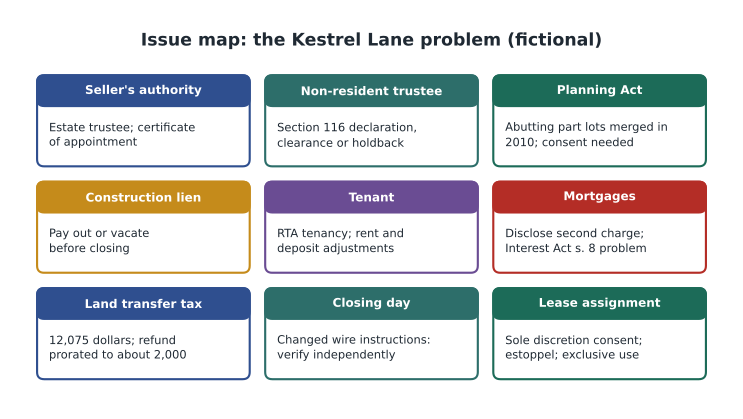
Model answer
To: Senior lawyer, real estate group. Re: Purchase of 212 Kestrel Lane by Nadine Corriveau and Thierry Lavoie; assignment of lease, Unit 2, Dumont Square. Prepared by: Articling student.
1. The seller's authority. The registered owner is the deceased, Agathe Pelletier. Only her estate trustee can transfer the property, and on a Land Titles parcel the land registry and the buyers will require proof of his authority, usually a certificate of appointment of estate trustee with a will issued by the Superior Court of Justice, together with a transmission application or a transfer by the estate trustee. Recommendation: by the requisition date, requisition a registered or registrable certificate of appointment and confirm that Gaspard is the only estate trustee. If the certificate has not been issued, closing may be at risk, and the buyers' remedy, if the estate cannot give title by closing, is to terminate and recover the deposit. Confirm also that the estate trustee is not required to obtain the consent of beneficiaries under the will and that no will challenge has been started; a quick search for a certificate of pending litigation and an estate court search would help.
2. Non-resident seller. Gaspard has lived in France for twenty years. The residence of an estate for tax purposes generally depends on where its trustees exercise central management and control, so the estate is likely a non-resident of Canada. Under section 116 of the Income Tax Act, if the seller is non-resident and does not deliver a clearance certificate, the buyers can become liable for a prescribed portion of the price on account of the seller's tax. The standard agreement entitles the buyers to a statutory declaration of residency or, failing that, to withhold the required amount. Recommendation: requisition a declaration that the estate is not non-resident or a clearance certificate; if neither is delivered by closing, hold back the required amount in trust under a written agreement with the seller's lawyer until the certificate is delivered, and adjust the closing funds accordingly.
3. Subdivision control. Agathe owned 212 and the abutting part lot at 214 in the same name and capacity. Because both are parts of a lot on a registered plan, they are not whole lots, and abutting land is retained. Under section 50 of the Planning Act, the estate cannot convey 212 alone without a consent or another exception, and a transfer that contravenes the Act does not create or convey any interest in the land. The 2022 amendments preventing merger on the death of a joint tenant do not help, because Agathe held both parcels alone, not as a joint tenant, and the parcels merged when she acquired 214 in 2010, after conversion. Unless there is a prior consent with a stamp permitting future conveyances, or the estate conveys both parcels together, a consent is needed. Recommendation: requisition proof of compliance, and if none exists, require the estate to apply for a consent from the committee of adjustment, making the agreement conditional on it or extending closing by written amendment. The Planning Act statements in the transfer cannot honestly be completed until the problem is solved, and our firm must not sign them otherwise.
4. The construction lien. A construction lien registered by Pikeridge Roofing affects the title. Under the Construction Act, a registered lien must be followed by an action and a certificate of action within the statutory period, or it expires, but that does not help us before closing. The agreement requires title free of liens. Recommendation: requisition that the estate pay the claim or vacate the lien by paying into court, or posting security in, the amount the Act requires, and that an order vacating the lien be registered before closing. Alternatively, agree with the seller's lawyer on a holdback of a sufficient amount from the proceeds with an undertaking to vacate, but only if the bank's instructions permit and title insurance covers the risk.
5. The tenant. Odile Marchand is a residential tenant under the Residential Tenancies Act, 2006, and the buyers take subject to her tenancy. They plan to keep her, so no notice of termination is needed. The statement of adjustments should credit the buyers with the last month's rent deposit and any interest owed on it under the Act, and apportion the current month's rent, with the closing day as the buyers' day. Recommendation: requisition a statutory declaration from the estate trustee about the tenancy, the rent, the deposit and any arrears or disputes, a direction to the tenant to pay rent to the buyers after closing, and copies of the lease. Confirm that the bank's instructions allow a rental unit, and that the buyers' insurance covers it.
6. The mortgages. The first charge to the bank will proceed on our standard joint retainer. The second charge from Thierry's uncle raises two issues. First, the clause raising the rate from six to eighteen percent if any payment is missed increases the charge on arrears and likely offends section 8 of the Interest Act, as Krayzel shows, so it is probably unenforceable to that extent. The uncle should get independent legal advice, and our firm should not act for him, because his interests conflict with the buyers'. Second, the bank must be told about the second charge, since its instructions require disclosure of secondary financing, and it may require a postponement or refuse the arrangement. Recommendation: disclose to the bank, advise the buyers in writing about the Interest Act issue, and recommend that the uncle's lawyer redraft the default clause.
7. Land transfer tax. The tax on 780,000 dollars for a single family residence is 275 dollars on the first 55,000 dollars, 1,950 dollars on the next 195,000 dollars, 2,250 dollars on the next 150,000 dollars and 7,600 dollars on the remaining 380,000 dollars, or 12,075 dollars. A duplex contains two single family residences and qualifies for the residential rates. Nadine is a first-time buyer; Thierry is not, because he owned a home in Ottawa. If they take title equally, the first-time buyer refund is limited to Nadine's half share, so the refund is about 2,000 dollars, and the tax payable on registration is about 10,075 dollars. Recommendation: confirm both buyers' citizenship or permanent residence, confirm that Thierry was never Nadine's spouse while he owned the condominium, and explain the calculation to them in writing before closing. No Toronto tax applies, and no HST applies to a resale duplex.
8. Closing day wire instructions. An emailed change of wire instructions on the morning of closing is a red flag of business email compromise. Recommendation: do not use the new instructions; call the estate's lawyer at an independently verified number, confirm the trust account, and send funds only to the confirmed account under the Document Registration Agreement. If confirmation cannot be obtained, agree on a short extension rather than risk the buyers' and the bank's money. Report the suspicious email to the other lawyer and to our insurer.
9. Fraud and identity. The seller is an estate trustee abroad whom we will never meet. That is not itself suspicious, but it calls for care. The estate's lawyer must verify Gaspard's identity under By-Law 7.1, which for a person outside Canada usually involves an agent, such as a notary or lawyer in France, under a written agreement. Recommendation: ask the estate's lawyer to confirm in writing that identity verification has been done, and confirm that the bank's title insurance covers fraud.
10. The lease assignment at Dumont Square. Nadine is buying a business whose lease requires the landlord's consent 'in its sole and absolute discretion.' Section 23 of the Commercial Tenancies Act implies that consent will not be unreasonably withheld only where the lease does not expressly provide otherwise, and this lease does. The landlord therefore has wide freedom to refuse, subject only to the duty of good faith in exercising contractual discretion recognized in Wastech. Wrenfield will usually remain liable after an assignment, and its owner's guarantee will continue, unless the landlord releases them. Recommendation: make the purchase of the business conditional on the landlord's written consent on acceptable terms; ask the landlord for an estoppel certificate confirming that the lease is in good standing, the rent, the term remaining and the absence of defaults; check whether the landlord's lender's consent is needed and request a non-disturbance agreement; review the use clause, since Yuen's Bakehouse has an exclusive for bakery and café uses in the plaza, to make sure a yoga studio selling drinks or snacks would not breach it; and advise Nadine that the landlord may ask for her personal guarantee, which she should try to limit.
11. Conflicts and retainers. We act for Nadine and Thierry on the purchase and for the bank on the first charge. We may act for Nadine alone on the lease assignment, but should confirm in writing that Thierry is not a party to the business and that there is no conflict between the two retainers. We must not act for the uncle on the second mortgage.
12. Summary of actions before the requisition date. Requisition: the certificate of appointment and the estate trustee's authority; a declaration of residency or clearance certificate; Planning Act compliance or consent; discharge or vacating of the construction lien; statutory declarations about the tenancy and work orders; and the usual discharges. Report to the clients in writing on the subdivision control problem, the non-resident holdback, the lien, the tax calculation and the second mortgage. Report to the bank on the second mortgage and the tenancy. Calendar the requisition date, a date to review answers, and the closing date, and prepare for a possible amendment extending closing if a consent is needed.
Five rules for exam answers
Ingleby ends the course with five rules. First, read the agreement before anything else, because its dates and clauses frame every issue. Second, say whose problem each issue is: the seller's, the buyers', the lender's or the lawyer's. Third, cite the rule precisely, with the statute section, rule or case, and do not invent citations. Fourth, recommend a concrete step, such as a requisition, a holdback, a condition, an amendment or an undertaking, and say who must do it and by when. Fifth, never recommend anything that requires a lawyer to make a false statement, sign a statement she has not verified, or keep from one client something another client is entitled to know. She picks up the house keys she put on the lectern at the start of term. 'And remember: two promises, one day.'
Worked problem
Grading the Planning Act issue
Three students answer issue 3 differently. Student A says the 2022 amendments solve the problem because Agathe has died. Student B says the parcels are LTCQ, so the Planning Act does not apply. Student C says the estate needs a consent unless both parcels are sold together, and recommends a requisition and a conditional extension. Which answer is best and why?
Show solution
- Student A misreads the 2022 amendment, which prevents merger on the death of a joint tenant; Agathe held both parcels alone, so the amendment does not apply.
- Student B overstates the effect of conversion. The LTCQ guarantee covers Planning Act compliance up to conversion in 2001, but the merger occurred when Agathe acquired 214 in 2010, after conversion.
- Student C identifies the rule in section 50, applies it to the facts of common ownership of abutting part lots, and recommends concrete steps.
- Student C's answer could be improved by explaining the consequence of non-compliance: the transfer would not create or convey any interest in the land.
- It could also mention that the lawyers cannot complete the Planning Act statements in the transfer until the issue is resolved.
- Student C's answer is best because it states the rule, applies it accurately and tells the senior lawyer what to do.
Common mistakes
MistakeWriting a general essay on real estate law instead of answering the problem.
InsteadWrite a memo that identifies each issue, states the rule, applies it and recommends concrete steps by date.
MistakeMissing issues that arise from the identity of the seller, such as an estate trustee or a non-resident.
InsteadAlways ask who the seller is, what authority they have and where they reside for tax purposes.
MistakeRecommending that the firm act for every person in the deal to keep it simple.
InsteadIdentify conflicts and require independent advice where interests diverge, such as a private lender who is a relative.
MistakeOverlooking the commercial side of a mixed problem.
InsteadApply the lease's consent clause, section 23 of the Commercial Tenancies Act, estoppel certificates, exclusives and guarantees.
Practice problems
Work each problem on paper first, then reveal the answer to check.
Why does the construction lien matter even though the buyers did not hire the roofer?
Show answer
Because a registered lien encumbers the title, and the agreement requires the seller to deliver title free of liens; it must be paid or vacated, or dealt with by an agreed holdback, before closing.
How is the first-time buyer refund calculated when only one of two equal co-owners qualifies?
Show answer
It is reduced in proportion to the eligible buyer's share, so with a half share the maximum refund is half of 4,000 dollars, or 2,000 dollars.
What is the effect of the clause raising the uncle's rate from six to eighteen percent on missed payments?
Show answer
It increases the charge on arrears and likely offends section 8 of the Interest Act, as interpreted in Krayzel, so the higher rate is probably unenforceable.
Summary and key terms
- A real estate problem answer is a working memo: timeline, issues, rules, application and concrete recommendations.
- Seller-side issues include authority (estate trustee certificate), residence (section 116) and Planning Act compliance.
- Title issues such as construction liens and tenancies must be resolved by requisitions, declarations, adjustments and, where appropriate, holdbacks.
- Financing issues include disclosure to the first lender, Interest Act limits on default rates and conflicts with related private lenders.
- Tax calculations, closing-day fraud precautions and commercial lease assignments complete a typical mixed transaction.
- Certificate of appointment of estate trustee
- A court certificate confirming the authority of an estate trustee to deal with a deceased person's estate.
- Holdback
- Part of the purchase price retained in trust on closing until a condition, such as delivery of a clearance certificate, is met.
- Construction lien
- A statutory lien on land in favour of an unpaid contractor or supplier who improved the land.
- Merger
- In subdivision control, the joining of abutting parcels into one for Planning Act purposes when they come into common ownership.
- Estoppel certificate
- A written confirmation of lease terms and status given by a tenant or landlord, on which a third party may rely.
- Issue map
- A diagram listing every issue in a problem and the party it affects, used to plan an answer.
Lesson quiz · 5 questions
Score 60% or more to complete this lesson.
Create a free account to save your progress, take quizzes and earn a certificate.